Disclosure: The Zulu Method is on this list. We wrote it, and we are biased. That said, we built this comparison because we think the market needs an honest look at who is doing real AI-native work versus who slapped "AI-powered" on their homepage. We evaluated every agency here on the same criteria and included their actual technology, team model, and positioning. You should talk to several of them before making a decision.
What Makes an Agency an "AI Marketing Agency"
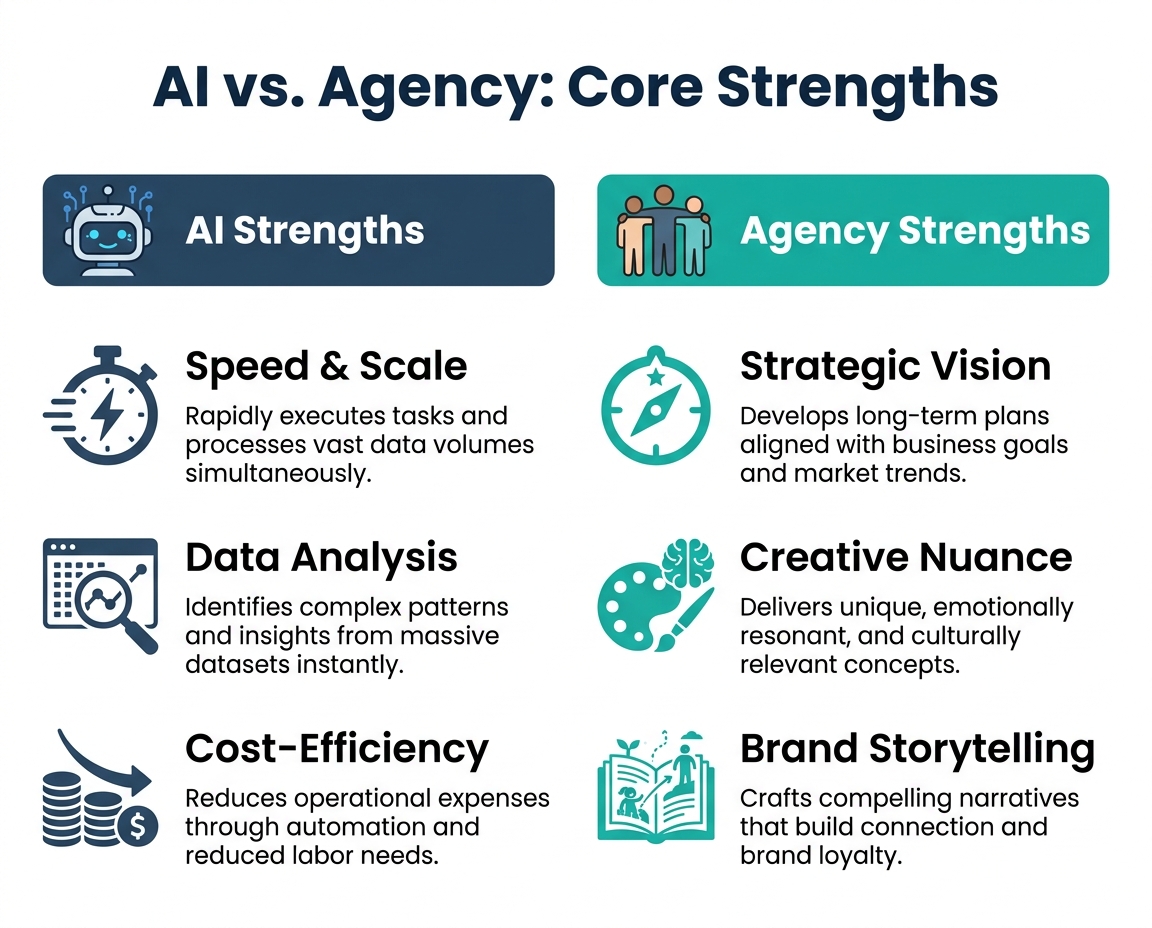
Before the list, some necessary context. The term "AI marketing agency" now covers a wide spectrum, from agencies that genuinely rebuilt their operations around AI to agencies that gave their team ChatGPT logins and updated their website copy. For the growth version of this model, one partner replacing an in-house team across every channel, see our AI growth agency page.
For this comparison, we looked at agencies that fall into at least one of these categories:
- AI-native agencies that were built from the ground up around AI systems, with small senior teams directing AI for execution
- AI-platform agencies that built proprietary technology platforms incorporating AI/ML into their service delivery
- AI-forward agencies that have meaningful, specific AI capabilities beyond basic tool usage
We excluded agencies that mention AI on their website but have no verifiable proprietary technology, no specific AI service lines, and no structural difference from a traditional agency. That filter removed most of the market. The seven that remained are listed below. If you're specifically weighing smaller shops rather than the whole field, we've also compared the top boutique marketing agencies and the case for fractional AI marketing.
One more thing: every agency on this list, including us, will tell you they are the best choice. Take all claims (including ours) with healthy skepticism and verify what matters to your specific situation.
How We Evaluated These Agencies
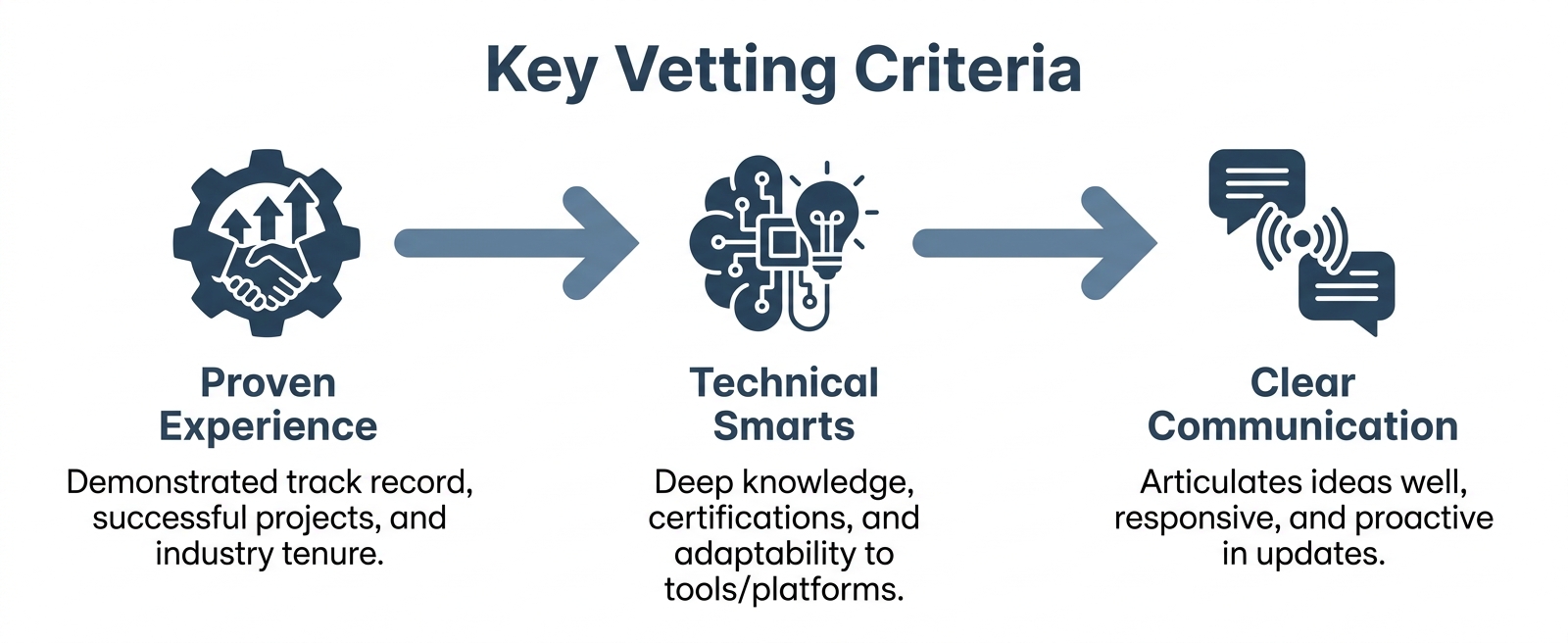
We assessed each agency on five criteria. These are the same criteria we recommend using when you are evaluating any AI marketing agency.
- AI depth. Does the agency have proprietary AI technology, or are they using off-the-shelf tools? Is AI central to their delivery model, or is it a feature they mention in pitches? We looked for named platforms, documented capabilities, and third-party validation (case studies, tech partner coverage).
- Team model. Is the agency built so AI does the volume work (small, senior teams) or does it still run on large traditional teams? Team size relative to client count reveals whether AI is actually changing how they work.
- Service coverage. How many channels does the agency manage? AI-native operations should be able to cover more channels than traditional agencies because the per-channel cost constraint is reduced. For reference, a mid-level in-house marketer can run one or two channels well, which is the comparison worth holding in your head when an agency quotes you a multi-channel scope.
- Market focus. Who does the agency serve best? B2B vs. B2C, company size, and industry specialization all matter. The best agency for a $200M SaaS company is not the best agency for a $10M professional services firm.
- Transparency. Does the agency publish pricing? Do they require long-term contracts? Do they provide real-time reporting? These signals tell you how confident the agency is in its own results. Most agencies on this list don't publish rates. We do, on the pricing page, and you can hold us to the same standard we're applying to everyone else here.
1. The Zulu Method, best for funded B2B companies with no marketing team yet
Founded: 2024 · Headquarters: San Diego, CA · Team size: Small, senior-only · AI platform: Proprietary multi-model, multi-agent orchestration across 60+ automations
The Zulu Method is the smallest agency on this list and the only one that is AI-native by design, meaning the entire operation was built around AI systems from day one rather than just bolting AI onto the legacy agency model. The team consists entirely of senior marketing experts with at least 15+ years of experience. Your retainer doesn't also pay for lots of junior coordinators, account managers, or large creative teams. Human experts manage an AI systems that helps drive scale across 10+ channels. Humans always handle strategy & quality control.
The operating model uses multi-model orchestration across 6+ specialized LLM models, with purpose-built automation pipelines scaling high-quality content production, campaign management, and cross-channel distribution. The firm's positioning is explicitly anti-AI-slop: every piece of content runs through a human editorial pipeline with senior review before publishing in your exact voice/tone/style. If you're still deciding whether an agency beats making your first internal hire, our guide to when to hire a marketing team walks through the cost and speed math.
The offer underneath it is structured differently from everyone else on this list (and all legacy agencies where you pay for hours not outcomes). Instead of renting a channel or two, the engagement is built to be a complete replacement for an in-house marketing function, with 10+ channels to choose from, CMO-level overwatch, and a dedicated senior marketing manager running daily execution with you. And you launch in under 30 days.
Since transparency is one of the five criteria above, here's ours. Pricing is published: $9,995 a month for the Growth tier (4 channels) and $19,995 for the full Marketing Team tier (7 channels).
They also offer a GTM Foundation Pilot at $4,995 (one-time) for companies that want to see the work before committing to a retainer.
For comparison, building the same function in-house runs 6 to 9 months and $500K+ once salaries, benefits, and tooling are loaded in, which is the math the cost calculator walks through step by step.
Best for: Series A and Series B B2B SaaS and tech companies that have raised money but don't have a marketing leader or department yet. If the board is asking about pipeline and there's nobody in-house to own it, that's the specific gap this model was built for. It also fits companies whose last agency put junior account managers on the day-to-day while senior people only showed up for QBRs. Here, you work directly with the strategists who direct the AI systems.
Considerations: The Zulu Method is deliberately small and was founded in 2024, so it doesn't carry the brand recognition of the others, but what it also doesn't carry is the overhead those names are built on that's passed on to you in their invoices. There are no junior account managers learning on your budget, no layers between you and the people doing the work, and no processes designed before AI existed that now have to be worked around. The roster is capped on purpose. If you want a large agency with hundreds of people across multiple offices, this isn't that, and it isn't trying to be.
Want to see how the AI-native model works?
We are happy to walk you through our systems and show you what the output looks like, even if you end up choosing another agency on this list.
2. Power Digital Marketing, best for enterprise brands wanting a large full-service agency
Founded: 2012 · Headquarters: San Diego, CA · Team size: 800+ employees · AI platform: nova Intelligence
Power Digital has made one of the largest investments in proprietary AI technology of any marketing agency. Their platform, nova Intelligence, is built on Snowflake's data infrastructure and includes multiple AI/ML modules: nova Insights AI for cross-channel analytics, nova Forecasts for predictive planning, and nova Creative Affinity for linking ad creative to customer lifetime value. The platform's capabilities are documented through third-party sources, including a Snowflake case study.
In January 2026, Power Digital completed a merger with Cardinal Digital Marketing, expanding their footprint further. They manage campaigns across SEO, paid media, affiliate, social, content, CRO, lifecycle marketing, and Amazon.
Best for: Mid-market to enterprise companies that want a large, full-service agency with deep data infrastructure. If you value having a named technology platform with documented AI/ML capabilities and you need coverage across 8+ channels including Amazon and affiliate, Power Digital has the scale and tech investment to deliver.
Considerations: This is a large agency. With 800+ employees, the experience will feel more institutional than boutique. Your day-to-day contact will likely be an account manager, not a senior strategist. The AI lives primarily in the analytics and optimization layer. Content creation and campaign execution still rely on traditional team structures with AI augmentation.
3. Single Grain, best for founder-brand-led content and podcast reach
Founded: 2009 (acquired by Eric Siu in 2014) · Headquarters: Los Angeles, CA · Team size: ~50-100 employees · AI platform: AI Acquisition Agency services
Single Grain is best known through its founder Eric Siu, whose podcasts (Marketing School and Leveling Up) reach over 2 million monthly downloads. Siu acquired the agency in 2014 when it was failing and rebuilt it into a recognized digital marketing brand. The agency now positions itself as an "AI Acquisition Agency" with services covering SEO, paid media, content marketing, and CRO.
Their AI positioning includes "Search Everywhere Optimization," which covers traditional search plus visibility in AI assistants like ChatGPT and Perplexity. This is a forward-looking service line that reflects the shift toward AI-driven search.
Best for: Mid-market companies that value thought leadership and want an agency with strong brand recognition in the digital marketing space. If the founder's content resonates with your marketing philosophy, the agency's approach will likely align with your expectations.
Considerations: Single Grain's AI positioning is relatively recent, layered onto an established SEO and paid media agency. The core service delivery model appears closer to a traditional agency that has adopted AI tools rather than an AI-native operation. Verify during your evaluation how deeply AI is integrated into their actual workflow versus their marketing.
4. Directive Consulting, best for large B2B SaaS paid-media programs
Founded: 2014 · Headquarters: Irvine, CA · Team size: 200+ employees · AI platform: Stratos
Directive is exclusively B2B, which immediately sets it apart from the generalist agencies on this list. Their "Customer Generation" methodology is their core differentiator: it aligns marketing channels to pipeline, CAC, and revenue rather than vanity metrics like MQLs. If you have been frustrated by agencies reporting on leads that never convert, Directive's philosophy directly addresses that problem. If you want the underlying numbers to hold that conversation with, we published B2B SaaS CAC benchmarks by stage and funnel conversion benchmarks by channel.
Their proprietary AI platform, Stratos, launched recently and integrates predictive modeling, standardized deliverables, and AI into strategist workflows. Stratos is newer than the platforms at Power Digital and Wpromote, so there is less third-party documentation of its capabilities. Core services cover paid media (Google, LinkedIn, Meta), SEO, content, CRO, and revenue operations including CRM/MAP architecture.
Best for: B2B tech and SaaS companies that want an agency laser-focused on pipeline and revenue metrics. Directive's client list includes ZoomInfo, Calendly, Adobe, and Cisco. If you are a B2B company that needs an agency speaking your language (CAC, LTV, pipeline velocity), Directive is worth evaluating.
Considerations: With 200+ employees, Directive is a mid-size agency. The Stratos platform is new and less proven than Power Digital's nova or Wpromote's Polaris. The B2B-only focus is a strength if you are B2B and a disqualifier if you are not. Pricing reportedly ranges from $5K-$25K+ per month depending on scope.
5. NoGood, best for venture-backed growth experimentation sprints
Founded: 2016 · Headquarters: New York, NY · Team size: ~55 employees · AI platform: Goodie (AEO-focused)
NoGood's standout positioning is Answer Engine Optimization (AEO): optimizing for AI-powered search platforms like ChatGPT, Perplexity, and Google AI Overviews. While most agencies are still figuring out what AEO means, NoGood has built a proprietary platform called Goodie specifically for tracking and improving AI search visibility. This is a genuinely forward-looking specialization, and one worth understanding before you buy it. We dug into what AI search traffic actually converts at in AI search conversion rate benchmarks.
The agency operates through cross-functional "growth squads" assigned to each client, covering AEO, SEO, paid search, social ads, lifecycle marketing, CRO, and content. Their client list includes Nike, TikTok, Spring Health, and MongoDB. They report an 84% client renewal rate.
Best for: Tech-forward B2B and B2C brands that want to get ahead on AI search visibility specifically. If ranking in ChatGPT and Perplexity responses matters to your business, NoGood has more specific expertise here than any other agency on this list.
Considerations: NoGood is a premium boutique. Average retainers are reportedly above $20K per month. The AEO specialization is valuable but narrow. If you need a full-service agency covering all channels equally, the AEO focus may mean other channels get less strategic depth. The agency is relatively small, so capacity may be limited.
6. Wpromote, best for multi-channel enterprise media buying
Founded: 2001 · Headquarters: El Segundo, CA · Team size: ~650+ employees · AI platform: Polaris IQ
Wpromote is the oldest agency on this list by a significant margin. Founded in 2001, they have evolved through every major digital marketing shift and now operate one of the more documented AI platforms in the agency space. Polaris IQ includes a Growth Planner (AI-powered media mix modeling), Creative Accelerator (rapid creative testing), and Trendspotter (social sentiment tracking). The platform is built on Google Cloud infrastructure, documented through a Google Cloud case study.
In 2025, Wpromote acquired creative agency Giant Spoon, signaling a push beyond pure performance into brand and creative territory. They manage over $3 billion in media spend and received a strategic investment from ZMC (private equity) in 2022. Their coverage spans paid search, paid social, SEO, Amazon, display, programmatic, email, and creative.
Best for: Enterprise and large mid-market companies that need a proven, scaled agency with documented AI technology and significant media buying power. If you are spending $500K+ annually on paid media and need an agency that can optimize that spend with AI-driven models, Wpromote has the infrastructure and track record.
Considerations: Wpromote is a large, PE-backed agency. The experience will be institutional. With 650+ employees and a focus on media spend optimization, this is primarily a performance agency with AI-enhanced analytics. Content, brand, and creative are newer additions through the Giant Spoon acquisition. If you are a smaller company or need a lean, agile partner, Wpromote may be more infrastructure than you need.
7. Hawke Media, best for ecommerce and consumer brands
Founded: 2014 · Headquarters: Los Angeles, CA · Team size: 200-500 employees · AI platform: HawkeAI
Hawke Media's differentiator is their "Outsourced CMO" model. Instead of large monthly retainers for bundled services, Hawke offers modular, a la carte marketing services that clients can mix and match. This flexibility has made them popular with companies that need specific capabilities without committing to a full-service engagement. The agency claims to have served over 5,000 brands.
On the AI front, Hawke has a platform called HawkeAI for campaign insights and optimization. However, the publicly available documentation on HawkeAI's specific capabilities is thinner than what Power Digital, Wpromote, and Directive provide for their platforms. The agency was named a 2026 Google Premier Partner and acquired Blue Light Media in early 2025. Founder Erik Huberman also runs Hawke Ventures with 50+ startup investments.
Best for: Companies that want flexible, modular marketing services without long-term commitments. If you need paid media management this month, email marketing next month, and creative the month after, Hawke's a la carte model accommodates that. Their broad client base (5,000+ brands) means they have seen a wide range of industries and challenges.
Considerations: The AI positioning is the thinnest on this list. HawkeAI exists, but the specific capabilities and depth of AI integration into their service delivery are less documented than their competitors. The core value proposition is the flexible engagement model, not AI-native operations. If you are specifically looking for an agency where AI fundamentally changes the operating model and output capacity, evaluate the AI claims carefully.
Trying to decide between agencies?
We will give you an honest assessment of whether we are the right fit, and if not, who on this list might be better for your situation.
Head-to-Head: Full Comparison Table
Here is how all seven agencies stack up across the evaluation criteria. Use this as a starting point for your shortlist, not as the final word. Every agency will present differently in a live conversation than they do on paper.
| Agency | AI Depth | Team Model | Best For |
|---|---|---|---|
| Power Digital | Proprietary (nova Intelligence on Snowflake). Multi-module: analytics, forecasting, creative. | Large (800+ people). Traditional team structure with AI-enhanced analytics. | Enterprise needing scale + data infrastructure |
| The Zulu Method | Proprietary multi-model orchestration. AI handles execution. Humans handle strategy. | Small, senior-only. 3-5 people per engagement. No junior staff. | B2B ($5M-$500M) wanting senior access + AI-native ops |
| Single Grain | AI Acquisition Agency services. Search Everywhere Optimization. | Mid-size (~50-100). Traditional agency structure. | Mid-market wanting recognized brand + thought leadership |
| Directive | Proprietary (Stratos). New platform with predictive modeling. | Mid-size (200+). B2B-only specialists. | B2B SaaS/tech wanting pipeline-focused metrics |
| NoGood | Proprietary (Goodie). AEO/AI search specialization. | Boutique (~55). Growth squads per client. | Tech brands wanting AI search visibility (AEO) |
| Wpromote | Proprietary (Polaris IQ on Google Cloud). Media mix modeling, creative testing. | Large (650+). PE-backed. Enterprise infrastructure. | Enterprise with large media budgets ($500K+/yr) |
| Hawke Media | HawkeAI (limited public documentation). | Mid-size (200-500). Modular/a la carte model. | Companies wanting flexible, no-commitment services |
AI Integration Depth (Based on Public Documentation)
A note on this chart: "AI integration depth" is our assessment based on publicly available documentation, third-party coverage, and stated capabilities. It is not a comprehensive audit of each agency's internal systems. Agencies may have deeper AI capabilities than what is publicly documented. We encourage you to ask each agency directly about their AI architecture during your evaluation.
How to Choose the Right AI Marketing Agency
The right agency depends on your specific situation. Here is a decision framework:
Choose a large platform agency (Power Digital, Wpromote) if you are an enterprise company with significant media budgets, need coverage across 8+ channels including Amazon and affiliate, and want a named technology platform with documented AI/ML capabilities. You are trading personal attention for institutional infrastructure and scale.
Choose a B2B specialist (Directive) if you are a B2B tech or SaaS company and your primary frustration is that your current agency reports on MQLs and impressions instead of pipeline and CAC. Directive's Customer Generation methodology is built for companies that want their marketing measured against revenue.
Choose an AI-native boutique (The Zulu Method) if you want senior strategists directly on your account, care about content quality as much as volume, and want the AI-native operating model where a small team of experienced humans directs AI systems. The sharpest fit is a funded startup with no marketing leader yet, where the alternative isn't another agency but a first hire you'd need 6 to 9 months to recruit. You are trading institutional scale for agility and senior access. The side-by-side comparison lays out how that trade looks against each alternative.
Choose an AEO specialist (NoGood) if your competitive advantage depends on showing up in AI-generated search results. If your buyers are using ChatGPT and Perplexity to research solutions, NoGood has more specific expertise in that space than anyone else on this list.
Choose a flexible engagement (Hawke Media) if you need specific marketing capabilities without committing to a full-service retainer. Their a la carte model is designed for companies that want to test one or two channels before expanding.
Choose a thought-leadership agency (Single Grain) if alignment with a specific marketing philosophy matters to you and you want an agency whose founder's content resonates with your approach to growth.
| Your Situation | Best Fit | Why |
|---|---|---|
| Enterprise, $1M+ annual media spend | Power Digital, Wpromote | Scale, data infrastructure, media buying power |
| B2B SaaS, $5M-$500M revenue | The Zulu Method, Directive | B2B-specific, pipeline-focused, senior teams |
| Need AI search visibility (AEO) | NoGood | Deepest AEO specialization and tooling |
| Want to test one channel first | Hawke Media | Modular, a la carte, no long commitment |
| Series A/B, funded, no marketing leader or team yet | The Zulu Method | Built as a replacement for the function you haven't hired, not a channel vendor |
| Want AI-native ops + senior access | The Zulu Method | Only AI-native-by-design agency on the list |
| Board asking about AI strategy | The Zulu Method, Power Digital | Can show AI deployment results within 30-90 days |
How One Company Evaluated the Market
A $40M B2B software company spent three weeks evaluating AI marketing agencies. They talked to four agencies on this list. Their process: first call to assess chemistry and approach, second call to see actual work samples and client results, third call to discuss pricing and terms. They ultimately chose based on three factors: the seniority of the team they would work with daily, the specificity of the AI capabilities (not just "we use AI"), and the contract flexibility. The entire evaluation took less than a month.
Questions to Ask Every Agency on Your Shortlist
- How many AI models do you use, and what does each one do?
- Who will be on my account day-to-day, and what is their experience level?
- Can I see a real-time reporting dashboard from a current client (anonymized)?
- What is your minimum commitment period, and what happens if I cancel?
- How do you prevent AI-generated content from sounding generic?