Hannon Brett | Published on: June 26, 2026 | Time to read: 24 min | Updated on: August 31, 2026
A boutique marketing agency is a small, specialized firm, usually under 50 employees, that trades broad capabilities for deep expertise in one niche, industry, or channel. Some people call it a boutique marketing company instead, but it's the same model. These firms offer cost-effectiveness, senior-led execution, and the kind of agility that large firms can't match. That combination makes them a strong fit for B2B companies and growth-stage businesses that need specialized expertise and faster decisions.
Small isn't the exception in this business. It's the rule. Of the 15,512 advertising agency establishments in the US, 95% employ fewer than 50 people and 88% employ fewer than 20, according to the U.S. Census Bureau's 2023 County Business Patterns data for advertising agencies (NAICS 541810). That's the catch. Almost any small shop can call itself a boutique marketing company, so the question that matters isn't size. It's whether the team is genuinely specialized, and whether senior people actually do your work. If you're weighing a boutique against a larger shop, our guide to digital marketing in the USA walks through the questions that separate a real partner from a vendor.
Key Takeaways
- Boutique agencies prioritize specialization over breadth, with deep expertise in specific industries or channels (B2B, SaaS, content marketing, etc.)
- Senior strategists stay directly involved in client work from start to finish, eliminating the hand-off problem common at large agencies
- Smaller teams and lower overhead translate to cost-effectiveness without sacrificing quality, so more budget goes toward actual work
- Boutique agencies thrive on agility, and decisions happen quickly without layers of bureaucratic approval
- The defining marker of a true boutique agency is specialization with a clear point of view, not just small size
- Senior access and transparent reporting are more important evaluation criteria than awards or marketing polish
- Red flags include guaranteed results promises, vague reporting disconnected from business outcomes, and poor communication during the sales process
Table of Contents
- What Exactly Is a Boutique Marketing Agency?
- Key Benefits of Partnering With a Boutique Marketing Agency
- Top 10 Boutique Marketing Agencies to Watch
- The Boutique Agency 'Right-Fit' Scorecard [Free Template]
- Red Flags to Avoid When Hiring a Small Marketing Agency
- Is a Boutique Marketing Agency Right for You?
What Exactly Is a Boutique Marketing Agency?
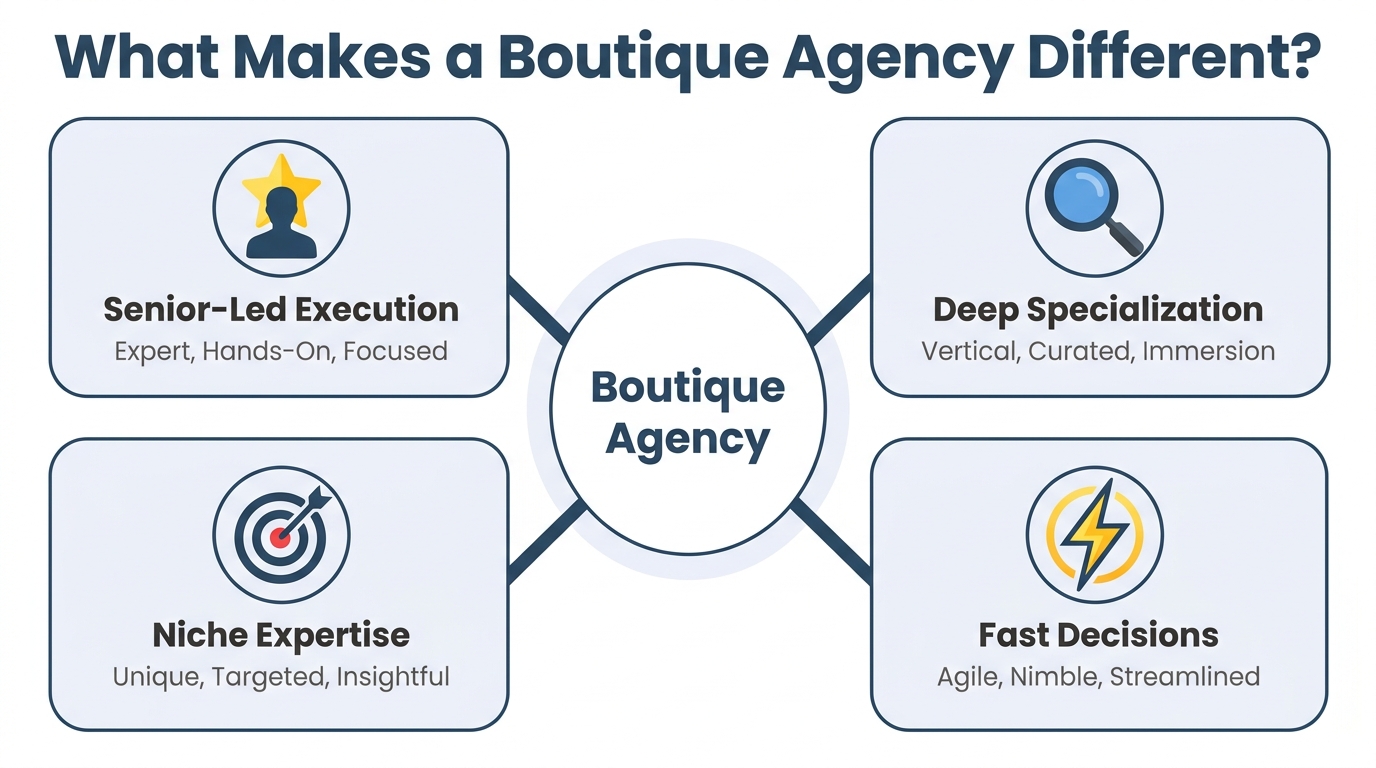
A boutique marketing agency is a small, specialized firm that focuses on a specific niche, industry, or set of services. These agencies typically have fewer than 50 employees, and many of the best ones run with teams of 20 or fewer. They trade broad capabilities for deep expertise, and personal attention over high client volume.
That definition matters a lot when you're shopping for a marketing partner.
Small Team, Deep Specialization
Large, full-service agencies can handle almost anything. But "can handle" doesn't always mean "does well." When you hire a big agency, your account often gets passed to junior team members while senior talent moves on to bigger clients.
Boutique agencies work differently. Their value comes from being really good at one thing, whether that's B2B content, paid media, or brand strategy for a specific industry. That depth is the whole point.
According to Ernst Media's breakdown of how boutique agencies operate, smaller agencies often offer more direct access to experienced strategists, which translates to faster decisions and more relevant work.
The Senior-Led Difference
One of the biggest differences you'll notice with a boutique shop is who actually does your work. At a large agency, you might meet a VP during the pitch, then never see them again. At a boutique, the senior people stay involved.
This matters for B2B companies especially. If you're a CMO or VP of Marketing trying to move fast and prove ROI, you can't afford to spend months onboarding a junior account team. You need people who already understand your space.
That's why teams like The Zulu Method position themselves around senior-led execution. The goal is to skip the hand-off problem entirely.
Not Just Small. Actually Specialized.
Being small doesn't automatically make an agency boutique. The real marker is specialization. A boutique agency should have a clear point of view, a defined type of client they serve, and a track record in that specific area.
If an agency claims to do everything for everyone, it's not really boutique. It's just small.
Boutique Digital Marketing Agency vs. Traditional Shop
Most of the firms you'll evaluate today are boutique digital marketing agencies. The "digital" label used to mean a separate budget line and a separate team. It doesn't anymore. A boutique digital marketing agency specializes in the channels where B2B pipeline actually gets built, things like SEO, paid media, lifecycle email, and content, rather than broadcast spots and billboards.
The practical difference is how these teams work. They run remote-first and collaborate online, which is why founders searching for an online boutique marketing agency usually aren't looking for someone local. They want a small senior team that already knows their category and can work from anywhere. Location stopped being a real selection criterion. Specialization didn't.
If you're weighing a boutique shop against larger options, our guide on how to find the best digital marketing agency walks through the wider evaluation process.
Key Benefits of Partnering With a Boutique Marketing Agency
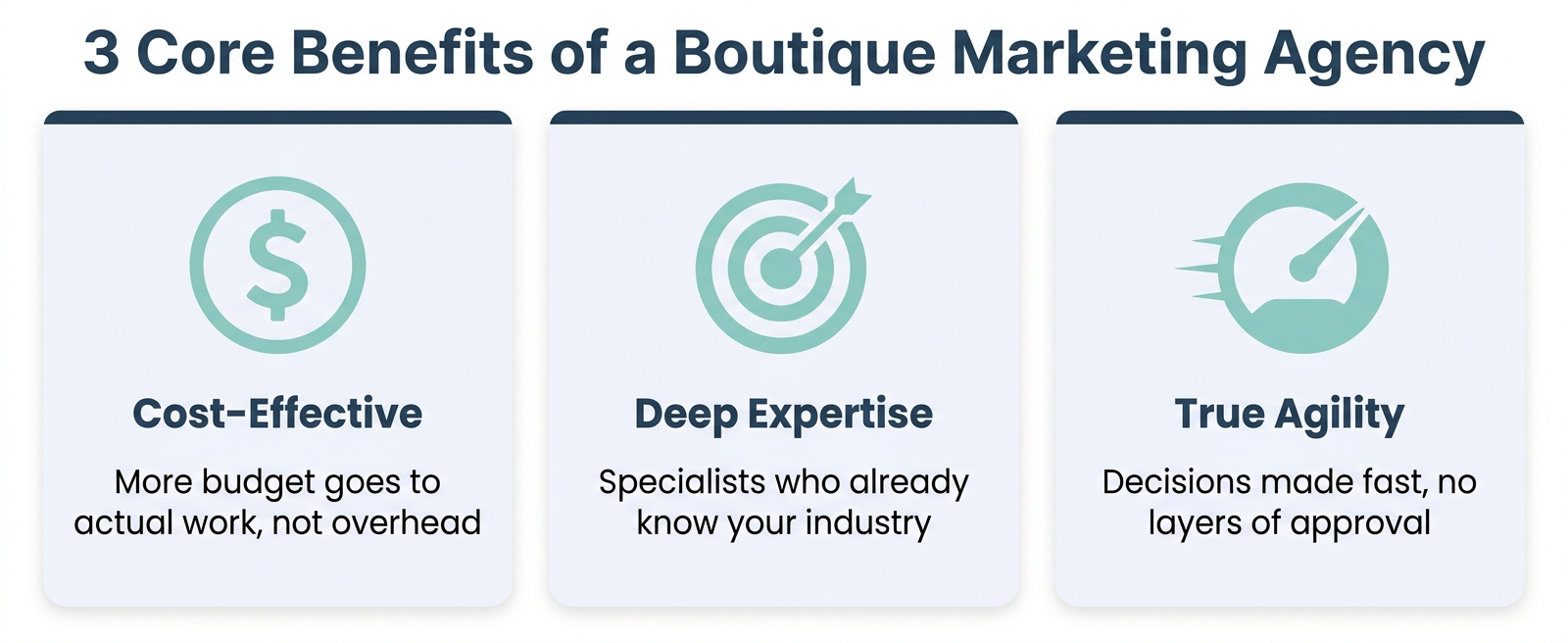
A boutique marketing agency gives you specialized expertise, lower costs, and faster decision-making than a large firm. If you're a CMO or VP of Marketing looking for a partner who actually knows your space, these three benefits explain why boutique agencies keep winning business from companies that once defaulted to big names.
Boutique Agency Cost-Effectiveness That Goes Beyond the Invoice
Boutique agencies carry far less overhead than large shops. No giant office floors, no bloated middle management, no layers of account coordinators. That leaner structure means more of your budget goes toward actual work.
And it's not just about price. It's about value. When a boutique team is smaller and more selective with clients, they have real incentive to produce results. You're not just another retainer keeping the lights on.
According to Ashworth Creative's overview of boutique agency expectations, clients working with boutique firms often get more personalized attention and senior-level involvement at a price point that larger agencies simply can't match.
Specialized Expertise You Can Actually Use
The whole point of a boutique agency is depth over breadth. These teams are built around specific industries, channels, or buyer types. They're not generalists trying to be everything to everyone.
For B2B companies especially, this matters. You want a partner who already understands your sales cycle, your buyer, and your competitive space. That kind of expertise cuts ramp-up time significantly.
This is where teams like The Zulu Method stand out by focusing on B2B marketing with senior-led execution, skipping the hand-off problem that plagues larger agencies.
Agility Without the Bureaucracy
At a large agency, changing direction means briefs, approvals, strategy reviews, and weeks of back-and-forth. At a boutique, the person you talk to is usually the person doing the work.
That speed is genuinely valuable. Markets shift. Campaigns underperform. Competitors make moves. You need a partner who can respond fast, not one waiting on three internal sign-offs.
Boutique agencies thrive in environments where flexibility isn't a nice-to-have. It's the whole operating model. Unlike traditional marketing automation that requires extensive setup and configuration, boutique agencies can pivot strategies quickly based on real-time performance data.
Real World Example: The Zulu Method
The Zulu Method exemplifies the boutique agency model at work. They focus exclusively on B2B marketing for SaaS & tech startups, delivering senior-led execution across AI-powered channels throughout the engagement. Rather than handing off strategy to junior coordinators after the pitch, experienced strategists remain involved in day-to-day work, understanding how to build and scale marketing from scratch. Built from decades of doing exactly that in the real world for many companies. This approach cuts ramp-up time significantly and delivers results tied directly to pipeline outcomes, not vanity metrics.
Top 10 Boutique Marketing Agencies to Watch

Looking for the right boutique marketing agency? Here's a curated list of standout firms known for deep specialization, proven results, and the kind of senior-level attention that large agencies rarely deliver. Each one brings something specific to the table, so you can find the fit that matches your goals.
How These Agencies Compare at a Glance
| Agency | Primary Focus | Best Fit |
|---|---|---|
| The Zulu Method | B2B AI-powered marketing, senior-led execution | Series A & B B2B SaaS and Tech startups |
| Ironpaper | Demand generation, pipeline growth | B2B tech and services |
| Directive Consulting | Paid media, SEO for SaaS | SaaS and software companies |
| Refine Labs | Demand creation, brand-led pipeline | Venture-backed B2B SaaS |
| Elevation Marketing | Integrated B2B strategy | Manufacturing, tech, professional services |
| Traction | Brand strategy, creative campaigns | Startups and growth-stage brands |
| Salted Stone | HubSpot, inbound, RevOps | HubSpot-centric B2B companies |
| Siege Media | SEO-driven content | SaaS and e-commerce |
| Simple Tiger | SaaS SEO and content | Early to mid-stage SaaS |
| Animalz | Long-form B2B content | B2B tech, thought leadership |
Each of these agencies earned its place on this list by doing one thing really well. None of them try to be everything to everyone, and that's exactly the point.
The best boutique marketing agency for your business depends on your industry, your goals, and how your team operates. But starting with a list of specialists who already know your world is a much smarter move than hiring a generalist and hoping for the best.
The Zulu Method: The AI-Native B2B SaaS Startup Specialists
Best for: Series A & B Funded SaaS & Tech Startups
The Zulu Method is a boutique B2B marketing agency built around one principle: senior experts only have 4 max clients and your dedicated expert stays on your account from start to finish. No hand-offs, no junior teams running your campaigns while the experts move on to the next pitch.
They focus exclusively on Series A & B funded SaaS and tech B2B startups. That narrow focus means they already know how to build from zero, how to onboard, launch, and get you to market fast. And the pipeline and revenue growth your board actually expects to see. Not just pretty decks and vanity metrics like most legacy agencies.
Their core services include demand generation, content strategy, and full-funnel B2B marketing execution across email, paid, socials, SEO/GEO/AEO, and much more. Everything is built around pipeline outcomes, not pretty numbers.
Why they stand out: is the senior-led AI-native model. For B2B startup founders tired of posting reels at midnight or expecting one non-marketing person on the team to have an actual impact, this model is the perfect fit. Accountability is a real differentiator.
Ironpaper: B2B Demand Generation Specialists
Best for: B2B technology and services companies focused on pipeline growthIronpaper works exclusively with B2B companies that need marketing tied directly to revenue. Their focus is demand generation, content, and sales alignment. They're not chasing traffic numbers. They're chasing qualified pipeline.
Clients point to strong communication and clear accountability as what keeps them coming back. For B2B teams frustrated by agencies that can't connect marketing spend to actual sales outcomes, Ironpaper brings a results-first mindset.
Why they stand out: Deep alignment between marketing and sales, with measurable reporting at every stage.Directive Consulting: Performance Marketing for SaaS
Best for: SaaS and tech companies running paid media and SEODirective works almost entirely with software companies. That tight focus means they've built real depth around SaaS-specific metrics: customer acquisition cost, pipeline value, and trial-to-paid conversion rates.
They're not trying to serve every industry. And that's the whole point. When an agency already knows your model, campaigns get smarter faster. Less ramp-up time, better targeting from day one.
Why they stand out: SaaS-native metrics and paid media expertise that generalist agencies simply don't have.Refine Labs: Demand Creation for B2B SaaS
Best for: B2B SaaS companies rethinking how pipeline gets builtRefine Labs built its reputation by challenging the traditional lead generation playbook. Instead of gated content and form fills, they focus on demand creation through brand and content that generates pipeline organically.
They work primarily with venture-backed and growth-stage SaaS companies. If your team is questioning whether the old model still works, Refine Labs brings a clear point of view backed by real results.
Why they stand out: A genuinely different take on B2B pipeline, with a track record to support it.Elevation Marketing: Integrated B2B Strategy
Best for: B2B brands in manufacturing, technology, and professional servicesElevation Marketing covers brand strategy, content, digital, and PR under one roof without losing the boutique feel. For companies that want coordinated multi-channel marketing without hiring a massive agency, they offer a strong middle ground.
Client reviews consistently highlight senior involvement and strategic depth. They're not just executing tactics. They're helping clients think through positioning and long-term brand direction.
Why they stand out: True multi-channel coordination with boutique-level attention and senior access.Traction: Brand Strategy for Startups
Best for: Startups and growth-stage companies building brand presenceTraction is a San Francisco-based boutique agency known for brand strategy and creative campaigns. They focus on inflection points: product launches, rebrands, and market expansions where getting the message right matters most.
They stay small and selective by design. That keeps quality high and client attention strong. Startups that need a strategic creative partner, not just an execution shop, tend to be a great fit.
Why they stand out: Creative campaigns grounded in strategy, built for companies at critical growth moments.Salted Stone: HubSpot-Centric B2B Marketing
Best for: HubSpot-centric B2B companies looking for full-funnel executionSalted Stone is a HubSpot Elite Partner with deep expertise in inbound marketing, CRM strategy, and revenue operations. If your tech stack runs on HubSpot, they're one of the strongest agencies for actually making it work.
They combine marketing strategy with technical execution. That combination helps teams stop losing leads between systems. Reviews highlight clarity in reporting and a real understanding of the sales and marketing handoff.
Why they stand out: HubSpot expertise that goes beyond setup into real revenue operations thinking.Siege Media: SEO-Driven Content
Best for: SaaS and e-commerce brands where organic traffic is a primary growth leverSiege Media specializes in high-quality, search-optimized content that ranks and converts. They're not creating content for content's sake. Every piece is built around search intent and measurable outcomes.
According to MarketingProfs research on agency confidence and client satisfaction, there's a notable gap between how agencies rate themselves and how clients actually feel. Siege consistently closes that gap with transparent processes and honest reporting.
Why they stand out: Content that earns rankings and drives real traffic, not just page views.Simple Tiger: SaaS SEO Without the Fluff
Best for: Early to mid-stage SaaS companies wanting honest SEO strategySimple Tiger runs a lean team focused entirely on SaaS SEO and content strategy. They build their work around real search data, not generic best practices copied from a template.
What clients mention most is transparency. Clear timelines, honest projections, and no mystery around what they're doing or why. That kind of straight talk is harder to find than it should be in the agency world.
Why they stand out: Lean, focused, and honest. No bloated retainers, no mystery deliverables.Animalz: Long-Form Content for B2B Tech
Best for: B2B tech and SaaS companies that need exceptional editorial qualityAnimalz works with some of the most well-known B2B technology brands. Their focus is deep, well-researched long-form content that builds authority over time. Not blog posts cranked out for volume. Actual useful content that earns trust.
For companies where content is the primary channel for building credibility, Animalz brings writing and strategic thinking that separates good content from truly valuable content.
Why they stand out: Editorial quality that positions brands as real authorities in crowded markets.One thing connects all nine of these agencies: they chose a lane and got really good at it. That's the boutique model working as designed.
The most common complaint businesses have after hiring the wrong agency? According to reviews aggregated across Clutch and G2 analysis by Groas, the top issues are no measurable ROI, generic cookie-cutter strategy, and frequent account manager turnover. All three of those problems are much less likely when you hire a specialist who already knows your world.
That's the whole argument for going boutique. While traditional agencies may offer broader services, specialized boutique firms often integrate with modern AI marketing agencies to deliver genuinely modern work without losing the personal touch.
The Boutique Agency 'Right-Fit' Scorecard
Choosing the right boutique marketing agency is easier when you have a clear framework. This free scorecard helps you compare agencies side by side using five objective criteria: Industry Experience, Case Study Relevance, Team Culture, Pricing Model, and Communication Style. Score each agency from 1 to 5 per category, then add up the totals.
How to Use the Scorecard
For each agency you're evaluating, rate them on the criteria below. Be honest. A polished website doesn't count as industry experience. A one-page case study without numbers doesn't count as proven results.
| Criteria | What to Look For | Score (1-5) |
|---|---|---|
| Industry Experience | Do they know your sector, buyer, and sales cycle? | |
| Case Study Relevance | Do their results match your goals, not just look impressive? | |
| Team Culture | Will senior people stay on your account? | |
| Pricing Model | Is pricing transparent with no hidden add-ons? | |
| Communication Style | Clear timelines, honest projections, regular check-ins? | |
| AI-Native |
Do they use AI in a system, not just have a couple people using ChatGPT |
|
|
|
||
According to Forbes guidance on evaluating agency partners, the strongest weighting should go to fit, evidence, and measurability rather than awards or marketing polish.
If you're evaluating B2B-focused agencies like The Zulu Method, use the Team Culture and Industry Experience rows first. Those two criteria separate genuinely senior-led boutique agencies from shops that just run small.
Red Flags to Avoid When Hiring a Small Marketing Agency

Not every boutique marketing agency delivers what it promises. Knowing the warning signs before you sign a contract can save you months of frustration and wasted budget. Here are three red flags to watch for.
They Promise Specific Results
No reputable agency guarantees a specific ranking, a fixed number of leads, or a precise revenue outcome. Markets shift. Algorithms change. Any agency promising guaranteed results is either overconfident or not being straight with you.
Good agencies forecast based on data and past performance. They set realistic expectations and explain the assumptions behind their projections. If an agency is throwing around guarantees to close the deal, that's a sign the pitch matters more to them than the work.
Reporting Is Vague or Disconnected From Real Goals
Some agencies send beautiful reports full of charts that don't connect to anything you actually care about. Impressions, clicks, and reach are fine to track. But if there's no clear link between those numbers and pipeline, revenue, or cost per acquisition, the report is hiding more than it shows.
Ask upfront: what KPIs will we track, and how do they connect to business outcomes? If the answer is fuzzy, keep looking.
According to Digital Third Coast's marketing agency research, agencies that tie reporting directly to business goals retain clients significantly longer than those focused on activity metrics alone.
They're Hard to Reach During the Sales Process
This one sounds simple, but it's one of the most reliable signals you'll find. If an agency is slow to respond, vague about timelines, or uses high-pressure tactics to rush your decision before the pitch is done, that behavior won't improve once you're a client.
The sales process is the agency's best behavior. If communication is already a problem there, expect it to get worse once they have your retainer.
Trust your gut here. A great boutique marketing agency wants to earn your confidence, not pressure you into a contract.
Questions to Ask When Evaluating a Boutique Agency
- Will the same senior strategists who pitched our business actually execute the work, or will we be handed to junior team members after contract signing?
- Can you provide 2-3 case studies from companies in our industry that show specific business outcomes (revenue impact, cost per acquisition, pipeline growth) rather than just activity metrics?
- How do you define success for our engagement, and what specific KPIs will you track monthly to prove ROI?
- What is your process for responding to market shifts or campaign underperformance, and how quickly can you make strategic adjustments?
- Do you guarantee specific results (rankings, leads, revenue), or do you forecast based on data and explain your assumptions?
- How transparent is your reporting, and will we have direct access to accounts and performance data?
- What happens to our relationship if campaigns aren't hitting targets after 90 days. Do you adjust strategy or pressure us to increase spend?
Is a Boutique Marketing Agency Right for You?
A boutique marketing agency offers something most large firms can't: real specialization, genuine agility, and a partnership where senior people stay involved from day one. If you've spent money on agencies that overpromised and underdelivered, the boutique model is worth taking seriously.
Who Benefits Most
Boutique agencies work best for businesses that need deep expertise, not broad coverage. That includes B2B companies with complex sales cycles, SaaS brands focused on specific channels like SEO or paid media, and growth-stage companies that can't afford to waste time onboarding a junior team.
If your goals are tied to pipeline, revenue, and real business outcomes, a specialist who already knows your world will almost always outperform a generalist who's learning on your budget.
If you're a SaaS company specifically, it's worth understanding how a B2B SaaS marketing agency drives growth before you shortlist anyone.
The Bottom Line
Not every boutique agency is the right fit. That's why having a clear evaluation process matters. Senior access, transparent reporting, and proven results in your specific market are the criteria that separate strong partners from polished pitches.
For B2B companies especially, teams like The Zulu Method are built around exactly that model: no hand-offs, senior-led execution, and a focus on outcomes over activity. Unlike traditional approaches that rely heavily on manual processes, modern boutique agencies often use strategic content marketing to build authority and drive sustainable growth.
Boutique Marketing Agency FAQs
What is a boutique marketing agency?
A boutique marketing agency is a small, specialized firm, usually under 50 employees, that trades a broad service menu for deep expertise in a specific niche, industry, or channel. You work directly with senior practitioners instead of junior staff, so decisions and execution move faster than at a large full-service shop.
How is a boutique agency different from a traditional full-service agency?
A traditional agency sells breadth across many services and often hands day-to-day work to junior teams. A boutique agency goes narrow and deep, keeps senior people on the account, and moves faster because there are fewer layers between strategy and execution. You trade a wide menu for depth and speed.
Are boutique marketing agencies more cost-effective?
Often, and the value goes beyond the invoice. Boutique agencies carry less overhead and put senior operators directly on the work, so more of your budget lands in execution instead of account-management layers. The real saving shows up as faster results and fewer wasted cycles.
Is a boutique marketing agency right for my B2B company?
It fits best when you need deep expertise in a specific channel or niche, you value senior-led execution, and you want speed over a sprawling service menu. That makes it a strong match for B2B and growth-stage companies. Use the right-fit scorecard above to pressure-test the call before you commit.
What red flags should I watch for when hiring a small agency?
Walk away if they promise specific results before they understand your business, if their reporting is vague or disconnected from real goals, or if they're already hard to reach during the sales process. How responsive they are while courting you is the best preview of how they'll act once you've signed.
Your Next Step
Download the Right-Fit Scorecard and start vetting our top agencies to find your perfect growth partner. Use the five criteria, score each agency honestly, and let the data guide your decision. The right boutique marketing agency is out there. Now you have the tools to find it.

A: A freelance marketer is an individual, while a boutique agency is a small, collaborative team. An agency provides a broader skill set (strategy, design, and copywriting under one roof), more stability, and built-in redundancy that a single freelancer cannot offer.
Q: How much does a boutique marketing agency cost?A: Retainers typically range from $2,500 to $15,000+ per month, with project-based pricing also available. Boutique agencies often have lower overhead than large firms, making them more cost-effective for their level of expertise.
Q: What services do boutique agencies typically offer?A: Boutique agencies usually specialize in a few core areas rather than trying to do everything. Common specializations include SEO, PPC/paid advertising, content marketing, social media management, email marketing, or creative services for specific industries like SaaS or e-commerce.
Q: How do I measure the ROI of hiring a boutique agency?A: Establish clear, business-focused KPIs before starting (e.g., cost per acquisition, customer lifetime value, marketing-qualified leads). A good agency will help you define and track these metrics rather than focusing on vanity metrics like impressions or likes.
Q: What questions should I ask a potential boutique agency partner?A: Ask about their experience in your industry, request 2-3 relevant case studies, ask who specifically will be working on your account day-to-day, inquire about their communication and reporting process, and ask how they handle strategy adjustments when campaigns underperform.