

Hannon Brett | Published on: July 03, 2026 | Time to read: 23 min
A fractional marketing consultant is a senior marketing leader who works part-time across several companies at once, setting strategy and directing the work for a monthly retainer instead of a salary. Founders hire one to get CMO-level judgment without a CMO-level payroll line. It's the most common answer to "we need marketing leadership but we can't justify a full-time VP yet."
Here's the part most guides on fractional marketing skip. A fractional marketing consultant gives you a brain, not hands. They'll decide which channels to run, what good looks like, and where the budget goes. Somebody still has to actually run those channels. For a Series A or B startup with no marketing leader and no marketing function underneath one, that gap is the entire problem.
The math is what pushes founders toward the model. A full-time VP of Marketing carries a median base salary of $245,937 as of July 2026, according to Salary.com's VP of Marketing benchmark data, and that's before bonus, equity, and employer payroll taxes. Next to that, a retainer looks like a bargain. But a mid-level in-house marketer at $150,000 to $200,000 burdened realistically runs one or two channels decently, and a fractional consultant runs none of them. You're weighing a strategy line item against an execution bill you haven't paid yet.
The short answer: hire a fractional marketing consultant when you already have people who can execute and what's missing is direction. Don't hire one when nothing is being built yet. A strategy without hands attached is an expensive PDF.
There's a third option that doesn't show up on most of these lists. AI-native marketing replaces the whole function instead of the top of it. The Zulu Method runs strategy and execution with 10+ channels to choose from, as a permanent in-house marketing team replacement, not a bridge to hiring one later. Our $4,995 Pilot exists so founders can test that before signing anything bigger.
This guide covers what a fractional marketing consultant actually does, what they cost, when they're the right call, and when they aren't. If you're comparing titles, our founder's guide to fractional CMOs breaks down that role specifically, and how to build an AI marketing team covers the execution layer a consultant won't build for you.
What Exactly Is a Fractional Marketing Consultant?
A fractional marketing consultant is a senior-level marketing expert who works with your company part-time, acting as a real member of your team rather than an outside advisor. You get access to top-tier marketing leadership for a fraction of the time and cost of a full-time hire. It's a flexible model built for businesses that need experienced guidance without the full-time price tag.
The "Fraction" Concept Explained
The word "fractional" simply means you're buying a portion of someone's time. Instead of hiring a full-time VP of Marketing at roughly $246,000 a year in base salary alone, you pay for the hours you actually need.
Monthly retainers for a fractional marketing consultant typically run between $5,000 and $15,000, depending on scope and seniority. That's a meaningful gap compared to a full-time executive salary plus benefits, bonuses, and equity.
This model has caught on fast. FRAK, the Fractional Conference, surveyed 250 fractional professionals for the first industry-wide study of the category and reported that more than 140,000 professionals on LinkedIn now list "fractional" in their job title. The supply side of fractional marketing isn’t niche anymore, which is good news for choice and bad news for quality control.
More Than Just Advice
Here's where a fractional marketing consultant differs from a traditional consultant. A standard consultant usually delivers a report or recommendation and then walks away. A fractional leader stays in the work.
They help build strategies AND help carry them out. They might manage your agency vendors, coach your internal team, set up your reporting dashboard, or run your go-to-market launch. They're accountable for results, not just recommendations.
Think of it this way: a consultant tells you what to do. A fractional marketing consultant helps you actually do it, just without the full-time contract.
Core Responsibilities of a Fractional Marketing Consultant
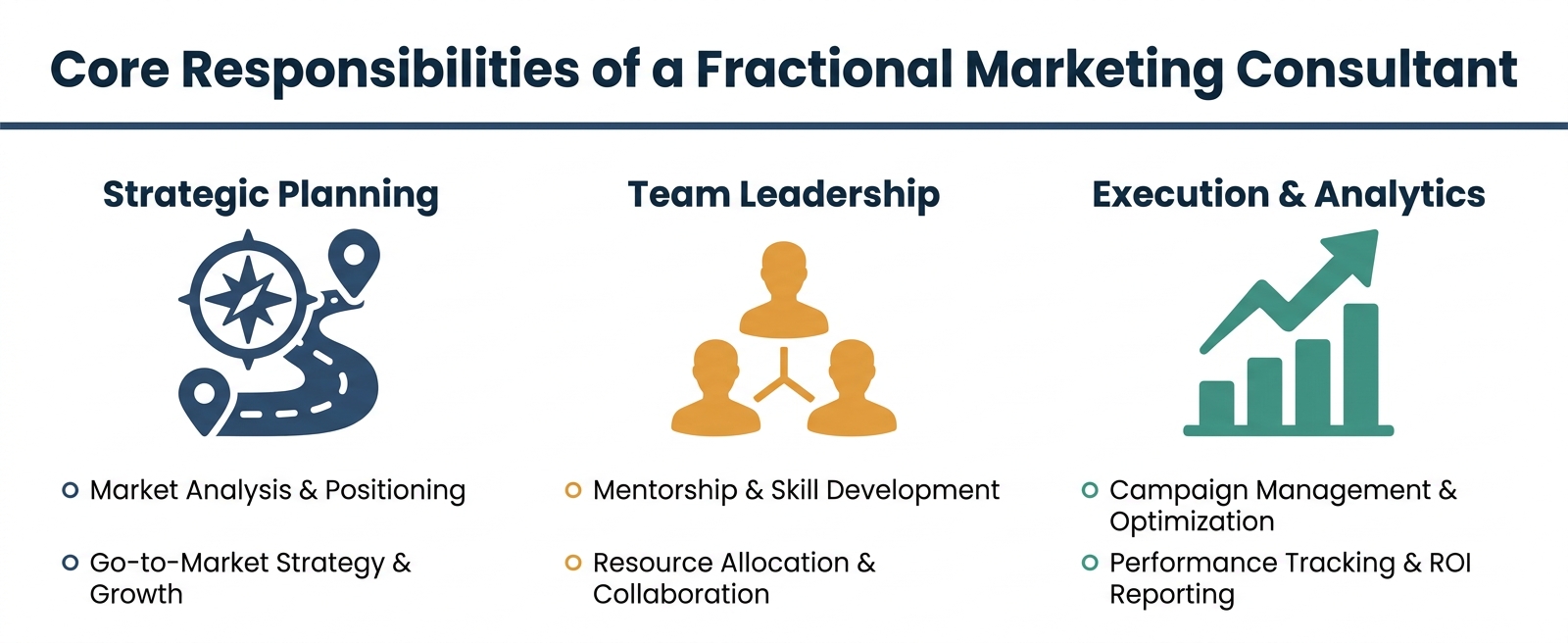
A fractional marketing consultant handles three main areas: strategy, team leadership, and performance tracking. They step into a senior role and own real outcomes, not just slide decks. Here's what that actually looks like day to day.
Strategic Planning
The most important job is building the marketing roadmap. That means figuring out which channels to use, how to position the brand, and where to spend the budget. A good fractional marketing consultant starts with your business goals and works backward to create a plan that's tied to real numbers.
This isn't a one-time document. They revisit and adjust the strategy as data comes in. Markets shift. What worked in Q1 might not work in Q3. The fractional leader stays close enough to notice and adapt.
They also handle budget allocation. That includes deciding how much goes to paid ads, content, events, or whatever mix fits the company's stage and goals. According to Pave's marketing salary and benchmarks guide, senior marketing leaders often shape spend decisions worth millions. Getting that allocation right is one of the highest-leverage things they do.
Team Leadership and Mentorship
Fractional marketing consultants don't just manage the work. They manage the people doing the work. That means coaching junior marketers, setting clear priorities, and making sure everyone knows what "good" looks like.
They also help with hiring. If a company needs a content manager or a paid media specialist, the fractional leader often defines the role, reviews candidates, and makes the call. They know what skills are needed because they've built teams before.
And they manage outside vendors too. Agencies, freelancers, and contractors all need direction. A fractional leader keeps those relationships organized and accountable. According to research from Marstudio's 2024 fractional marketing overview, vendor and agency coordination is one of the most consistent deliverables in a fractional consultant's scope of work.
Execution Oversight and Analytics
Fractional consultants oversee campaign execution without doing every task themselves. They set the direction, check the work, and flag what needs to change. Think of them as the quality control layer above the team.
But the part that makes them truly valuable is the analytics side. They define the key performance indicators (KPIs) that matter, build the reporting structure, and translate data into decisions. That includes metrics like customer acquisition cost (CAC) and lifetime value (LTV).
For context, healthy LTV to CAC benchmarks sit around 3:1 for both SaaS and direct-to-consumer businesses, according to SaaS Hero's B2B SaaS LTV:CAC benchmarks. A fractional marketing consultant knows these benchmarks and uses them to show leadership whether the marketing machine is working or burning cash.
They also run the executive reporting cadence. That means regular updates to founders or boards that connect marketing activity to business outcomes. No jargon. Just clear answers to the question: "Is marketing working?"
Key Signs Your Business Needs a Fractional Marketing Consultant
Your business needs a fractional marketing consultant when growth has stalled, your team lacks senior leadership, or a high-stakes moment like a product launch or funding round is approaching. These are the three clearest signals that part-time marketing leadership could be the right move.
Growth Has Stalled and Marketing Isn't Working
If your revenue has plateaued and your marketing efforts aren't moving the needle, that's a warning sign. More content, more ads, and more emails won't fix a strategy problem. They just cost more money.
This is where a fractional marketing consultant earns their place fast. They can step back and diagnose what's actually broken, whether it's positioning, channel mix, messaging, or targeting. Most in-house teams are too close to the work to see it clearly.
And because fractional leaders have worked across multiple companies and industries, they recognize patterns quickly. They've seen what works. They don't need six months to figure it out.
Your Junior Team Needs Senior Direction
A lot of growing companies have capable marketers on staff but no one to lead them. Junior and mid-level teams can execute, but they need someone to set the strategy, define priorities, and say "this is good enough to ship" or "go back and fix this."
Hiring a full-time CMO to fill that gap is expensive. According to Robert Half's 2025 marketing salary guide, senior marketing executives command significant base salaries, often with annual bonuses of 15 to 25% and equity on top.
For many companies, that's not realistic. A fractional marketing consultant gives your team the senior leadership it needs without the full-time cost. They coach, prioritize, and set the standard without taking a full-time seat.
You're Facing a High-Stakes Business Moment
Some moments require a stronger marketing strategy than you currently have. A new product launch, a move into a new market, or an upcoming funding round all fall into this category.
Investors want to see a clear go-to-market plan. New markets require different messaging, different channels, and a fresh read on the audience. Product launches need timing, positioning, and channel coordination to land properly.
These aren't situations where you want to figure things out as you go. A fractional marketing consultant has likely navigated several of these inflection points before. They bring a tested playbook and can help your team execute without costly mistakes.
If any of these three situations sound familiar, it's worth exploring whether fractional marketing leadership fits your next stage.
Fractional Marketing Consultant vs. Full-Time Hire vs. Agency
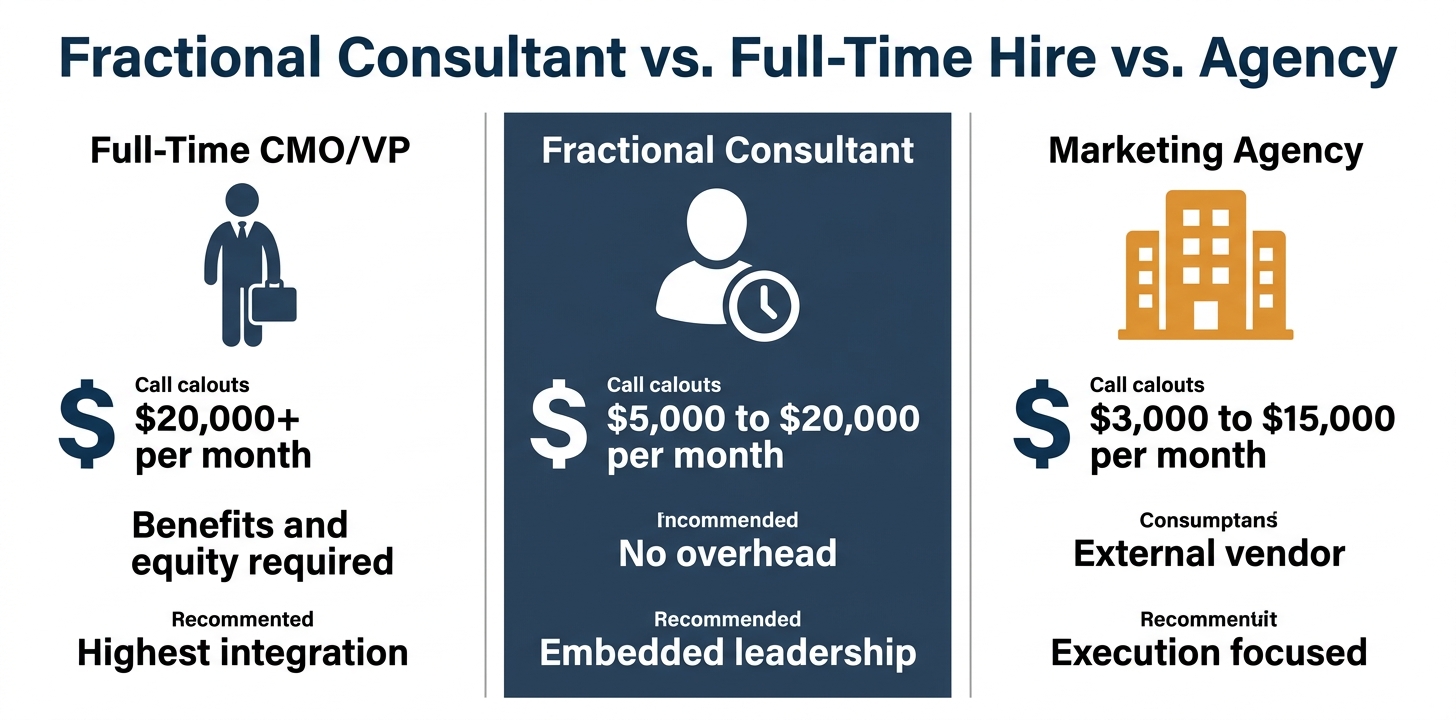
Choosing between a fractional marketing consultant, a full-time hire, and a marketing agency comes down to three things: how much you want to spend, how deeply you need someone integrated into your team, and what kind of work actually needs to get done. If you want the line items behind each path, we've broken down what a fractional CMO, an agency, and a first marketing hire really cost.
Cost Comparison
Let's start with the numbers, because they tell a clear story.
A full-time CMO or VP of Marketing is expensive. Base salaries for a VP of Marketing typically run between $239,000 and $252,000 per year, according to Salary.com's VP of Marketing benchmark data. And that's just base pay.
Add in benefits, annual bonus (often 15 to 25% of base), equity grants, and employer-side payroll taxes, and the real cost climbs fast. At growth-stage companies, signing bonuses alone can run $25,000 to $75,000.
A fractional marketing consultant costs a fraction of that. Monthly retainers typically land between $5,000 and $15,000 for most strategic advisory engagements. Senior fractional leaders with deeper execution involvement may charge up to $20,000 per month, according to GrowthExpertz's 2026 fractional CMO pricing guide.
Marketing agency retainers for a mid-sized firm usually fall in a similar range, around $5,000 to $15,000 per month, with lighter-scope engagements starting around $3,000 per month.
Here's a quick side-by-side comparison:
| Cost Element | Full-Time CMO/VP | Fractional Consultant | Marketing Agency |
|---|---|---|---|
| Monthly cost | $20,000+ (base alone) | $5,000 to $20,000 | $3,000 to $15,000 |
| Benefits and overhead | Yes | No | No |
| Equity | Often required | Rarely | No |
| Signing bonus | $25K to $75K | None | None |
| Long-term commitment | Yes | Flexible | Varies |
For most early-stage and mid-market companies, the fractional model offers the best cost-to-seniority ratio.
Level of Integration
This is where a fractional marketing consultant really stands apart from an agency.
Agencies work outside your company. They receive briefs, produce deliverables, and attend status calls. But they don't sit in on your leadership meetings, own your marketing decisions, or manage your internal team. Their loyalty is split across multiple clients.
A fractional marketing consultant is embedded inside your business. They attend leadership meetings, collaborate directly with your sales team, and take ownership of marketing outcomes. They act more like a part-time employee than an outside vendor.
A full-time hire is, of course, the most integrated option. But integration comes at a cost, and for many companies, paying for full-time presence isn't necessary to get full-time results.
Scope of Work
The three models handle scope very differently.
A full-time CMO or VP of Marketing owns everything: strategy, team, budget, brand, demand generation, and executive reporting. It's an all-encompassing role.
A marketing agency focuses on execution. They run paid campaigns, produce content, manage SEO, or handle social. But most agencies don't set your strategy, manage your internal team, or make budget decisions. They execute what they're told.
A fractional marketing consultant fills the space in between. They own strategy and leadership without doing every execution task themselves. They define priorities, manage the agency (if you have one), coach your internal team, and report results to leadership.
For many companies, the ideal setup is a fractional marketing consultant leading the strategy combined with a lean in-house team or agency handling execution. You get senior thinking without the senior-level overhead. And if your real question is the narrower one, whether your first marketing hire should be a person or an agency, we've written that decision up separately.
Understanding the Cost of a Fractional Marketing Consultant
A fractional marketing consultant typically costs between $5,000 and $15,000 per month on a retainer, compared to $240,000 or more per year for a full-time marketing executive. You get senior-level strategy and leadership at a fraction of the overhead, with no benefits, equity, or long-term commitment required. (To see the fully loaded numbers for every path side by side, run them through our marketing cost calculator.)
Common Pricing Models
Most fractional marketing consultants work on one of three structures:
- Monthly retainer: The most common setup. You pay a fixed monthly fee for a set number of hours and a defined scope of work.
- Project-based fee: Used for specific engagements like a brand audit, go-to-market launch, or messaging overhaul. The scope and price are fixed upfront.
- Hourly rate: Less common for senior-level work, but available. Senior marketing consultants typically charge between $150 and $500 per hour, according to Women Conquer Business's marketing consultant cost guide.
For most ongoing leadership needs, the retainer model makes the most sense. It gives you predictable costs and keeps the consultant close to your business. It's also the model The Zulu Method uses, with pricing published openly so you can compare it against any consultant quote you get.
Typical Price Ranges
What you pay depends on scope, seniority, and how much execution is involved:
| Engagement Level | Monthly Cost Range |
|---|---|
| Light advisory support | $1,500 to $5,000 |
| Mid-range strategy and oversight | $5,000 to $10,000 |
| Senior fractional leadership | $10,000 to $20,000+ |
Earlier-stage companies with narrow needs often start at the lower end. Companies going through a product launch, market expansion, or revenue push tend to need deeper involvement, which moves the price up.
The Value Proposition
The real question isn't what a fractional marketing consultant costs. It's what poor marketing leadership costs you instead.
Missed positioning, wasted ad spend, and a team without direction are expensive problems. A misaligned marketing strategy can quietly drain budget for months before anyone connects the dots.
A fractional marketing consultant brings in tested judgment that reduces that risk fast. And a Forbes survey found 72% of CEOs plan to increase their use of fractional executives in the next 12 months, which suggests the ROI case is landing.
For most companies, this model isn't an expense. It's a smarter way to buy senior marketing capability without the full-time price tag.
How to Integrate a Fractional Consultant with Your Existing Team

Bringing in a fractional marketing consultant works best when both sides are set up for success from day one. That means clear goals, consistent communication, and real authority. Without those three things, even the most experienced fractional leader will struggle to move fast.
The Onboarding Process: Getting the First 30 Days Right
The first 30 days are about learning, not doing. A good fractional marketing consultant will want to audit your current marketing, interview key team members, and understand the business goals before making big moves.
Expect deliverables like a current-state marketing audit, a stakeholder map, and a prioritized list of quick wins. These early outputs build shared understanding and prevent the consultant from pushing changes before they know what's actually broken.
According to CMO Alliance's 30-60-90 day plan framework, the strongest marketing leaders use the first phase to align on goals before committing to a strategy. That discipline pays off in faster execution later.
Set your expectations upfront. Define what success looks like in 30, 60, and 90 days. Write it down. Share it. That simple step removes ambiguity and gives everyone a shared definition of progress.
Establishing Communication Cadence
Because a fractional consultant isn't in your office every day, communication structure matters a lot. You need a defined rhythm, not an open-ended "reach out whenever" setup.
A practical cadence looks like this:
- Weekly check-in: A short call or async update covering priorities, blockers, and progress.
- Monthly reporting: A clear summary connecting marketing activity to business outcomes.
- Slack or email access: Defined response windows so the team knows when to expect replies.
The consultant also needs access to the right systems. Think analytics platforms, your CRM, ad accounts, and any project management tools your team uses. Delayed access is one of the most common reasons fractional engagements start slow.
Empowering Leadership to Make the Model Work
This is the part companies most often get wrong. You hire a senior fractional marketing consultant, and then you limit their ability to make decisions. That creates a bottleneck.
For the model to work, the fractional leader needs real authority over the marketing function. That means they can set priorities, direct the team, manage vendors, and make calls on campaigns without needing approval for every small move.
That doesn't mean unlimited autonomy. It means a clear scope of ownership. Agree upfront on where they have decision rights and where they need to escalate. Then hold that line.
When companies give their fractional marketing consultant that authority, results come faster. The engagement stops feeling like an advisory and starts working like actual leadership.
Measuring the ROI of Your Fractional Marketing Investment
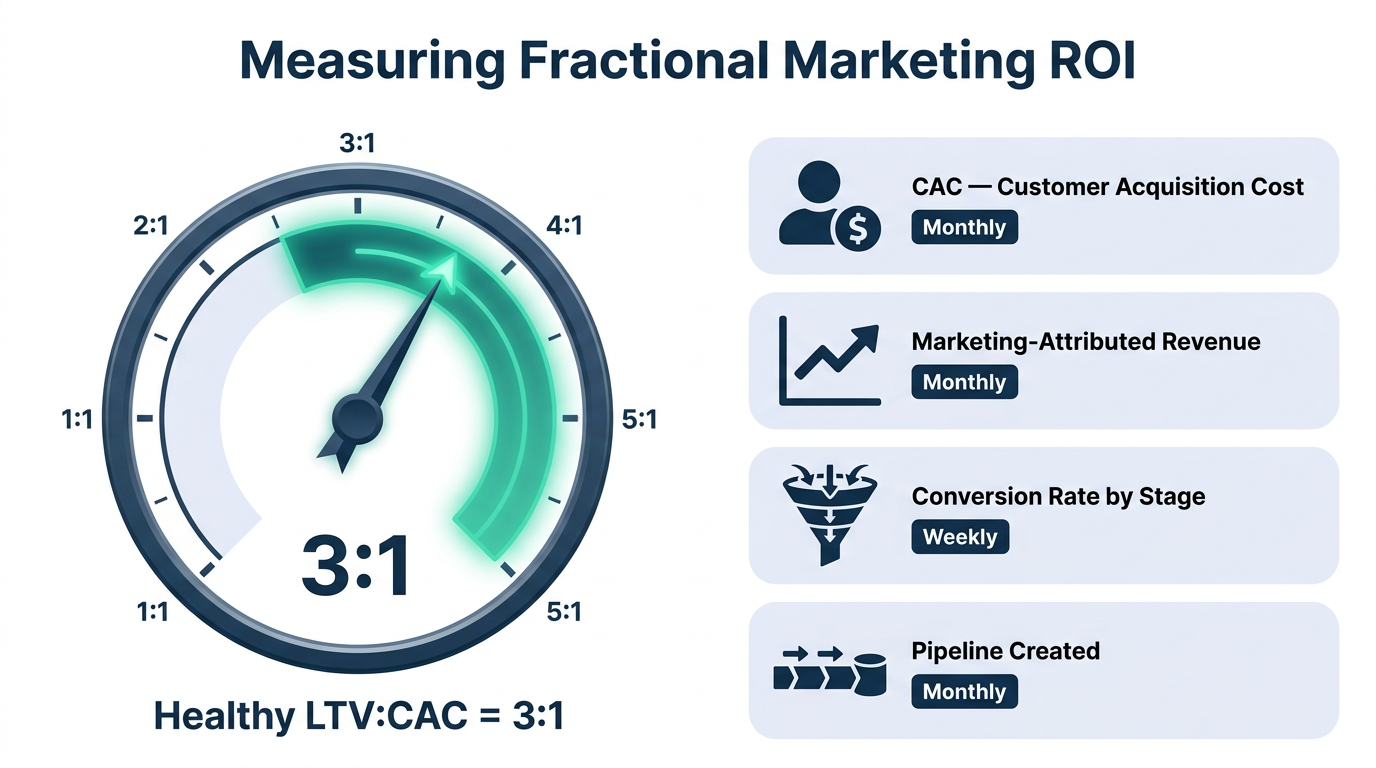
Knowing whether your fractional marketing consultant is delivering real value comes down to tracking the right numbers. Vanity metrics like follower counts and page views feel good but don't tell you if marketing is actually growing the business. The metrics that matter connect marketing activity to revenue.
Defining Success Metrics That Actually Matter
The KPIs worth tracking fall into a short, focused list. Customer Acquisition Cost (CAC) tells you how much you're spending to bring in each new customer. Lifetime Value (LTV) shows how much revenue that customer generates over time. Marketing-attributed revenue ties specific campaigns directly to closed deals.
These three numbers together give you a clear picture of whether your marketing machine is profitable. If your LTV:CAC ratio is sitting well below 3:1, that's a signal something needs to change, whether it's targeting, messaging, or channel mix.
According to KPI Sense's LTV:CAC benchmarking guide, a 3:1 ratio is the widely accepted healthy benchmark across both SaaS and direct-to-consumer businesses. A good fractional marketing consultant knows these numbers and uses them to anchor every strategy conversation.
Building a KPI Dashboard
A practical dashboard doesn't need to be complicated. It needs to answer one question: is marketing working?
Here's what to include in a weekly or monthly tracking view:
| Metric | What It Measures | Review Frequency |
|---|---|---|
| CAC | Cost to acquire one customer | Monthly |
| LTV:CAC ratio | Return on acquisition spend | Monthly |
| Marketing-attributed revenue | Revenue tied to campaigns | Monthly |
| Lead volume by channel | Which sources are producing | Weekly |
| Conversion rate by stage | Where leads are dropping off | Weekly |
| Pipeline created | Marketing's contribution to sales pipeline | Monthly |
Your fractional marketing consultant should own this dashboard. They build it, maintain it, and present it to leadership on a clear cadence. That reporting loop keeps everyone aligned and removes guesswork from the conversation.
Qualitative ROI: The Benefits You Can't Spreadsheet
Not every win shows up in a metric right away. Some of the most valuable things a fractional marketing consultant delivers are harder to measure but easy to feel.
Team morale often improves when junior marketers finally have a clear leader setting direction. Priorities get cleaner. People stop working on low-impact projects because someone with authority is saying what matters.
Processes also get better. A fractional leader typically brings repeatable systems from past engagements, things like campaign planning templates, agency briefing frameworks, and reporting structures. Those improvements stick around long after the engagement ends.
And strategic clarity is genuinely valuable. When everyone in the company understands what marketing is trying to do and why, decisions get faster and alignment across sales and marketing gets easier. That clarity is hard to put a dollar figure on, but its absence is costly.
The full ROI of a fractional marketing consultant includes both columns: the numbers you can measure and the organizational improvements that make everything run better.
Real World Example: SaaS Company at Inflection Point
A mid-market SaaS company with $5M revenue had a capable internal marketing team but no senior leader to set strategy. When they hired a fractional CMO at 15 hours/week ($8,000/month), the consultant spent the first 30 days auditing their marketing. She found that paid advertising spend wasn't aligned with actual sales cycle length, and messaging didn't clearly differentiate from competitors. In months 2 to 3, she repositioned the brand, restructured the budget to prioritize intent-based channels, and set up a KPI dashboard tied to pipeline contribution. By month 6, marketing-attributed revenue increased 40%, CAC dropped 25%, and the LTV:CAC ratio moved from 1.8:1 to 3.2:1, all while the internal team became significantly more confident and capable under her mentorship.
How to Find and Hire the Right Fractional Marketing Consultant
Finding the right fractional marketing consultant means knowing where to look, what to ask, and how to structure the engagement before anyone signs anything. The hiring process is shorter than a full-time search, but skipping the right steps will cost you time and money.
Where to Look
The three best sources are professional networks, specialized marketplaces, and direct referrals.
LinkedIn is a strong starting point. Search for fractional CMO or fractional marketing consultant, filter by location or remote, and look at who's actively posting about marketing strategy. Activity signals whether they're engaged in their field.Niche marketplaces go further. Platforms like MarketerHire and GrowTal pre-vet candidates and match you based on industry, stage, and scope. Right Side Up and Chief Outsiders focus on senior marketing operators specifically. These platforms reduce the screening burden considerably.
Referrals from founders, investors, or other operators in your network often surface the strongest candidates. Someone who's already proven themselves in a similar company is a lower-risk hire.
The Vetting Process
Interviews should focus on results, strategic thinking, and how they work within a part-time structure. A few questions worth asking:
- What does your first 90 days look like? A strong candidate will describe a clear learn-then-act approach, not a list of tactics.
- Tell me about a campaign that underperformed. What changed? This reveals honesty and learning mindset.
- How do you align marketing to sales and revenue goals? Strategy that doesn't connect to pipeline is just activity.
- How do you manage a team when you're not there full-time? This tests whether they can lead without constant presence.
- What's the biggest opportunity you see in our business right now? Even with limited context, a sharp fractional consultant should spot something.
Look for specific numbers in their answers. Vague claims about "driving growth" aren't the same as "reduced CAC by 30% over two quarters."
Contracting and Scope
A clear statement of work (SOW) protects both sides. It should define the monthly deliverables, the hours or availability committed, how performance gets measured, and the reporting cadence.
Include a termination clause. Most fractional engagements work on 30 to 90-day notice periods. That flexibility is part of the appeal, so make sure it's written in.
Agree on decision rights upfront. The consultant needs real authority over the marketing function to move fast. If every small call requires founder approval, the model won't work the way it's supposed to.
Questions to Ask Before Hiring a Fractional Marketing Consultant
- Where is marketing currently falling short in our business, and do we have the internal expertise to fix it?
- Is our team struggling because of a lack of strategy, execution capacity, or both, and which would a fractional leader best address?
- Are we at a clear inflection point (product launch, market entry, funding round) where experienced guidance could meaningfully reduce risk or accelerate results?
- Can we empower a fractional consultant with real decision authority over marketing priorities, budget allocation, and team direction without requiring approval for every small move?
- Do we have the systems and access in place (analytics platforms, CRM, ad accounts, project management tools) to ensure a fractional leader can move fast from day one?
Is a Fractional Marketing Consultant Right for You?
A fractional marketing consultant gives businesses access to senior-level marketing expertise at a fraction of the cost of a full-time hire. It's a flexible, embedded leadership model built for companies that need real strategic guidance without the overhead of a permanent executive.
The core benefits come down to three things: deep expertise, cost efficiency, and flexibility. You get a proven marketing leader who owns outcomes, not just recommendations, and you pay only for the time and scope you actually need.
This model fits best at an inflection point. If your growth has stalled, your team lacks senior direction, or a high-stakes moment like a funding round or product launch is approaching, that's the signal. You need strategic leadership, but a full-time CMO salary isn't the right answer yet.
Before making any decision, do a quick audit of your own situation. Ask yourself three questions: Where is marketing falling short? Does my team have the senior leadership it needs? And is there a high-stakes moment coming that demands a stronger strategy than I have today?
If the answers point to a gap, fractional marketing leadership is worth a serious look. It's not a workaround. For many businesses, it's simply the smarter way to buy the expertise that actually moves the needle.
A: A consultant typically advises, delivers a strategic plan, and then exits the engagement, leaving implementation to the client. A fractional CMO is more embedded, creating strategy but also managing the internal team, overseeing execution, and taking direct ownership of marketing results as a part-time leader within the company. A fractional leader stays accountable for outcomes, not just recommendations.
Q: How many hours does a fractional marketing consultant work?A: It varies based on the agreement, but typically ranges from 10 to 20 hours per week. Rather than tracking logged hours, most engagements are structured as a monthly retainer with a defined scope of deliverables and outcomes, focusing on impact and results instead of time.
Q: What size company is the best fit for a fractional marketer?A: Startups and small-to-medium-sized businesses (SMBs) in the $2M to $50M revenue range are the ideal fit. These companies are complex enough to need senior marketing strategy and leadership but typically lack the budget or consistent need for a full-time C-level marketing executive.
Q: How long is a typical fractional marketing engagement?A: Initial engagements are often structured for 6 months, which is sufficient time to develop a strategy, begin implementation, and see measurable initial results. Many successful engagements extend for years as the consultant becomes a long-term strategic partner integrated into the organization.
Q: Can a fractional marketing consultant manage an existing agency relationship?A: Yes, absolutely, and this is often a high-value part of the role. The fractional consultant acts as the primary point of contact with the agency, ensuring their work aligns with company strategy and translating business objectives into clear, actionable directives for the agency to execute.