
Hannon Brett | Published on: November 27, 2026 | Time to read: 16 min | Updated on: November 27, 2026
A marketing consultant for a small business is an outside expert who audits your marketing, writes a plan, and advises on what to do next, usually for a project fee or monthly retainer. You need more than a consultant when that plan requires weekly work nobody on your staff has time to run.
A marketing consultant for a small business can give an owner with no marketing leader a plan before anyone spends on guesses. It's also easy to buy the wrong thing, because a consultant hands you a plan and the plan still has to get done. At The Zulu Method, we put every plan through the who-runs-it test: each line gets a person's name, a weekly hour count, and a number before anyone calls it finished. This guide covers what a consultant does, what one costs, what you should see in 90 days, how a consultant differs from an agency, and how to tell when you need more.
Key Takeaways
- A marketing consultant audits your marketing, writes the plan, and advises on it, and many consultants don't run the work themselves.
- Published 2026 ranges run from $75 to $300 an hour, $1,500 to $15,000 a month, and $5,000 to $50,000 a project, and all of them come from sellers of these services.
- In the first 90 days you should get an audit, a written plan with targets, and a named owner for each line of the plan.
- The who-runs-it test lists a person, weekly hours, and a target number for every line, and it shows whether a consultant alone is enough.
- A consultant fills a gap in senior thinking, and an agency fills a gap in hands.
- Get scope, reporting, and ownership of the work in writing, because work from an outside contractor doesn't automatically belong to you.
Table of Contents
- What does a marketing consultant do for a small business?
- How much does a marketing consultant cost for a small business?
- What should you expect from a marketing consultant in the first 90 days?
- What happens to the plan after the marketing consultant leaves?
- Marketing consultant vs agency: what's the difference?
- When do you need more than a marketing consultant?
- How do you choose a marketing consultant for your small business?
- Questions & Answers
What does a marketing consultant do for a small business?
A marketing consultant for a small business reviews what you're doing now, decides what should change, and writes the plan: who to target, what to say, which channels to use, and what to spend. Many consultants advise and don't run the work, so confirm which one you're hiring.
Neal Schaffer's 2026 guide defines the role as "an external marketing professional who advises businesses on how to improve their marketing," working by the project, by the hour, or on a monthly retainer. Fit Small Business draws the same line: a consulting engagement gives you a tailored plan and regular check-ins, and many firms sell the hands-on work as a separate managed service. So the word "consultant" covers a range. At one end is a specialist who audits your ads. At the other is a senior strategist who sits in on your leadership meeting once a month.
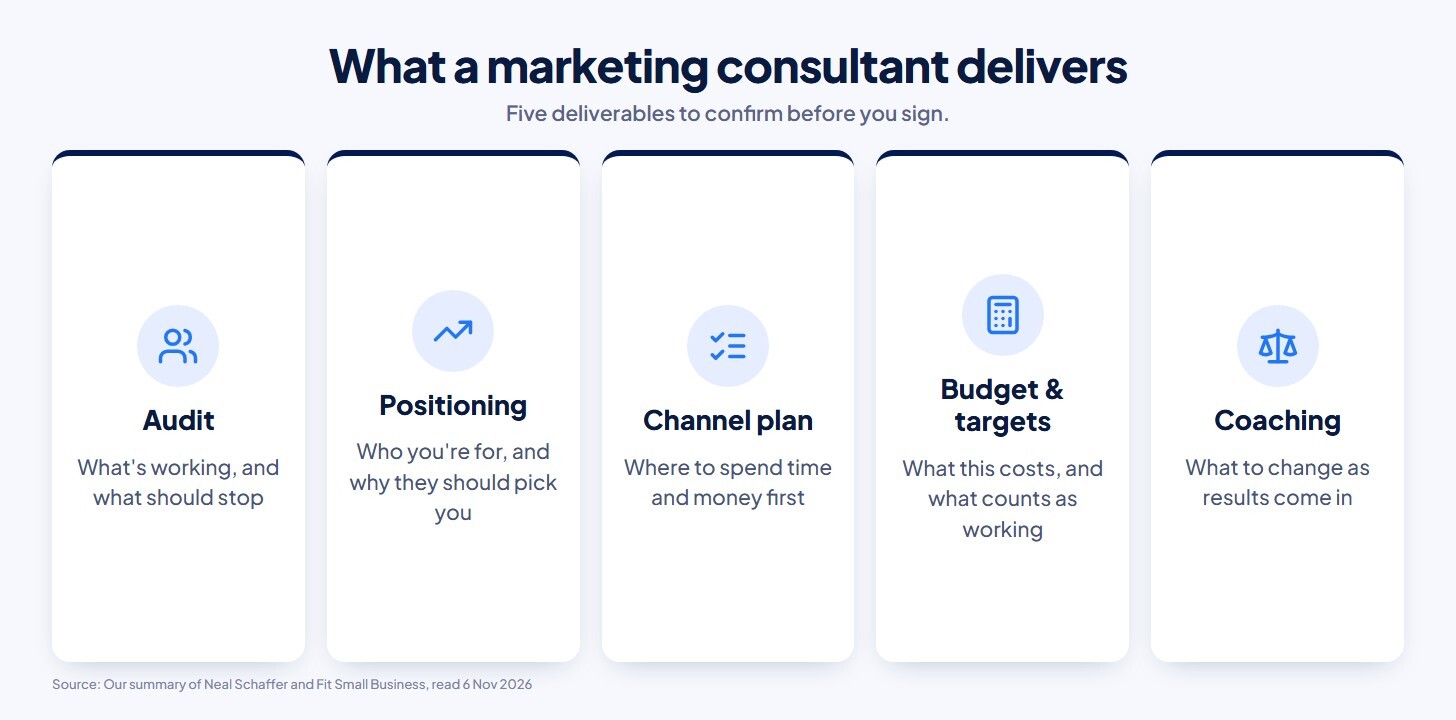
In a small business, the work usually falls into five deliverables. If you can't get a clear yes or no on each one before you sign, the scope isn't finished.
| Deliverable | What you should receive | What it answers |
|---|---|---|
| Audit | A written review of your site, data, ads, and sales process | What's working, and what should stop |
| Positioning | Your target customer and a message you can repeat | Who you're for, and why they should pick you |
| Channel plan | Two or three channels, in priority order | Where to spend time and money first |
| Budget & targets | A spending plan with a number for each channel | What this costs, and what counts as working |
| Coaching | Regular reviews with you or your team | What to change as results come in |
Source: Our summary of the Schaffer and Fit Small Business pages above, 6 Nov 2026.
Notice what's missing from that list: writing the emails, building the pages, running the ads, calling the leads. Some consultants will do pieces of it for an added fee. Ask, and get the answer in writing. And since we know of no US license for the title, anyone can call themselves a marketing consultant. References matter more here than in most purchases.
Who shouldn't hire a marketing consultant yet
You'll get little value from a consultant if you don't yet have a repeatable offer, or if nobody can give the engagement three or four hours a week. Both points come from a consultant's own advice to small businesses. The same page says a freelancer or small agency is the cheaper choice if what you need is execution. If your budget is tight, start with free help. The SBA's network of Small Business Development Centers advises on planning and marketing, and America's SBDC describes nearly 1,000 local centers offering no-cost business consulting. The SBA also describes SCORE as the nation's largest network of volunteer business mentors, offering advice at no cost. For an owner who needs a second opinion on a first plan, those are real options.
How much does a marketing consultant cost for a small business?
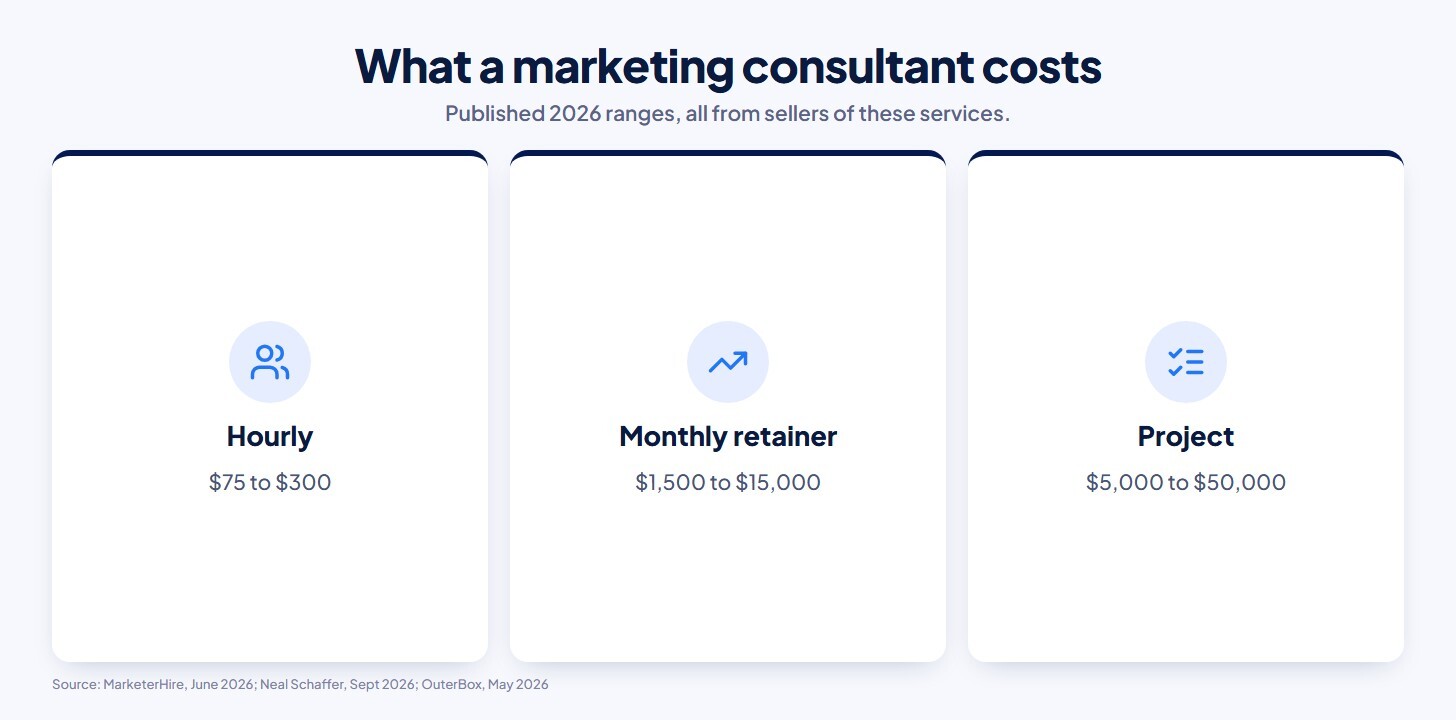
A marketing consultant for a small business usually costs $75 to $300 an hour, $1,500 to $15,000 a month on retainer, or $5,000 to $50,000 for a defined project, according to 2026 figures from MarketerHire, Neal Schaffer, and OuterBox. Every published range comes from a seller of these services, so treat them as planning numbers.
We looked for an independent survey of consultant billing rates and didn't find one. The federal data measures something else. The Bureau of Labor Statistics reports a median wage of $101,860 for management analysts in May 2025, a group that includes consultants, but that's employee pay and not what a client gets billed. So here's what the sellers say, with their reasons for saying it.
| Source & date | Hourly | Monthly retainer | Project | Keep in mind |
|---|---|---|---|---|
| MarketerHire, June 2026 | $100 to $300 | $3,000 to $15,000 for 10 to 40 hours | $5,000 to $50,000 or more | Its own marketplace data, from what it calls 30,000+ matches |
| Neal Schaffer, Sept 2026 | $125 to $300 for a strategic consultant | $1,500 to $3,000 for a light retainer | $5,000 to $25,000 for an audit plus strategy | A working consultant's published ranges |
| OuterBox, May 2026 | $75 to $250 for an independent consultant | $1,500 to $10,000 or more for a narrow retainer | $5,000 to $50,000 or more | An agency's estimate, which it calls a planning synthesis |
Sources read 6 Nov 2026.
Three practical notes on those numbers.
- Hours matter more than the rate. A $3,000 retainer at $150 an hour buys 20 hours a month. That's about five hours a week of someone's attention, and they're thinking about your business, not doing its work.
- Total the engagement. Six months at $3,000 is $18,000. Add the ad spend and any freelancers the plan calls for. Our guide to how much a small business should spend on marketing shows how to set the full number from revenue, margin, and goal.
- Run the payback math. One small business consultant puts it plainly: a consultant at $3,000 a month needs roughly $3,000 of monthly margin to break even. Note that's margin, not revenue. At a 50% gross margin, you'd need $6,000 a month in new sales from the work.
Rates also say little about quality. In our experience, a $250-an-hour consultant who tells you to drop two channels can cost less than a $100-an-hour one who adds three. Judge the plan on what it removes as well as what it adds.
What should you expect from a marketing consultant in the first 90 days?
In the first 90 days, a marketing consultant should finish an audit, deliver a written plan with priorities and targets, and hand each line of that plan to a named owner. If the consultant can't describe those three stages before you sign, ask for it in writing, because a vague start usually leads to a vague finish.
Schaffer lists being unable to describe the first 90 days as a red flag, along with vague answers about past clients, no reporting schedule, and a consultant who never pushes back on your assumptions. That last one is worth testing in the first meeting. Offer an assumption of yours and see whether they challenge it.
Here's a sequence you can hold a consultant to. The timing is from our experience, and a smaller business may move faster.
- Days 0 to 30: audit and listen. The consultant reviews your numbers and talks to customers, staff, and whoever sells. You should see a written list of what's working, what isn't, and what to stop.
- Days 31 to 60: write the plan. You should receive positioning, your target customer, two or three channels in order, a budget, and one number per channel. A one-page marketing plan beats a 40-page deck, because you'll use it.
- Days 61 to 90: hand it over. Every line of the plan gets an owner, a weekly hour count, and a start date. The first test goes live here. If the plan is still being edited at day 90, the engagement has drifted.
Get these three things in writing
A short agreement prevents most disputes. Put in the scope, including what's excluded. Put in the reporting schedule. And put in who owns the work. That third point catches owners by surprise. The US Copyright Office's Circular 30 explains that a work is "made for hire" in two situations: an employee creates it as part of regular duties, or a certain type of work is created under an express written agreement. A plan or a set of ads from an outside consultant doesn't become yours automatically. Ask for a written assignment of rights to everything you're paying for, and have your attorney check the wording, because this is general information and not legal advice.
Also ask for logins. Every ad account, analytics property, and domain should sit in your company's name, with the consultant added as a user. If the relationship ends, you keep the data.
What happens to the plan after the marketing consultant leaves?
After a marketing consultant leaves, the plan needs a weekly owner, and in most small businesses nobody has those hours. In our experience, the gap between a good plan and the work it requires is the most common reason a consulting engagement produces little. Count the hours before you sign, and you'll know whether a consultant alone is enough.
This is the plan-to-execution gap, and it's nobody's fault. A consultant's job ends where yours begins. A common pattern, in our experience: the plan arrives on a Friday. On Monday, the owner is back on payroll, customers, and a late shipment, and the office manager who was going to handle marketing has a full job already. Three months later, the plan is in a folder.
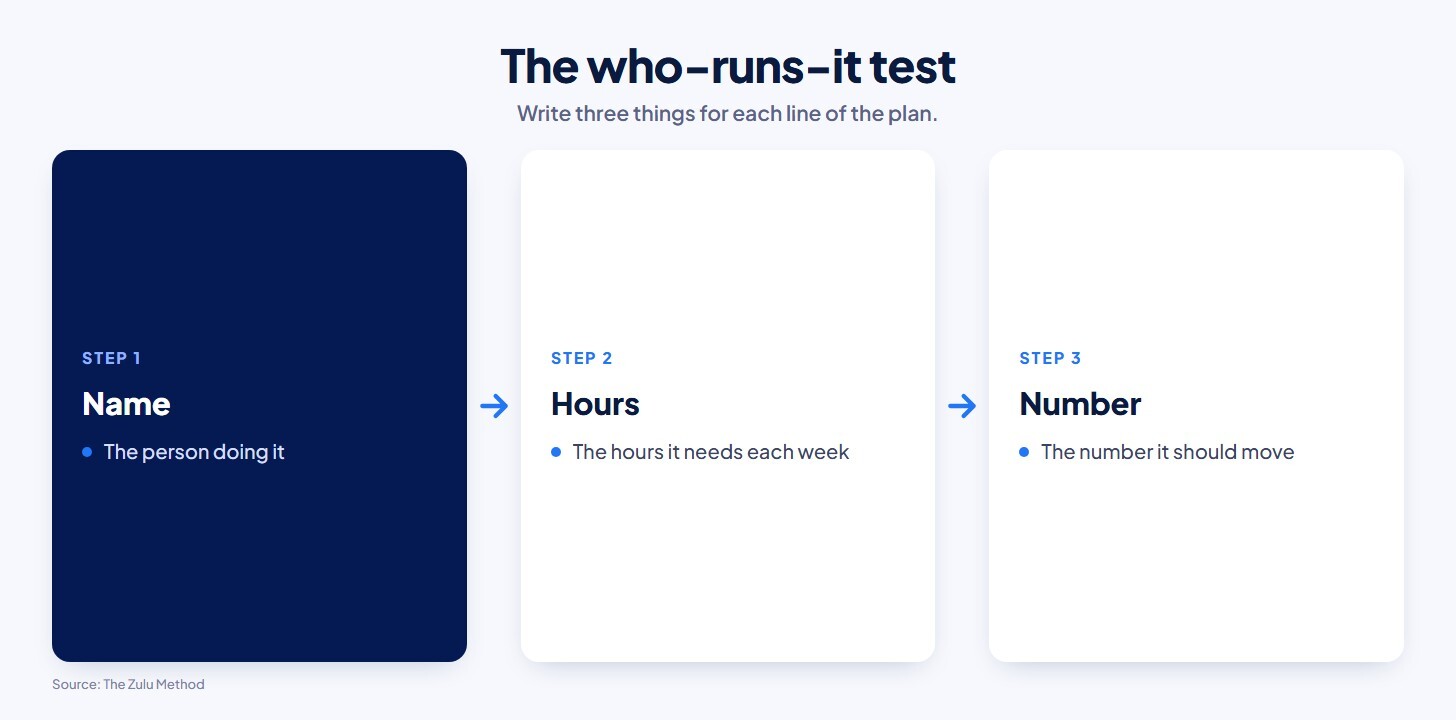
The who-runs-it test closes the gap before it opens. Take each line of the plan and write down three things: the name of the person doing it, the hours it needs each week, and the number it should move. Here's what that looks like on a typical plan for a small service business.
| Plan line | Who runs it | Hours a week | Number it moves |
|---|---|---|---|
| Outbound to 20 target accounts a week | ? | 8 | Conversations booked |
| Email and LinkedIn to past clients and referrers | ? | 3 | Referrals received |
| One customer story a month | ? | 3 | Close rate |
| Paid search test | ? | 4 | Cost per qualified lead |
| Weekly numbers review | ? | 1 | All of the above |
| Total | 19 |
Source: The Zulu Method's who-runs-it test. The hours are illustrative, made up to show the method, and aren't a benchmark.
In this example the plan needs 19 hours a week, about half of a full-time job, and it hasn't got one name on it. Fill in the question marks honestly. If real names with real spare hours fill the column, a consultant may be all you need, and you've saved yourself a bigger commitment. If the column stays empty, you already know what comes next: the plan needs either fewer lines or more hands.
A Worked Example
The last column of the test is how you'll know the plan is running. For one of our clients, that number was inbound leads. The case study shows 4 inbound leads in the 5 months before and 44 in the first month, with 60 days to market. That's one company, so treat it as a single data point.
Marketing consultant vs agency: what's the difference?
A marketing consultant builds the strategy, and a marketing agency carries it out. Hire a consultant when the direction isn't settled, and an agency when you know what you want done and need channels run. A consultant fills a gap in senior thinking. An agency fills a gap in hands, and neither fills both unless the contract says so.
| Question | Marketing consultant | Marketing agency |
|---|---|---|
| What you're buying | Judgment and a plan | Execution in one or more channels |
| Who does the work | You, your staff, or vendors you hire | The agency's team, often more junior than the people who sold it |
| Usual pricing | Hourly, project, or light retainer | Monthly retainer, sometimes plus a share of ad spend |
| Published cost | $1,500 to $15,000 a month | $2,500 to $25,000 or more a month per channel |
| Risk to watch | A good plan with no owner | Busy work with no strategy behind it |
| Best fit | Direction is unclear, and you have people to do the work | Direction is clear, and you lack people |
Sources: Published costs from Neal Schaffer, Sept 2026. Other rows are our experience, 6 Nov 2026.
Schaffer warns against expecting strategy from an agency, and owners do run into that. The trouble often starts at the handoff between sales and delivery, when the people who sold the retainer stop being the people who do the work. The question of who does the work after the contract is signed has its own guide, on how to choose a marketing agency. If you've already got one and want to grade it, try this 20-minute audit.
A hybrid also works well. In our experience, many owners use a consultant for four to eight weeks to set direction, then bring in an agency or freelancers to run the plan, with the consultant staying on a few hours a month to review results. That sequence gives the agency a clear brief, and it gives you someone independent to check the agency's numbers.
When do you need more than a marketing consultant?
You need more than a marketing consultant when the plan requires more weekly hours than your staff has, when you need pipeline this quarter, or when the same open items keep coming back to every monthly review. At that point the constraint is execution, and more advice won't fix it.
In our experience, four signs show up first.
- The who-runs-it column stays empty. You've got a good plan and no names to put on it.
- Your monthly call repeats itself. You're discussing the same three items you discussed last month, because nobody had time to do them.
- You're the bottleneck. Every asset waits for the owner's review, and marketing stops whenever you're busy.
- Referrals have reached their limit. Growth depends on new sources, and you need them running soon. Our post on how to get clients when referrals stop being enough covers the four-source map.
Here's how the options line up, sorted by who does the weekly work. That's the question to ask of any option you're considering.
| Option | Who runs it on Monday | Fits when |
|---|---|---|
| Free advisor (SBDC, SCORE) | You | You need a sounding board and have little budget |
| Marketing consultant | You or your staff | You have the hours and need direction |
| Consultant plus freelancers | Freelancers, and you manage them | The plan is clear, with one or two channels |
| Marketing agency | The agency, on a brief you own | The strategy is settled, and channels need running |
| Outsourced CMO or part-time leader | Your vendors, led by that person | You want someone to own the function without a full-time salary |
| Outside team that owns plan and execution | That team | You need strategy and several channels running at once |
| Full-time head of marketing | An employee | The work fills a job, and the margin covers the seat |
Source: Our experience, 6 Nov 2026.
None of these is the right answer for everyone. An owner with a capable office manager and one strong channel may never need more than a good consultant. An owner trying to open two new markets this year likely does. For the cost of a hire against outside help, see in-house marketing vs agency. Firms that sell expertise have their own version of this question, covered in marketing for service businesses.
How do you choose a marketing consultant for your small business?
Choose a marketing consultant by asking for a recent plan they wrote, a reference from a business your size, and a description of their first 90 days. The best signal is a consultant who tells you what they'd stop doing in your business, and who says plainly what they won't do themselves.
Look for experience with your kind of sale. Selling a $40,000 service through relationships has little in common with selling a $40 product through ads, and a consultant strong in one can be lost in the other. Also watch the title. Schaffer cautions that a real fractional CMO needs real leadership experience, and our guide to what a fractional marketing consultant is covers how that model compares. Be wary of anyone who quotes a return on investment before they've seen your numbers.
Questions to ask yourself
- Do I need direction, hands, or both?
- Who at my company has hours each week to carry out a plan?
- What would I stop doing if a consultant told me to?
- What number would tell me this engagement worked six months from now?
- Do I have the monthly margin to cover the fee?
Before you call anyone, write a one-page brief. List your last 12 months of revenue by source, your three best customers and why they bought, what you've tried, and the hours your team can give each week. Then run the who-runs-it test on your current plan, even if the plan lives in your head. That page takes an hour, it should shorten the first month of an engagement, and it might show you that the next step is free: a meeting at your local SBDC this week.

Questions & Answers
Outsourced CMO vs marketing agency: which should a small company choose?A small company should choose an outsourced CMO when it needs someone to lead marketing and manage vendors, and an agency when the strategy is settled and channels need running. Hawke Media says an agency usually provides execution, while an outsourced CMO is a broader model. Many companies with clear goals and few staff end up using both.
Our small business has no marketing leader. Who should run the plan?A small business with no marketing leader should give the plan to one named person with the weekly hours to run it. That can be a freelancer or an agency for channels, an outsourced CMO for leadership, or a full-time hire. An SBDC, SCORE, or a consultant can advise on the plan, and someone still has to run it each Monday.
Is a marketing consultant worth it for a small business?A marketing consultant is worth it for a small business when the direction is unclear, someone on staff has hours to carry out the plan, and the monthly margin covers the fee. A consultant is less useful before the business has a repeatable offer, or when the real need is more people doing the work.
Can a marketing consultant replace a marketing team?A marketing consultant can replace the senior thinking on a marketing team, and usually doesn't replace the people doing the work. Many consultants advise, review, and coach. If your plan needs content, ads, outreach, and reporting each week, you'll still need staff, freelancers, or an agency to produce it, even with a strong consultant in place.
How long should a marketing consultant engagement last?In our experience, a first marketing consultant engagement often runs about 90 days: an audit, a plan, and a handover to named owners. Many owners then keep a light monthly retainer so someone reviews the results. A longer engagement makes sense only when the consultant is coaching your team and the list of open items is shrinking.
Should I hire a local marketing consultant or a remote one?A local marketing consultant helps most when your customers are local and the consultant knows your market, your competitors, and your referral network. For most other businesses, experience with your kind of sale matters more than location. In our experience, most consulting work can be done remotely, so widen the search if the best fit lives elsewhere.
Free GTM Teardown
Get your calendar filled with qualified leads every month.
Your free teardown shows where your marketing loses buyers, how you rank against your top 5 competitors, and what to fix first.
Get your free teardown ↗