
Hannon Brett | Published on: November 24, 2026 | Time to read: 16 min | Updated on: November 24, 2026
A GTM engineer is a technical operator who builds the automated systems behind sales and marketing: data enrichment, lead routing, outbound sequences, and CRM connections. Hire one after your buyer, message, and sales process already work by hand, because the role scales an existing strategy and doesn't create one.
What is a GTM engineer, and do you need one? Much of what's written on this topic is aimed at people who want the job, or comes from companies selling the tools. This guide is for the founder deciding whether to hire. At The Zulu Method, we run the manual-first test before any automation gets built: prove the buyer, the message, the conversion, and the owner by hand, then automate what repeats. Below you'll find what the role does, what it costs on 2026 data, how it differs from RevOps, and how to decide between hiring, doing it yourself, and bringing in outside help.
Key Takeaways
- A GTM engineer builds automated systems for enrichment, routing, outbound, and CRM connections, and the role doesn't set the market, the message, or the positioning.
- Published pay medians run from $127,500 to $150,000 in base salary, and the $150,000 figure is about $219,000 a year with benefits by our arithmetic on federal data.
- In Bloomberry's review of 1,000 postings, 9 of the 10 top GTM engineer responsibilities also appeared in RevOps engineer postings.
- Hire after your buyer, message, and sales process work by hand, because automation multiplies whatever already exists.
- The manual-first test asks for four proofs before you automate: the buyer, the message, the conversion, and the owner.
- Doing it yourself with Clay and HubSpot is a good choice when you have a builder on the team and a go-to-market that already works by hand.
Table of Contents
- What is a GTM engineer?
- What is the difference between a GTM engineer and RevOps?
- How much does a GTM engineer cost?
- Should you hire a GTM engineer before you fix your go-to-market?
- What should you fix first, and in what order?
- Do it yourself with Clay and HubSpot, or hire a go-to-market agency?
- How do you hire a GTM engineer when you're ready?
- Questions & Answers
What is a GTM engineer?
A GTM engineer is a technical operator who builds the automated systems behind sales and marketing, such as data enrichment, lead routing, outbound sequences, and CRM connections. GTM stands for go-to-market, which is the plan and the machinery a company uses to reach buyers and sell to them.
The title is young, and the software vendor Clay says it coined it. Clay, a data enrichment company, dates the role to 2023 and defines the practice as "building automated revenue systems using AI, data enrichment, and workflow automation." ZoomInfo's version, updated in October 2026, calls it the discipline of building the systems "that turn buying signals into revenue motion." Both companies sell tools these engineers use, so read their enthusiasm with that in mind. The definitions themselves are fair.
What the job looks like in practice shows up in the postings. Bloomberry analyzed 1,000 of them and ranked the top responsibilities as building and automating GTM workflows, integrating the tech stack, and owning the CRM. Clay was the most requested tool, followed by HubSpot at 52%, Outreach at 49%, and Salesforce at 45%. SQL and Python each appeared in 38% of postings, and the average experience requirement was 4.11 years.
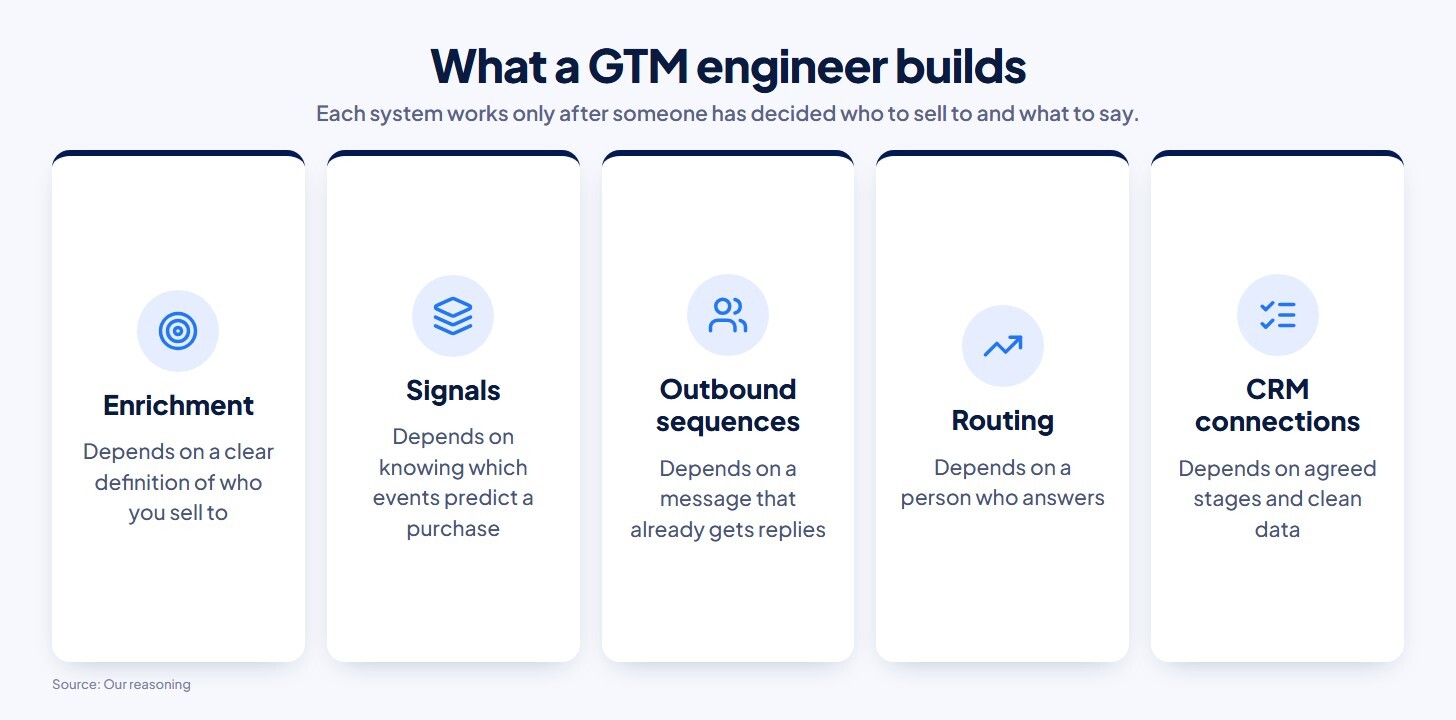
| What a GTM engineer builds | What it does | What it depends on |
|---|---|---|
| Enrichment | Fills in company and contact data automatically | A clear definition of who you sell to |
| Signals | Flags accounts that show a reason to buy now | Knowing which events predict a purchase |
| Outbound sequences | Sends personalized email and tasks at volume | A message that already gets replies |
| Routing | Sends each lead to the right person fast | A person who answers |
| CRM connections | Keeps tools and records in step with each other | Agreed stages and clean data |
Source: Bloomberry's posting analysis (updated 25 Jan 2026) for the work. The right-hand column is our reasoning, 6 Nov 2026.
Every item in the table works only after someone has decided who to sell to and what to say.
Why the title covers two different jobs
"GTM engineer" means different things at different company sizes. Bitscale, a data vendor, reported in October 2026 that it ran 1,000 LinkedIn postings through AI and found that at companies under 50 people, nearly 90% of the roles were outbound outreach under a newer title, against under 40% at companies above 1,000 people. It hasn't published the dataset, so take the number as a direction and not a measurement. The direction matches what you'd expect. A small company posting for a GTM engineer often wants someone to run cold email. A large one wants someone to build data infrastructure. In our reading, those are different people at different prices.
What is the difference between a GTM engineer and RevOps?
A GTM engineer builds new automated systems, while revenue operations, or RevOps, runs the processes, reporting, and CRM rules the company already has. In practice the two overlap heavily. In Bloomberry's analysis of 1,000 postings, 9 of the 10 top GTM engineer responsibilities also appeared in RevOps engineer postings.
Bloomberry's author went further and concluded the two jobs are "essentially the same." ZoomInfo draws a sharper line: "RevOps improves the output. GTM engineers build the machine." Both views are useful to a founder. The line matters at a company with a 40-person revenue team. It doesn't matter much at a company with one seller, where one person ends up doing both.
| Role | Main output | Owns strategy? | Talks to prospects? |
|---|---|---|---|
| GTM engineer | Automated workflows and data pipelines | No | Usually not |
| RevOps | Process, forecasting, reporting, and CRM rules | No | No |
| Sales development rep | Booked conversations | No | Yes, all day |
| Head of marketing | Market, message, budget, and pipeline target | Yes | Often |
| Growth marketer | Tests that scale one or two channels | Partly | Sometimes |
Source: Our reading of the Bloomberry, ZoomInfo, and HyperGrowth Partners pages linked in this post, 6 Nov 2026. Titles vary by company.
The column to look at is the third one. HyperGrowth Partners, which wrote one of the clearest pieces on the subject, put it directly in February 2025: GTM engineers "don't select markets, craft messaging, or determine positioning." They "scale an existing strategy instead of inventing one." RevPartners, a firm that sells this work, answers "No" to whether GTM engineers replace SDRs, and says they don't replace sales and marketing roles.
You'll also see advice telling founders to stop hiring a VP of Marketing and hire a "marketing engineer" instead. That advice goes too far, because engineering supports marketing and doesn't replace it.
How much does a GTM engineer cost?
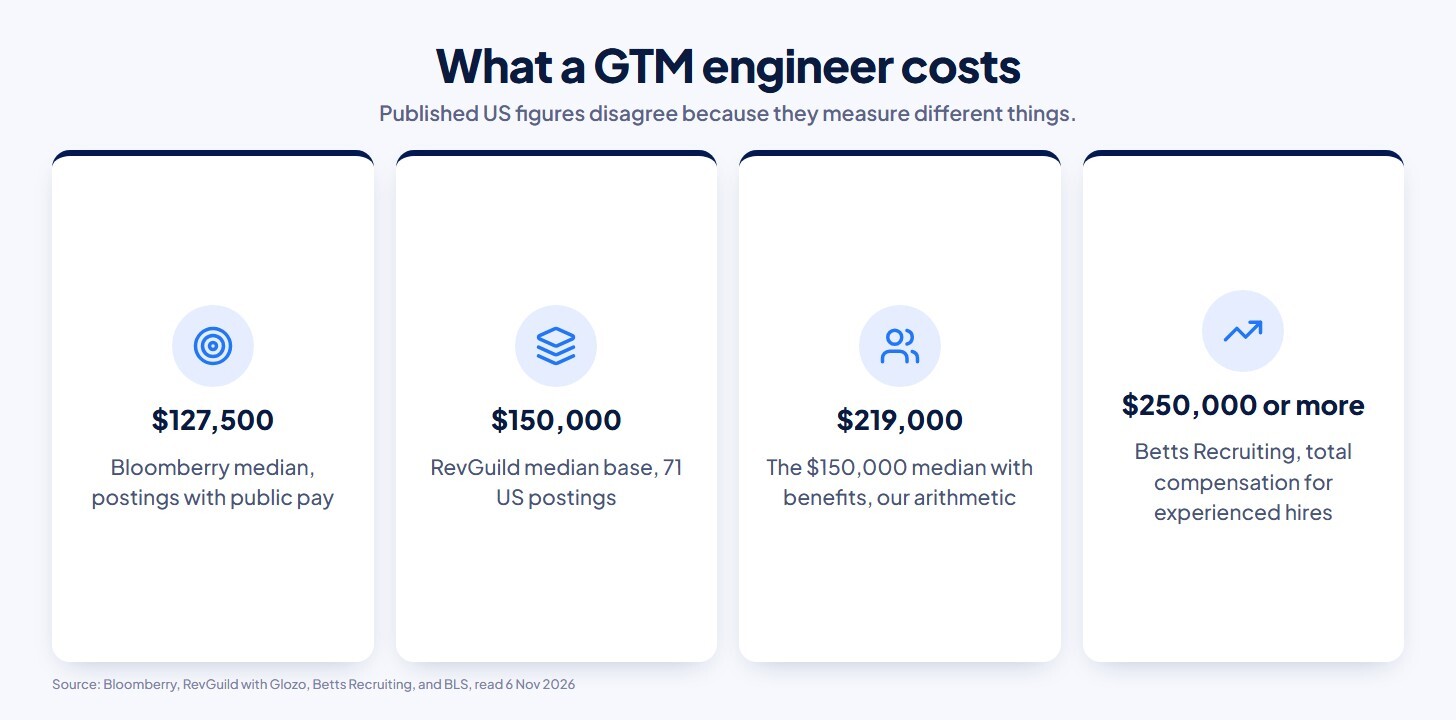
A GTM engineer in the United States costs about $150,000 in base salary at the median, based on RevGuild's 2026 report, or about $219,000 a year with benefits by our arithmetic. Published medians run from $127,500 to $150,000, and experienced hires at funded companies can reach $250,000 or more in total pay.
There's no federal wage category for this title yet, so all of these numbers come from job postings or recruiters. They disagree because they measure different things.
| Source | What it measured | Figure |
|---|---|---|
| Bloomberry, updated Jan 2026 | Postings with public pay, from a set of 1,000 | $127,500 median |
| RevGuild with Glozo, Aug 2026 | 71 US postings with disclosed base pay, June 2025 to June 2026 | $150,000 median, $82,500 to $210,000 full range |
| Betts Recruiting, Dec 2025 | Recruiter's view of experienced hires | $175,000 to $250,000 or more, total compensation |
Sources read 6 Nov 2026. RevGuild's sample is 71 postings with disclosed pay, and it warns against reading the seniority and regional splits as exact. Its pay figures exclude commission and total compensation.
Salary isn't the full bill. The Bureau of Labor Statistics reports for June 2026 that wages are 68.5% of total compensation for private-industry management and professional jobs. Dividing by that share turns the $150,000 median into about $219,000 a year, or about $18,200 a month, and turns $127,500 into about $186,000. Those two conversions are ours, and they don't include tools.
Tools come next. Clay's pricing page, read on 6 Nov 2026, showed paid plans from under $200 to under $500 a month before its custom enterprise tier, and a typical stack adds a CRM, a sending tool, and data sources on top. Check current prices, because this market moves quickly and the page itself showed different figures in different places.
The market for the role is growing from a small base. RevGuild counted 14 US postings in June 2025 and 129 in June 2026. Bloomberry reported postings for GTM engineer and RevOps roles combined up 205% for January through September 2025 against the same months of 2024. Clay says about 100 listings go live each month. Those counts come from different methods, so don't add them up. The practical point for a buyer is simple. The title is three years old, so nobody has a long track record under it, and you should judge candidates on what they've built.
Should you hire a GTM engineer before you fix your go-to-market?
You shouldn't hire a GTM engineer before you fix your go-to-market. Hire one after your buyer, message, and sales process work by hand, because automation multiplies whatever already exists. If replies are low and deals are unpredictable today, the role produces the same results at higher volume and cost.
The vendors who sell into this role say much the same thing, which is worth noticing. ZoomInfo's guide says "Not every team needs a dedicated GTM engineer" and warns that automation built on bad data produces bad results at scale. Betts Recruiting says companies typically consider the hire once they've established product-market fit and are ready to ramp up systematic outbound.
The trouble is the order in which small companies buy things. A founder sees a competitor's clever outbound, buys Clay, connects HubSpot, and spends a quarter on tables. The tools are good. The question they can't answer is who to sell to and why that person should care. That's what we mean by tools before strategy, and it's the most common sequencing mistake we see at companies under 50 people.
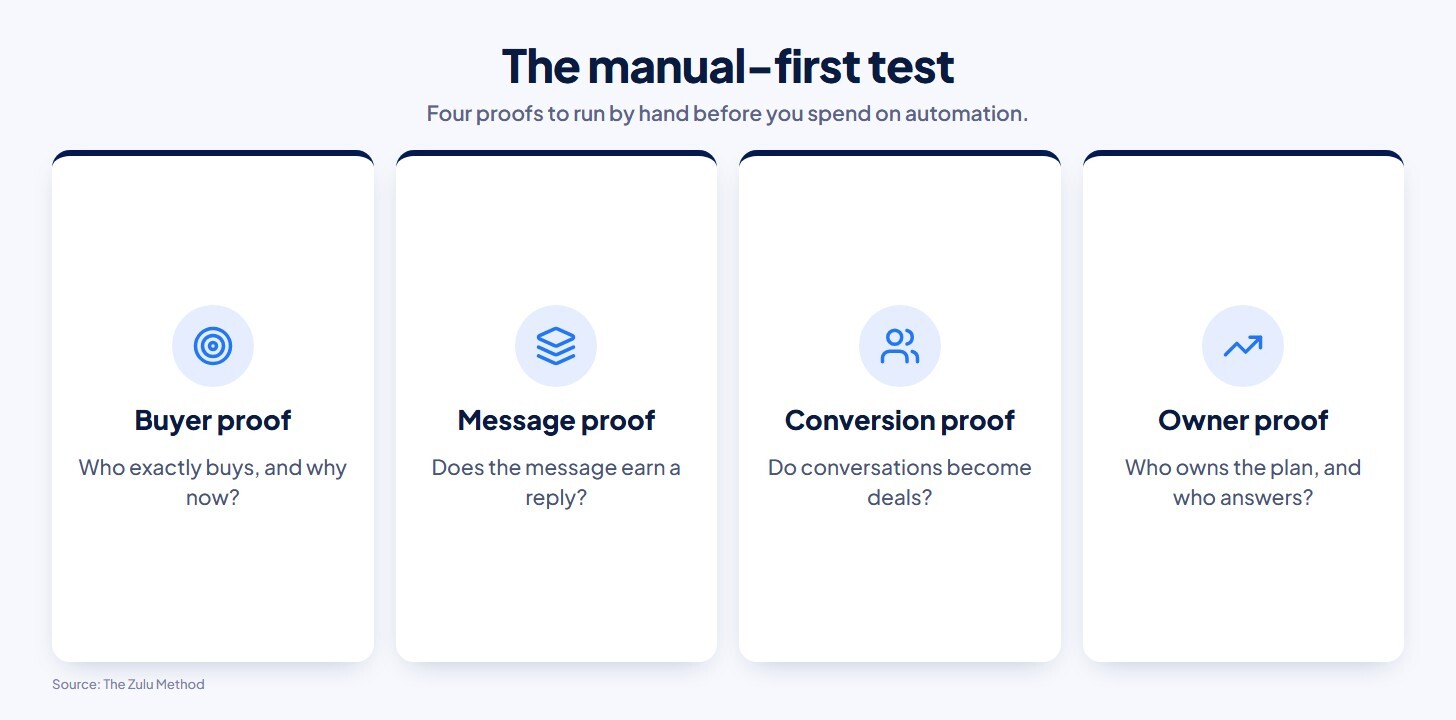
The manual-first test
The manual-first test is four proofs you can run by hand in a few weeks, before you spend on automation. Each one comes from our experience, so adjust the thresholds to your deal size.
| Proof | The question | How to run it by hand | You've passed when |
|---|---|---|---|
| Buyer proof | Who exactly buys, and why now? | Write the buyer in one sentence, then build a list of 100 accounts yourself | Two people on your team would build the same list |
| Message proof | Does the message earn a reply? | Send 50 to 100 notes yourself, one at a time | Real conversations start, and you can say which line caused them |
| Conversion proof | Do conversations become deals? | Review your last 10 wins and last 10 losses | You know your close rate and your sales cycle |
| Owner proof | Who owns the plan, and who answers? | Put a name on strategy and a name on every new lead | Leads get a reply within hours, and one person owns the target |
Source: The Zulu Method's manual-first test, 6 Nov 2026.
If you pass all four, a GTM engineer may be a strong hire, because now they've got something to scale. If you've passed two, spend the next 60 days on the other two. The steps below show how.
A Worked Example
A vendor's report, and its limit. Clay says the GTM engineers at Verkada have a charter of automating 80% of SDR workflows so reps can book four times the meetings, at 80 to 100 per rep a month. That's a vendor's account of a company with a sales team and a motion already in place.
What should you fix first, and in what order?
Fix your go-to-market in this order: choose the buyer, write the message, test it by hand, define the pipeline stages, and only then add tools. By our estimate, a founder working part time needs about 90 days. The tools come last because each one depends on decisions made in the earlier steps.
The bigger framework sits in our post on the six go-to-market decisions and your first 30 days. Here's how the 90 days look with automation in its right place.
- Days 0 to 30: decide, and test by hand. Name the buyer, write a positioning statement, and send the first 50 to 100 notes yourself. Use a spreadsheet. You'll learn more from reading replies than from any dashboard.
- Days 31 to 60: add structure. Set up a simple five-stage pipeline board and weekly numbers, clean the CRM, and agree what "qualified" means. Set up email authentication on a sending domain that's separate from your main one, so testing doesn't touch your day-to-day mail.
- Days 61 to 90: automate one step. Pick the task you've done by hand at least 50 times, usually research or list building, and automate only that. Compare the results against your hand-sent batch.
- After day 90: decide on the hire. Count the hours your team spends on repeatable system work each week. If that number could fill a job, write the job. If it's five hours, a contractor or a part-time specialist will do.
Why volume raises the stakes on email
Automation also changes what a mistake costs. Hand-sent email that misses stays small. Google's sender guidelines tell senders to keep their reported spam rate below 0.30% and recommend staying below 0.10%, and senders of 5,000 or more messages a day to Gmail accounts must also set up SPF, DKIM, and DMARC authentication and support one-click unsubscribe on marketing messages. An untested message sent at volume can push you past those lines quickly, and if you're sending from your main domain, the damage lands on the address your customers receive mail from. It's one more reason to prove the message at 50 before you send 5,000.
Do it yourself with Clay and HubSpot, or hire a go-to-market agency?
Do it yourself with Clay and HubSpot if a technical founder or teammate has the hours and your go-to-market already works by hand. Hire a go-to-market agency if the strategy itself needs building or you need several channels running this quarter. Neither choice helps if nobody owns the plan.
That's a fair comparison, and doing it yourself is often the right answer. These tools are good, the documentation is public, and you'll understand your own data better for having built it. Here's how the options compare.
| Option | Best when | What it won't do |
|---|---|---|
| Do it yourself | You've got a builder on the team, one market, and time to learn | Give you a second opinion on the strategy |
| Contractor or Clay specialist | You know what to build, and it's a defined project | Decide what to build, or maintain it afterward unless you keep paying |
| Full-time GTM engineer | You've passed the manual-first test and system work fills a job | Choose your market, or write your positioning |
| Go-to-market agency | You need strategy and execution at once | Stay inexpensive, and every agency differs on who does the work |
| Head of marketing first | Strategy has no owner, and you want it in-house | Deliver pipeline in the first few months, by our estimate of a head of marketing's first year |
Source: Our experience, 6 Nov 2026. For price ranges, see our marketing agency pricing benchmarks.
A few rules of thumb from what we've seen. Don't hire anyone for this if you've got fewer than a handful of paying customers, because the founder's own selling is the research you need. Don't buy the tools before you've got a list you built by hand. And don't treat a tool purchase as a strategy decision, even when the demo is impressive. If you have no marketing person at all, read how to get pipeline with no marketing team, and if you're a founder who's still doing all the selling, this guide to founder-led sales covers when and how to hand it off.
If you're comparing outside firms, this review of go-to-market agencies for startups shows how different the models are, and the overview for startups gives the wider picture for early-stage companies.
How do you hire a GTM engineer when you're ready?
Hire a GTM engineer by writing the job around one measurable system, testing candidates with a small paid build, and giving them a named owner for strategy. Look for someone who's half commercial thinker and half builder. Experience with your specific tools matters less than proof they've moved a pipeline number.
Clay describes the best candidates as "half commercial thinker, half builder" and suggests assessing them with a business problem investigation, a systems sketch, and a mini build challenge. ZoomInfo, citing Norwest, describes three profiles, which helps when you're writing the ad.
- The Builder is technical-first, comfortable in SQL and Python, and builds custom integrations when no-code tools fall short. ZoomInfo says it suits companies building their first revenue infrastructure.
- The Operator is RevOps-adjacent and fluent in no-code and low-code tools. ZoomInfo says it suits companies with clean data that need workflows built on top of it.
- The Strategist is commercial-first and designs hypotheses about which signals predict revenue. ZoomInfo says it suits later-stage companies that need strategic direction as well as execution.
Whichever profile you choose, ask each candidate to show one system they built, the number it moved, and what they'd do differently. Ask what they turned off. In our experience, good operators can name something they turned off. And give them a first-90-days brief with one system to ship, one baseline to beat, and one person to report results to.
Questions to ask yourself
- Could two people on my team write the same one-sentence description of our buyer?
- Which message has earned real replies when a person sent it by hand?
- Do I know my close rate and sales cycle from the last 20 deals?
- How many hours a week of repeatable system work do we have today?
- Who owns the plan that this person would be automating?
Your next step is free and takes an afternoon. Open a blank spreadsheet, write your buyer in one sentence at the top, and build a list of 25 accounts by hand. Then write one message and send it to five of them today. Whatever you learn from those five replies, or from the silence, is the input a GTM engineer would need from you anyway. Keep going until you've passed the four proofs, and then decide whether the work you've been doing by hand is big enough to be somebody's job.

Questions & Answers
Does a startup need a GTM engineer?Most early startups don't need a full-time GTM engineer. The role pays off once a company has a repeatable sales process and enough system work to fill a job. Before then, the founder's own selling teaches more than automation does, and a contractor can handle the occasional build at a fraction of the commitment.
Does the GTM engineer I hire need to know how to code?A GTM engineer doesn't always need to code. Clay says coding isn't necessarily required, and Bloomberry found SQL and Python each in 38% of postings, which means most postings didn't ask for them. Complex data work and custom integrations still call for real engineering skill.
Can a GTM engineer replace a salesperson?A GTM engineer doesn't replace sales development reps, according to RevPartners, a firm that sells this work. The role automates research, list building, and routing so reps spend more time in conversations. Clay's example from Verkada describes reps booking more meetings, which is a change in what reps do, with reps still in the seat.
Is a GTM engineer worth hiring, or is the title a fad?The title is new, and the work is not. Automating sales and marketing systems has existed under names like marketing operations and RevOps for years, and Bloomberry found the jobs nearly identical to RevOps engineering. Postings have grown fast from a small base, so the work looks durable even if the title changes. The hire is worth it once your buyer, message, and sales process already work by hand.
Who should a GTM engineer report to?Clay says most companies place a GTM engineer inside RevOps first. In our experience, at a small company the role should report to whoever owns the pipeline target. The rule that matters is that strategy has a named owner who isn't the GTM engineer.
What tools does a GTM engineer use?GTM engineers most often use Clay, HubSpot, Outreach, Salesforce, and Zapier, according to Bloomberry's review of 1,000 postings, with Apollo and n8n also common. A small company rarely needs all of them. Start with a CRM and a spreadsheet, then add a tool only when a task you've done by hand has proved worth repeating.