
Hannon Brett | Published on: November 18, 2026 | Time to read: 19 min | Updated on: November 18, 2026
To choose a marketing agency, define the one result you need, shortlist three agencies that have delivered it, ask each who will do the work after the sales call, meet those people before you sign, check a reference, and keep ownership of your own accounts and data. The Zulu Method calls this the who-does-the-work test.
The person who sells you an agency's services is often not the person who does the work, and that's a normal way to run an agency. It only becomes a problem when you find out after you've signed. The Zulu Method's who-does-the-work test gives owners and founders with no marketing leader nine questions that bring the staffing into the open before the contract. If nobody on your team leads marketing, also ask who will own the pipeline number across every channel, because an agency often reports only on the channel it runs. This guide also covers when not to hire an agency at all, which is sometimes the right call.
Key Takeaways
- The most useful way to choose a marketing agency is to find out who will do the work after the sales call, by name, before you sign.
- In Setup's sixth survey, 48% of clients named dissatisfaction with delivery as the top reason they ended an agency relationship, while agencies ranked that reason seventh.
- Junior staff, freelancers, and white-label partners can all do good work, so the test is whether the agency tells you who's involved.
- Google says no one can guarantee a #1 ranking, and it also says you're responsible for the actions of any companies you hire.
- Create your own ad and analytics accounts, keep an admin login, and have a lawyer check who owns the work, because paying for it doesn't settle ownership.
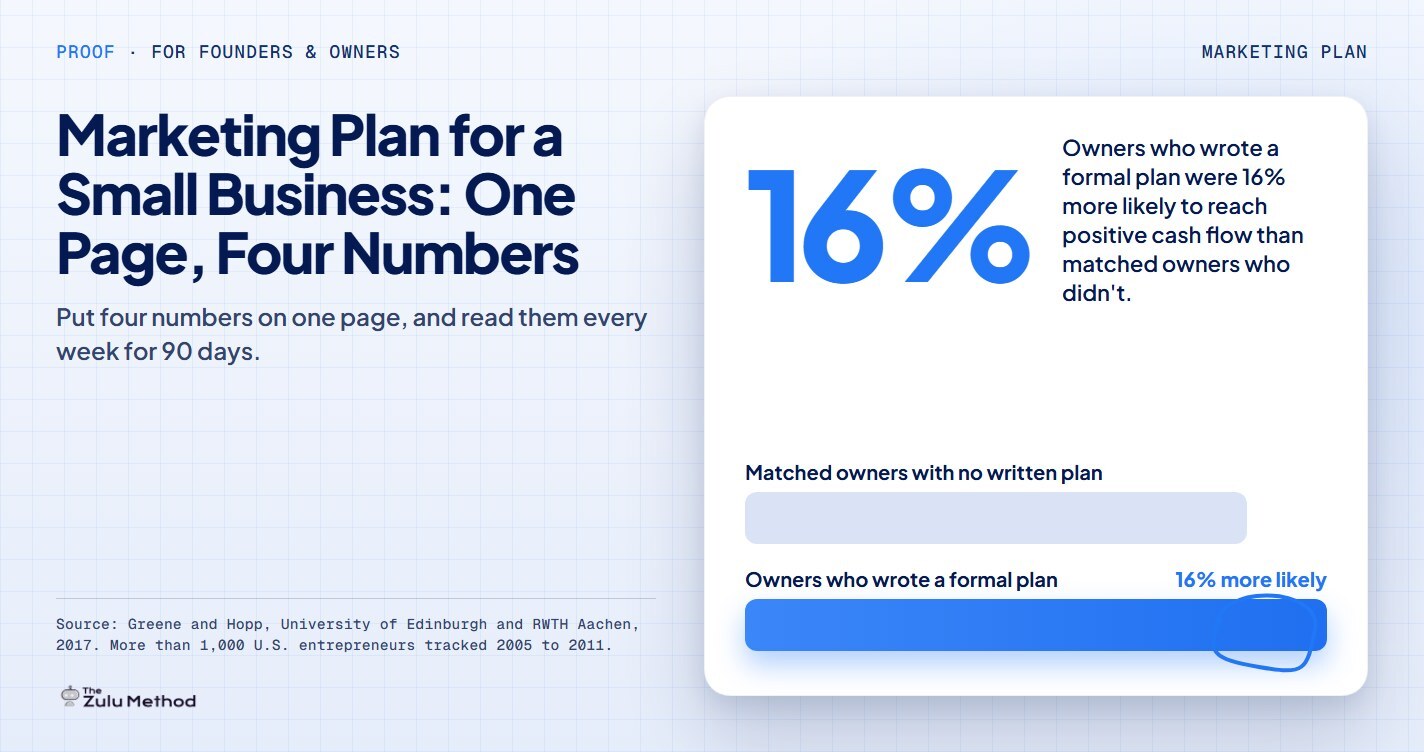
- An owner who can't yet say what a customer is worth should write a one-page plan before hiring anyone.
Table of Contents
- How do I choose a marketing agency?
- What should a family-owned or owner-led business that has never done marketing look for in a marketing agency?
- What are the 9 questions to ask a marketing agency before you sign?
- AI-native marketing agency vs traditional agency: what is the difference?
- What are the red flags when hiring a marketing agency?
- What should a marketing agency contract include?
- How do I run a marketing agency search in 30 days?
- Questions & Answers
How do I choose a marketing agency?
To choose a marketing agency, define the one result you need, shortlist three agencies that have produced it for companies like yours, then ask each one who will do the work after the sales call. Meet those people before you sign, check a reference, and make sure you keep your accounts and your data.
Most buying guides stop at portfolios and awards. Those tell you what an agency has done. They don't tell you what will happen to your account in week six. In our experience, disappointment often starts around week six. At The Zulu Method, we call the fix the who-does-the-work test: before you compare prices or case studies, get the names of the people who'll touch your account, and find out how much of their week you'll get.
There's data behind that focus. Setup, a consultancy that surveys marketers and agencies, asked both sides why relationships end. In its sixth annual survey, released in late 2024 with more than 400 contributions, 48% of clients named dissatisfaction with delivery as the top reason. Agencies ranked that same reason seventh.
| Rank | Why clients say they left | Why agencies think clients left |
|---|---|---|
| 1 | Dissatisfaction with delivery (48%) | Change in the client team's leadership |
| 2 | Agency did not understand our business | Client budget cuts |
| 3 | Dissatisfaction with strategic approach | Change in the agency's personnel |
| 4 | Dissatisfaction with value | Agency did not challenge the client enough |
| 5 | Change in my team's leadership | Client dissatisfaction with the relationship |
Source: Setup, sixth Marketing Relationship Survey, released late 2024, read 6 Nov 2026. This is Setup's own survey, run by a company that matches brands with agencies, and its list of reasons gives a percentage only for the top one. Setup's text says strategic approach and value tie for second, so treat ranks 3 and 4 as approximate.
The picture from the agency side deserves a fair hearing too. The ANA and 4A's reported in 2025 that average client-agency tenure is about 7 years, more than double the 3.2 years of 2016. That study is not about small companies, so don't expect it to describe a small company's retainer. It does show that long relationships are common.
In our experience, owners tell a sharper version of the delivery complaint, and it usually centers on the handoff between sales and delivery. The box below shows the general pattern.
A Worked Example
An illustrative composite, not a specific agency: the agency's most senior people run the pitch. After the sale, the account goes to a junior specialist who's also handling many other clients, and the owner rarely hears from the people who sold the work. Not every agency works this way, and plenty of owners have good experiences. The useful part is the question it raises: could you have found this out before you signed? You could have, by asking.
What should a family-owned or owner-led business that has never done marketing look for in a marketing agency?
A family-owned or owner-led business that has never done marketing should look for an agency that starts with a plan, assigns one senior person the owner can reach, explains its work in plain English, and offers a short first term. Channel skill matters less at this stage than judgment about what to do first.
If you've built a company on relationships and referrals, a typical agency pitch can feel like a foreign language. That's a reasonable reaction, and it's useful. An agency that can't explain its plan to you in plain English won't be able to explain its results either.
Three traits matter most for a first-time buyer.
- Curiosity about your business. A good first meeting has more questions than slides. Listen for questions about your margin, your best customers, and how your team follows up on a lead. "Agency did not understand our business" is near the top of Setup's list for a reason.
- Willingness to say what comes first. A first-time buyer needs priorities. Be wary of a proposal that starts six channels at once.
- A plan you could run without them. You should own the strategy, the accounts, and the numbers from the first month, so your options stay open.
When you shouldn't hire an agency yet
An agency is the wrong purchase in several common situations, and a good agency will tell you so.
- You can't say what a customer is worth. Spend two hours on a one-page marketing plan first. You'll brief any agency better, and you may find you can run the first steps yourself.
- The budget can't cover fees and the work. Add the agency's fee to any ad spend, then compare the total with what your margin supports.
- Nobody follows up on leads. More leads won't help if they sit in an inbox. Fix the follow-up first.
- You need direction more than hands. A senior adviser costs less than a team, so read what a marketing consultant does before you buy execution.
- The work fills a full week and won't end. A hire may suit you better, and the comparison of a first marketing hire with an agency walks through that choice. It also helps to know what a head of marketing does, because no agency fully replaces that role.
What are the 9 questions to ask a marketing agency before you sign?
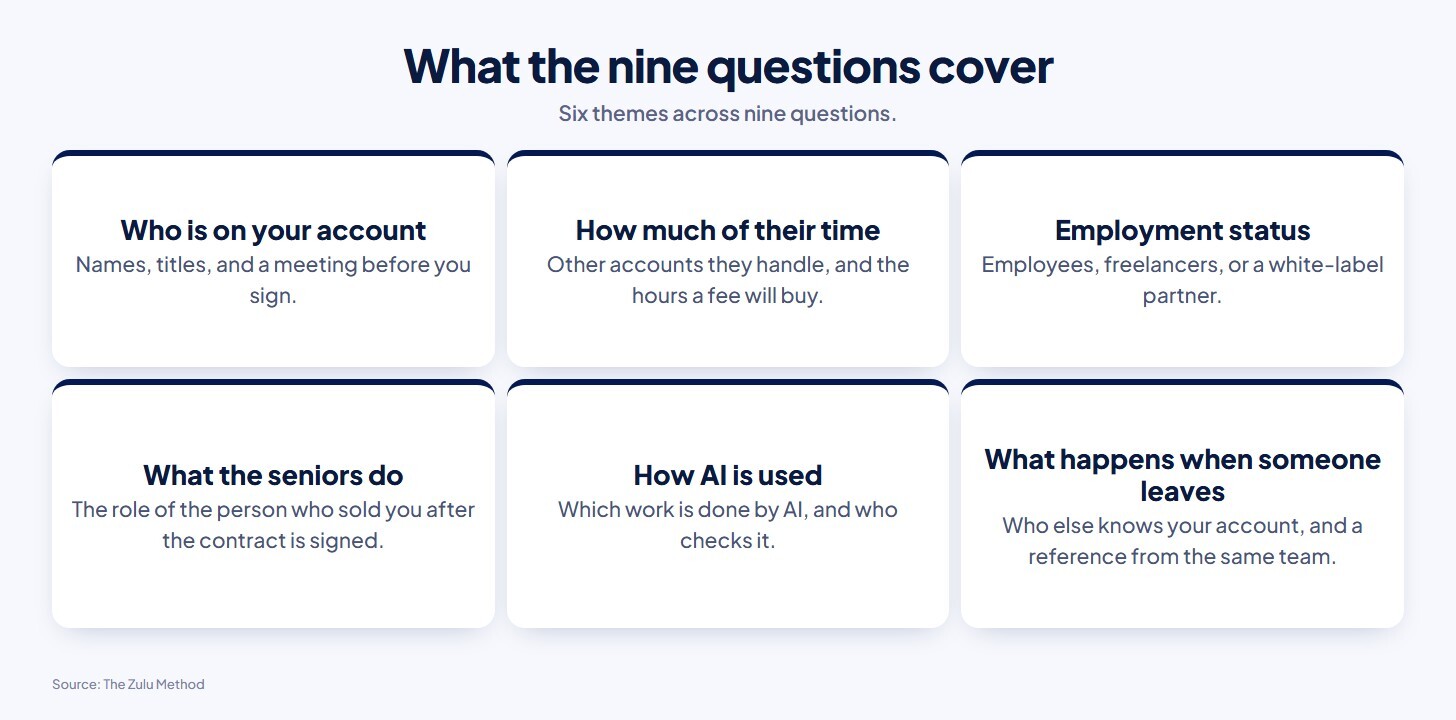
The nine questions to ask a marketing agency before you sign all concern who does the work: who is on your account, how much of their time you'll get, what their employment status is, what the seniors do after the sale, how AI is used, and what happens when someone leaves. Each has an answer you can check.
Ask them in the last meeting before the proposal, and ask for the answers in writing. No single answer settles it. You're listening for specifics, because a team that plans its staffing can answer on the spot.
1. Who, by name, will work on my account each week?
A good answer gives you names, titles, and each person's job on your account. "Our team" is where to press. If the agency can't name people until you sign, ask for the most likely names and for the seniority it's committing to.
2. Can I meet those people before I sign?
The ANA and 4A's guidance for agency searches says that each review phase should expand the interaction between client and agency teams. That guidance was written for large reviews, and it holds at any size. A 20-minute call with your day-to-day person will tell you more than another deck.
3. How many other accounts does that person handle?
There's no published standard for this, so ask, and then do the division. A specialist on 15 accounts has less than three hours a week for each one, assuming a 40-hour week and no meetings. That could be fine for a small, stable account. It won't be fine for a launch.
4. How many hours a month does my fee buy, and from whom?
Some agencies sell outcomes instead of hours, and that's a legitimate model. Even so, ask for a rough split of the effort by role. You're checking whether the senior time in the pitch shows up in the plan.
5. Are those people employees, freelancers, or a white-label partner?
All three can do excellent work. Plenty of strong agencies use trusted specialists, and it's how a small shop gives you skills it can't keep on payroll. What matters is whether you're told. Ask who employs each person, where the work is done, and whether anyone outside the agency will touch your accounts or data.
6. What does the person who sold me do after the contract is signed?
A good answer sounds like this: "I'm in your monthly review, and I own the strategy." Or it's an honest "I hand you to Dana, and here's why she's good at this." Both work. Trouble comes when the pitch suggests one thing and the staffing plan says another.
7. Which parts of the work are done by AI, and who checks them?
Expect AI in the workflow, and that's fine. Ask what's drafted by a tool, who reviews it, and what you'd see if you compared the first draft with the final one. The person who checks the work is the one accountable for it.
8. What happens if my main person leaves?
"Change in the agency's personnel" appears on both lists in Setup's survey. People leave every agency, so judge the plan for it: who else knows your account, where the notes live, and how quickly you'll meet the replacement. Ask for the right to approve the replacement, or to leave if you can't.
9. Can I talk to a client served by this same team?
Agencies offer their happiest references, so ask for one whose work was done by the people you just met. If you can, also ask to speak with a client who has left. Some agencies will say yes, and how a relationship ended tells you a lot about how the agency behaves.
Questions to ask yourself
- Which of these nine answers did I get in writing?
- Do I know the name of the person doing the work each week?
- Did the agency ask about my margin and my sales follow-up?
- Would I be comfortable if the most senior person in the pitch never spoke to me again?
- Have I done my part, with a clear brief and one decision-maker on our side?
That last question is fair to ask. Agencies do better work for clients who answer quickly, share real numbers, and give honest feedback early. On Setup's survey, agencies listed client leadership changes and budget cuts as top reasons relationships end, and they're right that those are out of their hands.
AI-native marketing agency vs traditional agency: what is the difference?
An AI-native marketing agency builds its delivery around AI tools with a small senior team, while a traditional agency builds delivery around staff hours across roles. The real difference for a buyer is who does the work and who checks it, so ask both types the same nine questions and judge the answers.
The label is easy to claim and hard to verify. In the 2026 CMO Survey, marketing leaders said their companies use generative AI in marketing activities a mean of 22.42% of the time. The Census Bureau put AI use across U.S. businesses at 19.8% as of May 2026. AI use is spreading across businesses, so a firm saying it uses AI tells you little. How the work is reviewed tells you more. If you're choosing an agency specifically for its AI work, we've covered that narrower decision in how to choose an AI marketing agency.
Agency type matters less than fit, and each type has a real strength. Here's a plain comparison.
| Type | Good fit when | Who usually does the work | What to check |
|---|---|---|---|
| Full-service agency | You need several channels run together and have the budget for it. | Account managers plus specialists by channel. | How much of the fee goes to coordination. |
| Specialist agency, such as SEO or paid media | You know which channel you need and have a plan. | Channel specialists, often deep in one skill. | Who connects their work to your sales results. |
| Boutique agency | You want senior attention and a small team. | Often the founder and a few senior people. | What happens if one person is out, and how much they can take on. |
| AI-native agency | You want speed and a small senior team using automation. | A few people directing AI tools. | Who reviews the output, and whether it sounds like your company. |
| Traditional agency | You value a deep bench and established process. | Teams across account, creative, and media roles. | Where the seniors spend their time after the pitch. |
| Freelancer | You have a defined task and can manage the work. | The person you hired. | You supply the strategy and the backup. |
Source: our judgment. Individual firms vary, which is why the nine questions matter more than the label.
Size isn't a verdict either. Some owners prefer very small shops because the seller also does the work. That's a real advantage, and it comes with a real risk: one illness or one resignation can stop your program. Larger firms offer depth and backup, and the handoff is where you'll need to look harder.
You may also be wondering about price. For market ranges by agency type, see our marketing agency pricing benchmarks. As one outside reference, SparkToro's State of Digital Agencies survey, published in January 2026, found 86% of agencies reporting an average monthly retainer of up to $10,000. Its respondents lean toward agencies of 1 to 50 people.
What are the red flags when hiring a marketing agency?
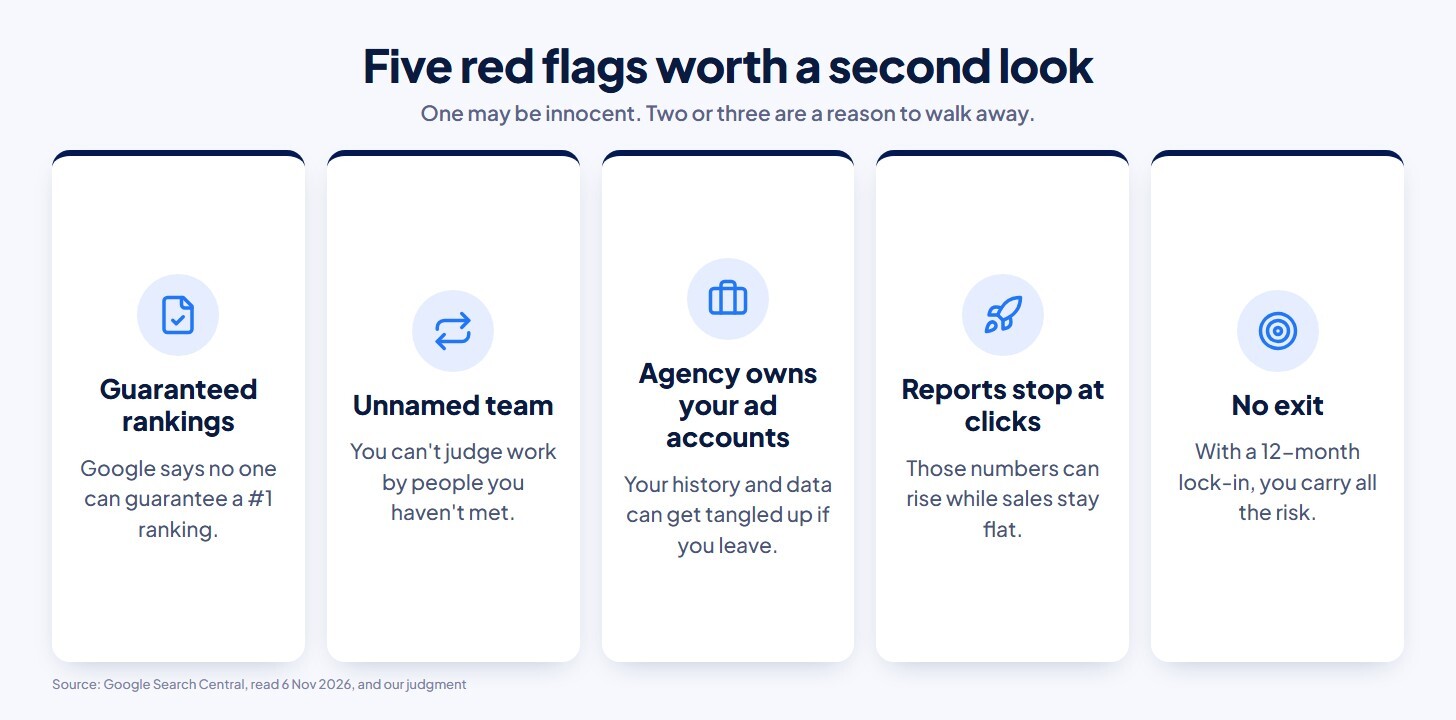
The biggest red flags when hiring a marketing agency are guaranteed rankings or results, a team nobody will name, ad accounts held in the agency's name, reports that stop at clicks, and a long contract with no exit. One flag alone may have an innocent explanation, so ask, but two or three together are a reason to walk away.
| Red flag | Why it matters | What to ask instead |
|---|---|---|
| A promise of the top spot on Google | Google says no one can guarantee a #1 ranking, and it tells you to find someone else if a provider promises first place. | What results do you expect, in what timeframe, and how will you measure them? |
| The team stays unnamed until you sign | You can't judge work by people you haven't met. | Who is the likely team, and what seniority will you commit to in writing? |
| The agency will own your ad accounts | Your history and data can get tangled up if you leave. | Can we create the accounts and give you access? |
| Reports stop at clicks and impressions | Those numbers can rise while sales stay flat. | Can you report on qualified leads and closed customers, using our data? |
| Offers of reviews or followers | The FTC's 2024 rule bans fake reviews, including AI-generated ones, and restricts buying fake social influence. | How do you earn real reviews from real customers? |
| A 12-month lock-in with no exit | You carry all the risk before anyone has proved anything. | What's the first term, and what's the notice period? |
| Nobody asks about your business | A pitch with no questions is a pitch for someone else. | What would you need to know to tell us not to hire you? |
Source: linked sources where shown, otherwise our judgment.
The legal point deserves a second look, because you stay on the hook. Google says you are responsible for the actions of any companies you hire. The FTC says the same about email: hiring another company to send it doesn't transfer your legal responsibility. An agency's shortcut can become your legal problem.
A word on what isn't a red flag. Junior staff on your account are normal, and they're part of how an agency keeps its fee affordable. Monthly minimums are normal. So is an agency declining to guarantee results, since it doesn't control your sales team, your price, or your market. An honest "we can't promise that" should raise your opinion of them.
What should a marketing agency contract include?
A marketing agency contract should name the people and the deliverables, state who owns the work and the accounts, set a short first term with a clear notice period, and define how results are reported. Those four terms protect you more than any discount, and a good agency won't object to them.
We aren't lawyers, so have yours read the agreement. Here are the items to raise.
- Ownership of the work. Don't assume paying for it means you own it. The U.S. Copyright Office explains that a commissioned work counts as a work made for hire only if it falls within one of nine categories and both the commissioning company and the creator sign a written agreement saying so. Much marketing work may fall outside those categories, so ask your lawyer about a written assignment of rights that also covers any freelancers the agency uses.
- Ownership of accounts. Create your own ad, analytics, and website accounts, then invite the agency. Google's help pages show why this matters: you can only grant access levels up to your own, so an owner without admin rights has to ask someone else for changes. Keep at least one admin login at your company.
- The people. Name the key people in the agreement, and add your right to leave if they're replaced without your approval.
- Term and exit. A first term of about 90 days is a sensible ask, followed by a 30-day notice period. That's our view, and agencies with long setup work may fairly want more.
- Money. Separate the agency's fee from any ad spend, and ask whether the agency marks up media or tools.
- Reporting. State which numbers you'll see, how often, and from which system.
The CMO Survey gives a useful reference for how much work can sit outside a company. Marketing leaders reported that external agencies and partners perform a mean of 33.59% of their digital marketing activities, with a median of 25%. Even those larger companies keep most of the work in-house. In our experience, a small company outsources more, which makes it more important to hold the accounts and numbers yourself.
How do I run a marketing agency search in 30 days?
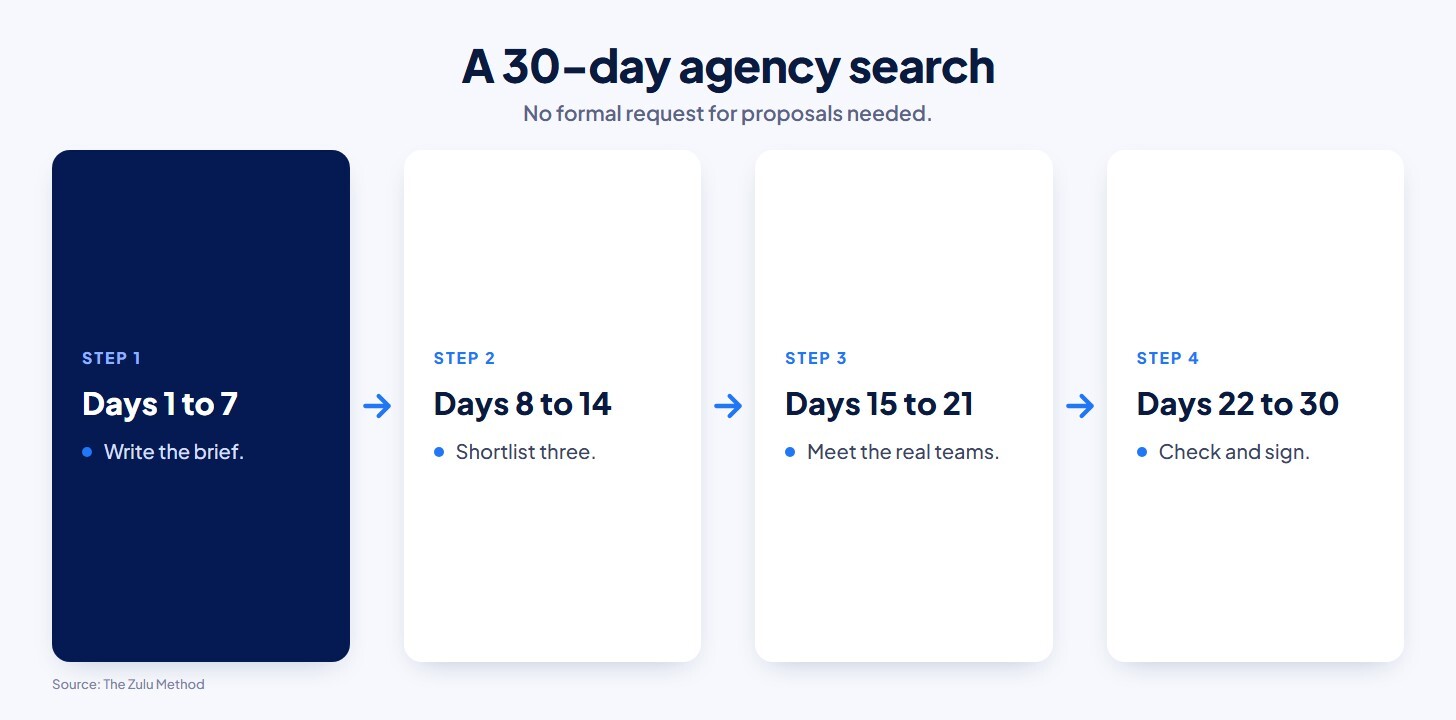
To run a marketing agency search in 30 days, write a one-page brief in week one, shortlist three agencies in week two, hold working meetings with the real teams in week three, and check references and contract terms in week four. A small company doesn't need a formal request for proposals to do this well.
The ANA and 4A's advise that every phase of a review needs a brief for the agency. A one-page version is enough at your size.
- Days 1 to 7: write the brief. Put your goal, budget range, best customers, and customer value on one page. Say what you've tried. Name the one person at your company who'll make the decision.
- Days 8 to 14: shortlist three. Ask peers in your industry first, then look at who's done similar work. If you ask an AI tool, treat the answer as a starting list only.
- Days 15 to 21: meet the real teams. Send the brief, then hold one working meeting with each agency, with the day-to-day people in the room. Ask the nine questions. Skip the free strategy test, since unpaid work rarely shows what paid work will look like.
- Days 22 to 30: check and sign. Call two references, including one from the same team. Have your lawyer read the contract. Tell the agencies you didn't pick, and thank them.
Then set up the first 90 days so you'll know early whether you chose well. By day 30, you should have full access to every account and a written plan. By day 60, the work should be live and the reports should use your numbers. By day 90, you should be able to name the person who did the work and say what it produced. If you're ever unsure how things are going, the 20-minute audit for judging a current agency gives you a way to score it.
Your next step needs no agency at all. Write down the one result you want in the next 90 days and what a new customer is worth to you. Then copy the nine questions above into an email draft, and send it to the first agency you talk to before the call.

Questions & Answers
What is the average cost of a marketing agency?Costs vary widely by type and scope. SparkToro's State of Digital Agencies survey, published in January 2026, found 86% of agencies reporting an average monthly retainer of up to $10,000, and 49% reporting $1,000 to $5,000. Those respondents lean toward agencies of 1 to 50 people, so expect larger firms to charge more.
Should a small company use one agency for everything or a different agency for each channel?Start with who will own the pipeline number. A specialist agency runs one channel well and reports on that channel, so someone on your side has to connect its work to sales. If nobody can do that, ask each agency who owns that job, and get the answer in writing.
How many marketing agencies should I talk to?Three is enough for most small companies. Fewer gives you little to compare, and more eats weeks of an owner's time. Ask each one the same questions from the same brief so you're comparing like with like. That number is our judgment, and a quick referral from a trusted peer can shorten the list.
Is a small agency better than a large one?Neither is better in general. A small agency usually gives you more senior attention, and the person who sells the work often does the work. A large agency gives you more depth and backup. Decide by asking who'll be on your account and what happens when that person is out or leaves.
How long should I give a marketing agency to show results?Agree on this before you sign, because it depends on the channel and your sales cycle. Paid ads can show early signals in weeks, while search work takes longer. Set a 90-day review for leading numbers such as qualified leads, and judge closed customers against your normal sales cycle. That timing is our view.
Should I issue a request for proposals to choose an agency?A small company usually doesn't need one. A formal request for proposals takes weeks and rewards polished documents. A one-page brief and one working meeting with each of three agencies will tell you more. Large brands run formal reviews because many people must agree, and that's rarely your situation.
Can I hire an agency if I've never done marketing?Yes, and many owners do. Look for an agency that starts with a plan, explains its work in plain English, assigns one senior contact, and accepts a short first term. Before you hire, work out what a new customer is worth to you, because that number shapes every decision the agency makes.