
Hannon Brett | Published on: November 19, 2026 | Time to read: 18 min | Updated on: November 19, 2026
A go-to-market strategy for startups is six decisions on one page: who buys first, what you tell them, what you charge, how the sale happens, where buyers find you, and which numbers you read weekly. A founder with no marketing leader can make all six in 30 days with about 10 hours a week.
Most go-to-market guides assume you have a marketing leader to hand them to. If you're a founder without one, the plan is yours to write, and it's shorter than you'd think. The Zulu Method's one-page plan reduces a go-to-market strategy for startups to six decisions, each with an owner and a test for when it's done. This guide walks through the six go-to-market decisions, gives you a week-by-week plan for your first 30 days, and says plainly when you should do this yourself and when you shouldn't.
Key Takeaways
- A go-to-market strategy for a startup is six decisions: market, message, offer, motion, channels, and measures.
- Founders with no marketing leader should make all six decisions personally until they've closed about ten customers on purpose.
- Your first market should be small enough that you can write down 50 company names.
- The first 30 days run in four steps: talk to buyers, write the message and offer, choose the motion and channels, and run the plan on 50 companies.
- Nobody builds a finished marketing function in 30 days, so judge each option by what exists on day 30 and who runs it on day 31.
- A company with revenue that redoes its go-to-market should start with evidence from the last 20 deals.
Table of Contents
- What is a go-to-market strategy for a startup?
- What are the six decisions in a go-to-market strategy?
- How do I build a go-to-market strategy for a small company with no marketing team?
- What should you do in your first 30 days?
- Who can build my marketing in 30 days?
- What changes when a company with revenue redoes its go-to-market?
- How do you know your go-to-market strategy is working?
- Questions & Answers
What is a go-to-market strategy for a startup?
A go-to-market strategy for a startup is the set of decisions that says who you'll sell to first, what you'll tell them, what you'll charge, how the sale will happen, where buyers will find you, and which numbers prove it's working. It covers one product or one market, and it fits on one page.
Stripe's guide for startups, updated in March 2026, draws a useful line here. A go-to-market strategy shares some similarities with a business plan, but it "focuses on launching a single product or entering one new market." A business plan explains the company. A marketing plan lists activities for a period. The go-to-market strategy sits between them and answers a narrower question: how does this product reach this buyer?
Why bother writing it down? CB Insights' March 2026 analysis of 431 venture-backed shutdowns found that 70% ran out of capital, which it calls the final cause and not the root problem. Poor product-market fit showed up in 43%. The sample is venture-backed companies, and many cited several causes, so don't read it as a clean ranking. It shows the costly mistake: spending before you know who buys and why.
When is it too early for a go-to-market strategy?
A go-to-market strategy is premature if you haven't talked to at least ten potential buyers. Our experience is that a plan written before those conversations is a list of guesses, so talk first and write second. It's also the wrong tool if you need a company strategy, a fundraising story, or a channel tactic. Founders at Series A deciding between product-led and sales-led growth should read this Series A go-to-market playbook instead. This guide is for the founder with little or no marketing help and a first 30 days to plan.
What are the six decisions in a go-to-market strategy?
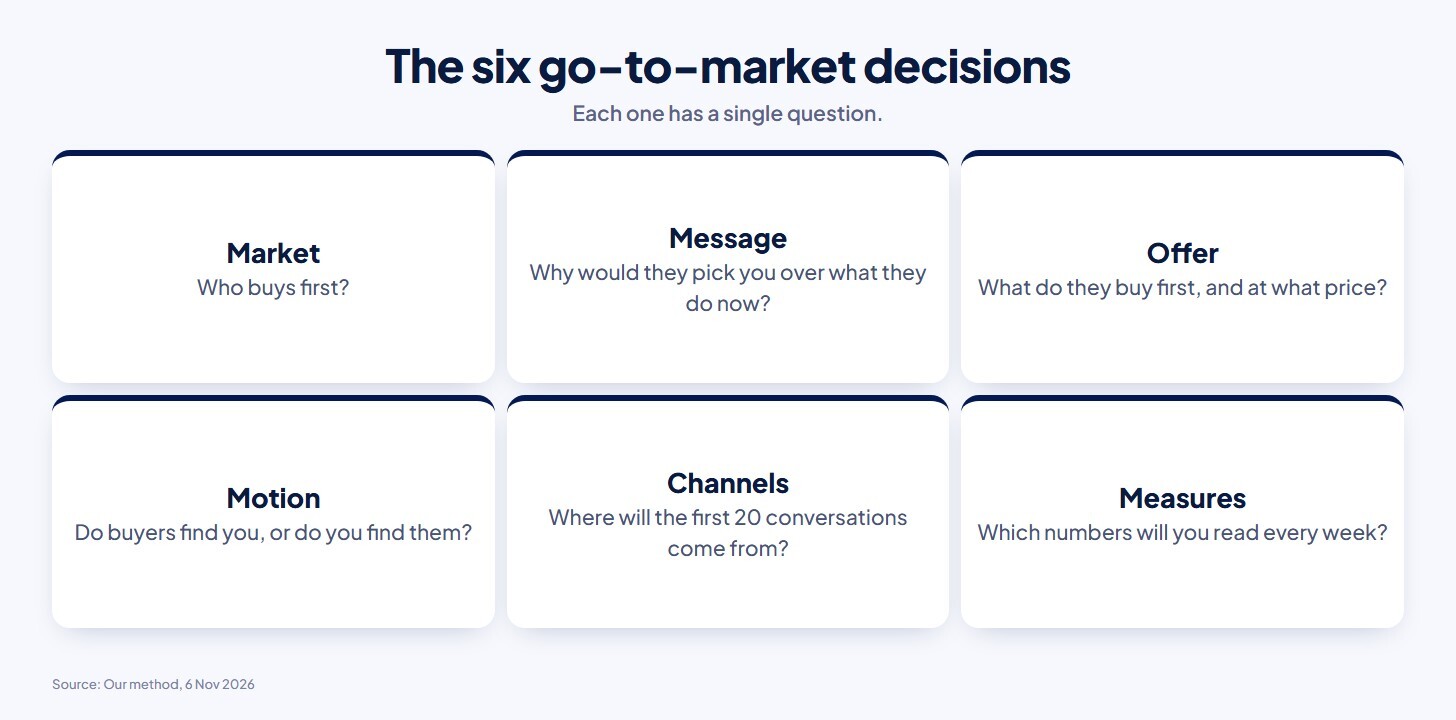
The six go-to-market decisions are market (who buys first), message (why they pick you), offer (what they buy and at what price), motion (how the sale happens), channels (where buyers find you), and measures (which numbers you read weekly). Each one has a single question, a single owner, and a test for when it's done. In our experience, founders often make two or three of them by instinct and leave the rest unwritten.
The Zulu Method's one-page plan puts all six in the table below. The hours are our estimates for a founder with no marketing leader, so adjust them for your company.
| Decision | The question | Who owns it | Founder time (our estimate) | Done when |
|---|---|---|---|---|
| 1. Market | Who buys first? | Founder | 8 to 12 hours | You have 50 named target companies |
| 2. Message | Why would they pick you over what they do now? | Founder, with whoever sells | 4 to 6 hours | Three buyers repeat it back correctly |
| 3. Offer | What do they buy first, and at what price? | Founder | 3 to 5 hours | A buyer has heard the price without you apologizing for it |
| 4. Motion | Do buyers find you, or do you find them? | Founder or first seller | 2 to 3 hours | You can draw the sale from first touch to signature |
| 5. Channels | Where will the first 20 conversations come from? | One named person per channel | 2 to 3 hours | One main channel and one backup have weekly targets |
| 6. Measures | Which numbers will you read every week? | Founder | 1 to 2 hours | Three numbers and a review date are on the calendar |
Source: Our method, 6 Nov 2026. Hours are estimates, not a published benchmark.
Decision 1: Who is your first market?
Your first market is the smallest group of companies you can name, reach, and win quickly. Paul Graham's 2013 essay "Do Things That Don't Scale" makes the case: "It's always worth asking if there's a subset of the market in which you can get a critical mass of users quickly."
Founders resist this because a small market feels like a small company. Treat it as a first step you can finish. Here's a test we like: try to write 50 company names on a page. If you can't, the segment is still an idea and needs a tighter definition. Then ask whether those 50 share a problem, have budget for it, and talk to one another. Companies in the same industry group refer each other, and that's free distribution.
Decision 2: What's your message?
Your message is one sentence that says who you serve, the alternative you replace, and why you're the better choice. April Dunford's starting question is "What would a customer do if your offering didn't exist?" For an early startup, the honest answer is usually a spreadsheet, a part-time person, or nothing. Your first job is to beat that. We've written out ten positioning statement examples with a fill-in template, so use that guide for this step.
Decision 3: What's your first offer?
Your first offer is the smallest paid thing a buyer can say yes to, with a real price attached. A paid yes teaches you more than ten compliments. Lenny Rachitsky's 2023 guide to B2B product-market fit puts it as a step of its own: get one company to pay a meaningful amount of money for your product. In the same guide, Gong's co-founder says 11 of its 12 design partners chose to buy once the beta ended.
On price, one starting point comes from Kevin Hale's 2019 Y Combinator talk: set the price at about a tenth of the value the customer gets, then raise it until you start losing deals. His rule was to keep going until you're losing 20% of customers. Treat those numbers as a software founder's rule of thumb. A services startup should price from delivery cost and margin first.
Decision 4: What's your sales motion?
Your sales motion is the path a buyer takes from first contact to signature, and it's set by your price, your market size, and how complicated the product is. Mark Leslie, the founding CEO of Veritas, gave First Round a clear test in 2017: "If you're marketing-intensive, the product is bought. If it's sales-intensive, the product is sold." His practical question is "Is it easier for them to find you or for you to find them?"
A Worked Example
A real case: Veritas. In First Round's account, Veritas had about 100 potential customers, so it went to industry shows and sought out buyers instead of advertising. The market size made the decision. With 100 possible buyers, it was easier for the company to find them. The same article warns that hiring a high-touch, expensive sales force to sell a low-priced product "can be a game-ender."
At the start, the motion is usually you. Founders should sell the first deals themselves, because nobody else can change the product, the price, and the pitch in the same meeting. When that stops being the right use of your week, this guide to founder-led sales and the 90-day hand-off covers what comes next.
Decision 5: Which channels come first?
Your first channels should be the one or two places where your named buyers already are, chosen for speed to a conversation and not for long-term reach. Rachitsky's 2020 study of how fast-growing B2B companies found their first ten customers came down to three sources: your personal network, the places your customers already are, and press. His 2023 follow-up adds that cold outbound works when it's done creatively.
Graham's version is blunter: "You can't wait for users to come to you. You have to go out and get them." That's why paid ads and search content usually come later for a startup with no brand. They're fine channels, and they take longer to read. Owner-led companies with years of referrals face a different choice, and the four-source map of referrals, outbound, content, and paid shows how the options compare.
Decision 6: What will you measure?
You should measure three numbers each week at this stage: new conversations, qualified opportunities, and closed revenue. Add a date when you'll review whether the plan is working. More numbers than that creates reporting work and no extra decisions. A one-page plan built around four numbers shows how an owner would run the same habit, and this guide to a pipeline board and weekly numbers covers the mechanics.
How do I build a go-to-market strategy for a small company with no marketing team?
To build a go-to-market strategy for a small company with no marketing team, have the founder make all six decisions personally, assign one named person to each channel, and buy skills by the task instead of by the title. At this stage the decisions matter more than the headcount, and those decisions can't be delegated yet.
You're in common company. Marketing Dive's January 2026 report on Spencer Stuart's analysis of S&P 500 companies says 31% have no CMO at all. Those are public companies with a different structure, so the number won't tell you what to do. It does show that the seat being empty isn't unusual, even at the top of the market.
Here's how the work divides when there's nobody with marketing in their title:
- The founder keeps the decisions. Market, message, offer, and motion stay with you until you've closed at least ten customers on purpose. Persona's founder told Rachitsky that closing more than 10 customers is the only really meaningful measure of product-market fit. That's one founder's view, and it's a useful bar.
- One named person runs each channel. That could be you, a co-founder, a salesperson, or a contractor. Two owners means no owner.
- Specialist work gets bought by the task. A freelance designer, a copywriter, or a list builder can do a defined job well. Give them a finished decision and they'll move fast. Ask them to make the decision and you'll get a guess.
- Tools come last. A spreadsheet or a basic CRM is enough for your first 50 accounts. If you're being sold on automation and enrichment tools, read whether a GTM engineer makes sense before you fix the plan.
- One hour a week is protected. Read the three numbers, look at what buyers said, and change one thing.
The options when you need more than this are laid out in how to get pipeline with no marketing team.
What should you do in your first 30 days?
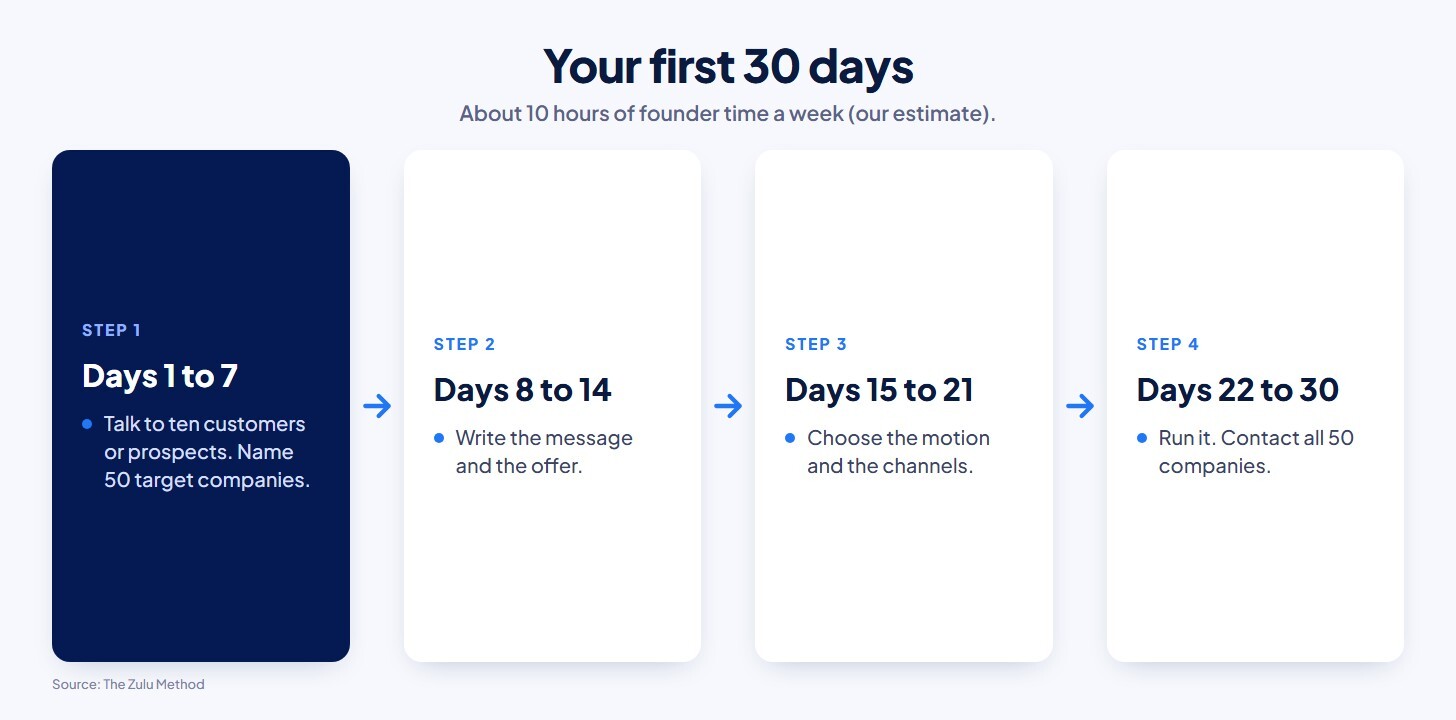
In your first 30 days, spend week one talking to buyers, week two writing your message and offer, week three choosing your motion and channels, and week four running the plan on 50 named companies. By day 30 you should have a one-page plan and real conversations on the calendar.
Plan on about 10 hours of founder time a week. That's our estimate, and it assumes the product exists and someone can demo it. Here's the sequence.
- Days 1 to 7: decide who buys first. Talk to ten customers or prospects. Ask what they use today, what it costs them, and who else was involved the last time they tried to fix it. Write down their exact words. Finish the week with 50 named target companies and a reason each one belongs on the list.
- Days 8 to 14: write the message and the offer. Draft the one-sentence position, then say it out loud to three of the people you spoke with. Set a first price, and put a one-page offer in writing. If you have customers, ask what they'd have done without you.
- Days 15 to 21: choose the motion and the channels. Draw the sale on one page, from first touch to signature. Pick one main channel and one backup. Set up a CRM or a spreadsheet with a handful of stages. Write the first outreach, and name who sends it.
- Days 22 to 30: run it. Contact all 50 companies, with the founder's name on the outreach. Log every reply and every objection. On day 30, read your three numbers and rewrite the page with what you learned.
Then keep going, because the next 60 days show whether the plan works.
- Days 31 to 60: Repeat the outreach on a second batch of companies. Rewrite the message around the objections you keep hearing. Close a first paid customer or pilot if your sales cycle allows it.
- Days 61 to 90: Keep the channel that produced conversations and drop the one that didn't. Decide what to hand to someone else. Write the next 90 days using real numbers.
How fast should this produce revenue? It depends on your sales cycle, and anyone who promises a date without knowing that is guessing. A solo founder should expect conversations by day 30 and judge pipeline after day 60.
Who can build my marketing in 30 days?
A founder, a marketing consultant, an agency, or an outsourced marketing team can each build a plan and a first working version in 30 days, as long as someone makes decisions quickly. Nobody builds a finished marketing function in that time. The honest question is what you'll have on day 30, and who keeps running it on day 31.
| Option | What you'd have on day 30 | Best fit | Watch for |
|---|---|---|---|
| Founder alone | A one-page plan, 50 named accounts, and first conversations | Pre-revenue or early revenue, with time to learn | Other company work pulling you away |
| Freelancers | Finished pieces, such as a site, a list, or copy | You've made the six decisions and need hands | Nobody owning the whole plan |
| Marketing consultant | A strategy and a plan, usually without the build | You have people to carry it out | A plan with no one to run it |
| Agency | One or more channels running | The strategy is settled and you need a channel run well | Who does the work after the sale |
| Outsourced marketing team | Strategy plus a build across several channels | You have budget and no marketing leader | Whether a senior person stays on the account |
| Full-time head of marketing | Usually a hire still in progress | You've proven the motion and want to own it long term | Time to recruit and ramp |
A full-time hire is the slowest route to a first campaign and the best route to long-term ownership. We estimate 6 to 9 months from starting the search to a marketing hire producing results. That's our estimate and we haven't found a published study of it. This comparison of a first marketing hire against an agency runs the cost and speed side by side.
Doing it yourself is often the right answer. If you have fewer than ten customers and you've never sold this product, keep the work in-house until you know what's true. Any outside team would be guessing with your money.
What changes when a company with revenue redoes its go-to-market?
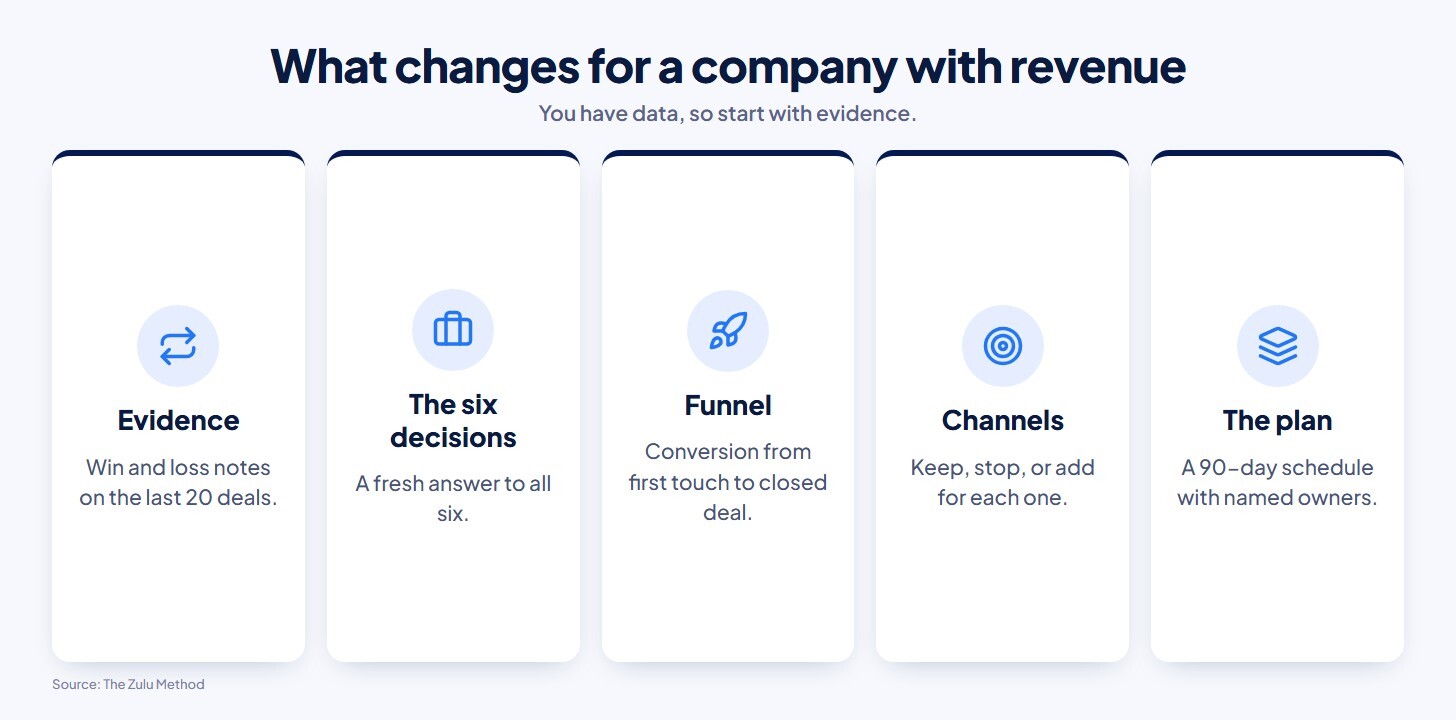
A company with revenue that redoes its go-to-market should gather buyer evidence, give a fresh answer to all six decisions, review its funnel, make a keep-or-stop call on every channel, and write a 90-day plan with named owners. The goal is a more predictable way to grow the revenue it already has.
This work differs from a first go-to-market plan in one important way: you have data. Here's what a thorough pass covers, whoever does it:
- Evidence. Win and loss notes on the last 20 deals, plus five to ten customer interviews.
- Market. Which segments have paid well and stayed, and which ones should you stop chasing?
- Message. A new position and the wording to carry it across the site, the deck, and sales calls.
- Offer. A review of pricing, packaging, and the first thing a buyer purchases.
- Funnel. Conversion from first touch to closed deal, how fast leads get a reply, and where deals go quiet.
- Channels. Keep, stop, or add for each one, using cost and closed revenue rather than clicks.
- Sales support. Call plans, proposal templates, and follow-up steps that match the new message.
- Tools. The CRM stages and reporting needed to read the numbers every week.
- The plan. A 90-day schedule, with one owner and one number for each line.
The work takes longer when partners disagree or the data lives in people's heads. It shouldn't include a new logo or a tool migration before the decisions are made. Both feel productive, and neither answers who buys and why.
Questions to ask yourself
- Could I name 50 companies that should buy from us this quarter?
- When we lose, what do buyers do instead?
- Which of the six decisions have I never written down?
- Who owns each channel by name?
- Which three numbers would I read if I had only ten minutes a week?
How do you know your go-to-market strategy is working?
Your go-to-market strategy is working when replies and meetings come from the buyers you named, the same reasons to buy keep showing up, and deals move without you pushing each one. Early on, read conversations and objections. After about day 60, read pipeline and closed revenue.
Read different signals at different stages. All of these thresholds are our rules of thumb, except where a source is linked.
| Checkpoint | Good sign | Change something if |
|---|---|---|
| Day 30 | Replies from the named list, with buyers using your problem language | Nobody replies, which usually points to the market or the message |
| Day 60 | Qualified opportunities and at least one buyer asking about price | Meetings happen but nobody moves, which usually points to the offer |
| Day 90 | A first paid deal or pilot, and one channel you'd repeat | Deals only close when the founder is in the room and you want that to change |
| Later | A shift from push to pull, as Rachitsky describes it, with referrals and inbound starting on their own | Growth depends entirely on your personal outreach |
One outside test is worth knowing. Superhuman's founder told First Round in 2018 how the team used Sean Ellis's survey question, which asks users how they'd feel if they could no longer use the product. Ellis's benchmark is 40% answering "very disappointed." Superhuman started at 22% and used the answers to decide what to build. A low score is useful information. It tells you to narrow the market or change the product before spending more on channels.
Which mistakes cost founders the most?
- Serving everyone at launch. A broad market gives you nothing to write on the list of 50.
- Hiring a seller before you can sell. A salesperson can repeat a working pitch. Inventing the pitch is founder work.
- Copying a famous company's playbook. A plan that worked at a later stage assumes a brand you don't have yet. These go-to-market strategy examples show what real companies did at the start, and how different those starts were.
- Running six channels at low effort. You'll learn nothing from any of them. Two channels with weekly targets teach you more.
- Changing everything at once. Change one decision at a time, or you won't know what worked.
Your next step needs an hour and a blank page. Write the six decisions down the left side and answer each one in a sentence. Circle the answers you made up without talking to a buyer. Those circles are your calendar for next week: book ten conversations, and start with the first one on the list.

Questions & Answers
How long does it take to build a go-to-market strategy?A founder can write a usable go-to-market strategy in about 30 days at roughly 10 hours a week, in our estimate. Most of that time goes to talking with buyers. The document itself takes an afternoon. A plan written faster than that usually skips the conversations, which are the part that makes it accurate.
What's the difference between a go-to-market strategy and a marketing plan?A go-to-market strategy decides who you'll sell to, why they'd buy, how the sale happens, and where buyers come from. A marketing plan schedules the activities that carry out those decisions over a set period. Write the strategy first. A marketing plan without one is a calendar of activities with no agreed target.
Can a founder do go-to-market without hiring anyone?Yes, a founder can run early go-to-market alone, and it's often the right choice before the first ten customers. You'll learn the objections and the buyer's language directly. Bring in help when the decisions are made and the work to carry them out takes more hours than you have each week.
How much should a startup spend on go-to-market?An early startup should spend time before money. The first 30 days of go-to-market work need little beyond founder hours, a basic CRM, and a list of accounts. Increase spending once a channel has produced qualified conversations you can repeat. For funded SaaS companies, budget benchmarks by funding stage give a more precise starting point.
When should a startup update its go-to-market strategy?Review your go-to-market strategy every 90 days and after any major change, such as a new product, a new segment, or a shift in who's buying. Between reviews, change one decision at a time so you can tell what worked. If replies dry up, check the market and the message first.
Do services startups need a different go-to-market strategy?Services startups make the same six decisions with different weights. The buyer is judging the people as much as the offer, so proof, referrals, and the founder's reputation count for more. Pricing starts from delivery cost and margin. Capacity also limits growth, so the first market should fit the number of clients you can serve well.