
Hannon Brett | Published on: November 11, 2026 | Time to read: 21 min | Updated on: November 11, 2026
A positioning statement is a one or two sentence internal summary of who you serve, what they need, your category, your main benefit, and how you differ from their next best option. A full example: For [buyer] who [need], [Company] is a [category] that [benefit]. Unlike [alternative], we [difference].
Examples from consumer brands with national budgets don't help a 40-person contractor or a founder selling a first software product. This guide writes out ten for B2B and owner-led companies, in full, with a template and before and after rewrites. At The Zulu Method, we start positioning with one question, what would this buyer do without you, and we call that order the alternative-first method. You'll see why the order matters, and you'll be able to draft your own statement by the end.
Key Takeaways
- A positioning statement is a one or two sentence internal summary of your buyer, their need, your category, your main benefit, and your difference from their next best option.
- The ten examples in this guide are illustrative, and each one names a narrow buyer, a real trigger, and an alternative the buyer would recognize.
- Write the alternative first, because the most common competitor is often a spreadsheet, an in-house habit, or a decision to do nothing.
- A strong statement passes the swap test, which means a competitor's name can't be dropped in and still read as true.
- Giving up some buyers is the point of positioning, and you can still accept that work when it comes without building your message around it.
- Use the fill-in sentence to record your decision, and use your last ten wins and ten losses to make the decision.
Table of Contents
- What is a positioning statement?
- What should a positioning statement include?
- What are good positioning statement examples?
- How do I write a positioning statement?
- What does a weak positioning statement look like, before and after?
- How narrow should your positioning be?
- How do I know if my positioning statement is good?
- Questions & Answers
What is a positioning statement?
A positioning statement is a one or two sentence internal summary of who you serve, what they need, what category you compete in, what benefit you deliver, and why a buyer should pick you over the next best option. Your team uses it to make decisions. Most buyers never read it word for word.
A positioning statement isn't a tagline, and it doesn't belong on your homepage as written. It's the sentence behind the homepage, the sales deck, the proposal template, and the answer your newest employee gives at a trade show.
The word has a long history in business-to-business selling. Jack Trout published an article in Industrial Marketing in 1969 that described positioning as a game companies play in a crowded, me-too market, and he and Al Ries wrote about it again in Advertising Age in 1972, though scholars dispute who came up with the idea first. The statement format most people use today is widely attributed to Geoffrey Moore's 1991 book Crossing the Chasm.
Why does a positioning statement matter for a small company?
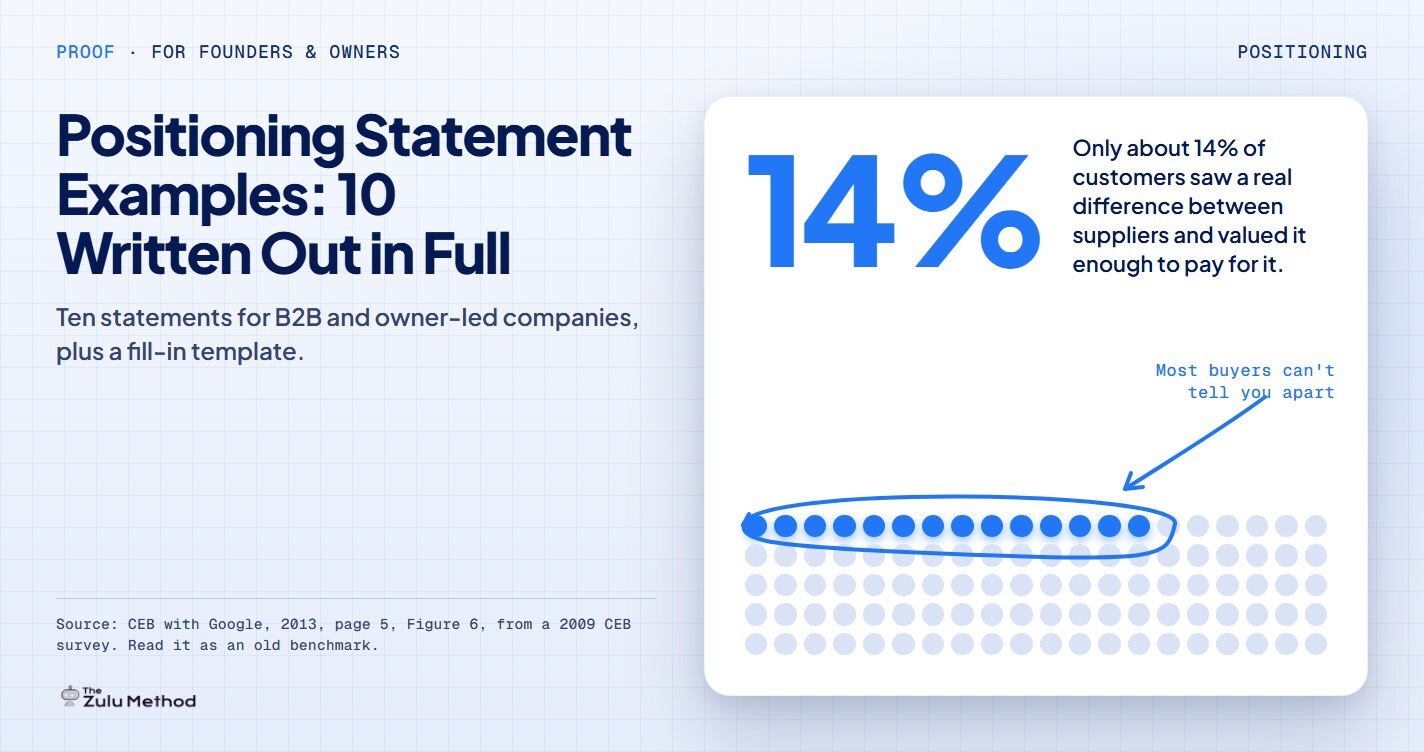
When the founder or owner is also the marketing department, a written statement is what lets a new hire or an agency describe the company the same way. A small company needs a positioning statement because buyers have trouble telling suppliers apart, and a sharp statement is how everyone in the company gives the same reason to pick you. A 2013 CEB paper written with Google reported that only about 14% of customers saw a real difference between suppliers and valued it enough to pay for it (page 5, Figure 6). That figure comes from a 2009 CEB survey, so read it as an old benchmark and not a current measurement.
The sentence also has to work when you're not there. Business purchases usually involve several people, and our guide to founder-led sales covers the research on how much of the decision happens before first contact. The lesson holds for a 30-person firm too: someone will describe you in a room you're not in, and they'll use whatever words you gave them.
Positioning statement vs. value proposition vs. tagline
A positioning statement is the internal decision, a value proposition is the promise a buyer reads, and a tagline is the short line people remember. The positioning statement comes first. The table compares five related items. It uses one company type we made up for this guide, a commercial cleaning firm, so its wording is illustrative.
| Item | Who reads it | What it does | Sample wording |
|---|---|---|---|
| Positioning statement | Your team | Records who you serve, against what, and why you win | For clinic managers who can't risk a failed inspection, [Company] is a medical-grade cleaning firm that keeps every room audit-ready. Unlike a general janitorial crew, we train each cleaner to infection control standards. |
| Value proposition | Buyers | States the outcome and the reason to believe it | Clinic cleaning that's built to pass inspection, with a logged checklist after every visit. |
| Tagline | The public | Gives people a short line to remember | Clinic clean, every visit. |
| Mission statement | Employees and the public | Says why the company exists | We make shared medical spaces safe for patients and staff. |
| Elevator pitch | A person you just met | Says the same thing in spoken words | We clean medical clinics, and our crews train to infection control standards, so you pass your audits. |
What should a positioning statement include?
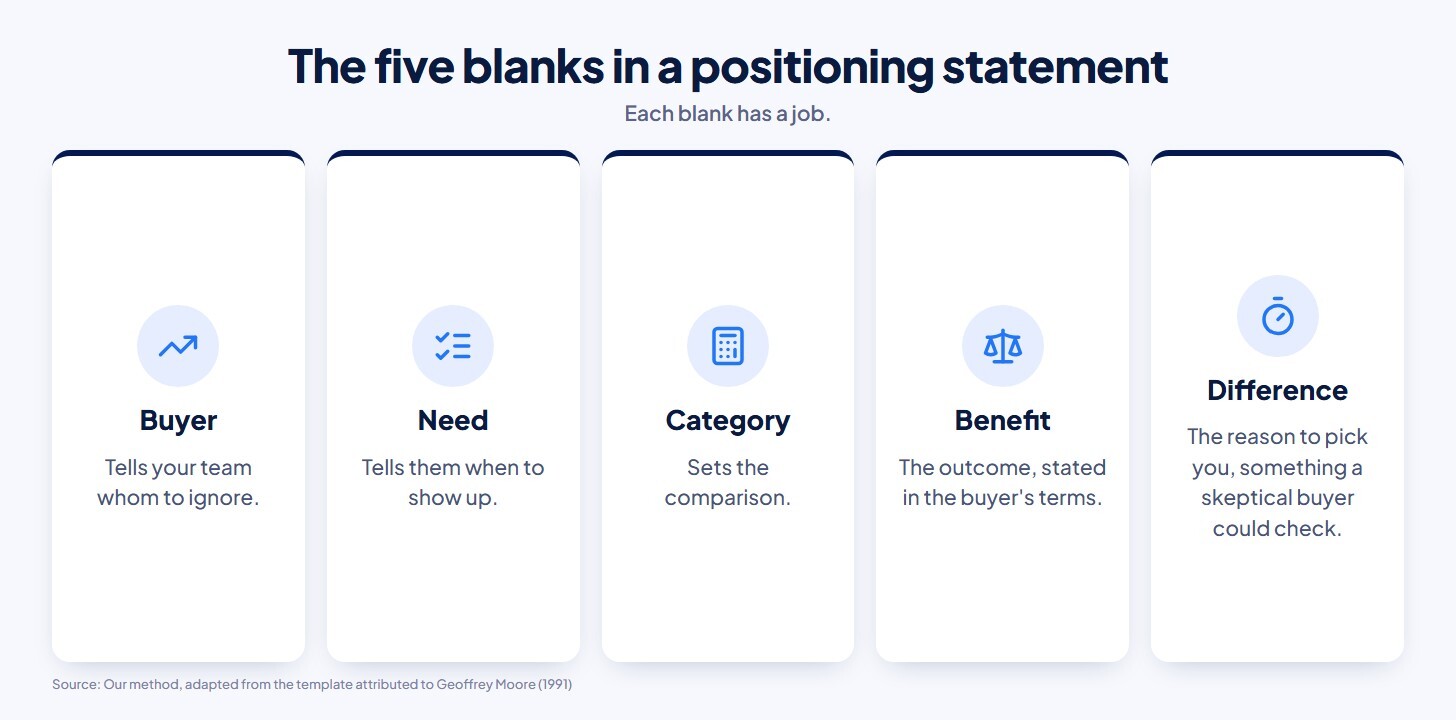
A positioning statement should include five things: a specific buyer, the need or trigger that sends that buyer shopping, the category you want to be judged in, the main benefit, and the difference from the buyer's next best option. Leave out any one of the five and the sentence stops helping anyone decide anything.
Here's the fill-in template, adapted from the version widely attributed to Moore:
For [specific buyer] who [need or trigger], [Company] is a [category] that [main benefit]. Unlike [next best option], we [difference you can prove].
Each blank has a job. The buyer blank tells your team whom to ignore. The need blank tells them when to show up. The category blank sets the comparison, because a buyer judges a "boutique consulting firm" against different things than a "managed services provider." The benefit is the outcome, stated in the buyer's terms. The difference is the reason to pick you, and it has to be something a skeptical buyer could check.
The next best option deserves the most thought. April Dunford, who teaches positioning to B2B companies, asks "What would a customer do if your offering didn't exist?" The honest answer is often another behavior and not another company. It could be a spreadsheet, an office manager doing it on the side, or doing nothing.
Dunford writes that in her enterprise software work, 20% to 30% of deals typically end in "no decision". Owner-led service firms lose deals the same way, in our experience, to the phrase "we'll keep doing what we're doing." If your statement names only rivals, it's silent on one of the most common ways you lose.
Which positioning sources should you use?
In our view, the Moore-style sentence is the clearest format for recording positioning, and Dunford's five components are the clearest order for deciding it. Use both. The sentence alone has a real weakness, and Dunford names it plainly: she calls it a fill-in-the-blanks exercise that "assumes that there is only one answer for each of the blanks." She's right. Most companies could fit several categories and serve several buyers, so picking among them is the work.
| Source | Date | What it gives you | Best use |
|---|---|---|---|
| Michael Porter, "What Is Strategy?" | Nov. 1996 | The rule that "the essence of strategy is choosing what not to do" | Deciding which buyers to give up |
| The template attributed to Geoffrey Moore | 1991 | A two-sentence format: for, who, is a, that, unlike | Recording the final decision |
| April Dunford's five components | March 2021 | Competitive alternatives, differentiated capabilities, value for customers, target customer segmentation, and market category | Working through the choices in order |
| Dunford in Lenny's Newsletter | March 2026 | A test for value: it should answer "Why pick us over the alternatives?" | Checking the benefit blank |
What are good positioning statement examples?
Good positioning statement examples name a narrow buyer, a real trigger, a category the buyer understands, a next best option the buyer would recognize, and a difference someone could verify. The ten statements below are illustrative. We wrote them for this guide using made-up company types, so none describes a real business, and every detail in them, including the numbers, is there to show the form.
The first seven fit owner-led companies. The last three fit startups. Replace [Company] with your name and read each one aloud.
1. Commercial HVAC service contractor (illustrative)
For facility managers at regional hospitals who can't afford a day without cooling, [Company] is a commercial HVAC service contractor that keeps critical systems running under one fixed annual contract. Unlike a low-bid repair call, we assign one technician team to each campus and send a written status report every Friday.
Why it works: The next best option is the low-bid repair call the buyer already makes, and the fixed contract and Friday report are differences a facility manager can check in the first month.
2. Family-owned commercial insurance brokerage (illustrative)
For owners of construction companies with 20 to 100 employees who've outgrown their personal agent, [Company] is a commercial insurance brokerage that lowers total risk cost year over year. Unlike an agent who shops the policy once at renewal, we review claims and job-site safety with you every quarter.
Why it works: "Outgrown their personal agent" is a trigger the owner feels. It also gives a referral source a clean way to describe who should call.
3. Managed IT provider (illustrative)
For dental groups with 3 to 15 offices who need HIPAA-ready systems without an IT department, [Company] is a managed IT provider that keeps every office online and audit-ready. Unlike a general IT shop, we work only with dental practices, so we already know your imaging and practice management software.
Why it works: Serving one vertical is the difference. The statement gives up every other buyer on purpose, which is Porter's point about choosing what not to do.
4. Boutique consulting firm (illustrative)
For second-generation owners of manufacturing companies who are preparing to hand off the business, [Company] is a succession consulting firm that gets the family, the managers, and the lender to one signed plan within 12 months. Unlike separate advice from an attorney, an accountant, and a business coach, we run all three workstreams on a single schedule.
Why it works: The alternative isn't a rival firm. It's the three advisers the owner already has, and the statement explains the gap between them.
5. Outsourced accounting firm (illustrative)
For owners of multi-location restaurant groups who get their numbers too late to act on them, [Company] is an outsourced accounting firm that closes the books by the fifth of every month. Unlike a tax-season CPA, we give you profit and loss by location while you can still change next month's schedule.
Why it works: The benefit is a date, and a date is hard to argue with.
6. Skilled-trades staffing agency (illustrative)
For plant managers at food processing facilities who lose production when a maintenance role sits open, [Company] is a skilled-trades staffing agency that fills maintenance technician roles within 10 business days. Unlike a general staffing firm, every one of our recruiters has worked in a plant, so candidates arrive screened on the equipment you run.
Why it works: The difference explains why the benefit is believable. Many statements claim speed, and few say what makes the speed possible.
7. Contract machine shop (illustrative)
For engineering leads at medical device startups who need prototype parts before a design review, [Company] is a contract machine shop that ships first articles with inspection reports in 10 business days. Unlike an online quoting marketplace, you talk to the machinist who's cutting your part.
Why it works: It names a modern alternative, and it turns a small-company trait, direct access, into the reason to buy.
8. Early-stage compliance software (illustrative)
For safety managers at US trucking fleets with fewer than 200 trucks who keep driver files in spreadsheets, [Company] is driver compliance software that keeps every file audit-ready. Unlike a spreadsheet and a shared drive, we flag each expiring document 60 days ahead and assign it to a person.
Why it works: A startup's main rival is usually the status quo. This statement competes with the spreadsheet and doesn't mention larger vendors the buyer has never considered.
9. Vertical software for property managers (illustrative)
For regional property managers with 500 to 5,000 units who spend their days chasing maintenance requests, [Company] is maintenance coordination software that closes work orders faster with the vendors you already use. Unlike the maintenance module in a property management suite, we text residents and vendors directly, so nobody has to log in.
Why it works: It compares itself with a feature instead of a company, and it claims a narrow category the company can lead.
10. AI startup selling to finance teams (illustrative)
For finance leads at professional services firms with 50 to 500 people who reconcile the month by hand, [Company] is an AI reconciliation tool that cuts the month-end close by a week. Unlike hiring another staff accountant, it's running by next month and every match it makes is logged for your auditor.
Why it works: The next best option is a hire, which is how the buyer budgets for the problem. "AI" appears in the category, and the difference answers the buyer's real worry, which is whether the work can be audited.
How do I write a positioning statement?
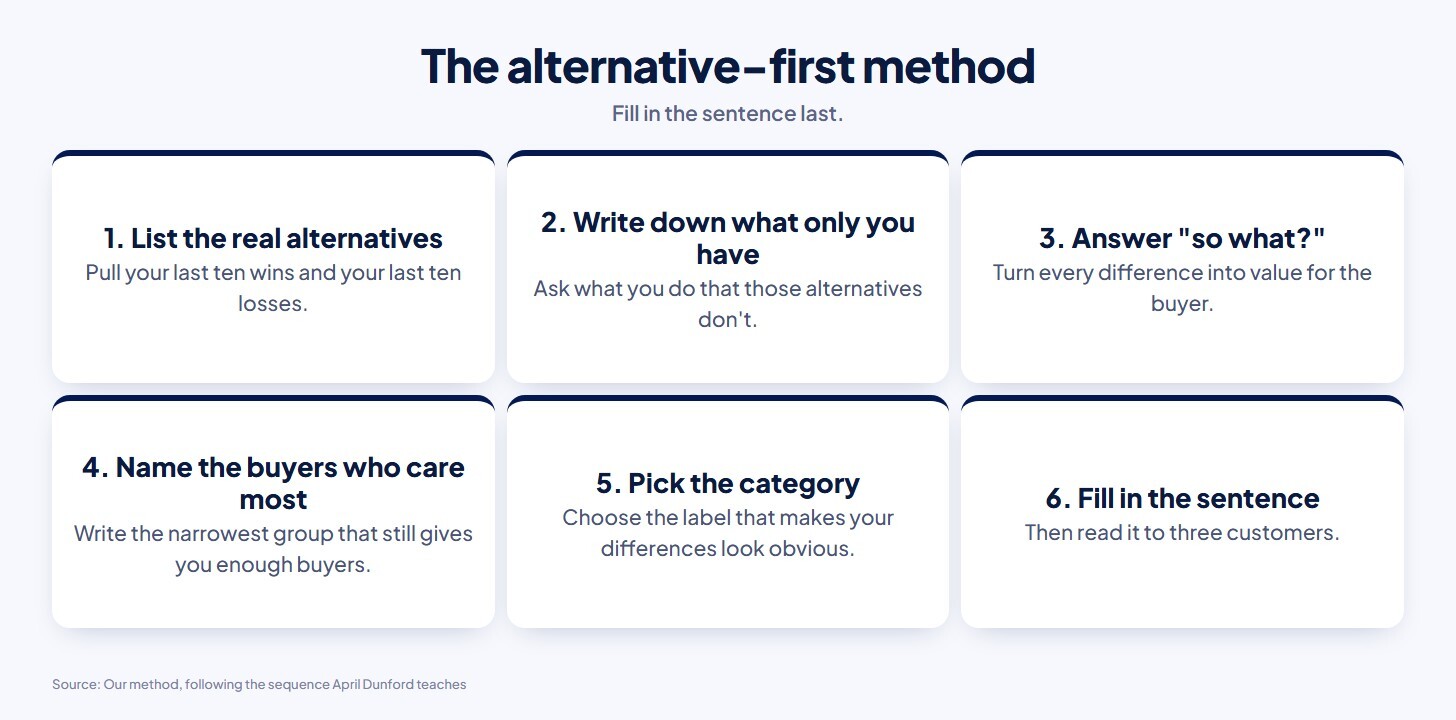
To write a positioning statement, start with what buyers would do without you, list what you have that those alternatives lack, turn each difference into a benefit, name the buyers who care most, pick a category, and only then fill in the sentence. Writing the sentence first is the most common mistake.
The Zulu Method calls this order the alternative-first method, and it follows the sequence Dunford teaches. The reason for the order is practical. If you start with your strengths, you get a list of adjectives. If you start with the alternative, every strength has to answer a question: better than what?
A company with at least ten customers can usually finish this in about a week of part-time work. That's our experience, not a published benchmark.
- List the real alternatives. Pull your last ten wins and your last ten losses. For each, write what the buyer was doing before and what they'd have done if you didn't exist. Include "nothing" and "kept doing it in-house." Leave out what Dunford calls "phantom competitors", the solutions your customers never actually consider.
- Write down what only you have. Ask what you do that those alternatives don't. Think about how you deliver, who does the work, what you've built, and what you know. Skip "quality," "service," and "experience" unless you can put a fact next to them.
- Answer "so what?" for each one. Turn every difference into value for the buyer. Dunford's short version for business buyers, from her March 2026 guide, is that value comes down to helping them make money or save money. Personal stakes count as well. Bain's research on business buyers, published in 2018, found that whether a purchase can enhance the buyer's reputation or reduce anxiety plays a large role.
- Name the buyers who care most. Look at your best ten customers and find what they share: size, industry, region, tools in use, or the event that made them call. Write the narrowest group that still gives you enough buyers to hit your revenue goal.
- Pick the category. Choose the label that makes your differences look obvious to that buyer. Test two or three. A category also tells people what to compare you with, so an unclear label leaves that choice to them.
- Fill in the sentence, then read it to three customers. Ask, "Is this why you bought?" Their corrections are often better than your draft, and the words they use belong in your marketing.
Who should be in the room? Include the owner or founder, whoever sells most, and whoever delivers the work. Dunford argues that positioning crosses every department, not just marketing. A statement written by marketing alone tends to promise things delivery hasn't agreed to.
Questions to ask yourself
- What did our last ten buyers do before they called us?
- When we lose, do we lose to a rival or to no decision?
- Which of our customers would be hardest to replace, and what do they have in common?
- What do we do that a skeptical buyer could verify in the first month?
- Which buyers are we willing to stop chasing?
What does a weak positioning statement look like, before and after?
A weak positioning statement fits any company in the category, while a strong one could only belong to you, because it names a specific buyer and a difference nobody else can claim. The fastest test is to swap in a competitor's name: if the sentence still reads as true, it isn't positioning yet. The rewrites below are illustrative, written for this guide with made-up company types.
| Company type | Before | After | What changed |
|---|---|---|---|
| Commercial roofing contractor | We're a full-service roofing company committed to quality and customer satisfaction. | For property managers of multi-tenant industrial buildings who can't shut down for a repair, [Company] is a commercial roofing contractor that repairs and replaces roofs while tenants keep operating. Unlike a crew that schedules around its own calendar, we plan each phase around your tenants' shifts. | Named a buyer, a trigger, and a checkable difference |
| AI startup (before and after) | The leading AI-powered platform that helps businesses of all sizes grow faster. | For owners of home services companies with 5 to 50 trucks who lose leads after hours, [Company] is an AI answering service that books jobs while the office is closed. Unlike a call center reading a script, it writes each booking straight into your dispatch software. | Traded "all sizes" for one buyer and "platform" for a category the buyer knows |
| Regional law firm | We deliver innovative legal solutions tailored to each client's unique needs. | For general contractors in the Southeast facing a payment dispute, [Company] is a construction law firm that resolves claims before they reach trial. Unlike a general business attorney, our partners are former project managers who read a schedule the way you do. | Replaced a promise anyone could make with a fact about who does the work |
Notice what the "after" column gave up. The roofer dropped homeowners. The startup dropped every industry except home services. That's the uncomfortable part, and Porter's 1996 essay explains why it's the point: trade-offs "purposefully limit what a company offers." You can still take the other work when it comes. You just stop building your message around it.
What are the most common positioning statement mistakes?
- Describing everyone. Dunford warns against defining ideal customers so broadly that every lost deal looks like a product failure.
- Naming a rival nobody compares you with. It feels bold and teaches the buyer about a company they hadn't considered.
- Claiming a difference you can't prove. "Better service" is a claim. "One named account lead, and a written report every Friday" is a fact.
- Stacking benefits. A statement with four benefits has none. Pick the one that matters most to the buyer you named.
- Writing it for the website. Polished language hides weak choices. Keep the internal version blunt.
How narrow should your positioning be?
Your positioning should be narrow enough that a buyer says "that's us" and wide enough to reach your revenue goal. In our experience, that means one buyer type in one or two industries for most small companies. A company with few customers should start narrower than feels comfortable, because a focused position is easier to explain, easier to refer, and easier to prove than a broad one.
Referrals show why. When an existing client recommends you, they repeat a sentence. If your work spans six industries, the sentence blurs and the referral goes nowhere. In our experience, owner-led companies moving past word of mouth often find positioning is the first thing to fix, which is why it sits ahead of channels in any plan for getting clients when referrals stop being enough. Service companies have an extra job, since the buyer is judging people they haven't met yet. Our guide to marketing for service businesses covers what proof carries that weight.
A Worked Example
A real case, reported by April Dunford. In a 2017 article, Dunford described running marketing at a startup that framed itself as "CRM for Banking and Insurance," a sub-market of the larger CRM category. She reports the sub-market was large enough for the company to reach $65M in revenue before it was acquired for over $1B. She doesn't name the company, so treat it as her account. The lesson is about scale: a narrow category didn't stop this business from growing, though one account can't prove narrowness caused it.
When should you not write one yet?
Hold off on a final statement if you have fewer than about five paying customers, because you don't yet know who cares most. Write a draft, label it a guess, and run it past every sales conversation. The same goes for a company in the middle of a real strategy change. Decide the strategy first, on your own or through a CMO-level strategy engagement. Founders working through that sequence will find positioning is one of the six go-to-market decisions, and it shapes the other five. If you want to see worked go-to-market examples from real companies, read these go-to-market strategy examples.
Do you need outside help?
Most owners with a few years of customers can do this themselves using the steps above. Outside help earns its cost in three situations: the partners disagree and need a neutral person in the room, nobody has time to call customers, or the team is too close to the work to see what's unusual about it. A marketing consultant can run the exercise as a short project. If you go further and need the position carried into a brand and a website, this page on how positioning differs from messaging explains the handoff, and these questions will help you judge anyone you consider.
How do I know if my positioning statement is good?
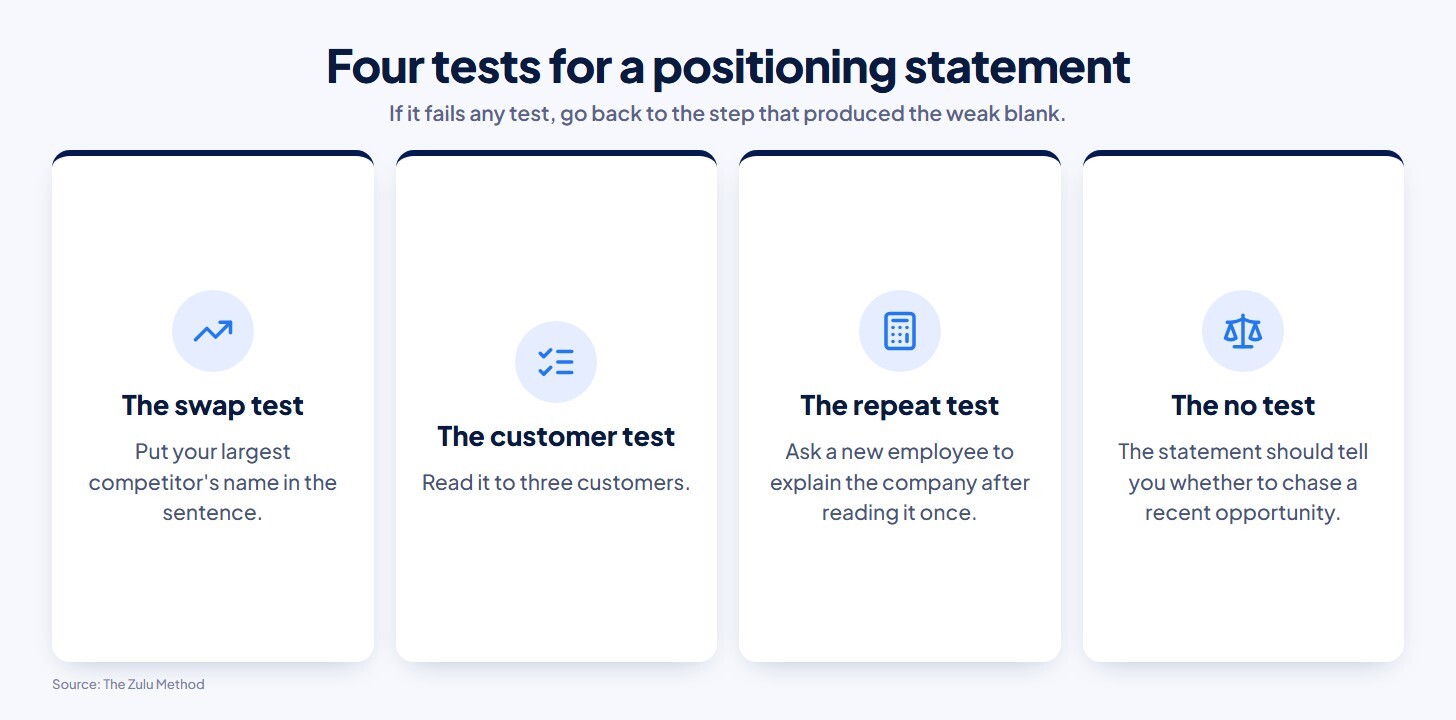
A positioning statement is good when it passes four tests: a competitor can't claim it, a customer agrees it's why they bought, a new employee can repeat it, and it tells you which work to turn down. If it fails any test, go back to the step in the sequence that produced the weak blank.
- The swap test. Put your largest competitor's name in the sentence. If it's still true, rewrite the difference.
- The customer test. Read it to three customers. If they'd describe your value differently, use their words.
- The repeat test. Ask a new employee to explain the company after reading it once. If the buyer and the difference survive, it's clear enough.
- The no test. Bring out a recent opportunity you weren't sure about. The statement should tell you whether to chase it.
Does positioning affect how AI tools describe your company?
Specific positioning may give AI tools something to repeat. Our reasoning is that a tool can only recommend you for a narrow need if your public pages state that need, that buyer, and that difference in plain sentences. Generic copy gives it nothing to match. We haven't measured that effect, so treat it as a sensible bet and not a finding.
How do you use the statement once it's written?
Print it. Then put it to work in three places this month: the first two lines of your homepage (rewritten for buyers), the opening of your proposal template, and the answer everyone gives to "What do you do?" Review it twice a year, and sooner if you keep losing to an alternative it doesn't mention.
Your next step takes about an hour. Open your CRM or your inbox, pull your last ten wins and ten losses, and write one line for each: what would this buyer have done without us? Those twenty lines are the first blank in your statement, and they'll tell you more than any brainstorm.

Questions & Answers
How long should a positioning statement be?A positioning statement should be one or two sentences, usually 30 to 60 words in our experience. If it runs longer, you're probably listing benefits instead of choosing one. Keep it short enough that a new employee can repeat it after reading it once, and move supporting proof into a separate messaging document.
What is an example of brand positioning?An example of brand positioning is a small accounting firm choosing to be the outsourced finance team for multi-location restaurant groups rather than a general CPA. The position is the place the firm holds in a buyer's mind. The positioning statement is the internal sentence that records the choice so the whole team can act on it.
Should customers see your positioning statement?Customers usually shouldn't see the statement as written, because it's an internal tool with blunt language about buyers and alternatives. They should feel its effect. Your homepage headline, proposals, and sales calls should all carry the same buyer, benefit, and difference, rewritten in language a buyer would use out loud.
Do you need a different positioning statement for each product or audience?You need a separate positioning statement when two offers have different buyers, different alternatives, or different categories. If the same buyer compares you with the same options, one statement is enough. A small company should start with one statement for its best segment, then add a second only after the first is producing work.
How often should you update a positioning statement?Review a positioning statement twice a year and rewrite it only when something real changes: a new alternative shows up in deals, your best customers shift, or your offer changes. Frequent rewrites confuse your team. If the win and loss notes still match the sentence, leave the sentence alone and keep using it.
Who should write the positioning statement in a small company?The owner or founder should make the final call, with input from whoever sells most and whoever delivers the work. Marketing can draft the sentence, but the choices underneath it affect pricing, delivery, and which deals you chase. If partners disagree, a neutral facilitator often settles the question faster than another internal meeting.