Published on: May 25, 2026 | Time to read: 29 min
Modern marketing teams are shifting from channel-based silos to outcome-driven structures powered by AI. By organizing around four key pillars (Strategy, Technology, Analytics, and Creativity), companies can automate repetitive tasks while freeing talented employees to focus on strategic, high-value work that drives revenue growth.
Key Takeaways
- Traditional channel-based marketing teams are becoming obsolete. Modern AI-powered teams organize around business outcomes instead
- 78% of marketers believe AI will intelligently automate over 25% of their work within three years
- The four pillars of a modern AI marketing team are Strategy & Leadership, Technology & Implementation, Analytics & Insights, and Creativity & Content
- AI acts as a collaborator and "cybernetic teammate" that enhances human creativity rather than replacing creative professionals
- Three organizational models exist: centralized Center of Excellence (CoE), decentralized embedded specialists, and hybrid hub-and-spoke structures
- A phased implementation approach (assess, pilot, define ROI, integrate) reduces risk and improves team buy-in
- Success requires measuring efficiency gains, performance uplift, and strategic impact, not just cost savings
Table of Contents
- The Seismic Shift: Why Your Traditional Marketing Team is Obsolete
- Core Pillars of the Modern AI Marketing Team
- The Technologists: Prompt Engineers & AI Tool Specialists
- The Analysts: Data Scientists & AI Ethicists
- The Creators: AI-Augmented Content & Creative Roles
- Model 1: The Centralized AI Center of Excellence (CoE)
- Model 2: The Decentralized Embedded Specialist
- Model 3: The Hybrid Hub-and-Spoke
- A Phased Blueprint for Building Your AI-Powered Team
- Measuring What Matters: Proving the ROI of Your AI Team
A modern AI marketing team structure integrates AI as a core collaborator, moving away from siloed, channel-based roles. This shift allows teams to focus on strategic outcomes like customer acquisition and retention, using AI for data analysis and task automation.
The Seismic Shift: Why Your Traditional Marketing Team is Obsolete
For years, marketing teams were organized by channels. You had an email team, a social media team, and an SEO team. But this setup is slow and creates silos. In today's data-heavy world, this disconnected approach just doesn't work anymore.
This is where artificial intelligence changes the game. AI tools are taking over the repetitive, time-consuming tasks. Think about generating performance reports, analyzing customer data, or setting up simple A/B tests. These jobs can now happen automatically, freeing up your team.
In fact, this trend is only growing. According to The 2024 State of Marketing AI Report, 78% of marketers believe AI will intelligently automate over a quarter of their work within three years. This frees up people to focus on strategy and creativity.
With AI handling routine work, teams can be rebuilt around goals, not channels. Instead of an "email team," you might have a "customer acquisition team." This group uses AI-driven insights from all channels to find and convert new customers. It's a smarter, more effective way to operate.
The biggest shift is thinking of AI as a coworker. It's not just a tool. It's a collaborator that enhances human skills. This idea of a "cybernetic teammate" completely changes how creative and strategic work gets done in a marketing department.
An executive from Procter & Gamble explained this concept well in a Knowledge at Wharton article on deploying AI. He described how AI helps marketing specialists develop "better and more holistic ideas." It's about human-AI partnership, not replacement.
The classic marketing team is quickly becoming a thing of the past. The new reality demands a more agile, outcome-driven approach. As CMS Wire highlights in a look at the CMO's job, there's more pressure than ever to show how marketing directly contributes to revenue. Building a modern team is the answer.
Real-World Example: Procter & Gamble
Procter & Gamble demonstrated the power of AI as a "cybernetic teammate" in marketing and R&D. An executive explained how AI helps marketing specialists develop better and more holistic ideas by serving as a collaborative partner rather than a replacement tool. This approach enabled their team to combine human creativity with AI-generated insights, resulting in more innovative campaigns and faster idea development than traditional methods alone.
Core Pillars of the Modern AI Marketing Team

A modern AI marketing team structure stands on four key pillars. These are Strategy, Technology, Analytics, and Creativity. This framework moves away from old channel-based silos. It helps organize your people around skills and outcomes, making the whole team more effective and agile.
1. Strategy & Leadership
The Strategy pillar is led by roles like the AI Marketing Strategist. This person guides the team's direction. They make sure that every AI tool and project connects back to the bigger business goals, like growing revenue or improving customer happiness.
2. Technology & Implementation
Next is the Technology pillar. This group is home to your technical experts. Roles like Prompt Engineers and AI Tools Specialists are key here. They choose the right AI software and write the instructions, or prompts, that tell the AI what to do. These new skills are highly valued.
For instance, a skilled Marketing Prompt Engineer is a huge asset. This role is so new that salary data is still emerging. But general prompt engineering jobs can range from $85,000 to over $150,000 annually, as outlined in a 2025 career guide from Jobright. This shows how important these specialized skills have become.
3. Analytics & Insights
The Analytics pillar turns data into action. AI can produce a ton of information, but it's weak without someone to make sense of it. This is the job of an AI Analyst. They dig into performance data to find trends and useful insights.
This is often a challenge for companies. A report on the state of AI from Deloitte points to a lack of worker skills as a major hurdle. Having dedicated analysts helps bridge this gap and open up the true value of your data.
4. Creativity & Content
Finally, the Creativity pillar includes your content creators, designers, and campaign managers. AI doesn't replace them. Instead, it acts as a partner. It handles the repetitive parts of their jobs so they can focus on big ideas and strategy.
This frees up a lot of time. Marketing leaders expect the share of AI-driven work to grow quickly. A recent analysis based on Gartner data projects that AI will handle 36% of marketing workflows by 2028. That's more time for your team to be creative.
Putting the Pillars into Practice
These pillars provide a clear blueprint for your team. They help define responsibilities in an AI-first world. The table below shows how these roles work together.
| Pillar | Key Roles | Main Responsibility |
|---|---|---|
| Strategy & Leadership | AI Marketing Strategist | Aligns AI initiatives with business goals. |
| Technology & Implementation | Prompt Engineer, AI Tools Specialist | Manages tech and crafts AI instructions. |
| Analytics & Insights | AI Analyst, Data Scientist | Interprets data to find actionable insights. |
| Creativity & Content | Content Creator, Campaign Manager | Uses AI to enhance and scale creative work. |
Building this team doesn't always mean hiring brand-new people. Many of these pillars can be filled by training your existing staff. A channel manager can become a strategist. A tech-savvy marketer can learn prompt engineering.
Some companies create a formal "AI Center of Excellence" (CoE) to centralize this expertise. A CoE brings together experts from each pillar to support the whole organization. It is a structure that helps share knowledge and drive adoption, as explained by experts at IBM.
The Technologists: Prompt Engineers & AI Tool Specialists
The technology pillar holds the new rockstars of a modern AI marketing team structure. These are the Prompt Engineers and AI Tool Specialists. This group is responsible for mastering the art and science of communicating with AI models. It's a critical, hands-on role.
Think of them as professional AI whisperers. They write the specific instructions, or prompts, that tell the AI what to create. Getting a high-quality email, blog post, or image from an AI model depends almost entirely on the quality of their prompts.
This job is a mix of creative writing and logical thinking. They need to understand the strengths and weaknesses of different AI models. Developing this expertise is becoming a major focus for forward-thinking companies. In fact, a detailed AI skill gap analysis framework from Blend-ed highlights how identifying these new skills is the first step in building a capable team.
Beyond prompting, these specialists also manage the marketing AI stack. They evaluate, select, and integrate the different software tools the team uses. They ensure all the technology works together smoothly so the rest of the team can focus on their jobs.
The Analysts: Data Scientists & AI Ethicists
The analytics pillar turns raw data into smart decisions. This is where Data Scientists and the growing role of AI Ethicists shine. They do not just report on what already happened. They look to the future to guide strategy.
Data Scientists build models that predict customer behavior. This allows the marketing team to be proactive, not just reactive. They help answer questions like "which customers might leave?" or "what product should we show them next?" It changes the game entirely.
The AI Ethicist provides a vital check on this power. They create governance frameworks to ensure fairness and prevent bias in AI outputs. This role also handles data privacy, making sure practices comply with laws like GDPR and CCPA.
Finding people with these skills is a common challenge. A 2025 McKinsey report on AI in the workplace highlights that skill gaps are a major hurdle. This makes the analyst pillar a critical investment for any modern ai marketing team structure.
The Creators: AI-Augmented Content & Creative Roles
The Creators are your content writers, designers, and campaign managers. In a modern AI marketing team structure, their jobs do not disappear. Instead, they get a powerful new assistant. AI tools help them brainstorm ideas, write first drafts of copy, and create image variations in seconds.
This partnership frees your creative talent from many repetitive tasks. Now, they can focus more on strategy and applying the final human touch. It empowers a single person to do work that once required a larger team. The focus shifts from manual production to high-level creative direction.
Think of the human as the editor-in-chief. For example, an AI can generate ten different blog post titles instantly. The content creator then uses their knowledge of the brand and audience to pick the best one. Or they might combine a few ideas to create an even better headline. The final judgment always rests with a person.
AI's role in creating marketing messages is growing quickly. Experts are seeing this trend accelerate across the industry. In fact, some analyses predict that by 2025, AI will generate 30% of outbound marketing messages at large organizations. This allows for personalization at an incredible scale.
This increased output doesn't come at the cost of quality. In fact, it boosts team efficiency. According to a comparison of AI features in popular sales software, many users report saving multiple hours per week with AI assistants. That's more time for planning and creative thinking.
Model 1: The Centralized AI Center of Excellence (CoE)
One popular way to build a modern ai marketing team structure is with a Center of Excellence, or CoE. This model creates a single, central team of dedicated AI experts. This specialized group supports the entire marketing department, and sometimes the whole company, with their technical skills and guidance.
This approach has big advantages. It creates strong rules for how AI is used and helps build deep expertise in one place. It is also efficient. Centralizing talent means resources are not spread too thin. For example, one article on future-proofing businesses explains how a CoE helped one company find $650 million in new value.
But there can be downsides. A centralized team can become a bottleneck if too many requests pile up. They might also feel disconnected from the daily challenges and fast pace of marketing campaigns. This can sometimes make them seem slow or out of touch with the team's immediate needs.
Model 2: The Decentralized Embedded Specialist
Another option is the decentralized model, where AI specialists are embedded directly into marketing teams. An expert joins the content team, for example. This makes them highly relevant to that team's specific goals and daily work. It is a very hands-on approach.
This model is fast and flexible, encouraging quick adoption of new tools. This aligns with trends noted in a 451 Alliance report on enterprise AI, where more projects are business-led. The main risk is a lack of consistency. Different teams may develop separate standards and duplicate efforts.
Model 3: The Hybrid Hub-and-Spoke
The hybrid model, or hub-and-spoke, offers the best of both worlds. It features a small central team that provides strategy, governance, and big-picture guidance. This "hub" supports AI specialists, or "spokes," who work directly inside various marketing teams. They handle the day-to-day execution.
This structure balances expert oversight with fast, flexible implementation. The hub ensures everyone follows the same standards, while the spokes provide relevant support on the ground. This shift in team design is happening across industries, as Fortune highlights how AI is already changing corporate org charts. It is often the ideal path for scaling a modern ai marketing team structure.
A Phased Blueprint for Building Your AI-Powered Team
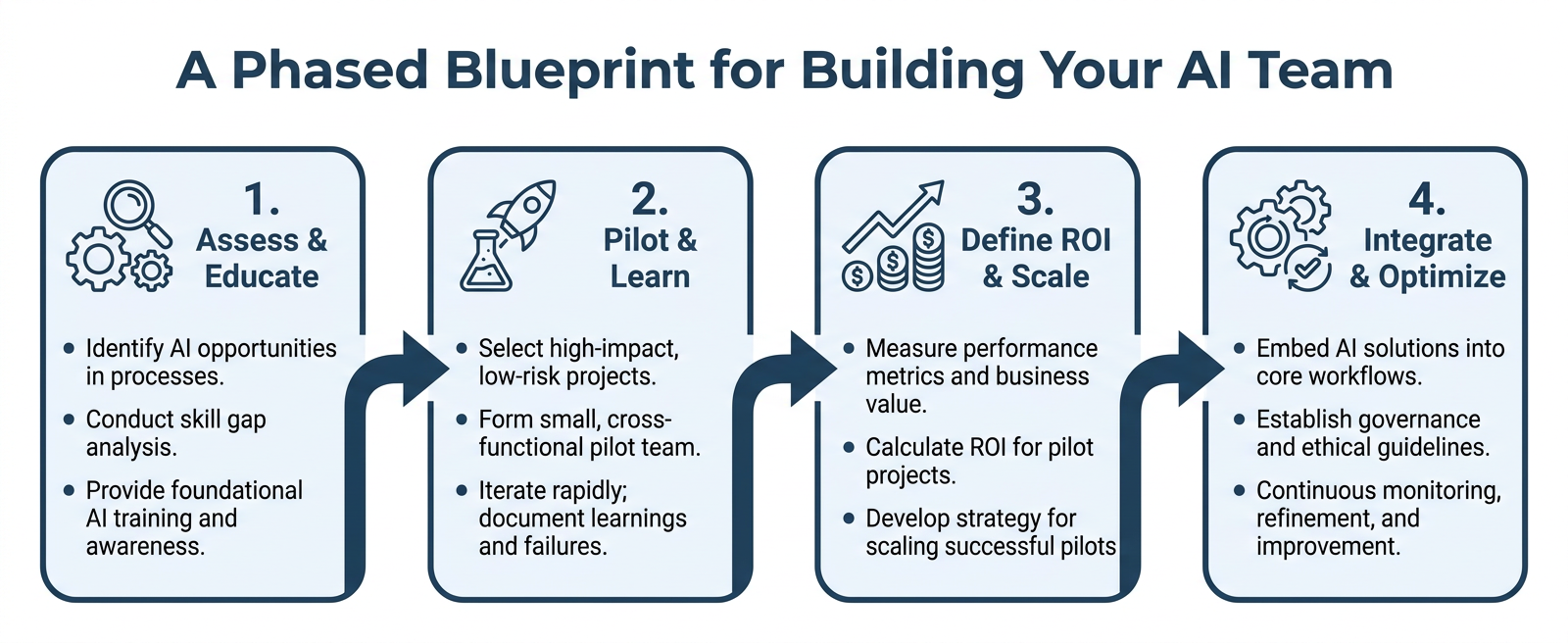
Building a modern ai marketing team structure does not happen overnight. Trying to change everything at once is risky and can upset your team. A better way is to follow a step by step plan. This approach reduces risk and helps you get everyone on board, from your team members to company leaders. It turns a big task into manageable steps.
Phase 1: Assess and Educate
Before you buy any new software, start with your people. The first step is to understand what your team already knows and where they need to grow. This is where a skills gap analysis comes in handy. It's a process for mapping out your team's current abilities against the skills needed for the future.
You can use a structured template to guide this process. A good example is the AI Learning Tracker offered by Consultport, which helps you identify specific training needs. This makes education targeted and effective.
The goal is building a foundation of knowledge. When the team understands the 'why', they are more likely to embrace the change. As one analysis of AI automation from WSI Waverley notes, AI's ability to better understand customers is a key benefit. This shared understanding aligns the team.
Phase 2: Pilot and Learn
Next, start small with a pilot program. Pick one specific area to test AI tools. This could be using an AI writer to help draft blog posts or an analytics tool to find customer patterns. The goal is to learn in a low risk setting. It's about discovering what works for your unique team and workflow.
During this phase, track your results carefully. How much time did the team save? Did content quality improve? These small wins are powerful. Finding efficiency is key, since AI tools for sales have shown the ability to save users 3.5 hours per day. Collecting this data gives you concrete proof of AI's value.
Phase 3: Define the ROI and Scale
With data from your pilot project, you can build a strong business case. This is how you get the budget and support from leadership to expand your efforts. You need to show a clear return on investment (ROI). It's not just about cool technology. It's about business results.
When you talk to finance leaders, use their language. This means focusing on financial impact and payback time. As one guide for CMOs seeking budget approval highlights, you must clearly show the "net impact, payback period, and risk-adjusted assumptions." This is how you turn a small test into a company-wide strategy for your new team structure.
Phase 4: Integrate and Optimize
Once you have support, it's time to scale. You can now formally implement a modern ai marketing team structure, like the hybrid hub and spoke model. The goal is to make AI a natural part of daily work, not just a special project. This is an ongoing process of learning and adjusting.
Managing this transition successfully is a skill in itself. Following a proven change management process ensures your team feels supported and confident. This is the key to long term success.
Phase 1: Audit & Experimentation (Months 1-3)
The first three months are about understanding what you have and where you want to go. Begin by auditing your team's current skills. A skills gap analysis will show you who your curious early adopters are and where you need to provide training. This is not about replacing people. It is about finding opportunities for growth within your existing team.
Next, identify two or three small pilot projects. These should be high impact but low risk. For example, you could use AI to brainstorm blog topics or generate different versions of social media copy. This lets your team get comfortable with new tools without the pressure of a major campaign. The goal here is simply to learn and build confidence.
Finally, invest in a couple of key AI tools for this small group. A targeted start helps you navigate common problems before a company wide rollout. An analysis of AI integration from Dapta AI highlights poor data quality and system compatibility as major hurdles. Testing on a small scale lets you work out these kinks first.
Questions to Ask Before Restructuring Your Marketing Team
- What are the biggest bottlenecks in your current marketing workflow that AI could address?
- Does your team have the foundational AI literacy needed, or will you need significant training investment?
- Which organizational model (centralized CoE, decentralized, or hybrid) best matches your company culture and decision-making speed?
- How will you measure success: efficiency gains, content performance improvements, or revenue impact?
- Do you have the data infrastructure and quality to support AI analytics and personalization at scale?
- Which existing team members could evolve into new roles like AI Strategist or Prompt Engineer?
- What ethical governance framework do you need to ensure responsible AI use and maintain customer trust?
- How will you secure leadership buy-in and ongoing budget for AI tools and training investments?
Measuring What Matters: Proving the ROI of Your AI Team
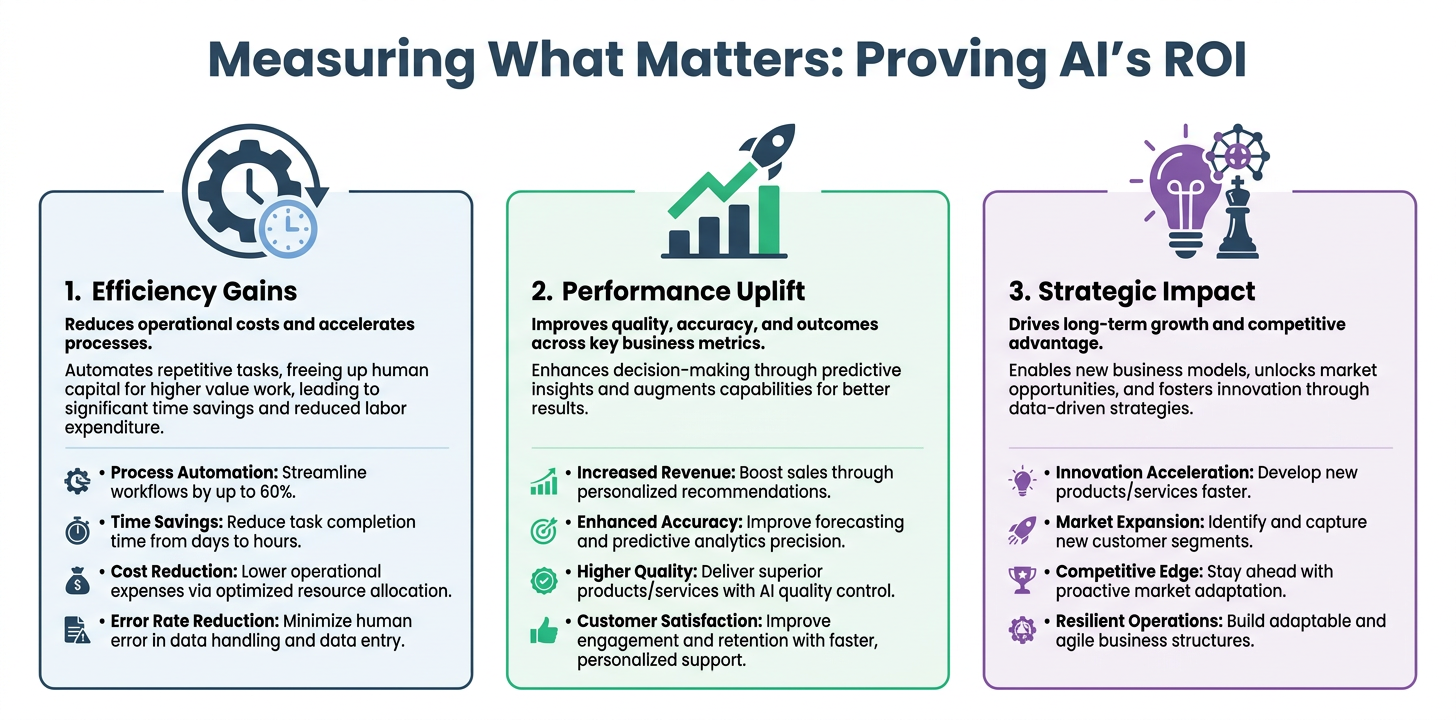
Investing in a modern ai marketing team structure requires clear justification. You must prove that new roles, training, and tools deliver a real return. To do this, you need a measurement framework that goes beyond simple metrics like clicks or views. It's about connecting your team's efforts directly to business outcomes like revenue and growth.
Demonstrating this value is how you secure ongoing support from leadership. The right metrics show how AI is not just a cost center but a powerful driver of business success. We can group these metrics into three main categories: efficiency gains, performance uplift, and strategic impact.
Efficiency Gains
The most direct benefit of AI is that it makes your team faster and more efficient. AI tools can automate repetitive tasks like writing first drafts of emails, creating social media posts, or generating basic reports. This frees up your skilled employees to focus on high-value work like strategy, planning, and creative problem-solving.
To measure this, track the time your team saves. How many hours per week are now free because AI handles certain tasks? You can also look at cost savings. For example, have you reduced freelance spending because your internal team can produce more content? These metrics provide a clear picture of operational improvements.
Performance Uplift
Beyond saving time, a modern ai marketing team structure should deliver better results. This means measuring how AI improves the performance of your marketing campaigns. Are AI-assisted emails getting higher open rates? Is AI-generated content leading to better engagement on social media? These are vital questions to answer.
New ways of measuring are also emerging. For instance, you can now track content quality with scores for brand consistency and clarity, as explained in an article on new content performance metrics. You should also watch for new KPIs related to AI search, such as how often your brand gets mentioned in AI-generated answers, which Search Engine Land points out in a guide to new search KPIs.
Strategic Impact
Finally, you must connect your AI efforts to high-level business goals. This is about showing how the modern team structure helps the company win in the market. Are you increasing market share faster? Is customer lifetime value improving because of better personalization? This is the language that executives understand.
Finance leaders want to see a clear link to growth. According to new research on how CFOs view AI, they judge ROI on outcomes like revenue growth and productivity gains, not just cost cuts. This focus on growth aligns with broader enterprise AI trends from Databricks that show companies are adopting AI to scale their business operations effectively.

Frequently Asked Questions
What does a modern AI marketer do?
A modern AI marketer shifts focus away from manual execution toward strategy, prompt engineering, and data analysis. Rather than creating all content manually, they use AI tools to generate and personalize content at scale, analyze performance data for insights, and automate routine campaign tasks. Their role is to act as a strategist who directs AI collaborators to amplify human creativity and drive business outcomes.
Do I need a data scientist on my marketing team?
Not necessarily, especially for smaller teams. Many modern AI analytics tools have democratized data science capabilities, making advanced analysis accessible to non-specialists. However, for large-scale personalization efforts or predictive modeling that directly impacts revenue, having a dedicated data scientist or AI analyst with specialized skills becomes invaluable and often pays for itself.
How do I upskill my current team for AI?
Start with foundational training on key AI concepts and popular tools. Encourage a culture of experimentation by running low-risk pilot projects where teams can safely learn. Invest in specialized courses focused on prompt engineering, data literacy, and AI ethics. Identify internal "AI champions" who are naturally curious and position them to lead adoption across the broader team.
What is the most important new role in an AI marketing team?
While needs vary by organization, the AI Marketing Strategist is arguably the most critical role. This person bridges AI capabilities with business objectives, ensuring technology is applied strategically to drive meaningful growth rather than being used as a novelty. Without strong strategy leadership, even the best tools underperform.
What are the ethical considerations when using AI in marketing?
Key ethical issues include data privacy (handling user information responsibly and transparently), algorithmic bias (ensuring AI models don't perpetuate harmful stereotypes or discriminate), and transparency (clearly disclosing when content or interactions are AI-generated). Establishing a formal AI governance framework with an AI Ethicist role helps mitigate these risks and builds customer trust.
How does the AI marketing team structure differ for B2B vs. B2C?
The four core pillars remain the same, but priorities shift. B2B teams typically lean heavily on AI for lead scoring, account-based marketing personalization, and sales enablement content creation. B2C teams focus more on hyper-personalization at scale for e-commerce, sentiment analysis from social data, and dynamic creative optimization to serve different customer segments in real time.