
Hannon Brett | Published on: August 25, 2026 | Time to read: 32 min | Last Updated on: August 25, 2026
A startup marketing strategy is a clear plan that connects business goals to specific marketing activities by defining who you're reaching, what you want them to do, and why your approach will work. Unlike a list of tactics, a real strategy ensures every marketing effort compounds toward the same target.
This guide walks through the three foundational pillars (ICP, UVP, and SMART goals), a phased approach from pre-launch to scale, lean budget allocation, channel selection, and measurement frameworks that separate startups that grow from those that stay stuck.
Key Takeaways
- A startup marketing strategy is not a to-do list. It tells you which tactics to use, when, and why they fit your current stage.
- The three foundational pillars before spending a dollar are: a sharp Ideal Customer Profile, a clear Unique Value Proposition, and SMART goals with measurable KPIs.
- Your strategy should evolve across three distinct phases: Pre-Launch (validation and audience building), Launch (impact and initial acquisition), and Post-Launch (growth and retention).
- A lean marketing budget works best when you allocate 70% to proven channels, 20% to experiments, and 10% to tools. Justify every dollar with CAC and LTV.
- Content marketing, SEO, and email are the highest-return channels for early-stage startups because they compound over time without ongoing ad spend.
- Track a small set of actionable metrics weekly (conversion rate, CAC, activation rate, retention, cost per lead) instead of vanity metrics like total traffic.
- Pre-launch tactics like waitlists, referral loops, and community engagement can validate demand before you ever build a full product.
- Product-Led Growth (PLG) turns your product into your primary marketing engine by reducing friction to value and building sharing features into the core experience.
Table of Contents
- What is a Startup Marketing Strategy (And Why It's Not Just a List of Tactics)
- Before You Market: 3 Foundational Pillars of Your Startup Marketing Strategy
- A Phased Approach: Your Startup Marketing Strategy from Pre-Launch to Scale
- The Lean Startup Marketing Budget: How to Allocate Scarce Resources
- Choosing Your Channels: Where to Execute Your Startup Marketing Strategy
- Measuring What Matters: KPIs for Your Startup Marketing Strategy
- Build Your Next Growth Engine with the Right Strategy
What is a Startup Marketing Strategy (And Why It's Not Just a List of Tactics)
A startup marketing strategy is a clear plan that connects your business goals to the specific marketing activities you run. It answers three questions: who you're trying to reach, what you want them to do, and why your approach will work. Without that plan, you're just guessing.
Lots of founders confuse a strategy with a to-do list. Posting on social media every day isn't a strategy. Neither is running ads, sending emails, or attending events. Those are tactics. And tactics without a strategy are just busy work.
The difference matters a lot. According to startup failure research compiled by Failory, around 14% of startups fail specifically because of poor marketing. That's not a product problem or a funding problem. It's a direction problem.
A real startup marketing strategy tells you which tactics to use, when to use them, and why they fit your goals right now. It keeps every effort pointed at the same target instead of pulling in different directions.
Think of it this way. A checklist says "post on LinkedIn three times a week." A strategy says "we'll build awareness with founders in fintech by sharing educational content on LinkedIn because that's where our buyers spend time and trust advice from peers."
One gives you tasks. The other gives you a reason.
When all your marketing activities connect back to the same goal and the same audience, they stop competing with each other. They start building on each other. That compounding effect is what separates startups that grow from ones that stay stuck.
Before You Market: 3 Foundational Pillars of Your Startup Marketing Strategy

Before you spend a single dollar or write a single post, your startup marketing strategy needs three things in place: a clear picture of who you're selling to, a sharp reason why they should pick you, and specific goals that tell you if it's working. Skip any of these and every tactic you try will underperform.
Pillar 1: Define Your Ideal Customer Profile (ICP) and Buyer Personas
Your ICP is a description of the exact type of company or person most likely to buy from you, stay with you, and grow with you. It's not a vague guess. It's built from real signals like industry, company size, budget, job title, and the specific problem they need solved.
Why does this matter so much? Because research from Salesforce on ICP strategy shows that companies with a sharp ICP attract higher-quality leads that are more likely to convert. One reported startup experiment found an ICP-driven sales group booked 40% more meetings than a group without one.
A buyer persona goes one level deeper. It describes the actual human making the decision: their goals, fears, daily frustrations, and where they spend time online. Your ICP tells you which company to target. Your persona tells you who inside that company you're actually talking to.
Start here before anything else. If you don't know exactly who you're trying to reach, every channel you pick is a coin flip.
Pillar 2: Nail Your Positioning and Unique Value Proposition (UVP)
Your UVP is the single clearest answer to the question: "Why should I pick you over everyone else?" It's not a tagline. It's a strategic statement that shapes everything from your homepage copy to your sales pitch.
Strong UVPs are specific and outcome-focused. Think about how Slack's core message makes the product feel like the default place work happens, or how Stripe's positioning signals serious financial infrastructure rather than just another payment tool. Both communicate a clear outcome for a specific audience in plain language.
A weak UVP sounds like: "We help businesses grow." A strong one sounds like: "We help fintech founders reduce onboarding drop-off by 30% in their first 60 days." One is forgettable. The other stops the right person mid-scroll.
If your positioning isn't clear, your marketing will attract the wrong people, and no amount of ad spend fixes that problem.
Pillar 3: Set SMART Goals and KPIs
SMART goals are Specific, Measurable, Achievable, Relevant, and Time-bound. Without them, you can't tell if your startup marketing strategy is working or if you're just staying busy.
For pre-product-market-fit startups, the most useful KPIs to track are activation rate, retention, and core feature engagement. According to guidance from RevenueCat on early-stage metrics, these three metrics tell you whether users are reaching value, coming back, and actually using what matters most about your product.
Here's a simple starting framework:
| Goal Type | Example KPI | What It Tells You |
|---|---|---|
| Awareness | Website visitors per month | Are people finding you? |
| Activation | % of signups who complete onboarding | Are new users reaching value? |
| Retention | 30-day return rate | Are users coming back? |
| Revenue | Monthly Recurring Revenue (MRR) | Is growth translating to money? |
| Efficiency | Customer Acquisition Cost (CAC) | Can you afford to grow? |
Don't track 20 numbers. Pick three to five that directly connect to your current stage and check them weekly. When the numbers move, you'll know why. And when they don't, you'll know where to look.
These three pillars aren't glamorous. But they're the reason some startups get traction fast while others burn through budget and wonder what went wrong.
A Phased Approach: Your Startup Marketing Strategy from Pre-Launch to Scale
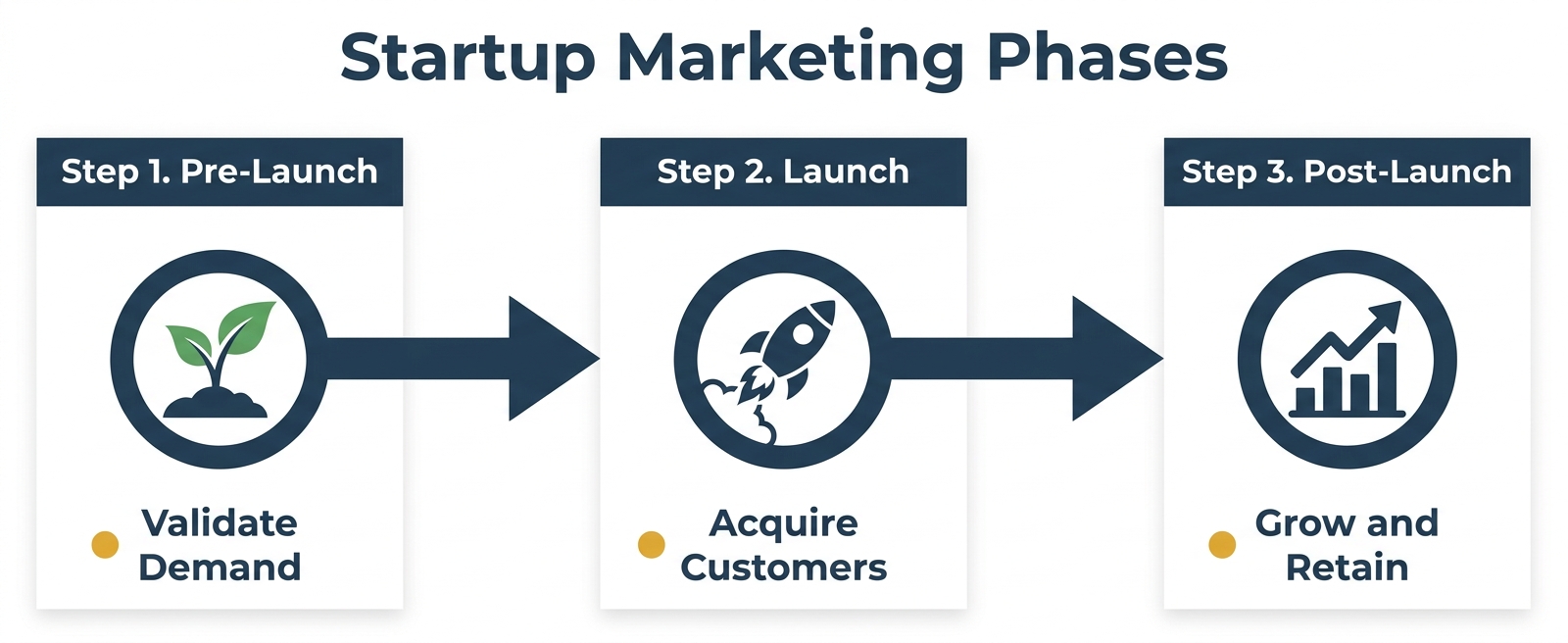
A startup marketing strategy isn't something you set once and forget. The goals, channels, and budget that work before launch look completely different from what works at scale. Founders who treat every phase the same way end up wasting money and missing momentum.
Think of your strategy as three distinct chapters: Pre-Launch, Launch, and Post-Launch. Each chapter has its own purpose, and what you measure in one phase often doesn't matter in the next.
Phase 1: Pre-Launch (Validation and Audience Building)
Before you launch anything publicly, your job is to validate that someone actually wants what you're building. This means talking to potential customers, testing your messaging, and building a small but engaged audience before day one.
The goal here isn't traffic. It's signal. Are people excited enough to sign up for early access? Will they refer a friend just to move up a waitlist? Those answers tell you whether your idea has real pull.
Your budget at this phase should stay lean. Seed-stage startup marketing spend typically lands around 10 to 20% of funds raised, which means most of your pre-launch effort should be low-cost and high-learning.
Phase 2: Launch (Impact and Initial Acquisition)
Launch phase is about turning your early audience into paying customers and proving your acquisition channels work. This is when you run your first real experiments: a Product Hunt launch, targeted paid ads, or an email sequence to your waitlist.
The most important shift here is from learning to converting. You already know your ICP and your UVP. Now you're testing whether those assets actually move people to act.
Keep your channel list short. Pick one or two acquisition channels and commit to them long enough to get real data. Spreading spend across five channels at launch just means you get bad data on all five.
Phase 3: Post-Launch (Growth and Retention)
Once you have paying customers, the strategy shifts again. Growth without retention is just a leaky bucket. Keeping the customers you've already won costs far less than replacing them.
At this stage, metrics like LTV and CAC become your most important compass. The basic formula is simple: CAC equals total sales and marketing spend divided by new customers acquired. LTV equals average revenue per customer times gross margin divided by your monthly churn rate. When LTV is at least three times your CAC, your growth engine is healthy.
Here's a simple overview of how the three phases compare:
| Phase | Primary Goal | Key Focus | Main KPI |
|---|---|---|---|
| Pre-Launch | Validate demand | Audience building, ICP testing | Waitlist signups, feedback quality |
| Launch | Acquire customers | Channel testing, conversion | CAC, trial-to-paid rate |
| Post-Launch | Grow and retain | Retention, LTV improvement | LTV:CAC ratio, churn rate |
The biggest mistake founders make is skipping Phase 1 entirely. They jump straight to launch tactics without validating demand first. And then they wonder why nothing converts.
A startup marketing strategy that adapts to each phase keeps you from spending money you don't have on channels that don't fit where you are right now.
Phase 1: Pre-Launch Strategy, Build an Audience Before You Have a Product
The best time to start building your audience is before your product is ready. Seriously. Waiting until launch day to find your first customers is one of the most common and costly mistakes in a startup marketing strategy.
Pre-launch is your chance to validate that real people actually want what you're building. And you can do most of this without writing a single line of code.
Start With a Simple Landing Page and Email Waitlist
A one-page website with a clear headline, a short description of your product, and an email signup form is enough to start. You don't need a finished product. You need a clear promise.
Robinhood is the classic example here. Before it had a working app, it launched a simple page showing your place in line and let you move up by referring friends. That single mechanic turned a waitlist into a sharing engine. According to Waitlister's breakdown of the Robinhood pre-launch, the company built a list of over one million people before it ever opened to the public.
The tactics that made it work were straightforward: low-friction signup, a compelling reason to join early, and a built-in referral loop. You don't need a big brand to copy this. You need a clear offer and a reason to share.
Use Smoke Tests to Validate Demand
A smoke test is a quick experiment designed to see if people care before you build anything. It could be a landing page with a "Join the waitlist" button, a fake pricing page where you track clicks, or a short survey sent to your target audience.
The goal is signal, not perfection. If nobody signs up, that's useful information. If a hundred people join in the first week, that's even more useful.
Keep your budget lean at this stage. Most of your pre-launch effort should cost more in time than money, which is exactly where early-stage founders have an edge.
Build Community Where Your Buyers Already Are
You don't need to build your own community from scratch. Go where your target customers already spend time. That might be a Reddit thread, a Slack group for a specific industry, or a Discord server for a niche interest.
Show up and be helpful. Answer questions. Share opinions. Don't pitch your product. Just become a familiar, trusted name in the conversation. When launch day comes, you'll have real relationships instead of a cold audience.
This kind of community-first approach also gives you a steady stream of honest feedback before you've committed to any major product decisions.
Use Content to Build Authority Early
Publishing blog posts, guides, or short-form content before launch does two things at once. It signals that you understand the problem deeply, and it starts attracting organic search traffic before your product page even exists.
Content marketing has a meaningful long-term ROI advantage. B2B benchmark data from The Starr Conspiracy shows content marketing returning roughly $3 for every $1 invested, compared to paid advertising which tends to return around $1.80 to $2.00 per dollar spent.
For a pre-launch startup with limited budget, that compounding return matters a lot. A well-written article explaining the problem your product solves can keep attracting the right readers for months after you publish it.
What Pre-Launch Success Actually Looks Like
You're not trying to go viral before launch. You're trying to confirm that a specific group of people cares enough about your problem to give you their email address, share your link, or answer your questions.
A few hundred engaged early signups who match your ICP are worth far more than ten thousand random visitors who bounce immediately.
Track these simple signals during pre-launch:
| Signal | What It Tells You |
|---|---|
| Email signups | Basic demand exists |
| Referral rate | People care enough to share |
| Survey responses | You have access to real feedback |
| Content engagement | Your messaging resonates |
If the signals are weak, you still have time to adjust your positioning, your offer, or your audience before spending serious money on launch.
Phase 2: Go-to-Market Strategy, Launch with Maximum Impact
A go-to-market launch is not a single post or a single day. It's a coordinated push across multiple channels, timed to hit at once. When done right, each channel amplifies the others instead of competing for attention.
Coordinate Your Launch Across Channels
The most effective startup launches run PR, Product Hunt, email, and social media at the same time. Your email list hears first. Your social audience sees the announcement. Product Hunt voters show up already primed. Press coverage adds third-party credibility.
For a Product Hunt launch specifically, timing matters. Guides from experienced makers recommend launching at 12:01 AM PST on a Tuesday through Thursday to maximize your full 24-hour voting window. Prepare strong visuals, a clear demo, and a ready-made maker comment before the day starts.
Assign launch-day roles in advance. One person watches comments and replies within minutes. Another monitors signups and site performance. Speed of response on launch day matters more than vote count.
Turn Early Adopters Into Your Marketing Engine
Your beta testers and early users are your most credible marketing asset. They've used the product. Their words carry weight that your own copy never will.
Ask them for short testimonials, honest reviews, and permission to share their results publicly. Even a single specific quote about a real outcome beats ten generic five-star ratings.
Word-of-mouth is still one of the strongest growth drivers for early-stage startups. People trust peers. They don't trust ads. So make it easy for your early adopters to share: give them a referral link, a shareable result, or a clear reason to tell their network.
Focus Paid Spend on Tight, Targeted Audiences
At launch, paid ads aren't about scale. They're about learning. Your goal is to find the audience segment that converts at the lowest cost, then feed that data back into your strategy.
Keep your targeting narrow. Broad audiences burn budget fast without telling you much. A tightly defined audience, even a small one, gives you real signal on messaging, creative, and offer.
Research on startup marketing budget allocation consistently shows that startups with limited funds get better results from highly targeted campaigns than from wide reach. Pick one platform where your ICP actually spends time. Run two or three ad variations. Pause what doesn't convert within the first two weeks.Your first paid campaign teaches you what your audience responds to. That knowledge is worth more than the clicks themselves.
Phase 3: Post-Launch Growth Strategy, Find Your Repeatable Growth Levers
The launch buzz fades fast. What comes next is the real work: finding the channels and loops that keep growing without requiring you to reinvent your strategy every month.
This phase is about shifting from short-term spikes to long-term systems.
Build Sustainable Acquisition Channels
Paid ads can kick-start growth, but they stop the moment you stop spending. Channels like SEO and content compound over time. Each article, guide, or video you publish keeps pulling in the right people long after you hit publish.
For example, SEO benchmarks cited by Omnibound suggest search-focused content can return around 748% ROI over time. That's roughly $7.48 for every $1 spent. Compare that to paid ads, and the long-term math strongly favors building owned channels.
Referral programs are another powerful lever. When your product naturally encourages users to invite others, your acquisition cost drops sharply. The key is making sharing feel effortless and giving users a real reason to do it.
Use Product-Led Growth to Fuel Acquisition
Product-Led Growth (PLG) means your product itself does the marketing. Users experience real value quickly, often through a free tier or trial, then upgrade naturally. And when they invite teammates or share results, the product spreads without extra ad spend.
Startups like Tally.so and Granola.ai have used this model effectively. According to ProductLed's breakdown of PLG examples, the core mechanic is simple: reduce friction to first value, then build sharing or collaboration features that pull new users in organically.
PLG works best when your product is genuinely easy to try and delivers a clear "aha" moment early in onboarding.
Double Down on What Actually Worked
Your launch data is a map. It shows you which channel brought the highest-quality users, which message converted best, and which audience segment stuck around longest.
Don't spread budget across new channels too early. Pick the one or two signals that showed real promise and put more behind them. Depth beats breadth at this stage.
Growth loops accelerate this. A simple loop looks like this: a user gets value, invites a friend, the friend signs up and gets a benefit, and both users engage more deeply. Each cycle makes the next one easier.
Here's how the key post-launch growth levers compare:
| Growth Lever | How It Works | Time to See Returns |
|---|---|---|
| SEO and content | Organic traffic compounds over time | 3 to 6 months |
| Referral programs | Users bring in new users | 1 to 3 months |
| Product-Led Growth | Product drives its own adoption | Ongoing from day one |
| Paid retargeting | Re-engages warm audiences efficiently | Weeks |
The startups that scale well don't find one magic channel. They find the loop that fits their product and audience, then they build systems to keep that loop spinning.
Real World Example: How Robinhood Built 1 Million Users Before Launch
Before Robinhood had a working app, it launched a simple landing page that showed users their place in a waitlist and let them move up by referring friends. That single mechanic turned waiting into a sharing engine. The tactics were straightforward: low-friction signup with just an email, a compelling reason to join early (exclusive access to commission-free trading), and a built-in referral loop that rewarded sharing. According to Waitlister's breakdown, the company built a list of over one million people before it ever opened to the public. You don't need a big brand to copy this approach. You need a clear offer, a reason to share, and visible progress that creates momentum and social proof.
The Lean Startup Marketing Budget: How to Allocate Scarce Resources
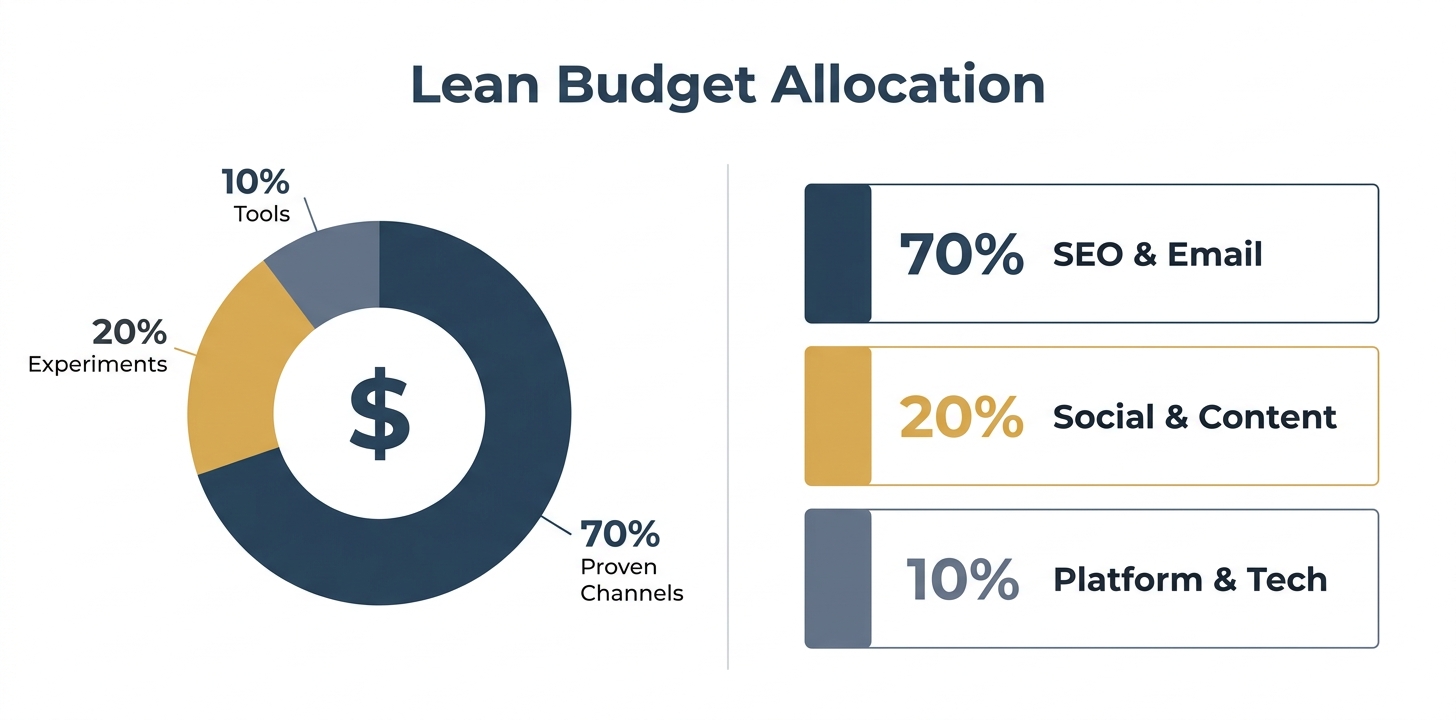
A lean startup marketing budget isn't about spending less. It's about spending smart. The goal is to put your limited dollars where they generate the most learning and the most growth, before you scale anything.
Start With Low-Cost, High-Impact Channels
When budget is tight, the best starting points are channels that compound over time. Content marketing, SEO, and community building don't stop working the moment you stop paying. They keep pulling in the right people long after the initial effort.
Paid ads are useful for testing, but they're not a foundation for lean growth. They stop the moment your budget runs out. Owned channels like a blog, an email list, or an active presence in the communities your buyers hang out in keep delivering returns for months or even years.
For a startup with limited funds, this distinction matters more than almost anything else in your strategy.
A Simple Budget Allocation Framework
Once you know which channels to focus on, the next question is how to split your budget. A practical framework used by many early-stage teams looks like this:
| Budget Bucket | Allocation | What It Covers |
|---|---|---|
| Proven channels | 70% | Channels already showing real results |
| Experimental channels | 20% | Testing one or two new ideas |
| Tools and tech | 10% | Email software, analytics, basic design |
The 70% goes to what's already working. Don't abandon a channel that's converting just to chase something new. The 20% keeps you learning. Pick one experiment at a time and run it long enough to get real data. The 10% covers the tools you need to operate without overspending on software you don't yet need.
If you're working with under $1,000 a month, practical guidance from budget-focused marketing resources suggests putting roughly $200 to $500 toward one channel of paid testing, keeping the rest for content creation, landing page assets, and email tools. Narrow focus beats spreading spend thin.
Justify Every Dollar With CAC and LTV
The cleanest way to decide how much to spend on marketing is to connect it directly to your unit economics. Two numbers matter most: Customer Acquisition Cost (CAC) and Lifetime Value (LTV).
CAC tells you what it costs to win one customer. LTV tells you how much that customer is worth over time. When LTV is at least three times your CAC, your marketing spend is sustainable. When it's less than that, you're likely spending more to acquire customers than you'll ever earn back.
The formulas are straightforward:
- CAC = Total sales and marketing spend divided by new customers acquired in the same period
- LTV = Average revenue per customer multiplied by gross margin, divided by monthly churn rate
For example, if you spend $5,000 on marketing in a month and acquire 50 new customers, your CAC is $100. If those customers pay $30 a month, your gross margin is 70%, and your monthly churn is 5%, your LTV is $420. That's a 4.2x LTV:CAC ratio, which is healthy.
According to Wall Street Prep's breakdown of CAC fundamentals, this ratio is one of the most widely used benchmarks investors and operators use to evaluate whether a startup's growth is economically sound.
Track the Right Numbers Weekly
You don't need a complex dashboard. You need a small set of numbers that tell you if your budget is working. Here's a minimal but effective tracking setup:
| Metric | What It Tells You |
|---|---|
| CAC by channel | Which channel acquires customers most cheaply |
| LTV:CAC ratio | Whether your spend is sustainable |
| Conversion rate | Whether traffic is turning into customers |
| Cost per lead | Whether top-of-funnel spend is efficient |
Check these weekly. When CAC rises without a corresponding increase in LTV, that's your signal to pause or adjust. When a channel's cost per lead drops while conversion holds steady, that's your signal to put more behind it.
Lean budgeting isn't a permanent constraint. It's a discipline that teaches you which channels actually work before you pour serious money into them.
Choosing Your Channels: Where to Execute Your Startup Marketing Strategy
The best startup marketing strategy picks two or three channels and commits to them fully. Spreading effort across every platform at once leads to weak results everywhere. The goal is to find where your ICP actually spends time, then show up there consistently with real value.
Here are the three channels that give early-stage startups the highest return for their effort.
Content Marketing and SEO: Build a Long-Term Asset
Content marketing and SEO are the closest thing to a compounding interest account in marketing. You write a helpful article or guide once, and it keeps attracting the right people for months or even years after you publish it.
This matters especially for startups with tight budgets. B2B content marketing benchmarks from businessignites.com show content marketing generating roughly $47 cost per lead compared to $121 for paid ads. That gap adds up fast when every dollar counts.
Start with a small number of high-quality posts that directly address the problems your ICP is already searching for online. One well-researched, genuinely useful article will outperform ten thin posts every time.
SEO takes time to kick in, usually three to six months before you see meaningful organic traffic. But once it starts working, it doesn't stop when you stop spending. That's the core advantage over paid channels.
Community and Social Media: Go Where Your Buyers Already Are
You don't need a massive following to get traction on social media. You need to be in the right conversations. That means showing up in the communities, forums, and social platforms where your specific ICP hangs out.
For B2B startups, that might mean LinkedIn or niche Slack groups. For consumer products, it could be Reddit, Discord, or Instagram. The platform matters less than whether your buyers are actually there.
The approach is simple: be helpful before you're promotional. Answer questions, share real opinions, and contribute something useful to the conversation. When your product finally comes up, people already know and trust you.
Community engagement also gives you a constant stream of honest feedback. You'll hear objections, frustrations, and language your buyers use naturally, which directly improves your messaging.
Email Marketing: Own the Channel You Can't Lose
Email is the only marketing channel you fully own. Social media algorithms change. Ad costs rise. But your email list stays yours, and the people on it already said they want to hear from you.
For startups, email serves two jobs at once. It nurtures leads who aren't ready to buy yet by keeping your product top of mind. And it retains customers by delivering ongoing value after the sale.
A simple weekly or biweekly email with genuinely useful content, a quick tip, a case study, or a product update keeps your audience warm without feeling like spam. The key is consistency and relevance, not volume.
Start building your list from day one. Even a small, engaged list of a few hundred people who match your ICP is worth more than thousands of unqualified followers on any social platform.
Picking the Right Mix for Your Stage
Not all three channels deserve equal attention at the same time. Here's a simple guide for prioritizing by stage:
| Stage | Primary Channel | Why It Fits |
|---|---|---|
| Pre-launch | Community and email | Low cost, high signal, direct feedback |
| Launch | Email and social media | Fast reach to warm audience |
| Post-launch growth | SEO and content | Compounds over time, lowers CAC |
The pattern here is intentional. Early on, you need speed and directness. Later, you need compounding and scale. Matching your channel mix to your current phase keeps you from spending money on strategies that don't fit where you are right now.
Measuring What Matters: KPIs for Your Startup Marketing Strategy
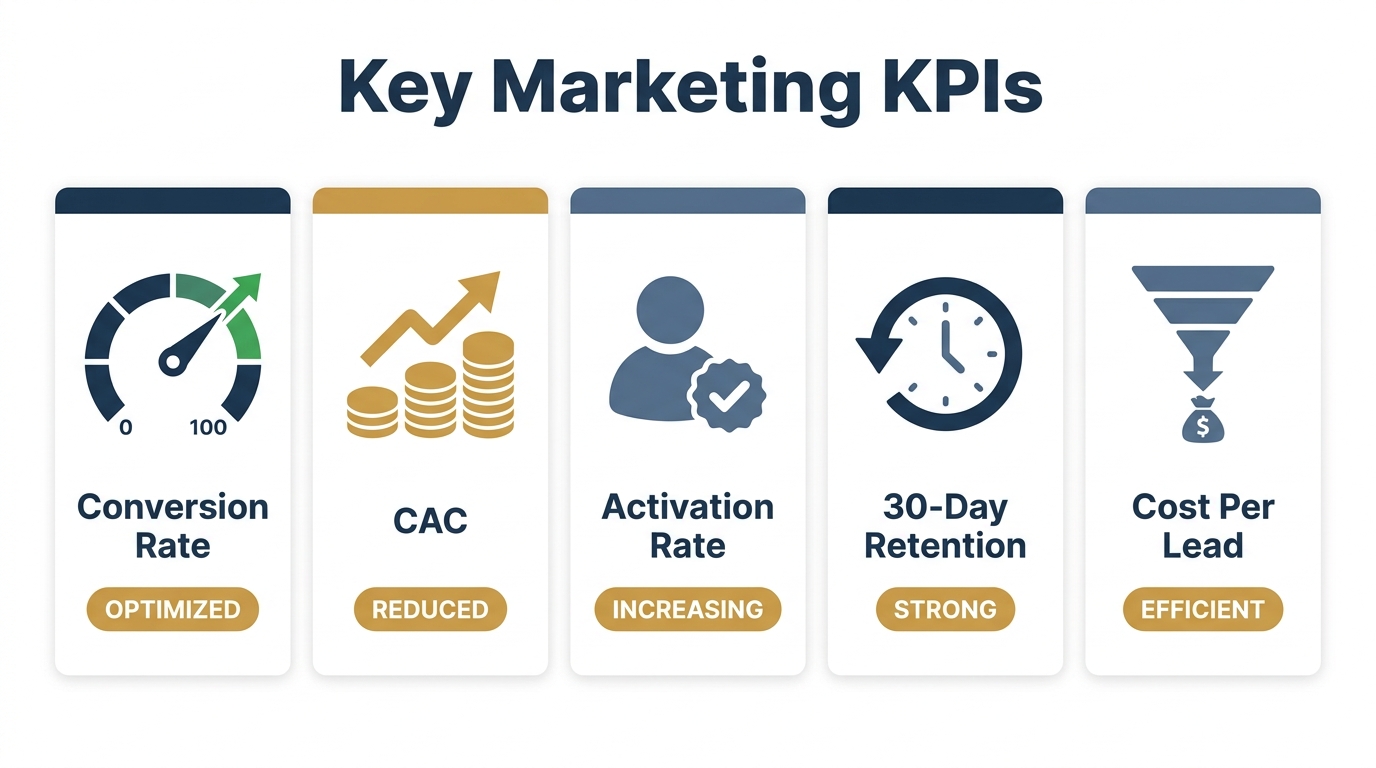
The fastest way to waste your marketing budget is to track the wrong numbers. Vanity metrics like total page views or social media followers feel good but don't tell you if your startup marketing strategy is actually working. Real measurement means watching a small set of numbers that connect directly to growth.
Skip Vanity Metrics, Track What Converts
Traffic alone doesn't pay the bills. A thousand visitors who never sign up is worse than a hundred who do. The metrics that matter are ones that show movement through your funnel: are people arriving, converting, and coming back?
Focus on these instead:
| Metric | What It Tells You | Why It Beats a Vanity Metric |
|---|---|---|
| Conversion rate | % of visitors who take the target action | More useful than raw traffic numbers |
| Customer Acquisition Cost | Cost to win one paying customer | Shows if spend is sustainable |
| Activation rate | % of signups who reach first value | Reveals onboarding quality |
| 30-day retention | % of users who return after a month | Shows whether the product sticks |
| Cost per lead | Spend divided by leads generated | Diagnoses top-of-funnel efficiency |
Pick three to five of these. Check them weekly. Don't add more until you've mastered the ones you have.
Build a Simple Marketing Dashboard
You don't need expensive software to track your startup marketing strategy. A shared spreadsheet works fine at the early stage. What matters is consistency, not complexity.
Free tools like Google Analytics handle website traffic and conversion tracking. Mixpanel or PostHog work well for product-level behavior like activation and feature engagement. Your email platform likely already shows open rates, click rates, and unsubscribes.
A minimal dashboard has three rows. The top row shows your core KPIs with a number and the change from last week. The middle row shows one trend chart for traffic and one for conversions. The bottom row breaks down performance by channel so you can see which source is working hardest.
That's it. Simple beats elaborate every time at the early stage.
Use Data to Iterate, Not Just Report
Data is only useful if it changes what you do next. Treat your startup marketing strategy like a series of small experiments. Each week, you form a hypothesis, run the test, check the numbers, and adjust.
If conversion rate drops, check your landing page copy and your traffic source quality. If retention falls, look at your onboarding flow and your first-week email sequence. If CAC rises without a corresponding lift in LTV, pause the expensive channel and double down on what's cheaper.
According to startup failure research from The RCKT, weak marketing execution and poor measurement are among the most common reasons startups stall after launch. The fix isn't more tactics. It's clearer feedback loops.
The goal isn't a perfect dashboard. It's a habit of looking at the right numbers, asking why they moved, and making one focused change at a time.
Build Your Next Growth Engine with the Right Strategy
A solid startup marketing strategy always starts with foundations, not tactics. Know your ICP. Nail your UVP. Set goals you can actually measure. Get those three things right, and every tactic you try has a real chance of working.
The biggest shift most founders need to make is treating their strategy as a living document, not a one-time plan. Your ICP will sharpen as you talk to more customers. Your messaging will improve as you see what actually converts. Your channel mix will evolve as you move from pre-launch to growth.
That's not a sign something is broken. That's the strategy working.
According to startup statistics compiled by Whatsthebigdata, about 22% of startups fail due to ineffective marketing strategies. That's not a budget problem or a product problem. It's a direction problem, and it's entirely avoidable with a clear plan.
The pattern across every phase covered in this article is consistent. Strategy comes first. Tactics follow. And data tells you when to adjust.
Your Action Plan for This Week
Don't let this stay theoretical. Here's one focused task to start with:
Define your ICP and UVP using the frameworks above.
Specifically:
- Write down the exact type of company or person most likely to buy from you (industry, size, role, problem)
- Write one sentence that completes this prompt: "We help [specific audience] achieve [specific outcome] in [specific timeframe]"
- Check whether that sentence is specific enough to stop the right person mid-scroll
If you can do those three things clearly, you have the core of a startup marketing strategy worth building on. Everything else, the channels, the budget, the campaigns, flows from knowing exactly who you're helping and why they should care.
Start there. The rest will follow.
Questions to Ask Yourself Right Now
- Can I clearly describe the exact type of company or person most likely to buy from me, including their industry, role, budget, and the specific problem they need solved?
- Does my UVP answer this in one sentence: We help [specific audience] achieve [specific outcome] in [specific timeframe], and is it specific enough to stop the right person mid-scroll?
- Which three to five KPIs directly connect to my current stage, and am I checking them weekly to know when the numbers move and why?
- Am I spreading my limited marketing budget across too many channels, or am I committing 70% to what's already working and 20% to one focused experiment?
- Is my LTV at least three times my CAC, and if not, what is the most expensive part of my acquisition funnel that I can improve or cut this week?

What is the best marketing strategy for a startup? There is no single best strategy since the right approach depends on your product, audience, and stage. However, a great starting point for most startups is combining content marketing to build authority and organic traffic via SEO with direct community engagement to get early feedback and users.
How do you market a startup with no money? Focus on channels that require time instead of budget. Create valuable content that solves your ICP's problems, engage in online communities where your ICP hangs out (Reddit, Slack, Facebook Groups), build in public on platforms like Twitter or LinkedIn to attract an audience, and actively seek out early users for testimonials and word-of-mouth.
How do you create a marketing plan for a new startup? Follow these steps: define your Ideal Customer Profile and Value Proposition, set clear measurable goals (KPIs), choose one to two marketing channels to start with instead of spreading yourself thin, outline your activities for the pre-launch and launch phases, and set a lean budget with a plan for measuring success.
What is Product-Led Growth and is it a marketing strategy? Yes, Product-Led Growth (PLG) is a powerful marketing and business strategy where the product itself drives customer acquisition, conversion, and expansion. It relies on a great user experience, freemium or free trial models, and viral features like sharing or collaboration to grow the user base, as seen with companies like Slack, Calendly, and Dropbox.
How soon should a startup hire a marketing person? It depends on the founder's skillset. If a founder has marketing experience, they can often manage it until after securing seed funding. If not, it's wise to bring on a marketing contractor or a versatile T-shaped marketer as soon as you have a validated product and are ready to move from the pre-launch to the launch phase.