
Hannon Brett | Published on: July 26, 2026 | Time to read: 28 min | Updated on: August 31, 2026
Outsourced marketing cost is shaped by scope of services, industry competitiveness, strategic partnership level, and specialized expertise, with most small to mid-sized businesses investing between $3,000 and $10,000 per month. Understanding pricing models (retainer, project-based, hourly, and performance-based) and the full cost picture including hidden expenses like ad spend, setup fees, and tools is essential for making smart outsourcing decisions.
When compared to building an in-house team, outsourcing typically delivers a full marketing department for the cost of one or two salaries, making it a financially efficient choice for businesses that need broad capability without fixed overhead.
Key Takeaways
- Outsourced marketing cost typically ranges from $3,000 to $10,000 per month for small to mid-sized businesses, driven by scope, industry competitiveness, speed expectations, and level of strategic partnership.
- Monthly retainers are the most common pricing model, offering predictability and continuity, with packages ranging from $1,000 to $15,000+ per month depending on complexity.
- Building an in-house marketing team costs far more than most expect: a Marketing Manager alone averages $161,030 in salary, with fully loaded costs reaching 1.25x to 1.4x that amount when benefits, taxes, and overhead are included.
- Hidden costs like ad spend (billed separately), onboarding fees, major content production, software licenses, and scope creep can add 14% to 60% to your effective monthly spend if not planned for.
- ROI benchmarks for B2B marketing typically target 5:1 ($5 back for every $1 spent), while e-commerce often aims for 4:1 ROAS, with tracking KPIs like CAC, LTV, cost per lead, and lead-to-customer rate essential for measuring success.
Table of Contents
- What Really Drives Outsourced Marketing Cost?
- A Breakdown of Common Outsourced Marketing Pricing Models
- In-House vs. Outsourced Marketing Cost: A Full Comparison
- What to Expect at Different Outsourced Marketing Budget Levels
- The Hidden Costs When You Outsource Marketing
- How to Calculate the ROI on Your Outsourced Marketing Cost
- Is Outsourcing Marketing the Right Financial Move for You?
What Really Drives Outsourced Marketing Cost?
Outsourced marketing cost isn't just about how many hours an agency works. It's about the value they create, the complexity of your market, and the type of relationship you want. Most small to mid-sized businesses pay between $3,000 and $10,000 per month, but that range tells only part of the story.
So what actually moves the needle on price? Let's break it down.
Scope of Services Changes Everything
A basic SEO retainer looks nothing like a full-funnel campaign running paid ads, content, email, and social all at once. The more channels you add, the more people, tools, and time are involved.
According to agency pricing benchmarks from WebFX, SEO retainers typically run $1,500 to $5,000 per month, while paid media management can add another $2,500 or more on top of that. Stack a few services together and you can see how costs climb fast.
Each added service isn't just more work. It's more coordination, more reporting, and more strategy.
Your Industry's Competitiveness Sets the Floor
Marketing a B2B SaaS company is a very different job than marketing a local bakery. Competitive industries have higher ad costs, harder keywords to rank for, and buyers who need more convincing before they act.
If you're in a crowded space like insurance, legal services, or enterprise software, expect to pay more. Not because agencies are charging extra for fun, but because the work genuinely requires more skill and effort to cut through the noise.
A local service business might do well with a $2,000 to $3,000 monthly retainer. A B2B tech company going after national clients will likely need $7,500 to $15,000 or more to compete effectively.
Speed of Results Affects the Price Tag
Want results in 60 days? That costs more than a slow-burn content strategy built over 12 months. Fast results usually mean paid ads, aggressive testing, and senior attention from day one.
Longer-term plays like SEO and organic content are cheaper monthly but take time to pay off. The timeline you're working with shapes what kind of help you actually need.
Strategic Partner vs. Task Executor
This is the biggest cost factor most buyers overlook. There's a real difference between an agency that executes a list of tasks you hand them and one that helps you decide what to do in the first place.
A task executor runs your ads, posts your content, and sends you a report. A strategic partner looks at your business goals, spots problems in your funnel, and recommends what to cut, change, or scale.
That second type of relationship costs more. But it often delivers better results because the decisions behind the work are smarter.
As one agency pricing guide from ClicksGeek puts it, retainer costs rise significantly when clients move from execution-only packages into accounts that include dedicated strategy and senior-level oversight.
Expertise and Specialization Add a Premium
A generalist agency that handles any client in any industry charges differently than one that only works with, say, e-commerce brands or healthcare companies.
Specialized agencies know your buyer, your competitors, and what works in your space. That shortens ramp-up time and usually means better results faster. But that knowledge comes at a price.
The same logic applies at the skill level. A specialist in conversion rate optimization or marketing automation typically bills at $100 to $200 per hour, well above what a general content writer or social media manager commands.
When you're comparing quotes, check whether you're paying for a team of specialists or a generalist shop. The monthly number might look similar, but the expertise behind it can be very different.
A Breakdown of Common Outsourced Marketing Pricing Models

Understanding outsourced marketing cost starts with knowing how agencies charge. There are three main pricing models most agencies use, and each one fits a different type of business need. Picking the wrong model can leave you overpaying or getting less than you expected.
Monthly Retainer: The Most Common Model
A monthly retainer means you pay a set fee each month for ongoing marketing work. This is the most popular model because it gives both sides predictability. You know what you're spending, and the agency knows what they're building for you. If you're still setting the number rather than allocating it, start from the SaaS marketing budget by funding stage benchmarks and work back to a retainer you can defend.
For small businesses, retainers typically run between $1,000 and $5,000 per month for lighter packages. Mid-sized businesses with broader needs often land in the $5,000 to $15,000 range, according to FBD Agency's marketing pricing guide.
The big advantage here is the relationship. A retainer creates continuity. The agency learns your brand, your audience, and your goals over time. That institutional knowledge is hard to replicate with one-off engagements.
The downside? If your marketing needs slow down during certain months, you're still paying the same rate. Retainers work best when you need consistent, ongoing work rather than occasional bursts.
Project-Based: Good for Clear, One-Time Needs
Project-based pricing means you pay a flat fee for a defined deliverable. Think a website launch, a brand refresh, a product launch campaign, or a one-time SEO audit.
This model works well when you have a specific goal with a clear start and end date. You agree on the scope, the deliverables, and the price upfront. No surprises, no ongoing commitment.
But scope creep is the real risk here. If the project grows beyond the original agreement, costs can climb fast. Strong contracts with clear deliverables and revision limits protect both sides.
Project fees vary widely by scope. A single landing page build might cost a few thousand dollars. A full website redesign with strategy and content could run $15,000 to $50,000 or more depending on complexity.
Hourly Rate: Flexible but Unpredictable
Some agencies and freelancers bill by the hour. This can work well for consulting, audits, or advisory work where the scope isn't fully defined upfront.
Hourly rates for general digital marketing work average around $82 to $150 per hour depending on the agency size and specialty. Specialized skills like conversion rate optimization can push into the $100 to $200 per hour range, with senior consultants sometimes charging more, according to data from Convert Experiences on CRO agency pricing.
The flexibility is nice. But the unpredictability is a real challenge for budget planning. Hours can add up fast, and it's hard to know the total cost before the work is done.
Hourly billing is best for short advisory engagements, not long-term ongoing marketing work.
Performance-Based: An Emerging Alternative
Performance-based pricing is less common but growing in use. Instead of a flat fee, the agency earns compensation tied to results. That might mean a cost-per-lead arrangement, a percentage of revenue generated, or a bonus structure tied to hitting specific targets.
This model can align incentives well. The agency only wins when you win. But it also introduces complexity. Attribution can get messy, and not every marketing channel produces results that are easy to track directly to a sale.
Performance-based deals tend to work best for businesses with clear, trackable conversion paths, like e-commerce brands, lead generation companies, or businesses with short sales cycles.
Real-world results back up the potential. One performance-based lead generation program delivered a 680% increase in leads alongside a 79% drop in cost per acquisition, according to a case study featured on Billo's performance marketing research.
But not every agency offers this model. It requires both parties to agree on attribution, reporting, and what counts as a qualified lead or conversion before any work begins.
Comparing the Four Models Side by Side
| Pricing Model | Best For | Typical Cost Range | Key Risk |
|---|---|---|---|
| Monthly Retainer | Ongoing, multi-channel work | $1,000 to $15,000+/month | Paying for slow months |
| Project-Based | One-time campaigns or builds | Varies widely by scope | Scope creep |
| Hourly Rate | Consulting or audits | $75 to $200+/hour | Unpredictable total cost |
| Performance-Based | Trackable lead or revenue goals | % of revenue or per lead | Attribution disputes |
Most businesses start with a retainer once they've identified a clear ongoing need. But knowing all four models helps you ask better questions when evaluating agencies and negotiating contracts.
Real-World Performance Marketing Success
Hiro Systems partnered with a performance-based marketing agency and saw a 680% increase in leads alongside a 79% decrease in cost per acquisition within their first year. This case demonstrates how performance-based pricing, where agency compensation ties directly to measurable outcomes, can align incentives and deliver breakthrough results for businesses with clear, trackable conversion paths.
In-House vs. Outsourced Marketing Cost: A Full Comparison
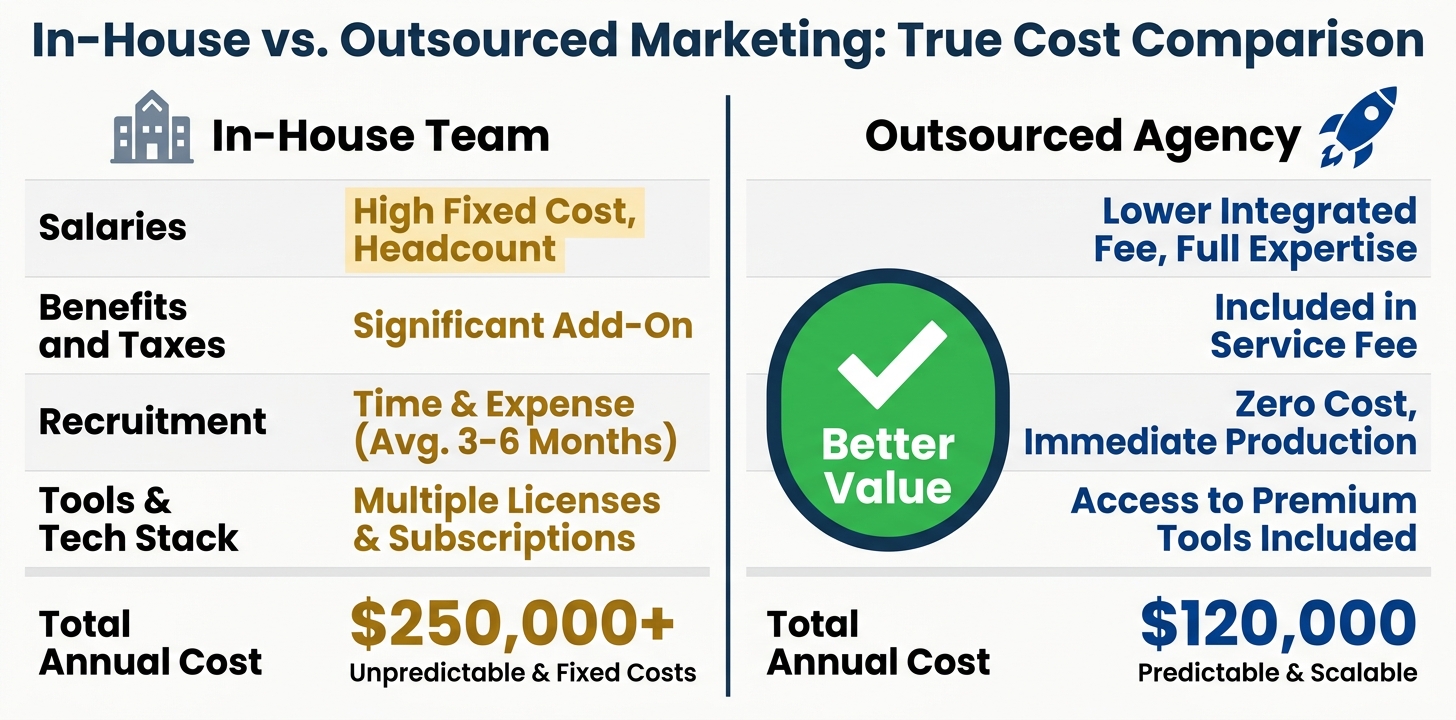
When comparing in-house vs. outsourced marketing cost, the numbers are rarely equal. Building an internal team costs far more than most businesses expect once you factor in benefits, taxes, and tools. An agency retainer, by contrast, gives you a full team for roughly the price of one or two salaries.
The True Cost of Hiring In-House
Most business owners look at a salary and think that's what hiring costs. But salary is just the starting point.
The U.S. Bureau of Labor Statistics reports the median annual wage for a Marketing Manager at $161,030. But that's just base pay. The fully loaded cost of an employee includes payroll taxes, health insurance, a 401(k) match, paid time off, and recruitment fees.
A standard industry multiplier puts fully loaded employee cost at roughly 1.25x to 1.4x base salary, according to Vena Solutions' employee cost research. So a $161,000 marketing manager can easily cost $200,000 to $225,000 or more per year when everything is added up.
And that's one person. A functional in-house team needs multiple roles:
- A marketing manager or director
- An SEO specialist
- A paid media or PPC manager
- A content writer
- A designer or creative resource
Each hire brings its own fully loaded cost. Add software subscriptions, tools, training, and hardware, and the annual budget for a small in-house team can easily push past $500,000 to $600,000 per year.
What You Actually Get With an Agency
Here's where the math shifts. A mid-tier agency retainer running $5,000 to $10,000 per month, or $60,000 to $120,000 per year, gives you access to a full team.
That team typically includes strategists, SEO specialists, paid media managers, designers, and copywriters. You're not paying one person. You're paying for the output of a coordinated group with shared tools and infrastructure already in place.
For the cost of one senior marketing manager, you can often access an entire agency team with cross-channel expertise. That's a significant value difference, especially for small and mid-sized businesses that can't afford to staff every discipline in-house.
The Non-Financial Costs Worth Considering
Salary comparisons don't tell the whole story. There are real time and flexibility costs that affect the decision too.
Speed to market: Hiring takes time. Between posting a job, interviewing, negotiating offers, and onboarding, filling a marketing role can take three to six months. An agency can start in weeks.
Flexibility: Business needs shift. An agency lets you scale services up or down based on budget cycles, campaign needs, or growth phases. A full-time employee is a fixed cost regardless of whether you need them at full capacity every month.
Turnover risk: If a key in-house marketer leaves, your programs stop. Institutional knowledge walks out the door with them, and the replacement cycle starts over. An agency provides continuity because the account is held by a team, not an individual.
Side-by-Side Cost Comparison
| Cost Factor | In-House Team | Outsourced Agency |
|---|---|---|
| Team of 3 to 5 specialists | $300,000 to $600,000+/year | $60,000 to $120,000/year |
| Benefits and payroll taxes | Add 25% to 40% on top | Included in retainer |
| Recruitment and onboarding | $5,000 to $30,000 per hire | None |
| Tools and software | Additional monthly cost | Usually included |
| Time to start | 3 to 6 months | Weeks |
| Flexibility | Fixed cost | Scalable |
| Turnover risk | High | Low |
The comparison makes a strong case for outsourcing, particularly for businesses that need broad marketing capability without the overhead of a fully staffed department.
That said, in-house teams have real advantages too. Deep brand knowledge, faster internal communication, and tighter alignment with product or sales teams are genuine benefits. Some businesses reach a size where building internal capacity makes more sense, often layering an agency on top for specialized support rather than replacing one with the other.
The outsourced marketing cost often wins on pure dollars spent. But the right choice depends on your growth stage, how much strategic direction you need to provide, and whether your marketing needs are consistent enough to justify full-time headcount.
What to Expect at Different Outsourced Marketing Budget Levels
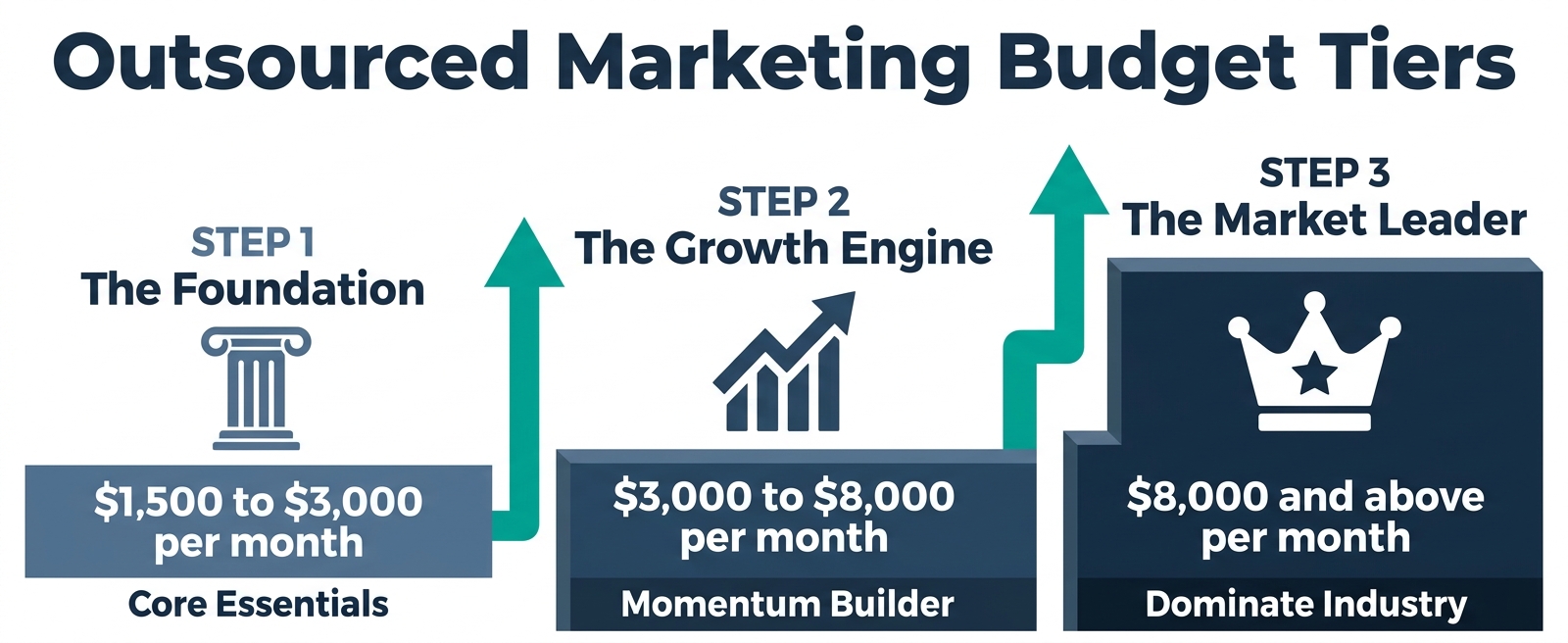 Your outsourced marketing budget directly shapes what kind of help you can get. Spend too little and you get limited execution with no real strategy. Spend in the right range for your goals and you unlock real growth potential. Here's a simple breakdown of what each budget tier typically delivers.
Tier 1: The Foundation ($1,500 to $10,000 per Month)
At this budget level, you're paying for one core service done well. Think foundational SEO, basic social media management, or a simple content program. You're not getting a full team or a multi-channel strategy.
This tier works best for small businesses just getting started with outsourced marketing. The goal is to build one solid channel before adding more complexity.
Expect monthly reporting, basic optimization, and execution-focused work. Strategy is limited at this level. Most of the decisions will still come from you. But for a local business or a startup testing the waters, this is a reasonable entry point.
Tier 2: The Growth Engine ($5,000 to $12,500 per Month)
This is where most small to mid-sized businesses find their footing. At this range, you can combine two or three services. Common pairings include SEO plus content marketing, or paid ads plus conversion rate optimization.
According to agency pricing data from Tom Wardman's marketing retainer breakdown, packages in the $3,000 to $5,000 per month range typically cover dedicated management, regular strategy sessions, and multi-channel reporting. That's a meaningful step up from pure execution.
You also start getting more strategic input at this level. An account manager or strategist is usually part of the picture, helping you prioritize what to focus on next.
For most growing businesses, this tier offers the best balance between cost and output.
Tier 3: The Market Leader ($15,000+ per Month)
At $8,000 per month and above, you're not just buying services. You're buying an outsourced marketing department.
This tier typically includes a fully integrated, multi-channel strategy. Paid ads, SEO, content, email, and analytics all work together under one coordinated plan. You get senior-level strategists, regular executive check-ins, and proactive recommendations tied directly to your business goals.
The Starr Conspiracy's B2B agency pricing benchmarks show that enterprise and growth-stage B2B companies commonly invest at this level when they need an agency to function as a true strategic partner, not just a vendor.This is the right tier for businesses competing in tough markets, scaling aggressively, or replacing what would otherwise be a full internal marketing team.
Budget Tier Summary
| Budget Tier | Monthly Range | What You Get | Best For |
|---|---|---|---|
| The Foundation | $1,500 to $10,000 | One core service, basic execution | Small businesses, startups |
| The Growth Engine | $5,000 to $12,500 | 2 to 3 services, strategic input | Growing SMBs |
| The Market Leader | $15,000+ | Full-funnel, multi-channel, C-level strategy | Scaling or competitive markets |
Knowing which tier matches your current stage helps you set realistic expectations before you ever talk to an agency. The right outsourced marketing budget isn't the biggest one you can afford. It's the one that matches what you actually need right now.
The Hidden Costs When You Outsource Marketing
The quoted retainer price is rarely the full picture. When you outsource marketing, the number on the proposal covers agency labor and account management. But several real costs sit outside that number, and they catch businesses off guard every year.
Knowing what to watch for before you sign protects your budget and your relationship with the agency.
Ad Spend Is Almost Never Included
This is the number one surprise for first-time outsourcers. When an agency quotes you a management fee for paid media, that fee covers their time to run the campaigns. It does not include the money that actually goes toward your ads.
Paid advertising budgets flow directly to the platforms, like Google, Meta, or LinkedIn. They're paid separately, on top of whatever the agency charges to manage them.
A business paying $4,000 per month in agency management fees might also be spending $8,000 to $20,000 per month directly in ad spend. Always ask what's included and what's billed separately before you compare quotes.
Setup and Onboarding Fees Add to the First-Month Cost
Many agencies charge a one-time onboarding or setup fee when a new client starts. This covers account audits, campaign builds, strategy sessions, and initial creative development.
These fees can range from a few hundred dollars to several thousand, depending on the scope of work. According to Growth Rocket's analysis of outsourced marketing costs, onboarding and ramp-up costs are among the most consistently overlooked expenses when clients calculate what outsourcing actually costs them.
Always ask whether a setup fee applies and what it covers before signing.
Major Content Assets Are Usually Out of Scope
A standard retainer covers ongoing content like blog posts, social copy, and email. But bigger production assets often fall outside that scope.
Video shoots, brand photography, animated explainers, and white paper design usually come with a separate project fee. These are legitimate production costs that require different skills and resources than a typical content calendar.
If video or high-production creative is part of your marketing plan, ask whether it's included or quoted separately. Assuming it's covered is a common and costly mistake.
Software and Tool Licenses Can Land on You
Agencies use a range of platforms to run campaigns: marketing automation tools, SEO platforms, analytics dashboards, CRM integrations, and reporting software. Some agencies bundle these into the retainer. Others do not.
Enterprise tools like HubSpot, Marketo, or Semrush carry meaningful monthly costs on their own. If the agency uses these tools on your behalf but doesn't cover the license, that cost falls to you.
Ask your agency directly: which tools are included in the retainer, and which ones require a separate license paid by the client? Get the answer in writing.
Scope Creep Adds Up Quietly
Scope creep is what happens when small requests pile up outside the original agreement. An extra landing page here, a rush turnaround there, a new channel added mid-quarter. None of it feels big in the moment. But each request outside the agreed scope is either eating into agency margin or getting billed back to you.
According to Cooperative Computing's outsourcing cost analysis, unplanned scope additions are one of the primary reasons clients see their effective monthly spend drift significantly above the retainer price they budgeted.
The fix is simple: make sure your contract defines the scope clearly, specifies revision limits, and outlines how out-of-scope requests are priced and approved. A well-written statement of work protects both sides.
A Quick Checklist Before You Sign
Before finalizing any agency agreement, get clear answers on these five questions:
- Ad spend: Is it included, or billed separately to you?
- Setup fees: Is there a one-time onboarding cost, and how much?
- Content production: Are video shoots or major creative assets covered?
- Tools and software: Which platforms are included, and which require a separate license?
- Out-of-scope work: How are requests outside the agreed scope priced and approved?
The retainer quote is the starting point. Your real monthly investment in outsourced marketing includes everything on that list.
Questions to Ask Before You Sign Any Agency Agreement
- What's included in the retainer, and what's billed separately (ad spend, tools, major creative assets)?
- Are there setup fees or onboarding costs in the first month, and what do they cover?
- How do you handle requests that fall outside the agreed scope, and how are they priced and approved?
- What KPIs will you track, how often will we review them together, and what benchmarks define success for our industry?
- Which marketing tools and software licenses are included in the retainer, and which require a separate license paid by the client?
How to Calculate the ROI on Your Outsourced Marketing Cost
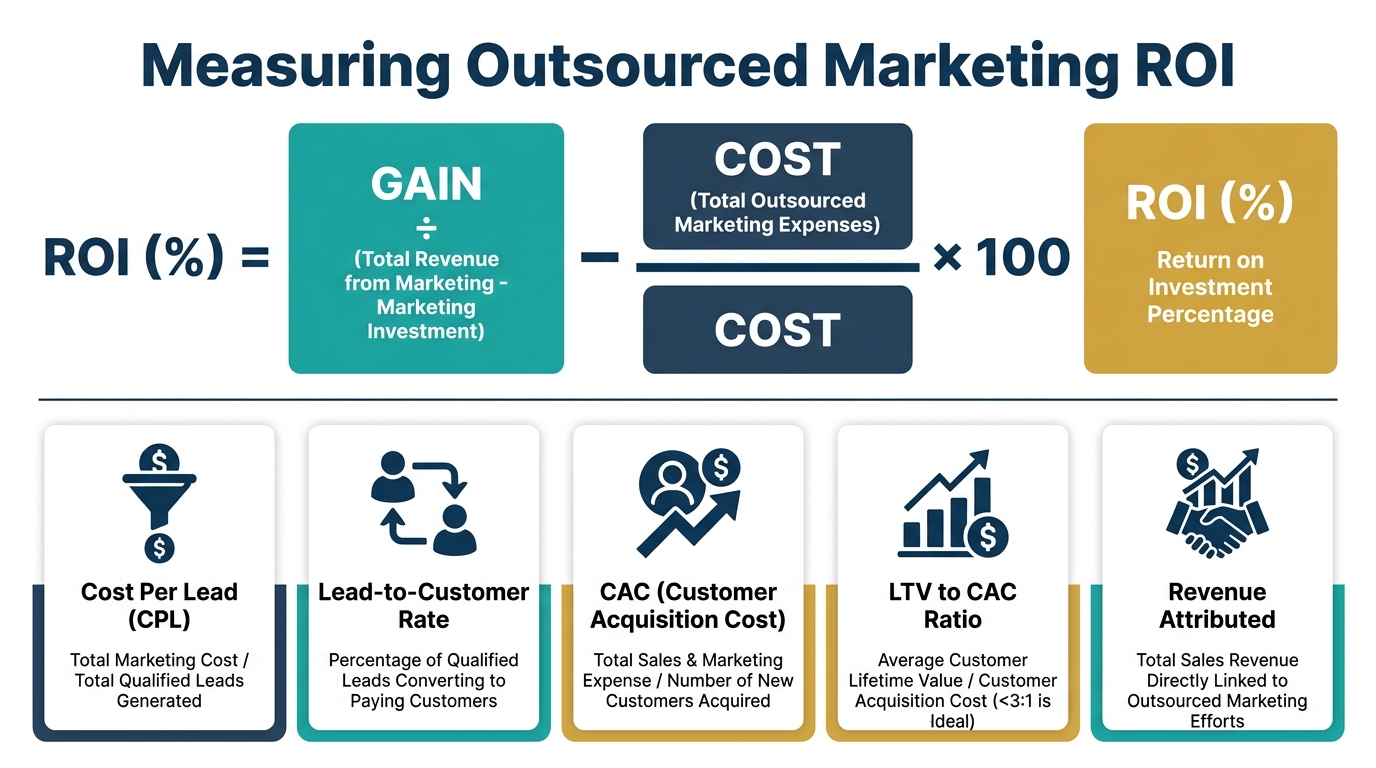
Outsourced marketing cost only makes sense when you can tie it back to results. The good news is you don't need a finance degree to do this. A simple ROI formula, the right KPIs, and a shared dashboard with your agency give you everything you need to know if the investment is working.
The Basic ROI Formula
The standard marketing ROI formula looks like this:
ROI = ((Gain from Investment - Cost of Investment) / Cost of Investment) × 100So if you spend $6,000 per month on an agency and that work generates $30,000 in new revenue, your ROI is 400%. That's a strong return by any measure.
But the math only works if you're honest about what counts as "gain" and what counts as "cost." Both sides of the equation need to be complete.
Don't Just Count Revenue. Count Lifetime Value.
Here's where most businesses undercount their returns. A new customer isn't just worth the first sale. They're worth every purchase they make over the entire relationship.
Customer Lifetime Value (LTV) gives you a more accurate picture. A simple formula used by many growth teams is:
LTV = Average Monthly Revenue per Customer × Gross Margin × (1 ÷ Monthly Churn Rate)For example, a customer paying $200 per month with an 80% gross margin and a 2% monthly churn rate has an LTV of $8,000. That one customer, acquired through your outsourced marketing program, is worth far more than their first payment.
Using LTV instead of first-sale revenue often flips the ROI calculation in your favor. According to Wall Street Prep's LTV framework, this gross-margin-adjusted formula is the standard starting point for businesses with recurring revenue or repeat purchase patterns.
What ROI Benchmarks Should You Aim For?
Knowing your formula is only half the job. You also need to know what "good" looks like.
For B2B marketing, a 5:1 return is widely considered a solid benchmark, meaning $5 back for every $1 spent. According to Directive Consulting's B2B marketing ROI benchmarks, a 3:1 to 5:1 return is healthy for most B2B programs, with 8:1 and above considered excellent depending on the channel and sales cycle length.
For e-commerce, a 4:1 return on ad spend is a common profitability target, though averages vary widely by margin structure and vertical.
If your outsourced marketing investment is hitting those ranges, you're in good shape.
Track the Right KPIs From Day One
ROI calculations only work if you're tracking the right inputs. Set these KPIs up before the agency starts work, not three months in.
The metrics that matter most:
- Cost Per Lead (CPL): How much are you paying to generate each new lead? This tells you if your acquisition cost is sustainable.
- Lead-to-Customer Rate: What percentage of leads actually convert to paying customers? A high CPL is fine if your close rate is strong.
- Customer Acquisition Cost (CAC): Total marketing spend divided by new customers acquired. This is the number you compare against LTV.
- LTV to CAC Ratio: A ratio of 3:1 or higher generally signals a healthy marketing program.
- Revenue Attributed to Marketing: How much new revenue can be tied back to specific campaigns or channels?
These five numbers, tracked consistently, give you a clear view of whether your outsourced marketing cost is paying off.
Build a Shared Dashboard With Your Agency
Tracking KPIs only works if both you and your agency are looking at the same numbers. A shared reporting dashboard removes ambiguity and keeps everyone accountable.
Ask your agency to set this up from the start. It should include the core KPIs above, updated at least weekly for paid channels and monthly for organic programs. When both sides can see the same data in real time, conversations shift from "what did you do this month" to "what does the data tell us to do next."
That shift is where outsourced marketing goes from a cost center to a growth engine.
Is Outsourcing Marketing the Right Financial Move for You?
Outsourcing marketing makes financial sense for most small and mid-sized businesses. You get a full team of specialists for less than the cost of one senior hire. But the right answer depends on your current stage, your budget, and how much strategic direction you need. Here's how to think it through.
Review What You've Learned Before Deciding
This guide has covered a lot of ground. Let's bring the key decision points together.
Building an in-house team costs far more than most business owners expect. A single marketing manager runs well over $160,000 per year in base salary alone. A full team covering SEO, paid media, content, and design can push your annual spend well past what most growing businesses can absorb.
An agency retainer gives you that same cross-channel coverage at a fraction of the cost. Most small businesses find their footing somewhere between $3,000 and $8,000 per month. That's a full team, not one person.
The scope of work matters too. If you need one channel managed consistently, a lighter retainer works. If you're running paid ads, content, SEO, and email all at once, you need more investment and more coordination.
And your growth stage shapes the whole equation. A startup testing its first marketing channel needs something very different from a scaling company trying to dominate a competitive market.
A Final Checklist Before You Decide
Use these questions to guide your thinking before talking to any agency.
Questions to ask yourself:- What's your actual monthly marketing budget, including ad spend?
- Do you need one focused channel, or multi-channel coverage?
- How much strategic input can you provide, and how much do you need from an outside partner?
- Is your primary goal brand awareness, lead generation, or revenue growth?
- Do you have the internal bandwidth to manage an agency relationship well?
- What's included in the retainer, and what's billed separately?
- Is ad spend included, or does it come out of a separate budget?
- Are there setup fees or onboarding costs in the first month?
- How do you handle requests that fall outside the agreed scope?
- What KPIs will you track, and how often will we review them together?
According to SHNO's retainer pricing research, the most common frustration clients report isn't the monthly fee itself. It's the surprise costs they didn't ask about upfront. A few good questions before signing protects your budget.
Start Here: Define Goals and Budget First
The best way to enter any agency conversation is with two things clear in your mind: what you want to achieve, and what you can realistically spend.
Write down your top two or three marketing goals. Be specific. "Get more leads" is vague. "Generate 50 qualified leads per month at a cost below $200 each" is a goal you and an agency can build a plan around.
Then set a realistic budget range, not just the retainer fee, but the full picture including ad spend, tools, and any setup costs.
With those two things defined, you'll have better conversations, pick the right pricing tier, and hold any agency accountable to outcomes that actually matter to your business.
Outsourced marketing cost is only a burden when the investment isn't tied to results. When it is, it's one of the most efficient growth levers a business can use.

Start with 7% to 12% of revenue as a planning baseline. For new businesses or those just beginning to outsource, an initial budget of $2,000 to $5,000 per month is a realistic starting point to see tangible results from one or two core channels like SEO or paid ads.
Is outsourcing marketing cheaper than hiring in-house?Yes, often significantly. When you factor in the fully loaded cost of an employee (salary, benefits, payroll taxes, software, training), outsourcing to an agency for access to a full team of specialists is frequently more cost-effective than hiring even one senior marketer. A $5,000 monthly retainer can deliver an entire cross-functional team for less than the cost of one in-house marketing manager.
What is a typical marketing retainer fee?Retainer fees vary widely but generally range from $2,000 per month for basic services from a small agency or freelancer, to $20,000+ per month for a comprehensive strategy from a large, full-service agency. Most small to mid-sized businesses find their fit between $3,000 and $10,000 per month depending on channel mix and strategic depth.
What does an outsourced marketing package typically include?Packages are based on your goals and budget but can include services like strategy development, SEO, content creation (blogs, social media), PPC ad management, email marketing, and analytics reporting. Higher-tier packages often add conversion rate optimization, marketing automation, creative production, and dedicated account management with regular strategy sessions.
Can I negotiate my outsourced marketing cost?Yes, to an extent. While top agencies don't heavily discount fees, you can often negotiate the scope of work to fit your budget, for example, asking for 2 blog posts instead of 4, or committing to a longer contract (such as 12 months versus 6) for a slightly reduced monthly rate. Clear scope definition protects both sides and prevents surprise costs.
What KPIs should be tied to the cost to prove value?The best KPIs tie directly to business objectives. Focus on metrics like Cost Per Acquisition (CPA), Customer Lifetime Value (LTV), lead-to-customer conversion rate, and overall marketing-influenced revenue, not just vanity metrics like traffic or impressions. A healthy B2B program typically targets 5:1 ROI, while e-commerce often aims for 4:1 ROAS.