Hannon Brett | Published on: August 12, 2026 | Time to read: 26 min | Updated on: August 31, 2026
For Series A fundraising, investors prioritize pipeline over MQLs because pipeline represents real buying intent and potential revenue, not just marketing interest. VCs want proof of a scalable, repeatable go-to-market motion backed by clean pipeline data, stable conversion rates, and forward momentum. Founders who can show 6 to 9 months of consistent pipeline growth with honest CRM data are far more likely to close their round.
Key Takeaways
- MQLs show marketing interest; pipeline shows commercial intent and potential revenue, which is what Series A investors actually fund
- VCs expect pipeline coverage of 3x to 4x your quarterly bookings target, with consistent stage progression and stable conversion rates
- Pipeline quality validates your ICP, proves your GTM motion is repeatable, and gives investors confidence that revenue is predictable
- Start building your pipeline 6 to 9 months before your raise to show momentum over time, not just a snapshot
- Clean CRM data, honest conversion rates, and consistent qualification processes are non-negotiable for Series A due diligence
- Investors look for pipeline momentum (deals moving through stages), not just pipeline size (total dollar value)
- Tell a story with your pipeline data: connect your commercial momentum to how you will deploy capital and generate revenue
Table of Contents
- MQL vs. Pipeline: The Core Debate for Series A Founders
- Why VCs Prioritize Pipeline Quality for Series A Investments
- Defining MQL and Sales Pipeline from an Investor's Perspective
- How to Build an Investor-Ready Pipeline for Your Funding Pitch
- Key Metrics to Showcase Your Pipeline Health to VCs
- Translating Pipeline Data into a Winning Series A Narrative
- Secure Your Series A by Proving Pipeline Momentum
MQL vs. Pipeline: The Core Debate for Series A Founders
For Series A fundraising, MQLs and pipeline are not the same thing. MQLs show marketing interest. Pipeline shows commercial intent and potential revenue. Investors at this stage want proof that people are ready to buy, not just curious about your product. That difference can make or break your raise.
What Each Metric Actually Tells You
An MQL is a lead that marketing has flagged as worth pursuing. It might be someone who downloaded a whitepaper or signed up for a webinar. There's interest there, but interest doesn't pay invoices.
Pipeline is different. It represents real opportunities with real buyers who are actively evaluating your solution. These are conversations with budget holders, not just curious visitors. That distinction matters enormously when you're sitting across from a VC.
How Investor Priorities Shift at Series A
At the seed stage, investors bet on vision. They're backing a founder's belief in a problem worth solving. The bar for proof is relatively low because the company is still early.
Series A changes that completely. Now investors want traction. They want to see that your go-to-market engine works, that customers are converting, and that revenue is repeatable. According to CRV's Series A metrics framework, investors expect evidence of a scalable commercial motion, not just early signals of demand.
MQLs belong to the seed conversation. Pipeline belongs to Series A.
Why This Distinction Can Win or Lose Your Round
When you're asking investors for millions to scale your GTM engine, they're essentially betting that you can turn fuel into forward momentum. Pipeline is that fuel. It tells a VC how much revenue is potentially incoming and whether your sales process is repeatable.
MQLs alone can't tell that story. Top-of-funnel activity is too easy to inflate. A startup can generate thousands of MQLs through paid ads or gated content, and still have zero paying customers.
Burkland Associates notes that Series A investors increasingly focus on quality of revenue over quantity, asking specifically about gross margins, net retention, and sales efficiency. These are pipeline-driven metrics, not MQL counts.The Real Question Investors Are Asking
When a VC asks about your sales motion, they're really asking: "Can this team generate, qualify, and close deals without heroics?" That answer lives in your pipeline data.
For founders raising Series A, especially those at early-stage B2B tech startups still building their GTM motion, this shift in framing is where preparation pays off. The goal isn't to hide your MQLs. It's to show how they convert into real pipeline, and how that pipeline converts into revenue.
That story, told with clean data and honest conversion rates, is what moves investors from interested to committed.
Why VCs Prioritize Pipeline Quality for Series A Investments
For Series A funding, pipeline quality is the single clearest signal investors use to judge whether your business can scale. A healthy, growing pipeline tells VCs that revenue is predictable, your ideal customer is well-defined, and your sales process works beyond a few lucky wins. MQLs alone can't tell that story.
Pipeline as a Leading Indicator of Revenue Predictability
VCs aren't just buying what you've built. They're buying what you're going to build with their capital. That means they need to see forward-looking signals, not just historical revenue.
Pipeline is that signal. When a VC looks at your pipeline, they're asking: how confident can I be that revenue next quarter is real? A strong pipeline with clear stage-by-stage progression gives investors a basis for valuation that MQL counts simply can't provide.
Tomasz Tunguz's sales implementation guide notes that investors expect founders to know their pipeline coverage requirements cold, including how many opportunities at each stage are needed to hit bookings targets. That level of clarity is what separates fundable companies from interesting ones.For early-stage B2B SaaS, the benchmark for healthy pipeline coverage sits around 3x to 4x your quarterly bookings target. That buffer accounts for natural deal slippage and gives investors confidence that your forecast isn't wishful thinking.
How Pipeline Validates Your ICP and GTM Motion
A pipeline isn't just a list of deals. It's a map of who actually buys from you, why they buy, and how they found you.
When VCs review pipeline data, they're looking for ICP consistency. If your closed deals come from wildly different company sizes, industries, or buyer personas, that's a signal your go-to-market strategy isn't focused yet. Focused pipeline tells a much cleaner story.
According to RatedRD Group's breakdown of what VCs actually look for, investors pay close attention to whether your pipeline reflects a deliberate customer acquisition strategy or a pattern of reactive selling. The former scales. The latter doesn't.
This is also where your GTM motion gets validated. If your pipeline shows consistent lead sources, predictable stage progression, and similar deal sizes, it tells investors that you know exactly who you're selling to and how to reach them.
Pipeline Momentum as Proof of a Repeatable Sales Process
One good quarter doesn't raise a Series A. Three consistent quarters might.
Investors look for pipeline momentum over time, not just a snapshot. They want to see that deals are moving, conversion rates are stable, and new opportunities are entering the funnel at a predictable pace. That pattern is the definition of a repeatable sales process.
Startupsmagazine's analysis of what kills Series A rounds flags "pipeline bloat" as a major red flag, where stalled deals pile up without progressing. VCs read this as a sign that the team is hoarding weak opportunities instead of qualifying them out. Clean, moving pipeline is a stronger signal than a fat pipeline that isn't converting.The questions VCs typically ask at this stage tell you exactly what they're probing for:
- What is your conversion rate from qualified opportunity to closed deal?
- How long is your average sales cycle, and is it getting shorter?
- Who is selling today, and can this motion scale beyond the founder?
- What pipeline coverage do you need to hit your next revenue target?
These aren't trick questions. They're a test of whether you understand your own sales engine well enough to double it with new capital.
For seed and Series A stage B2B tech startups that are still building their GTM motion, this is exactly where preparation separates funded founders from those who get a polite pass. Knowing your pipeline numbers cold, and being able to explain the story behind them, is what turns a VC conversation from interesting to investable.
Defining MQL and Sales Pipeline from an Investor's Perspective
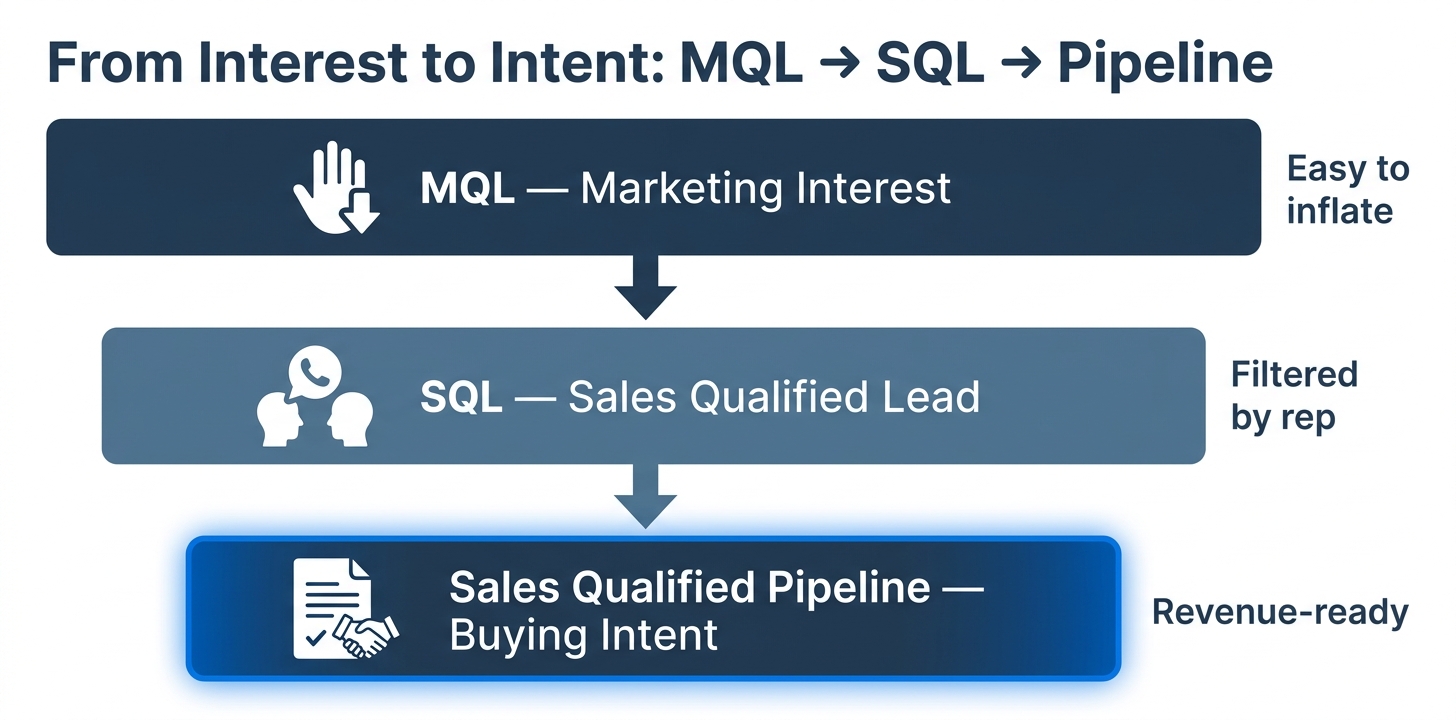
For Series A funding, an MQL is marketing interest. A sales pipeline is buying intent. Investors care about the second one. If you can't show qualified pipeline with real buyers moving toward a decision, no amount of top-of-funnel activity will close your round.
What an MQL Actually Tells a VC
An MQL, or Marketing Qualified Lead, is a contact that marketing has decided is worth a sales follow-up. Maybe they downloaded a guide, attended a webinar, or clicked on a paid ad. The bar for becoming an MQL is typically low.
That's exactly why VCs don't trust them on their own. MQL counts are easy to inflate. You can spend $20,000 on paid ads this month and show a spike in MQLs that has zero connection to revenue. Investors know this, and they'll push past that number fast.
The core issue is that an MQL lacks what's called BANT qualification. There's no confirmed budget, no verified authority to buy, no established need, and no timeline to close. It's a hand raise, not a commitment.
The Step Between: Sales Qualified Leads
A Sales Qualified Lead, or SQL, is an MQL that sales has accepted. A real human on your team has spoken with this contact and confirmed a few things: there's a legitimate problem your product solves, the person has some level of buying authority, and there's enough intent to justify moving forward.
This step matters because it filters out the noise. The conversion from MQL to SQL is where the quality of your go-to-market motion starts to show. According to B2B SaaS benchmark data from The Starr Conspiracy, the typical MQL-to-SQL conversion rate for B2B companies sits around 13 to 15 percent. If you're hitting that or better, it signals your marketing is attracting the right audience.
For investors, the MQL-to-SQL conversion rate is one early signal worth watching. But it still isn't where their attention lives.
Where Investor Interest Actually Begins: Sales Qualified Pipeline
Sales Qualified Pipeline is the total value of all active opportunities your sales team is currently working. These are deals that have moved past initial qualification, usually post-discovery call, where a real buying conversation has started.
This is where Series A investors pay attention. Pipeline represents potential revenue with real buyers who have shown intent. It's not theoretical demand. It's commercial motion.
When a VC looks at your pipeline, they're assessing three things at once:
- Size: Is there enough pipeline to hit your next revenue target, with room for natural deal slippage?
- Quality: Are the opportunities well-qualified, with defined timelines and budget holders involved?
- Momentum: Are deals progressing through stages, or are they sitting stalled and aging?
Top-tier investors see pipeline as a window into how well your GTM engine actually works. As Eqvista's breakdown of how top VC firms evaluate startups notes, leading investors focus on whether a company can demonstrate repeatable, capital-efficient customer acquisition, not just signs of early demand. Pipeline is the evidence they need.
Why This Three-Level Framework Matters for Your Pitch
Many founders walk into a Series A pitch ready to talk about leads and traffic. VCs want to talk about pipeline and close rates. That gap can quietly kill a raise.
Understanding the difference between MQLs, SQLs, and Sales Qualified Pipeline lets you tell a coherent revenue story. You can show how top-of-funnel activity converts, where it breaks down, and what your actual commercial engine looks like.
For B2B tech startups still building their GTM motion, this is exactly where outside support can help. A service like The Zulu Method is built for seed and Series A founders who need to move fast, get pipeline moving, and show investors a real commercial story without spending nine months and significant budget building an in-house team.
Knowing these definitions cold, and being able to walk a VC through your funnel with honest conversion data, is what separates founders who get a term sheet from those who get a follow-up email that never leads anywhere.
How to Build an Investor-Ready Pipeline for Your Funding Pitch
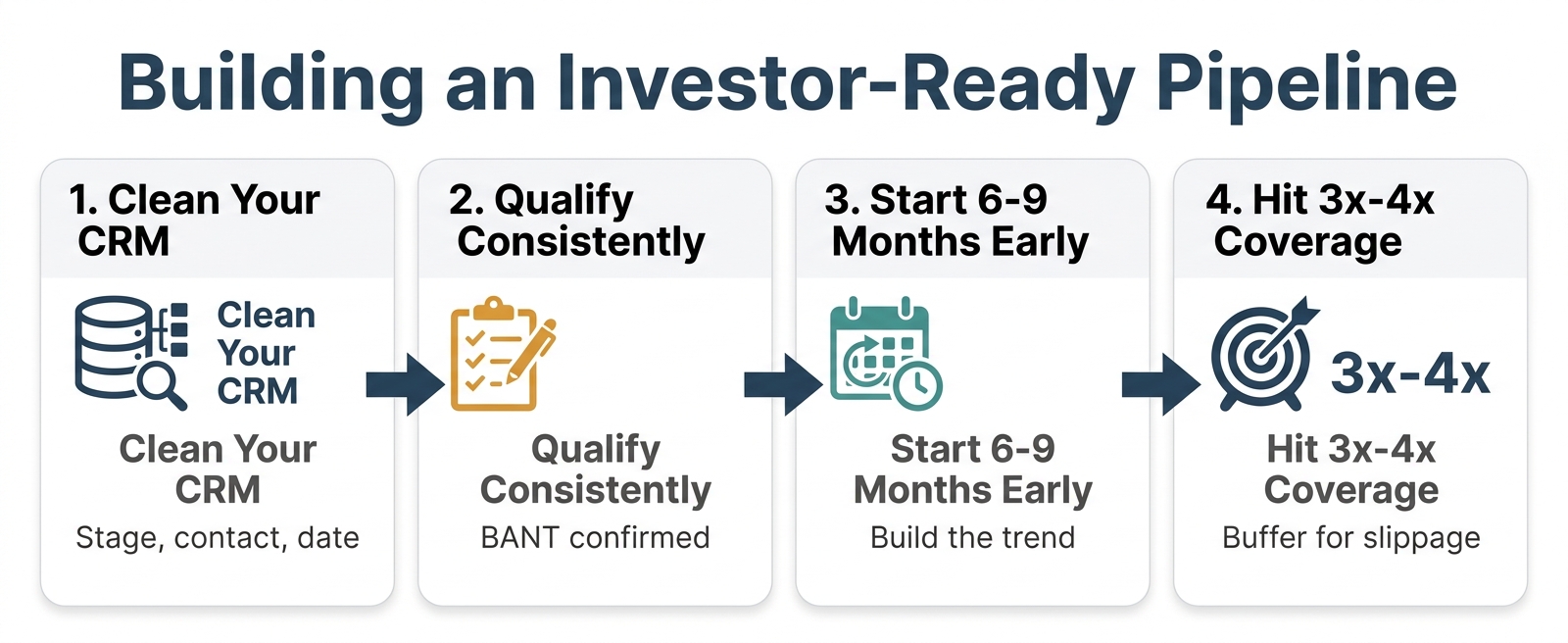
Building an investor-ready pipeline means showing VCs a clean, moving, well-qualified set of real deals before you ever walk into a pitch meeting. It's not about having the most leads. It's about having the right ones, tracked honestly, with data that tells a credible revenue story.
Start With a Clean CRM as Your Single Source of Truth
Your CRM is the first thing a VC will ask to see during diligence. If it's messy, outdated, or inconsistent, that's a signal about how you run your business.
Every deal in your pipeline should have a clear stage, a last activity date, an estimated close date, and a contact with verified buying authority. Deals missing this information hurt your credibility. According to Growth Decode's investor readiness framework, low CRM data quality signals poor adoption and unreliable forecasting, which is exactly what VCs are watching for.
Make it a weekly habit. Every rep updates every open deal. No exceptions. A clean CRM isn't a nice-to-have at Series A. It's a prerequisite.
Build a Consistent Qualification Process
Pipeline integrity depends on how deals get in and how they move through stages. Without a consistent qualification process, your pipeline becomes a mix of real opportunities and wishful thinking.
Use a simple qualification framework to decide which leads belong in your pipeline. Confirm there's a real problem your product solves, a person with buying authority, some level of urgency, and a rough timeline. If a deal can't clear that bar, it doesn't belong in the pipeline.
This discipline matters enormously for your pitch. VCs want to see consistent stage progression and stable conversion rates over multiple quarters. That pattern only shows up if your qualification process is the same every single time.
For seed and Series A founders still building their GTM motion, this is one area where outside help pays off fast. A service like The Zulu Method helps founders implement a repeatable outbound process with built-in qualification, so pipeline quality is high from day one.
Build Pipeline 6 to 9 Months Before You Raise
This is the part most founders get wrong. They start building pipeline when they start fundraising. By then, it's too late.
VCs want to see pipeline momentum over time, not just a snapshot. They want a consistent pattern of new opportunities entering the funnel, progressing through stages, and converting to revenue. That pattern takes months to build.
Start your outbound motion at least six to nine months before your target raise date. Diversify your channels: direct outbound, referrals, content, partnerships. Each channel gives you a different signal about demand and makes your lead sources more credible to investors.
Benchmark data on pipeline coverage for early-stage B2B SaaS suggests healthy coverage sits between 3x and 5x of your quarterly bookings target, with the range depending on your ACV and sales cycle length. Build toward that number early. Don't arrive at your pitch with a pipeline you assembled in the last 30 days.When you walk into a Series A pitch with six months of clean pipeline data, consistent conversion rates, and a CRM your investors can actually trust, you're not just telling a story. You're showing proof.
Key Metrics to Showcase Your Pipeline Health to VCs
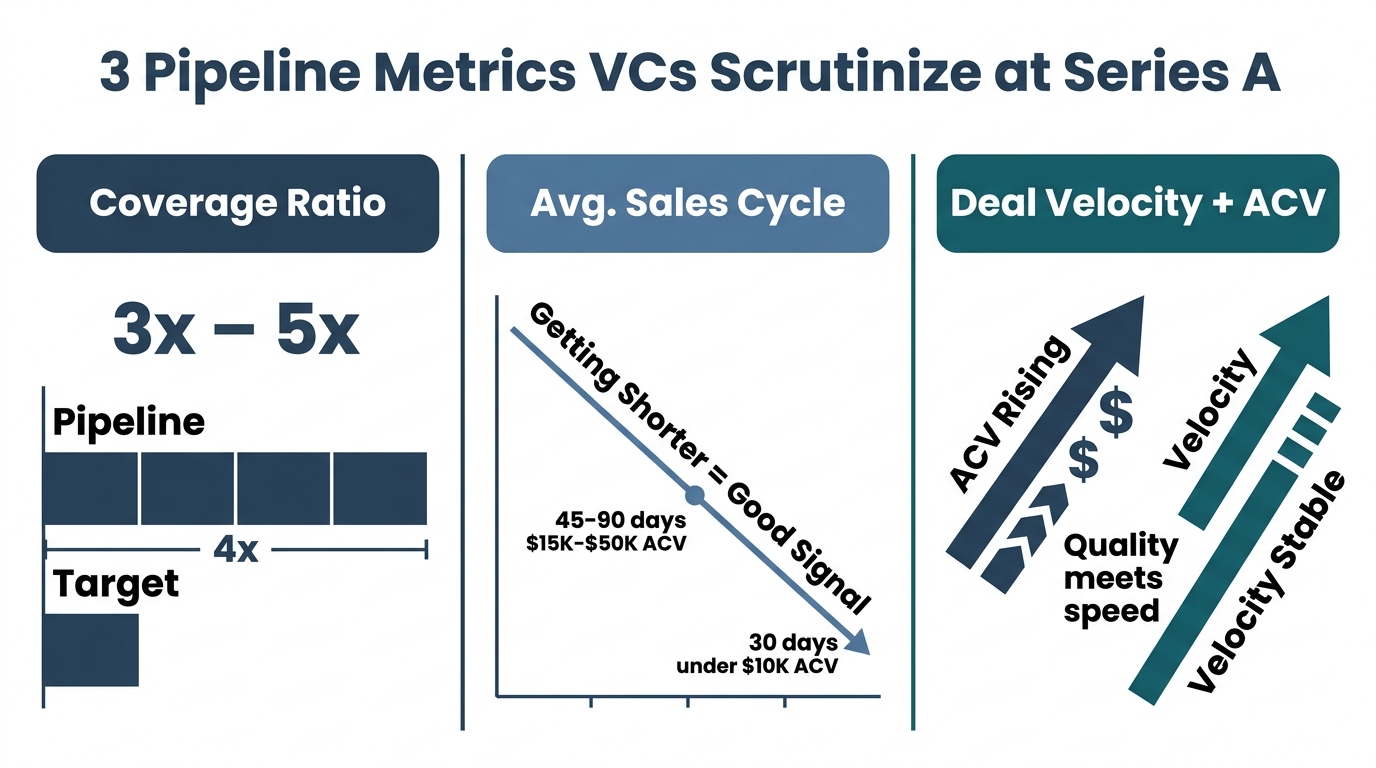
When VCs evaluate your pipeline for Series A funding, three numbers matter most: your pipeline coverage ratio, your average sales cycle length, and your deal velocity alongside average contract value. Together, these metrics tell investors whether your revenue is predictable, your sales process is repeatable, and your business is worth betting on.
Pipeline Coverage Ratio: The Safety Net Investors Want to See
Pipeline coverage ratio is simple to calculate: divide your total open pipeline value by your revenue target for the same period. If you're trying to close $500K this quarter and your pipeline shows $2M in active deals, your coverage ratio is 4x.
For Series A B2B SaaS companies, the widely cited benchmark sits between 3x and 5x of your quarterly bookings target. According to pipeline coverage benchmark data from Ven.Studio, early-stage teams with less predictable win rates should aim for the higher end of that range to account for natural deal slippage.
Why does this ratio matter so much to investors? Because it tells them how much buffer you have between what's in your pipeline and what you actually need to close. A 1x or 2x ratio says you're one lost deal away from missing your target. That's not a story that funds well.
VCs also watch how this ratio trends over time. A coverage ratio climbing from 2x to 4x over three quarters is a powerful signal. It tells investors that your top-of-funnel activity is growing faster than your bookings target, which is exactly the kind of momentum that justifies writing a check.
Average Sales Cycle Length: Proof Your Motion Is Getting Sharper
Your average sales cycle length tells investors how long it takes from first qualified conversation to signed contract. It's a direct input into your revenue forecast and a signal of how efficient your sales process is.
For context, B2B SaaS sales cycle benchmarks from Artisan Growth Strategies show that deals under $10K ACV typically close in about 30 days. Deals between $15K and $50K ACV usually take 45 to 90 days. Enterprise deals above $100K often stretch past six months.
Knowing your benchmark is step one. But what investors really want to see is the trend. Is your sales cycle getting shorter as your team gets better at qualifying and closing? Or is it getting longer, which could signal deals are stalling or your ICP isn't tight enough?
Bring this data to your pitch as a trend line, not just a single number. Three quarters of a shortening sales cycle is a compelling signal that your sales motion is maturing.
Deal Velocity and ACV: The Combination That Shows Real Growth
Deal velocity measures how fast opportunities move through your pipeline stages. It's a function of how quickly leads enter your pipeline and how efficiently they convert. High velocity means your team isn't letting deals sit and age.
Average contract value, or ACV, tells investors what each win is worth. Together, these two numbers reveal whether you're building a scalable business or grinding through low-value deals that will never move the needle.
The direction of these metrics matters as much as the current numbers. Investors want to see ACV trending up as you refine your ICP and move upmarket. They want deal velocity staying stable or improving even as deal size grows. That combination shows you're not sacrificing quality for speed, and not sacrificing speed for quality.
For seed and Series A founders still building their GTM motion, getting these numbers clean and trackable takes time. That's why services like The Zulu Method focus on helping early-stage B2B tech startups build a qualified outbound pipeline from day one, so by the time you're raising, you have six-plus months of real data to show investors, not a story assembled in the last few weeks before your pitch.
When you can walk a VC through your coverage ratio trend, your shortening sales cycle, and your rising ACV with clean CRM data behind each number, you're not just answering their questions. You're telling them the business already works.
Translating Pipeline Data into a Winning Series A Narrative

Pipeline data alone won't close your Series A. The way you tell the story around that data is what moves investors from curious to committed. VCs want to see momentum, a repeatable motion, and a clear connection between the capital they deploy and the revenue that comes out the other side.
Structure Your GTM Slides Around Movement, Not Just Size
Most founders build their traction slides like a report card. Here's our ARR. Here's our pipeline. Here are our customers. That's not a narrative. That's a list.
Investors respond to movement. They want to see your pipeline growing faster than your team, your sales cycle shortening as you get sharper, and your win rates improving as your ICP gets tighter. Those are signals of a machine learning to run.
For your Go-to-Market or Traction slide, lead with directional momentum. Show the pipeline trend over six months, not just a current snapshot. If your pipeline grew 300% in six months while your average sales cycle dropped by 20%, that's a story worth telling prominently. It shows your GTM motion is compounding, not just accumulating.
According to Carta's Series A pitch deck guidance, Series A decks are expected to be far more data-heavy than seed decks, with emphasis on traction, growth rates, and evidence of a scalable go-to-market motion. Pipeline trends belong front and center in that section.
Show the Momentum Arc, Not Just a Number
A single pipeline number tells a VC where you are today. A pipeline trend tells them where you're going.
If you can show three to four quarters of consistent pipeline growth alongside improving conversion rates, that's a momentum arc. It tells investors your demand generation is working, your qualification is getting sharper, and deals are closing faster. Each of those is worth real money at Series A.
The most compelling version of this story looks something like this: six months ago, you had modest pipeline with slow-moving deals. Today, pipeline has tripled, deals are closing 20% faster, and average contract value is climbing. That arc tells a VC that you've found something repeatable and you're ready to pour fuel on it.
NFX's Series A fundraising checklist notes that investors expect at least six months of consistent month-to-month growth to feel confident extrapolating future performance. Build your slides around that pattern.Connect Pipeline to Your Use of Funds
This is where most founders leave money on the table. They show great pipeline data, then pivot to a use-of-funds slide that feels disconnected from everything before it.
VCs want a straight line from pipeline to capital deployment to revenue output. Make that line explicit. Something like: "We currently have X in qualified pipeline with Y coverage ratio. With this funding, we'll hire Z account executives to systematically convert that pipeline, targeting N in new ARR over the next 12 months." That's not a hope. That's a model.
This framing works because it shows the investor exactly what their check is buying. It's not buying headcount. It's buying a specific multiple on existing commercial momentum. That's a very different and much more fundable pitch.
Sequoia-backed companies are evaluated on whether growth can continue after capital deployment, with investors specifically probing whether the current sales motion can absorb new hires without breaking. Your pipeline data is the evidence that it can.Anticipate the Questions Your Data Will Raise
When you put pipeline trends in your deck, VCs will probe them. That's good. It means they're engaged. But you need to be ready.
Expect questions like: Where did this pipeline come from? What channels are working? What's your conversion rate from qualified opportunity to closed deal? How much of this pipeline was founder-led versus team-led?
Have honest answers with clean CRM data behind each one. If your pipeline growth was driven by one channel, say so, and explain why that channel scales. If most deals were founder-led, acknowledge it, and show how the new hires you're funding will replicate that motion.
For seed and Series A founders still building their GTM motion, having that data clean and story-ready is exactly where services like The Zulu Method help. Getting a structured outbound pipeline in place six to nine months before your raise means you walk into pitch meetings with a real momentum arc, not a scrambled snapshot.
When your pipeline data tells a clear, honest, forward-looking story, you're not just answering a VC's questions. You're making their decision easy.
Questions to Ask Yourself Before Your Series A Pitch
- Can I show 6+ months of consistent pipeline growth with clean CRM data behind it?
- What is my pipeline coverage ratio, and does it meet the 3x to 4x benchmark investors expect?
- What are my stage-by-stage conversion rates, and can I defend them honestly in a diligence call?
- Is my average sales cycle getting shorter as my team gets sharper, or is it stalling?
- Who is selling today: is it mostly founder-led, or have I proven the motion scales beyond me?
- What channels are driving my pipeline, and can I explain why those channels will continue to work at scale?
- Does my pipeline reflect a tight, consistent ICP, or am I closing deals across wildly different segments?
- Can I connect my pipeline data directly to my use of funds and show exactly what the capital will buy?
Secure Your Series A by Proving Pipeline Momentum
MQLs belong on your marketing dashboard. Qualified pipeline belongs in your investor conversation. For Series A funding, the difference between those two things is often the difference between a term sheet and a polite pass. Investors want proof that revenue is real, repeatable, and ready to scale with their capital behind it.
Pipeline Is Your Strongest Proof of Product-Market Fit
A lot of founders think product-market fit shows up in customer satisfaction scores or NPS surveys. But VCs read it differently. They read it in your pipeline.
When qualified deals are moving consistently through your funnel, from real buyers with real budgets, that's evidence that the market actually wants what you've built. It's harder to fake than a good NPS score and more convincing than a reference call.
Automated Demand's Series A pipeline playbook notes that investors use pipeline growth trends in the six months before a raise as one of the clearest signals of a repeatable go-to-market motion. That pattern, built consistently over time, is what tells a VC your business can absorb capital and turn it into growth.The Actionable Takeaway for the Next 6 Months
If your Series A target is 6 to 9 months away, here's what actually moves the needle:
- Clean your CRM now. Every open deal needs a stage, a last activity date, and a verified buyer contact. Stale deals hurt your credibility more than an empty pipeline.
- Build pipeline consistently, not in bursts. VCs want a trend line, not a spike. Steady inbound and outbound activity over multiple quarters tells a far better story than a flurry of activity right before your pitch.
- Track your conversion rates honestly. Know your MQL-to-SQL rate, your SQL-to-opportunity rate, and your close rate. If those numbers aren't clean, start fixing them now.
- Know your coverage ratio cold. Aim for at least 3x to 4x your quarterly bookings target in active, qualified pipeline before you start pitching.
For seed and Series A founders still building their GTM motion, this is where focused outside help pays off. Services like The Zulu Method are built for exactly this moment: getting structured outbound pipeline moving fast, without the 6 to 9 month ramp and significant budget of building an in-house team from scratch.
The Bottom Line
MQLs show curiosity. Pipeline shows commercial intent. Investors are betting on the second one.
The founders who close Series A rounds aren't always the ones with the best product. They're the ones who walk in with six months of clean pipeline data, honest conversion rates, and a clear story connecting their commercial momentum to how they'll use the capital.
Build that story now, with real data behind it, and your raise becomes a business decision instead of a leap of faith.

Immediately. While MQLs are useful for marketing, the discipline of tracking pipeline should begin as soon as you have your first few potential customers. For a Series A raise, you need at least 6 to 12 months of consistent pipeline data to show investors a credible trend line and proof of a repeatable sales motion.
Is there a magic number for pipeline value needed for a Series A?No magic number exists, but VCs look for a healthy pipeline coverage ratio, typically 3x to 5x the revenue you plan to close in the next quarter. The quality and momentum of the pipeline matter more than the absolute dollar value. Investors want to see that deals are moving, conversion rates are stable, and new opportunities are entering at a predictable pace.
What if my MQL count is high but my pipeline is weak?This is a major red flag for investors. It signals a disconnect between marketing and sales, a flawed ideal customer profile, or a weak product value proposition. The answer is to pause and diagnose the conversion problem before fundraising, because top-of-funnel activity without commercial traction will not close a Series A round.
How do I account for different sales cycles for different customer segments in my pipeline?Segment your pipeline reporting. Show investors the pipeline metrics for your enterprise and SMB segments separately, including average sales cycle, conversion rates, and deal sizes. This demonstrates sophistication and a deep understanding of your market, and it helps VCs model how capital will scale each motion.
Can I raise a Series A with just a few large deals in the pipeline?It is risky. Investors call this whale hunting. While big deals are great, a Series A is about proving repeatability. A pipeline with a healthy mix of deal sizes is much more convincing than one dependent on closing one or two massive contracts, because it shows your sales motion works across customer segments and is not dependent on heroics.
MQL vs Pipeline FAQs
What is the difference between an MQL and pipeline?
An MQL is a lead marketing has flagged as worth pursuing, someone who downloaded a paper or joined a webinar. There is interest, but interest does not pay invoices. Pipeline is qualified opportunity that sales is actively working, with a value and a stage attached. One measures attention and the other measures money in motion.
Why do Series A investors care more about pipeline than MQLs?
Because pipeline is a leading indicator of predictable revenue and an MQL is not. Investors are trying to work out whether your sales motion repeats. Pipeline shows that people who fit your ideal customer profile move through defined stages at a rate you can forecast. A large MQL count with a thin pipeline usually signals the opposite.
What is a sales qualified pipeline?
The stage where investor interest actually begins. An MQL is marketing's judgment that somebody looks interested. A sales qualified lead is sales agreeing they are worth time. Sales qualified pipeline is the subset where a real opportunity with a value and a close path exists. Each step filters out optimism, which is exactly why the last one carries weight.
What makes a pipeline convincing to an investor?
A healthy spread of deal sizes rather than dependence on one or two large contracts, because that shows the motion works across segments instead of relying on heroics. Consistent stage to stage conversion, a clear link between the pipeline and your stated ideal customer, and momentum over several quarters rather than one strong month.