
Published on: April 24, 2026 | Time to read: 20 min
AI in social media leverages intelligent technology to automate marketing tasks, with nearly 90% of social media teams now using these tools daily or weekly. This shift towards automation helps teams save 6-20 hours per week while enabling hyper-personalization and deeper audience insights, fundamentally changing how brands connect with their audiences online.
Key Takeaways
- Nearly 90% of social media teams now use AI tools daily or weekly, showing widespread industry adoption.
- AI automation saves marketing teams 6-20 hours per week on repetitive tasks, freeing time for strategy and creativity.
- Key applications include content creation, intelligent scheduling, and advanced analytics with sentiment analysis.
- AI tools range from all-in-one platforms like Buffer to specialized solutions for content creation (Predis.ai) and analytics (Sprout Social).
- A successful AI strategy requires clear objectives, workflow audits, and the right tool selection with proper human oversight.
- Measuring ROI involves tracking both efficiency gains (time saved) and effectiveness improvements (better performance metrics).
- Human creativity and oversight remain essential, as AI should augment rather than replace authentic brand communication.
Table of Contents
- The Core Benefits of Integrating AI into Your Social Strategy
- Key Applications of AI in Social Media Marketing
- Top AI Social Media Tools to Power Your Strategy
- Platform by Platform: How AI Works on Each Social Network
- Social Listening: How AI Tracks the Conversation
- B2B Social Media AI: The LinkedIn Problem
- AI Social Media Analytics & Reporting
- Social Media Advertising With AI
- Building Your AI-Powered Social Media Strategy: A Step-by-Step Framework
- Beyond the Hype: Measuring the ROI of AI in Social Media
- The Human Touch: Navigating the Challenges and Ethics of AI
- How to Keep AI Social Content Authentic
- Building an AI Social Media Calendar
- Common AI Social Media Mistakes
What is AI in Social Media and Why Does It Matter Now?
AI in social media uses smart technology to help with marketing tasks. Think of it as a helpful assistant that understands patterns and language. It uses machine learning to learn what your audience likes, natural language processing (NLP) to understand comments, and computer vision to analyze images or videos. This tech makes managing social accounts much easier and more effective.
The old way of managing social media involved a lot of manual work. But that is changing fast. Teams are shifting from doing everything by hand to using smart, automated tools. In fact, a report from Sociality.io found that 89.7% of social media teams use AI tools daily or several times a week. This shows how quickly the industry is adopting this technology.
So, why is everyone jumping on board? The biggest reason is efficiency. AI helps teams get more done with fewer resources. Instead of spending hours on repetitive tasks, automation takes over. For example, an analysis by Averi.ai shows) that automating core jobs like post scheduling can save teams over 20 hours per person each week.
This shift gives marketers their time back. It allows them to focus on the things that matter most, like creating better content and building real connections with their audience. It's about working smarter, not just harder.
The Core Benefits of Integrating AI into Your Social Strategy
It seems like almost every social media team is using AI. And the numbers back that up. Recent data shows that around 88% of marketers now use AI every day. This isn't just a passing trend. It's a major change in how brands manage their online presence.
The biggest reason for this shift is efficiency. AI automates many of the slow, repetitive jobs that take up a social media manager's day. Think about creating post schedules, pulling basic reports, or finding relevant content to share. AI tools can handle these jobs automatically, freeing up your team for more important work.
This leads to huge time savings. A 2024 report from Sociality.io shows over 71% of marketers say saving time is the top benefit. The same report found that nearly 60% use AI for analytics, getting smarter insights faster than ever.
When you combine more time with better audience data, you unlock another key benefit: hyper-personalization. Instead of using a one-size-fits-all approach, you can start creating content that speaks directly to different segments of your audience. This helps build stronger connections and drives better results from your efforts.
This is why data from ArtSmart.ai's 2024 analysis reveals that 83% of marketers feel generative AI helps them create a lot more content. With AI's help, teams can quickly adjust messages, images, and offers for specific user preferences, making every interaction feel more relevant and personal.
Key Applications of AI in Social Media Marketing
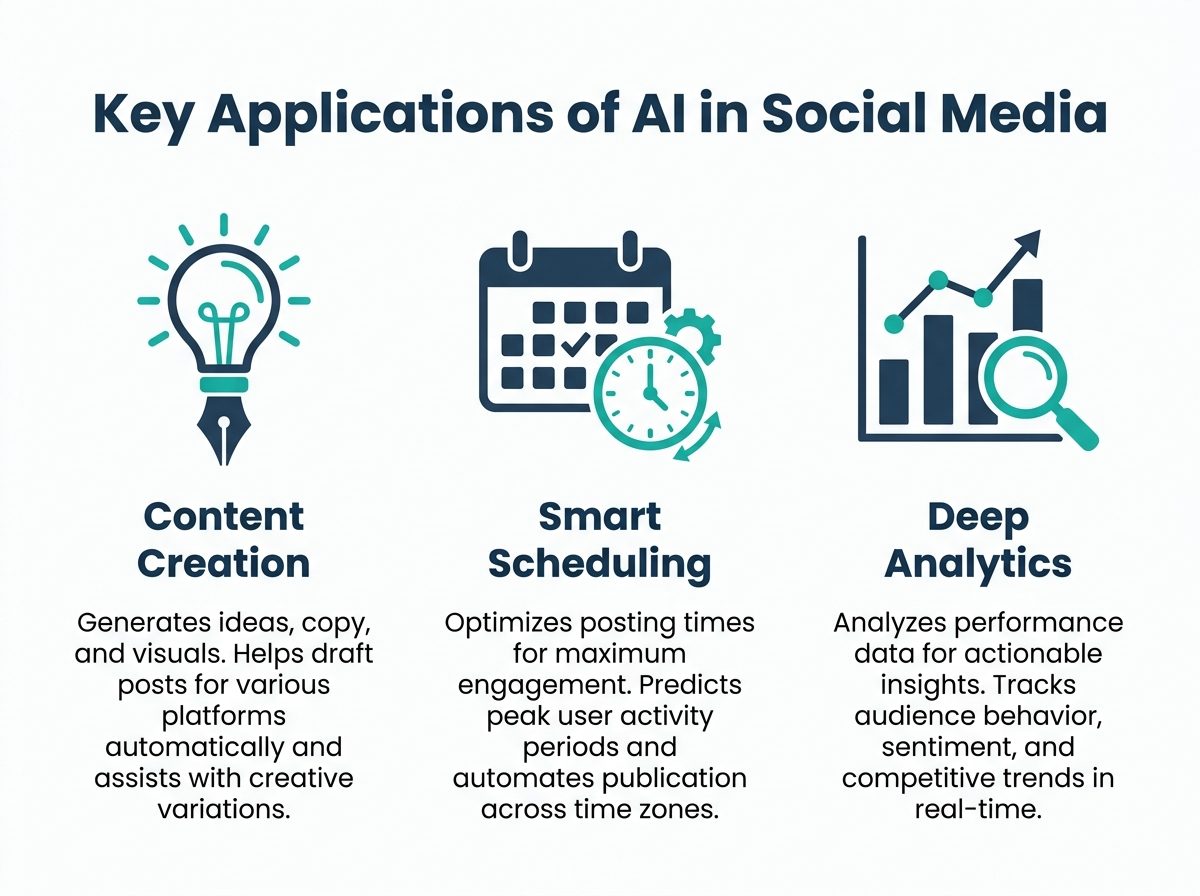
AI is quickly becoming a standard part of social media strategy. It's no longer just an experiment. In fact, Sociality.io's latest AI marketing report shows that nearly 90% of teams use AI tools multiple times a week. This technology helps with content creation, analyzing data, and automating daily tasks.
AI-Powered Content Creation and Curation
AI is a huge help for creating and finding social media content. It can break through writer's block by drafting post ideas, witty headlines, and clear calls to action. Many social media teams already depend on it for this. In fact, data from ArtSmart.ai shows that 75% of marketers use AI for social media content creation.
But it's not just about ideas. AI also dramatically increases how much content a team can produce. Instead of spending hours writing one post, you can generate several options in minutes. This frees up time to focus on strategy and engagement. For most teams, the impact is big. They can post more often and test different messages to see what works best.
Beyond text, AI is changing visual content for social media. AI image and video generators can create completely unique creative assets that grab attention. This means you don't always need a big budget for photoshoots. For example, Marketing Brew reported that the brand Set Active openly uses AI-generated images in its social media feed to stand out.
AI also helps you become a valuable resource for your followers. It's great at content curation, which means finding relevant articles and posts from others to share. Instead of manually searching for news, some tools are designed specifically to monitor trends and suggest interesting content. This keeps your feed active and gives your audience more reasons to follow you.
Intelligent Scheduling and Optimization
Beyond creating content, AI social media tools help you deliver it perfectly. It's not just about what you post, but when you post it. Getting your timing right can make a huge difference in who sees your content. The AI takes the guesswork out of this process by analyzing past performance and follower activity.
This powerful capability is why so many marketers rely on AI. In fact, some 2024 reports show that nearly 90% of social media teams now use artificial intelligence tools every day. These systems find the best times to post on each platform for maximum reach and engagement.
AI can also build your content calendar for you based on your main topics. This automation is a huge time saver. Marketers using AI for these tasks often report saving between 6 and 20 hours/) weekly, freeing them up for more creative work.
Running tests to see what works best is another area where AI shines. You can easily A/B test different ad copy, images, and headlines at a large scale. The AI system quickly identifies the winning combinations. This helps you understand what resonates with your audience much faster.
Many all-in-one platforms now include these smart features. For example, popular tools like Buffer and Sprout Social use AI to suggest posting schedules and analyze performance. This integration makes it simple for teams of any size to make better, data-driven decisions.
Advanced Analytics and Social Listening
AI helps you understand what people are saying about your brand online. It's more than just counting likes and shares. With AI, you can dig deeper into online conversations. In fact, its use is widespread. A recent Sociality.io AI in Social Media Marketing Report found that nearly 90% of social media teams use AI tools multiple times per week.
One of the most powerful features is sentiment analysis. This uses something called Natural Language Processing, or NLP, to read and understand human language. The AI can figure out the emotion behind a comment or post. Is someone happy, frustrated, or just asking a question? This happens in real time, so you get instant feedback.
AI is also great at spotting trends. It can scan countless conversations across social media to find new topics that are gaining popularity in your industry. This allows you to join important conversations early. You can create relevant content before a topic becomes too crowded. It gives you a big advantage over competitors who are not watching as closely.
Beyond what's happening now, AI can also help predict what's next. Predictive analytics looks at past data to forecast how a new campaign might perform. This helps you allocate your budget more effectively. Some platforms can even warn you about a potential crisis by detecting a rise in negative comments, giving you time to respond.
Tools with advanced analytics give you a complete view of your social media landscape. For instance, platforms like Brandwatch are designed for this kind of deep social listening. They turn massive amounts of unstructured data into clear insights. This helps teams move from guessing to knowing what their audience truly wants and feels.
Real-World Example: Set Active
Athleisure brand Set Active openly uses AI-generated imagery created with Midjourney in their social media feeds, as disclosed by their chief brand officer on TikTok. Unlike brands that have faced backlash for undisclosed AI content, Set Active's transparency about their AI use demonstrates how brands can ethically incorporate artificial intelligence into their social strategy while maintaining audience trust.
Top AI Social Media Tools to Power Your Strategy
With so many marketers using AI tools, it can be tough to know where to start. In fact, a staggering 89.7% of social media teams now use AI daily or several times a week. The right AI social media tool can save time, boost creativity, and provide deeper insights. Let's look at some of the best options available.
Finding the perfect tool depends on your specific needs. Some platforms are all-in-one solutions that handle everything from scheduling to analytics. Others specialize in a single area, like creating engaging content or listening to online conversations. We've broken them down into a few main groups to help you choose.
Here are some of the top AI social media tools to explore:
| Tool | Category | Best For | Standout AI Feature |
|---|---|---|---|
| Buffer | All-in-One | Customizing posts for each network | Adapts one piece of content to fit the unique style of different platforms |
| Publer | All-in-One | Powerful automation at a low cost | Built-in AI image generation and a chat assistant to analyze performance |
| Predis.ai | Content Creation | Turning simple ideas into full posts | Generates complete social media posts including visuals and captions |
| Copy.ai | Content Creation | Writing compelling social media copy | Advanced drafting wizard that helps write captivating posts from a prompt |
| Sprout Social | Analytics | Detailed performance and optimization | AI-powered sentiment analysis and deep competitor intelligence reports |
| Content Distribution | Posting your content on multiple platforms in one click | AI creation of tweet cards and carousels from your content | |
| ContentStudio | Content & Discovery | Finding and sharing trending topics | Suggests relevant new content based on trending articles and past performance |
Tools like these are popular for a reason. Marketing teams using AI for social media tasks often save between 6 and 20 hours per week). This frees up your team to focus on strategy and building stronger relationships with your audience instead of getting stuck on repetitive tasks.
Beyond social media-specific tools, you might also want to explore free AI marketing tools that can complement your social media efforts across other marketing channels.
The best way to find what works for you is to experiment. Many AI social media tools offer free trials or limited free plans. You can test them out to see how they fit into your workflow before making a commitment. This hands-on experience will show you which platform truly meets your team's goals.
Platform by Platform: How AI Works on Each Social Network
Each social platform has its own algorithm, formats, and audience behavior, so AI needs to be used differently on each one.
- LinkedIn: This is the most important platform for B2B and the one where AI content most easily sounds inauthentic. Let AI generate the framework and talking points, then add the opinion, story, or insight that makes the post worth reading.
- Meta (Facebook and Instagram): For organic posts, AI is most useful for resizing visuals for Stories and Reels, writing captions, and optimizing the schedule. Instagram rewards frequent posting, so AI helps you keep a steady presence.
- TikTok: AI helps with script frameworks, captions, trend identification, and posting times. The algorithm rewards authenticity and entertainment, so the video itself still needs a real person on camera.
- X: X rewards concise, opinionated, timely content. AI-assisted threads can break a complex topic into clear points. Single posts tend to sound generic, and reacting to live news stays a human job.
Social Listening: How AI Tracks the Conversation
Social listening is one of the most valuable uses of AI in social media, because no human can monitor that volume of conversation by hand. AI social listening tracks four things:
- Brand mentions and sentiment: AI tracks mentions of your brand, products, and executives, classifies their sentiment, and flags sudden shifts.
- Competitor activity: AI shows what competitors post, what earns engagement, and where they gain or lose share of voice.
- Industry trends: AI spots emerging topics and growing pain points across your industry.
- Advocates and influencers: AI identifies the people who engage with your content, mention your brand, or influence your target audience.
The practical output is a weekly or monthly report that feeds content planning. It shows which topics are gaining traction, what competitors are posting, and where the gaps are that you could fill.
B2B Social Media AI: The LinkedIn Problem
LinkedIn is usually the most important social platform for a B2B company, and it is also where audiences notice AI-generated content fastest. The posts that earn the most engagement share a real opinion based on real experience. AI drafts tend to be generic, safe, and hedged. AI still helps on LinkedIn in four ways:
- Data-driven posts: AI finds and formats specific data points into posts. Verify every number before you publish it.
- Content repurposing: AI turns blog posts, webinar transcripts, and case studies into LinkedIn posts, and a person adds why it matters.
- Carousel creation: AI drafts slide frameworks for key takeaways, step-by-step guides, and comparisons, and a person handles the design and final edit.
- Employee advocacy: AI drafts posts for each executive in that person's voice. The executive reviews, personalizes, and posts under their own name.
AI Social Media Analytics & Reporting
AI's role in social analytics is to consolidate data and surface patterns that would take an analyst hours or days to find.
- Cross-platform dashboards: AI combines reach, engagement, clicks, and conversions from LinkedIn, Meta, X, and TikTok in one view.
- Content patterns: AI shows which topics, formats, and posting times perform best on each platform, which builds into your own content playbook.
- Audience trends: AI tracks follower growth, engagement rates, and changes in who follows you over time.
- Competitive benchmarks: AI compares your share of voice, engagement, and content mix against competitors, so you judge your numbers in context.
Social Media Advertising With AI
Paid social is the most mature use of AI in social media. The platform AI handles most of the execution, and your job is to configure it correctly. Our tactical guide to AI paid ads covers the setup in detail. Here is the summary for social:
- Meta: For lead generation, use customer list seeds, the Conversions API for server-side tracking, and Cost Cap bidding to control your cost per acquisition. Creative volume matters, because the AI needs variations to test.
- LinkedIn: Accelerate campaigns automate targeting, bidding, and creative, and Predictive Audiences build lookalikes from your seed audiences. Layer firmographic filters on top, so the audience stays relevant.
- TikTok: Smart+ campaigns automate targeting and bidding. For B2B, use TikTok for awareness and brand building, not for bottom-of-funnel lead generation.
Building Your AI-Powered Social Media Strategy: A Step-by-Step Framework
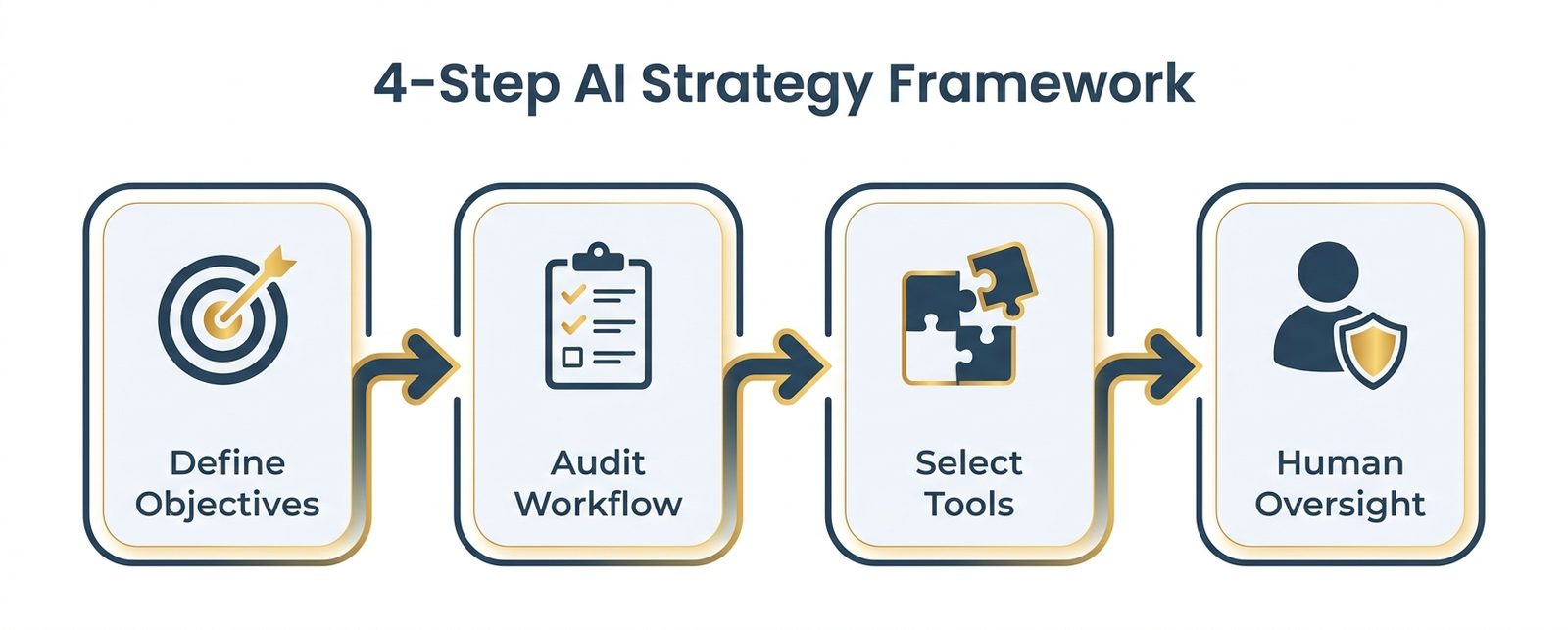
Jumping into AI social media without a plan can be messy. A clear strategy ensures you use these tools effectively. It's no wonder this approach is popular now that almost 90% of social media teams use AI regularly. A step-by-step framework helps you join them successfully and get the most out of your investment.
Step 1: Define Clear Objectives
Start by defining what you want to achieve. Don't just say "more engagement." Be specific with measurable goals. For example, you could aim to increase qualified leads from social channels by 15%. Or you could try to reduce customer service response time by half. These specific targets will guide your entire AI strategy and help you prove its value.
Step 2: Audit Your Current Workflow
Next, look closely at your current social media process. Where are the bottlenecks? Which repetitive tasks eat up the most time? This analysis helps pinpoint the best opportunities for AI to make a real impact. You can use a free social media audit template from Hootsuite to map out your daily tasks and find areas for improvement like content creation or reporting.
Step 3: Select and Integrate the Right Tools
With your goals and opportunities clear, it's time to choose your tools. Don't try to automate everything at once. Start small with one or two platforms that solve your biggest pain points. Focus on tools that integrate well with your existing systems. Many offer free trials, so you can test them out to see how they fit before making a bigger commitment.
When building your social media strategy, consider how it fits into your broader AI marketing strategy to ensure all your marketing channels work together effectively.
Step 4: Establish Guidelines and Human Oversight
Finally, create clear guidelines for using AI. Your team needs to understand its role. AI can generate drafts, but a person should always review, edit, and approve content before it goes live. This ensures quality and brand alignment. As Sprout Social explains in its guide to marketing ethics, transparency is vital. Always have a human accountable for the final output.
Questions to Ask Before Implementing AI in Your Social Strategy
- What specific tasks are currently taking up most of my team's time?
- Which metrics am I hoping to improve with AI assistance?
- How will we maintain brand voice consistency when using AI tools?
- What level of human oversight will we maintain for AI-generated content?
- How will we measure and report on the ROI of our AI implementation?
- What ethical guidelines should we establish for AI use?
- How will we disclose AI use to our audience when necessary?
- Which team members need training on our new AI tools?
- How will we integrate AI tools with our existing workflow and tech stack?
- What is our backup plan if the AI produces unexpected results?
Beyond the Hype: Measuring the ROI of AI in Social Media
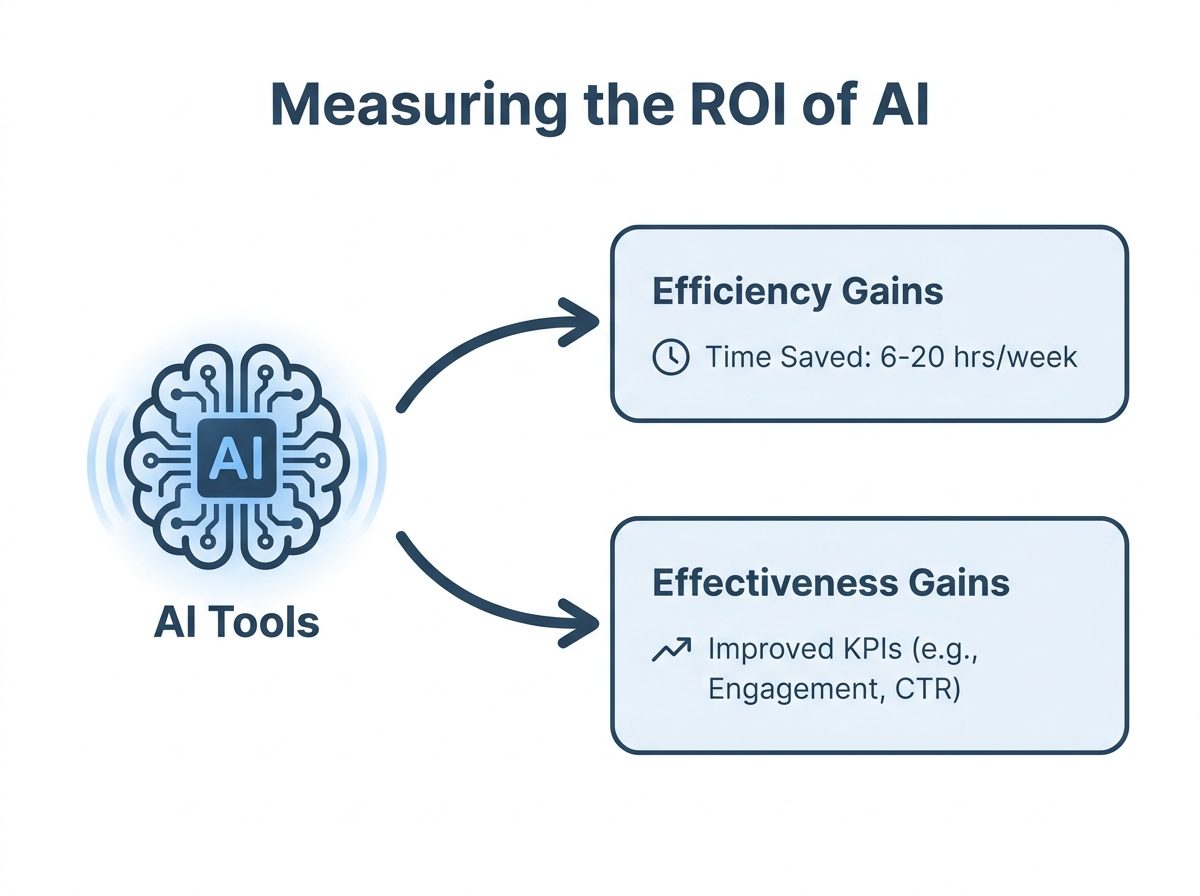
Everyone is talking about AI for social media, but how do you know if it's really working for you? Measuring its return on investment (ROI) is key. It's not surprising that many teams are adopting it. In fact, a 2024 report from Sociality.io shows that about 89% of social media marketers use AI weekly.
Start by looking at efficiency gains. The easiest win to track is time saved. AI tools can automate scheduling, content curation, and reporting. This frees up your team for more creative work. How much time? Some marketing teams report saving 6 to 20 hours per week for each team member) on these tasks.
But saving time is only half the story. You also need to measure effectiveness. Is the AI-assisted content performing better? Track key social media metrics like engagement rate, click-through rate, and lead quality. Compare these numbers to your pre-AI benchmarks. You want to see a clear improvement in performance, not just speed.
The final step is connecting these metrics to your business goals. Higher engagement is great, but does it lead to more sales? Tie your social media efforts directly to revenue. Track how many leads from AI-driven campaigns become paying customers. This shows the true financial impact of your investment in new tools.
When measuring ROI across multiple channels, consider how your social media automation integrates with other automated marketing efforts like AI email automation to get a complete picture of your marketing efficiency gains.
Measuring the ROI of AI social media tools isn't just about one number. It's about understanding the complete picture. By tracking both time saved and performance improvements, you can prove the value of AI and make smarter decisions for your marketing strategy.
The Human Touch: Navigating the Challenges and Ethics of AI
While AI social media tools bring amazing efficiency, they aren't perfect. Sometimes, AI can make up information, an issue known as hallucination. It can also miss the subtle jokes or emotions that humans easily understand. This lack of nuance can make your brand's posts feel robotic or out of touch with your audience.
Another big concern is bias. AI learns from huge amounts of internet data, which can contain unfair stereotypes. If a tool produces biased content, it can seriously harm your brand's reputation. A human must always be in the loop to catch these mistakes and ensure content reflects your company's values.
Being honest with your audience is key. It's not just good practice. It's often the law. According to Federal Trade Commission (FTC) guidelines, you must disclose AI use if not doing so could mislead customers. This is especially true for AI influencers or AI-generated reviews. Transparency builds trust with your followers.
So, how do you balance AI and authenticity? The best strategy is to use AI as a helpful assistant, not a replacement for human creativity. Let AI handle routine tasks like scheduling posts or analyzing data. This frees up your team to focus on strategy, building relationships, and creating unique content.
Think of AI as a starting point. An AI tool can draft a post, but a person should review and edit it to add empathy and brand personality. As Sprout Social explains, transparency is your best tool. By combining AI's speed with a human's heart, you get the best of both worlds.
How to Keep AI Social Content Authentic
The biggest risk in AI social media is sounding like everyone else. As more companies use AI, feeds fill up with posts that share the same phrasing, the same hedged tone, and the same closing question. Keeping your content authentic takes five steps:
- Start with a human opinion: Before AI generates a word, a person decides the specific point of view the post will express.
- Use AI for structure, not voice: Let AI build the outline and adapt the format. Then rewrite the opening line, the key insight, and the closing yourself.
- Add specifics AI cannot know: Reference an anonymized client conversation, a metric from your own experience, or something that happened this week.
- Cut the hedge phrases: Delete lines like "it's important to note that" and say the thing directly.
- Engage manually: Reply to comments yourself, and refer to what the person actually said. Relationships form in the replies, and automated replies damage trust.
Building an AI Social Media Calendar
A practical AI social media calendar for B2B combines planned content repurposed from your source assets, reactive content on trends and industry events, and time set aside for engagement. Here is a sample week:
- Monday: Publish one opinion-driven LinkedIn post, edited by a person. Schedule the week's planned content across platforms.
- Tuesday: Publish one carousel or data-driven post from an AI framework, reviewed by a person. Adapt it for your other platforms.
- Wednesday: Use AI to turn your latest blog post or content asset into platform-specific posts, and queue them for the rest of the week.
- Thursday: Publish one engagement post, such as a question or a poll. Set aside time to reply to comments across platforms.
- Friday: Publish one lighter post, such as a team spotlight or a behind-the-scenes look. Review the week's analytics and adjust next week's plan.
Common AI Social Media Mistakes
These five mistakes cause most AI social media content to fail:
- Publishing AI drafts without editing: AI posts are first drafts. They need a person to add voice, cut filler, and verify accuracy.
- Posting the same content everywhere: LinkedIn, X, Instagram, and TikTok each have their own audience expectations, formats, and algorithms.
- Automating engagement: Audiences can tell when a reply is automated, and it erodes trust.
- Ignoring social listening data: The value comes from feeding what you learn back into your content plan, not from the dashboard itself.
- Chasing volume without a strategy: Posting more only helps when each post has a reason to exist.
Conclusion: The Future is a Human-AI Partnership
The journey into AI social media is not about replacing your team. It is about making them stronger. AI acts as a powerful amplifier for skilled marketers, handling repetitive work so they can focus on what matters most. And marketers are already embracing this shift in huge numbers.
In fact, new research from ArtSmart.ai reveals that 88% of marketers use AI every day. Why? The benefits are clear. For instance, an Averi.ai analysis shows) teams can save over 20 hours weekly just by automating basic tasks.
But this is not just about saving time. It is about reinvesting it into building real relationships with your audience. Use the efficiency AI provides to create more thoughtful content and have deeper conversations. The goal is always to foster more meaningful human connections, just at a bigger scale.
Ready to start? Do not try to change everything at once. Pick one area, like using AI for content ideas. Run a small pilot project, measure your results, and learn from the experience. This approach will help you build a successful human-AI partnership for the future.
Frequently Asked Questions
What is the best AI for social media?
There is no single "best" AI tool for social media as the ideal choice depends on your specific needs. For comprehensive management, platforms like Sprout Social or Hootsuite offer robust solutions. If you're focused on content creation, specialized tools like Jasper or Copy.ai may be more suitable. For in-depth analytics, Brandwatch provides powerful capabilities. Identify your biggest challenge first, then select a tool designed to address that specific need.
How can I use AI for social media?
Start with small, focused applications of AI in your social media workflow. You can use AI to generate ideas and first drafts for your posts, automatically schedule content at optimal times for maximum engagement, analyze sentiment in comments and mentions to understand audience reactions, and create performance reports to identify what's working. Beginning with one specific task allows you to build confidence and experience before expanding.
Is there a free AI for social media?
Yes, many premium tools offer free tiers or trials with limited functionality. Platforms like Buffer and Later provide free plans with basic AI scheduling capabilities. Additionally, general AI tools like ChatGPT or Google's Gemini can be used at no cost to help with brainstorming ideas and creating social media copy, even though they aren't specifically designed for social media management.
How does AI affect social media?
AI affects social media in two key ways. For users, it powers the recommendation algorithms that determine what content appears in feeds. For marketers, AI provides tools to automate routine tasks, personalize content for different audience segments, and extract deeper insights from social data more efficiently, enabling more strategic and effective campaigns.
Can AI replace social media managers?
No, AI is designed to augment, not replace, social media managers. While AI excels at handling repetitive, data-heavy tasks, human managers remain essential for strategy development, creative direction, community building, and interpreting the complex nuances of AI-generated data. The most effective approach is a partnership where AI handles routine work while humans focus on strategy and creativity.
What are the ethical concerns of using AI in social media marketing?
Key ethical concerns include data privacy issues regarding how user information is collected and utilized, potential algorithmic bias in ad targeting that could exclude certain groups, lack of transparency when not properly disclosing AI-generated content, and the risk of spreading misinformation through automated accounts. Responsible use requires transparency and human oversight.
How can I get started with AI for my small business social media?
Begin by identifying one specific problem to solve, such as spending too much time writing captions. Then explore a free or low-cost tool that addresses that problem, like using ChatGPT for caption generation. Dedicate 1-2 hours weekly to learning and experimenting with the tool, and measure concrete results, such as how many hours you saved each month. This focused approach makes adoption manageable for small businesses.