
Hannon Brett | Published on: July 26, 2026 | Time to read: 30 min
A marketing consultant builds your strategy, while a marketing agency executes it. Consultants audit your current position, identify gaps, and deliver a clear roadmap, but they don't run campaigns day to day. Agencies provide a full team of specialists who write content, manage ads, build assets, and track results across multiple channels.
Key Takeaways
- A marketing consultant delivers strategic direction and guidance, while a marketing agency provides ongoing execution and campaign management across channels
- Consultants typically charge $50 to $200+ per hour for project work or advisory retainers, while agencies run $2,500 to $10,000+ per month for ongoing retainers
- The right choice depends on four factors: your budget, whether you need a plan or execution, who internally will manage the relationship, and how fast you need results
- For seed and Series A B2B tech startups, the smartest sequence is often strategy first (consultant), then execution (agency or hybrid model)
- A hybrid model combines a consultant's strategic oversight with an agency's execution power, keeping the agency accountable to business outcomes rather than vanity metrics
- Jumping to agency execution without a locked strategy is one of the fastest ways early-stage startups burn runway
Table of Contents
- What Is a Marketing Consultant? The Strategic Architect
- What Is a Marketing Agency? The Execution Powerhouse
- Marketing Consultant vs Agency: Key Differences at a Glance
- Cost of a Marketing Consultant vs. an Agency
- When to Hire a Marketing Consultant
- When to Hire a Marketing Agency
- The Hybrid Model: A Unique Outsourced Marketing Option
- A Decision Framework for Choosing Your Marketing Partner
- Make the Right Choice for Your Marketing Strategy's Future
What Is a Marketing Consultant? The Strategic Architect
A marketing consultant is a senior expert you hire to figure out what your business should do with its marketing. They're not there to run your campaigns day to day. They audit what you have, spot the gaps, and hand you a clear roadmap. Think of them as the architect who draws the plans before anyone picks up a hammer.
What a Consultant Actually Does
When you bring in a marketing consultant, their job starts with a deep look at your current situation. They review your messaging, your channels, your data, and your competitive position. That audit becomes the foundation for everything else they recommend.
From there, a good consultant identifies the opportunities you're missing and the money you might be wasting. They map out a prioritized marketing roadmap. And in many cases, they'll also train your team on how to execute that plan once the engagement wraps up.
The key thing to understand is what they don't do. Most consultants don't write your ad copy, manage your paid campaigns, or post your social content. That's not their role. They deliver the strategy and the guidance, then it's up to you or another partner to run with it.
As Fox Group explains, consultants "bring advice and guidance" that your team uses for execution, while agencies "do marketing on behalf of your company." That one sentence captures the whole distinction.
When the Consultant Model Makes Sense
For seed and Series A B2B tech startups, a consultant can be a smart early move. You get senior-level strategic thinking without committing to a full agency retainer. And you build a foundation that makes every dollar you spend afterward more effective.
But if you need campaigns launched and pipelines built now, strategy alone won't cut it. That's where the conversation gets more interesting.
What Is a Marketing Agency? The Execution Powerhouse

A marketing agency is a full team of specialists you hire to do your marketing for you. Where a consultant tells you what to do, an agency actually does it. They write the content, run the ads, manage the social channels, and track the results. Think of them as the construction crew that builds what the architect designed.
A Team Built for Multi-Channel Execution
When you hire a marketing agency, you're not getting one person. You're getting a roster of specialists. A typical agency team might include SEO specialists, paid media managers, copywriters, graphic designers, web developers, and email marketers, all working on your account.
That breadth is their strength. Instead of coordinating five different freelancers yourself, you get one point of contact managing a whole team behind the scenes. For B2B tech startups without a dedicated marketing hire, that can mean campaigns are live in weeks rather than months.
What Agencies Actually Deliver
Here's what most full-service digital marketing agencies cover:
- Content creation: blog posts, case studies, landing pages, and thought leadership
- SEO: technical audits, on-page optimization, and link building
- Paid advertising: Google Ads, LinkedIn, and Meta campaigns
- Social media management: scheduling, community management, and reporting
- Email marketing: nurture sequences, newsletters, and lifecycle campaigns
- Web development: landing pages, CRO updates, and site performance
For seed and Series A B2B tech startups without an in-house team, this kind of full-service support can replace the need to hire five or six specialists. That's a big part of why agency retainers for SMBs typically run between $2,500 and $10,000 per month. You're paying for a whole team's output, not just one person's time.
The Trade-Off to Know About
Agencies are built for scale and execution. But that structure comes with trade-offs. You'll often work with an account manager rather than the senior strategist who pitched you. Onboarding takes longer. And most agencies prefer 6 to 12 month contracts because they need time to see results.
That's not a flaw. It's just how the model works. If you need a machine that runs campaigns while you focus on building the business, a good agency delivers that. But if you're still figuring out your positioning or ideal customer, jumping straight to execution can burn budget fast.
For early-stage startups, the smartest move is often making sure the strategy is locked before handing execution over to an agency team.
Marketing Consultant vs Agency: Key Differences at a Glance
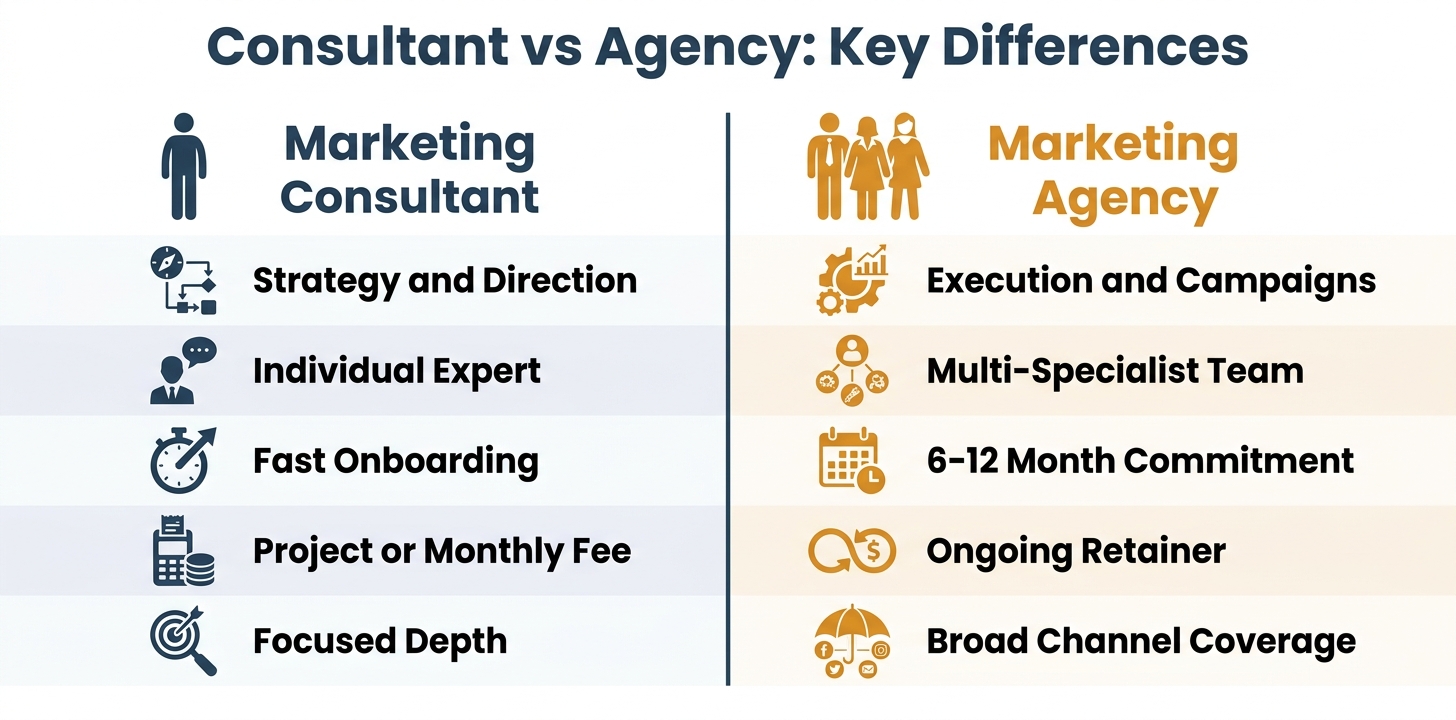
A marketing consultant builds your strategy. A marketing agency executes it. The right choice depends on what your business actually needs right now: a clear plan, active campaign management, or both. For B2B tech startups, getting this decision wrong can burn runway fast.
Here's a side-by-side breakdown of the core differences:
| Attribute | Marketing Consultant | Marketing Agency |
|---|---|---|
| Primary role | Strategy, diagnosis, and guidance | Execution across one or more channels |
| Team structure | Individual expert or small firm | Multi-person team of specialists |
| Point of contact | Direct access to the senior expert | Account manager coordinating a team |
| Breadth of services | Deep focus in one or two areas | Broad coverage across many channels |
| Speed to start | Fast onboarding, often within days | Slower due to coordination and setup |
| Accountability | One person owns the outcome | Shared across teams and processes |
| Cost structure | Flexible, often project or monthly | Higher cost, paying for a full team |
| Contract terms | Often month-to-month or project-based | Usually 6 to 12 month commitments |
| Best fit | Strategy audits, roadmaps, focused guidance | Ongoing execution, scale, full-service support |
Sources like HawkSEM's agency vs. consultant breakdown and Powered by Search both point to the same core truth: this isn't about size or price. It's about who owns execution.
The Scope Difference Is the Big One
Consultants deliver direction. Agencies deliver work. That sounds simple, but plenty of founders blur this line when shopping for help.
If you don't have a clear marketing strategy yet, hiring an agency first means paying a full team to execute a plan that doesn't exist. That's a fast way to waste budget.
But if your strategy is solid and you need campaigns running, a consultant alone won't move the needle. You need a team that can actually build and launch.
Who Actually Does the Work
With a consultant, the senior person you hired is usually the one doing the thinking. You get direct access to their expertise, and there's no junior staffer interpreting what they meant.
With an agency, work gets distributed. Your account manager is the face of the relationship, but the SEO work, ad builds, and content might be handled by three or four different people. That's not a problem if it's managed well. But it's worth knowing going in.
What This Means for Seed and Series A Startups
For early-stage B2B tech founders, the sequencing matters most. Many startups that come to programs like The Zulu Method are looking for the fastest path to pipeline without blowing their runway on the wrong resource at the wrong time.
A good rule of thumb: get the strategy locked first, then bring in the execution team. That order keeps every dollar accountable.
Marketing consultant rates typically run between $75 and $250 per hour for experienced North American strategists, according to marketing consultant rate benchmarks from arshsingh.com. Agency retainers for SMBs and startups generally start around $3,000 to $7,000 per month for ongoing work, based on data from agency pricing guides at influenceflow.io.
Knowing those numbers upfront helps founders make a cleaner decision about what fits their current stage and budget.
Cost of a Marketing Consultant vs. an Agency
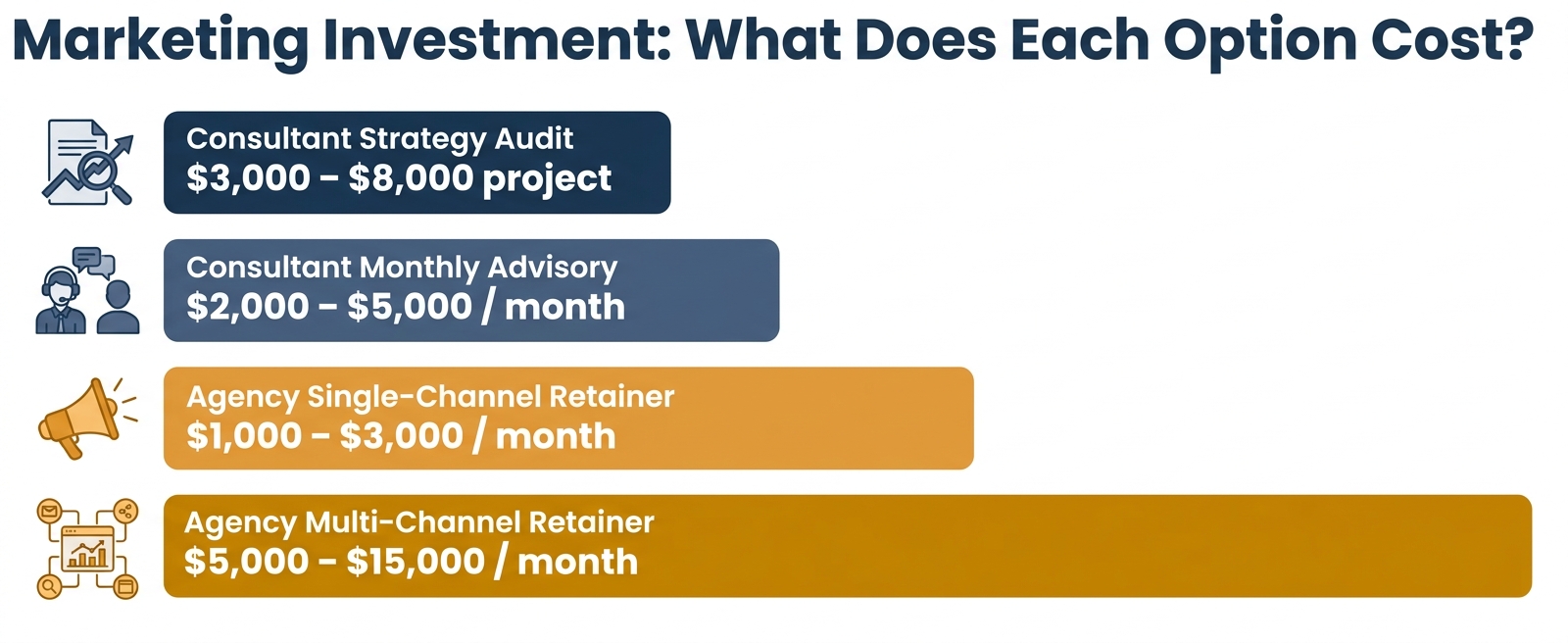 Marketing consultants typically charge $50 to $300+ per hour, while agencies run $2,500 to $20,000+ per month on retainer. The key difference: consultants often cost less in total for strategic work, while agencies are a larger ongoing expense built for continuous execution across multiple channels.
How Consultants Price Their Work
Consultants use three common pricing models. Hourly rates are the most flexible, letting you pay only for the time you need. Project fees cover a defined scope like a full marketing audit or a go-to-market roadmap. Monthly retainers give you ongoing access to strategic guidance for a fixed fee.
Global benchmarks from contractrates.fyi put the crowdsourced average for marketing consultants at roughly $101 per hour worldwide. In North America, experienced strategists typically fall between $150 and $300 per hour depending on specialization and seniority.For B2B tech founders, project-based consultant fees are often the smartest entry point. You can scope a go-to-market strategy engagement for a fixed price, get the roadmap, then decide what to execute and with whom.
How Agencies Price Their Work
Agencies charge differently because you're paying for a team, not one person. The three most common structures are monthly retainers, percentage of ad spend, and project-based fees for large builds like a new website.
Monthly retainers are the default for ongoing work. According to agency pricing data from fbd.agency, lean single-channel SMB packages often start around $1,000 to $3,000 per month, while broader multi-channel retainers commonly run $5,000 to $15,000 per month when SEO, paid media, content, and social are bundled together.
Percentage of ad spend is common for paid media specialists. Expect to pay 10% to 20% of your monthly ad budget on top of the management fee. That structure scales costs alongside your spend, which can add up fast for early-stage startups.
The Real Value Comparison
Here's what most founders miss: a consultant's hourly rate often looks higher than an agency's blended rate per hour. But the total engagement cost tells a different story.
A strategic consultant engagement might run 20 to 40 hours over six weeks. That's a one-time investment for a clear roadmap. An agency retainer at $5,000 per month runs $60,000 over a year before you factor in ad spend or project add-ons.
The table below shows a simplified cost comparison for seed and Series A B2B tech startups:
| Scenario | Typical Cost | What You Get |
|---|---|---|
| Consultant: strategy audit + roadmap | $3,000 to $8,000 (project fee) | Clear plan, prioritized channels, team training |
| Consultant: ongoing advisory retainer | $2,000 to $5,000/month | Monthly strategic guidance and accountability |
| Agency: lean single-channel retainer | $1,000 to $3,000/month | One channel actively managed |
| Agency: multi-channel retainer | $5,000 to $15,000/month | SEO, paid media, content, social all running |
For startups at programs like The Zulu Method, where runway preservation matters as much as growth speed, a consultant-first approach often delivers better early ROI. You get senior strategic thinking at a fraction of the annual cost of an agency retainer. And when you do bring an agency in, your strategy is already locked, so every dollar they spend is pointed at the right target.
The short version: consultants cost less in total for focused strategic work. Agencies cost more but replace the need to hire an entire in-house team. Neither is wrong. The right answer depends on whether you need a plan, execution, or both.
When to Hire a Marketing Consultant
Hire a marketing consultant when you need a clear strategy before spending on execution. Consultants are the right fit if your team can run campaigns but lacks senior direction, or if you're facing a specific challenge like a rebrand or new market entry. Strategy first saves runway.
You Don't Have a Clear Marketing Strategy Yet
This is the most common situation where a consultant pays for itself quickly. If you're a seed or Series A B2B tech startup and you're not sure which channels to prioritize, who your ideal customer really is, or why your messaging isn't converting, jumping straight into agency execution is risky.
An agency will execute. But if they're executing the wrong strategy, you're burning budget fast. A consultant comes in, audits what you have, and hands you a prioritized roadmap before a single ad dollar gets spent.
For founders at programs like The Zulu Method, this is often the first step: lock the strategy, then scale the execution.
Your In-House Team Is Stuck
Sometimes the problem isn't a missing team. It's a team that's executing without clear direction. You might have a content writer, a demand gen hire, and a designer, but no one with the senior experience to set strategy, align messaging, or decide what to cut.
A consultant steps in as the senior voice without the cost of a full-time CMO hire. They get your team unstuck, set priorities, and build the frameworks your people can actually use.
According to MarketerHire's breakdown of the consultant vs. agency model, this gap between execution capacity and strategic direction is one of the top reasons growing companies bring in outside consultants.
You Have a Specific, Defined Problem
Not every marketing challenge needs an ongoing agency relationship. Sometimes you just need someone who's solved your exact problem before.
A rebrand. A new market entry. A broken attribution model. A product launch that isn't getting traction. These are scoped, definable challenges. A consultant can come in, focus on that one problem, and exit once the work is done.
This is where consultant pricing makes real sense. A project engagement might run 20 to 40 hours over four to six weeks. That's a focused investment with a clear deliverable, not an open-ended monthly retainer.
Fahrenheit Advisors documented a case where a consultant-led strategy pivot helped a heavy equipment manufacturer shift from product-focused to customer-centric marketing. Net Promoter Score jumped from 19 to 45, and orders grew by 21%. The work was targeted, strategic, and tied to a specific business problem.A Quick Self-Check
Ask yourself these three questions before you start shopping for help:
- Do you know exactly which channels and messages will drive pipeline for your business right now?
- Does your team have senior-level marketing direction, or are they executing without a clear plan?
- Are you facing a specific challenge that a focused expert could solve in weeks rather than months?
If the answer to any of these is no, a consultant is likely your next right move. Once the strategy is locked, that's when bringing in an agency for execution starts to make financial sense.
Real World Example: Consultant-Led Strategy Pivot Delivers Measurable Results
A global manufacturer of heavy-engineered equipment brought in a consultant to shift from a product-focused model to a customer-centric growth strategy. The consulting team identified core customer segments, revised business processes, changed management measures so customer success became the top performance metric, and reinforced the shift through internal training. The reported results were substantial: Net Promoter Score rose from 19 to 45, and orders increased by 21%. This case shows how a focused consultant engagement can solve a specific strategic problem with measurable business impact.
When to Hire a Marketing Agency
Hire a marketing agency when your strategy is set and you need a full team to execute it. Agencies work best when you want campaigns running across multiple channels fast, without building an in-house team from scratch. If you need ongoing execution rather than just a plan, an agency is the right call.
You Have a Strategy But Can't Execute It Alone
This is the clearest signal. You know which channels to focus on. You know your ideal customer and your messaging. But you don't have the people to actually run the campaigns, build the content, or manage the paid media.
That's exactly what an agency is built for. They take your strategy and run with it. You get a team of specialists, one point of contact, and campaigns live in weeks rather than months.
For seed and Series A B2B tech startups, this is often the moment to bring in outside execution support. Hiring five in-house specialists takes six to nine months and real budget. An agency gets you there faster.
You Need to Scale Across Multiple Channels Quickly
Single-channel growth has limits. At some point, you need SEO, paid media, content, and email all working together to build pipeline. Coordinating that internally without a dedicated team is a full-time job on its own.
Agencies are structured for exactly this kind of multi-channel execution. According to WebFX's digital marketing agency cost guide, most full-service SMB retainers bundle several channels into one monthly fee, letting startups scale marketing without hiring a full department.
For B2B tech founders at programs like The Zulu Method, this matters. You can't afford to build slowly when pipeline is the priority.
You Want One Partner to Manage It All
Coordinating freelancers across SEO, content, ads, and email takes time you don't have. An agency acts as your outsourced marketing department. One account manager. One invoice. One team responsible for results.
That simplicity has real value for early-stage founders who are already stretched across product, sales, and fundraising. You don't want to manage five vendor relationships on top of everything else.
MarketerHire's hybrid marketing team research supports this. Their analysis shows founders with no internal marketing hire benefit most from a single external partner who can own the full execution layer while leadership stays focused on the business.A Quick Self-Check for Agency Readiness
Before you reach out to agencies, ask yourself:
- Is your go-to-market strategy already defined and validated?
- Do you know which channels your ideal customers use?
- Do you have budget for a monthly retainer of at least a few thousand dollars?
- Are you ready for a 6 to 12 month commitment to see real results?
If you answered yes to all four, you're ready for an agency. If any answer is no, especially the first two, a consultant should come first. Get the strategy locked before you pay a team to execute it.
The Hybrid Model: A Unique Outsourced Marketing Option
The hybrid model combines a consultant's strategic oversight with an agency's execution power. You hire a consultant to build the master strategy and define the KPIs. Then you bring in an agency to run the campaigns. It's the best of both worlds, and it's a smarter outsourced marketing option than most founders realize.
How the Model Actually Works
Here's the setup. A consultant comes in first. They audit your current position, define your ideal customer, nail your messaging, and map out a prioritized go-to-market plan. That roadmap becomes the brief the agency works from.
Once the strategy is locked, the agency takes over execution. They build the campaigns, create the content, manage the paid media, and run the channels. But the consultant doesn't disappear. They stay on in a lighter capacity to review the agency's output and make sure everything stays aligned with the original strategy.
That oversight layer is what most startups skip. And it's exactly where budget gets wasted.
Why This Approach Works So Well
Agencies are great at execution. But they're not always great at strategy. And when an agency is working without a strong strategic brief, they default to what they know how to do, not necessarily what your business actually needs.
The consultant acts as a quality control layer. They hold the agency accountable to business outcomes, not just activity metrics. That keeps the agency's work pointed at the right goals instead of drifting toward vanity deliverables.
According to Column Five Media's breakdown of hybrid B2B marketing teams, the model works best when strategy stays internal or with a trusted advisor, while specialized execution is distributed externally. That separation of roles is what makes the whole system function.
The Benefits for Seed and Series A Startups
For B2B tech founders at programs like The Zulu Method, the hybrid approach solves a real problem. You don't have time to build an in-house team. But you also can't afford to hand a blank strategy to an agency and hope for the best.
Here's what the hybrid model delivers:
- World-class strategy: a senior consultant thinks through your positioning, channels, and priorities before any money gets spent on execution
- Full execution capacity: an agency runs the campaigns, creates the assets, and manages the channels
- Ongoing alignment: the consultant reviews results and keeps the agency accountable to business goals, not just output
- Runway protection: you're not paying for a full-time CMO or a bloated agency retainer doing work without direction
A Practical Way to Think About the Cost
The hybrid model isn't necessarily more expensive than hiring an agency alone. In many cases, it's cheaper in the long run because the strategy prevents wasted spend.
A consultant engagement to build the strategy might run four to eight weeks. After that, they shift to a lighter monthly advisory role to oversee the agency's work. That advisory retainer is a fraction of what it would cost to have a senior strategist embedded inside the agency.
You get senior-level strategic thinking plus a full execution team, without paying the premium a top-tier full-service agency would charge for both.
When This Model Makes the Most Sense
The hybrid approach isn't for every situation. It works best when:
- You need campaigns running fast but don't have an internal strategist
- You've been burned by an agency that executed well but in the wrong direction
- Your budget is large enough for an agency retainer but you want a senior check on the work
- You're entering a new market or launching a new product where strategic clarity matters most
For early-stage B2B tech founders, this is often the model that gets results fastest. Strategy first, execution second, with an expert watching both.
A Decision Framework for Choosing Your Marketing Partner
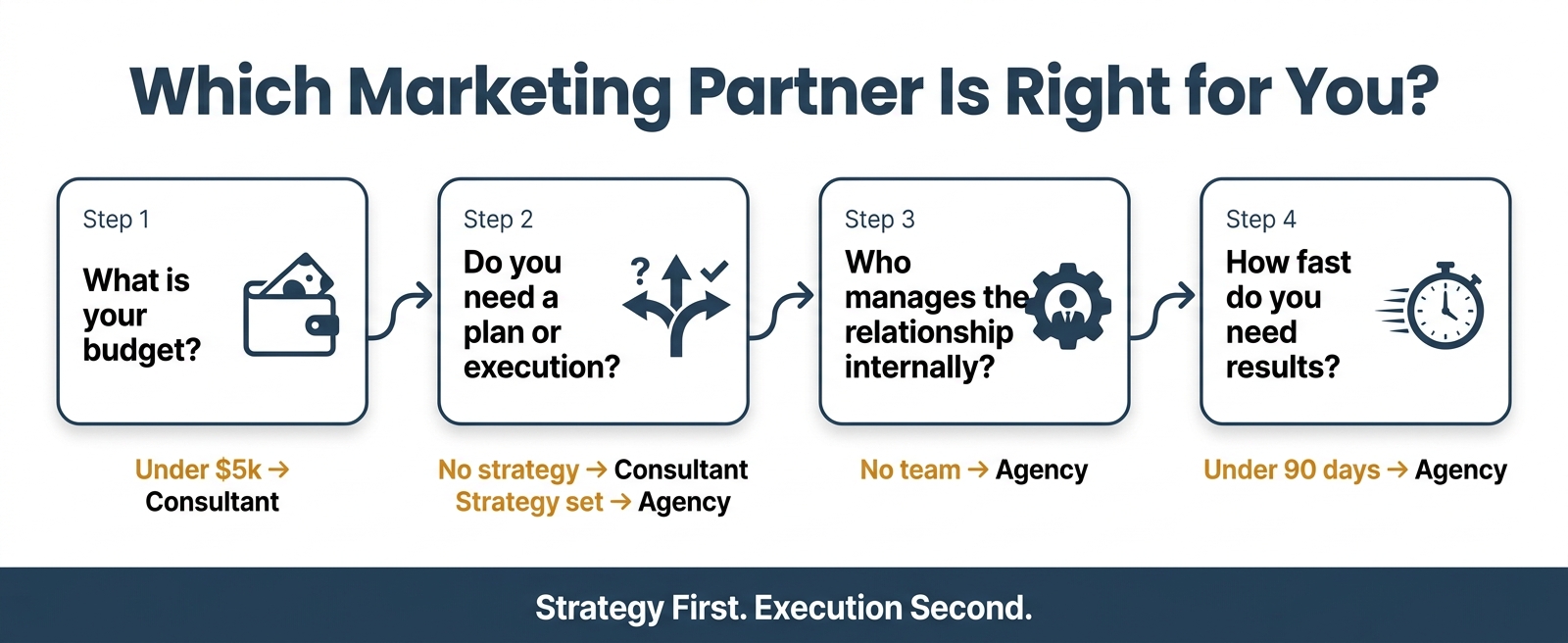
Not sure whether to hire a marketing consultant or an agency? Answer four questions: What's your budget? Do you need a plan or execution? Who internally will manage the relationship? And how fast do you need results? Your answers will point you directly to the right marketing partner for your stage.
Step 1: What Is Your Total Quarterly Marketing Budget?
Budget is the first filter. It tells you what's actually available before you fall in love with an option that doesn't fit.
Consultants are typically more flexible. Project engagements for a go-to-market strategy or full audit often run between $3,000 and $8,000 total. Monthly advisory retainers for ongoing strategic guidance usually sit below what a full agency costs.
Agencies require more committed spend. Most SMB retainers start around $2,500 to $5,000 per month for a single channel, and multi-channel packages climb from there. According to Hubstaff's average hourly rates report, North American marketing freelancers average around $56 per hour, but senior marketing consultants often bill well above that range.
A quick budget check:
- Under $5,000 total available: A focused consultant project is your best fit
- $3,000 to $7,000 per month: You can support a lean agency retainer or a strong ongoing consultant
- $7,000+ per month: Multi-channel agency support becomes a real option
Step 2: Do You Need a Plan or Do You Need Things Done?
This is the most important question in the whole decision. Be honest with yourself here.
If you don't yet know your ideal customer, your best channels, or why your messaging isn't converting, you need a plan. Hiring an agency without one means paying a full team to execute a strategy that doesn't exist yet. That's a fast way to burn runway.
If your strategy is already locked and you need campaigns built, content created, and ads running, you need execution. A consultant alone won't move the pipeline needle.
According to Process Street's breakdown of marketing agency vs. consultant, the biggest mistake founders make is skipping strategy and jumping straight to execution because it feels faster. It rarely is.
- Need a plan first: Hire a consultant
- Strategy is set, need execution: Hire an agency
- Not sure if your strategy is solid: Start with a consultant
Step 3: Who on Your Team Will Work with This Partner?
Your internal resources shape what kind of partner will actually work for you.
If you have no marketing hire at all, a consultant can give you direction, but you'll still need someone to execute their roadmap. Either you do it yourself, hire a freelancer, or bring in an agency to run with the plan.
If you have a small team that can execute but lacks senior direction, a consultant is a smart fit. They become the strategic brain your team doesn't have yet, without the cost of a full-time CMO.
If you have no one available to manage an agency relationship, that's worth knowing too. Agencies need a point of contact. Someone needs to review work, give feedback, and make decisions. Budget an hour or two per week at minimum.
- No internal team: You need either an agency or a consultant plus execution support
- Small team, no strategy leader: A consultant fills the gap without a full-time hire
- Team in place, needs direction: Consultant first, then consider an agency
Step 4: Do You Need Immediate Results or a Long-Term Plan?
Timeline pressure changes the answer.
If you need pipeline in the next 90 days and your strategy is already clear, an agency with strong paid media or outbound capability can move fast. Campaigns can be live within a few weeks of onboarding.
If you're playing a longer game and need to build the right foundation, rushing into agency execution without a solid strategy will cost you more time and money in the end. A consultant engagement that runs four to six weeks upfront can save months of wasted agency spend.
For seed and Series A B2B tech startups at programs like The Zulu Method, the answer is often: move fast, but move smart. Strategy first, then execution.
Your Decision Scorecard
Use the table below to score your situation. For each row, pick the answer that fits. Count your totals at the bottom.
| Question | Answer A (score 1) | Answer B (score 2) | Answer C (score 3) |
|---|---|---|---|
| Budget available | Under $5k total | $3k to $7k/month | $7k+/month |
| Strategy clarity | No strategy yet | Some direction, needs refinement | Strategy is locked |
| Internal resources | No team at all | Small team, no senior direction | Team ready to manage a partner |
| Timeline | 6+ months, building foundation | 3 to 6 months, need momentum | Under 90 days, need pipeline now |
For B2B tech founders at programs like The Zulu Method, most early-stage companies land in the 4 to 8 range. That's not a weakness. It's just the reality of where strategy tends to be at seed and Series A. Getting the plan locked first is what makes every dollar you spend on execution worth it.
Questions to Ask Before Choosing Your Marketing Partner
- Do you know exactly which channels and messages will drive pipeline for your business right now?
- Does your team have senior-level marketing direction, or are they executing without a clear plan?
- What is your total quarterly marketing budget, and can you commit to a 6 to 12 month agency retainer?
- Is your go-to-market strategy already defined and validated, or are you still figuring out your positioning and ideal customer?
- Who on your team will manage the relationship with an outside partner, and do they have time to review work and give feedback weekly?
- Do you need a roadmap and guidance you can execute internally, or do you need a full team to run campaigns on your behalf?
Make the Right Choice for Your Marketing Strategy's Future
The marketing consultant vs agency decision isn't about which option is better. It's about which one fits where your business is right now. Consultants bring clarity and direction. Agencies bring capacity and execution. Getting the sequence right is what protects your runway and builds real pipeline.
It Always Comes Back to Stage and Need
If you don't have a clear marketing strategy yet, a consultant is your first move. You need a senior expert to audit your position, sharpen your messaging, and hand you a prioritized roadmap before a single dollar goes toward execution.
If your strategy is already locked and you need campaigns running, an agency is the right call. You get a full team of specialists without spending six to nine months building one in-house.
And if you need both, the hybrid model gives you a consultant to own strategy and an agency to run execution. That combination is often the smartest path for seed and Series A B2B tech founders who can't afford to get the sequence wrong.
Use the Framework, Then Be Honest
The decision scorecard from the previous section gives you a starting point. But the framework only works if you're honest about two things: your actual budget and your internal resources.
Many founders overestimate how strategy-ready they are. If your messaging isn't converting or you're not sure which channels your ideal customers actually use, that's a signal you need strategic clarity before execution. Jumping to an agency too early is one of the most common ways early-stage startups burn runway.
According to Thunderstrike Marketing's breakdown of consultant vs. agency roles, the biggest mistake founders make is assuming execution speed equals results speed. Without the right strategy underneath, faster execution just means faster waste.
Your Next Step
If you're a seed or Series A B2B tech startup without a clear go-to-market strategy, start there. Programs like The Zulu Method are built specifically for founders who need senior strategic thinking without the cost of a full-time CMO or a bloated agency retainer running in the wrong direction.
Get the strategy right first. Then bring in the execution team. That order is what makes every dollar you spend afterward worth it.

The main difference is scope. A consultant's primary role is strategic advice and planning, helping you figure out what your business should do with marketing. An agency's primary role is execution and implementation, actively running campaigns and managing channels on your behalf.
Is it better to hire a marketing consultant or an agency?It's not about which is better, but what's right for your current stage. Hire a consultant if you need expert strategic direction, a roadmap, or focused guidance on a specific problem. Hire an agency if your strategy is already clear and you need an outsourced team to handle ongoing execution across multiple channels.
How much does a marketing consultant cost?Costs vary widely, but typically range from $50 to $200+ per hour depending on experience and specialization. Project fees for a comprehensive strategy or audit can range from $3,000 to $8,000, while ongoing monthly advisory retainers usually run $2,000 to $5,000 per month.
How much does a marketing agency cost?Agency fees are usually paid as a monthly retainer. For SMBs and startups, retainers typically range from $2,500 to $10,000+ per month depending on the scope of services and number of channels. Some agencies also charge a percentage of ad spend, usually 10% to 20%, for media buying services.
Can a consultant replace an entire marketing team?No. A consultant replaces the need for a senior strategic leader like a CMO, but they do not replace the team needed to execute the work such as writers, designers, and media managers. An agency, however, can act as a replacement for an entire marketing team because they provide both strategy and execution specialists.
What are the red flags when hiring a marketing consultant vs an agency?For a consultant, red flags include a lack of a clear process, promising specific results they can't control, or vague deliverables. For an agency, red flags include vague reporting, high client turnover, long-term contracts without a trial period, or account managers with no access to the senior strategists who pitched you.