
Hannon Brett | Published on: June 16, 2026 | Time to read: 20 min
A fractional CMO is a senior marketing executive who leads your marketing part-time, usually one to four days a week, for a monthly fee instead of a full-time salary. You get C-suite strategy, a leader in the room for key decisions, and accountability for revenue outcomes at a fraction of the $200,000-plus a full-time hire costs. This guide covers what a fractional CMO actually does, what one costs, how the model compares to agencies and in-house hires, and how to tell whether it's the right fit for your stage.
Why Does the Fractional CMO Model Exist?
The fractional model rests on a strategic philosophy: maximum marketing impact comes from smart resource allocation, not bigger budgets. Instead of spending more to get more, it asks a simple question: are you getting the best possible return from every dollar, hour, and decision your marketing team makes?
The Three Pillars Behind the Model
Think of it as a three-legged stool. Pull any one leg away and the whole thing falls over.
-
Capital Efficiency is about doing more with less. It means every budget decision is tied to a measurable outcome. As Harvard Business School research on capital use points out, the smartest companies constantly re-examine how they put capital to work, not just how much they spend.
-
Talent Use is about accessing the right expertise at the right time. You don't always need a full-time hire to get senior-level thinking. On-demand access to experienced strategists means smaller teams can punch well above their weight.
-
Data-Driven Decisions means you only keep what you can prove is working. Metrics like Customer Acquisition Cost and lifetime value become your compass, not just your report card.
A Fractional CMO Isn't Just Cheap Marketing
This is the most common misunderstanding. Hiring a fractional CMO isn't a cost-cutting move dressed up as strategy. And it's not the same thing as hiring the cheapest agency you can find.
Peter Drucker put it best: "Efficiency is doing things right; effectiveness is doing the right things." The fractional model is about choosing the right strategies first, then executing them well. That distinction matters a lot.
The goal is senior-level strategy applied with financial discipline. It's the kind of thinking that asks "should we be doing this at all?" before asking "how do we do this better?"
What Does a Fractional CMO Actually Do?
In practice, a fractional CMO works with your team on a part-time basis, joins your leadership meetings, and owns the marketing function the way a full-time executive would. The difference is the commitment: you pay for the leadership you need, not a permanent seat.
What a Fractional Engagement Actually Looks Like
Instead of hiring a full-time CMO, you bring in an experienced marketing leader for a set number of hours or days each week. They join your leadership team, attend key meetings, and drive strategic decisions just like a full-time hire would.
The cost difference is significant. Full-time CMO compensation in the US averages around $258,000 per year in total pay, according to Comparably's CMO salary data. A fractional arrangement can deliver the same strategic output at a fraction of that cost.
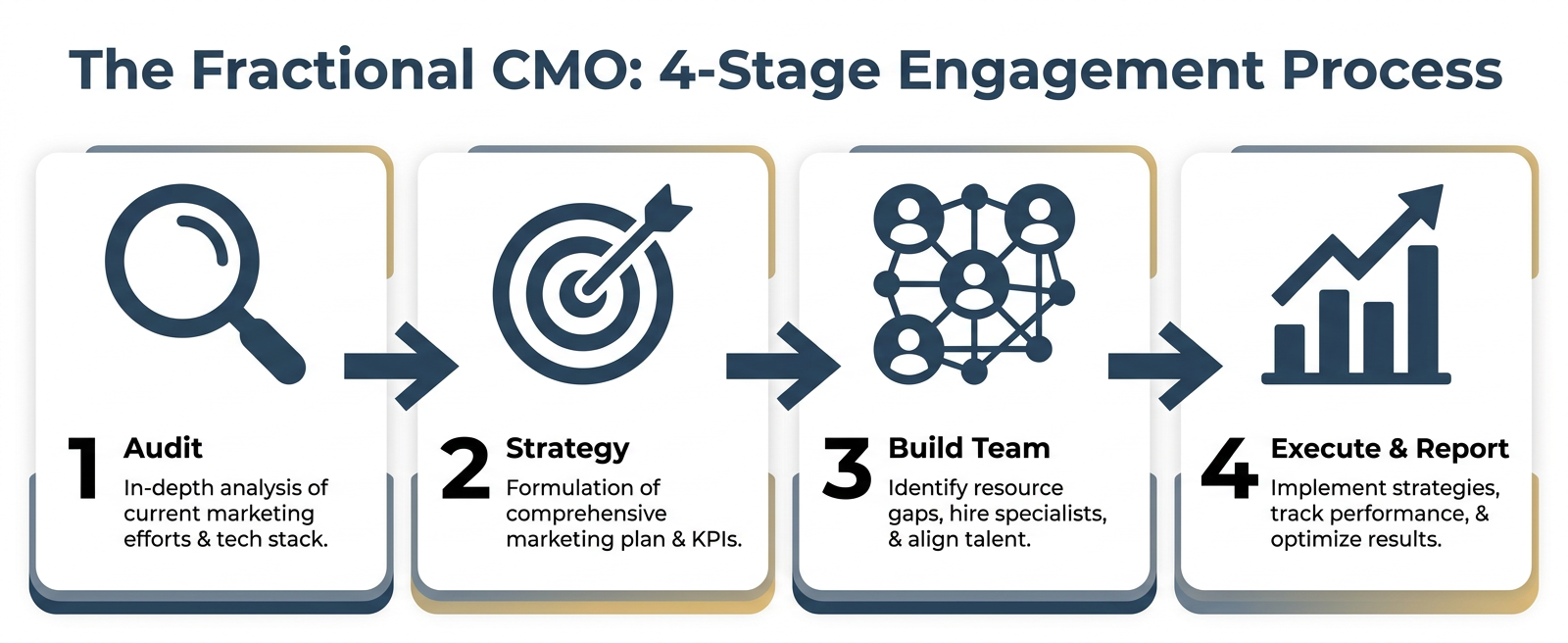
The Four-Stage Process
A typical fractional CMO engagement follows a clear sequence:
Stage 1: The Audit. The first step is always a deep look at what's already happening. Where is budget going? What's working? What's producing zero return? This audit creates the foundation for every decision that follows.
Stage 2: Strategy Development. With a clear picture of the current state, the fractional leader builds a focused plan. This covers target audiences, channel priorities, messaging, and measurable goals.
Stage 3: Building the Specialist Team. Here's where the model gets lean. Rather than hiring a big in-house team, the fractional CMO assembles a small group of freelance specialists and junior staff. Each person covers a specific function, like paid ads, content marketing, or email. No redundancy, no overhead bloat.
Stage 4: Execution and Reporting. The fractional leader oversees the team, tracks performance, and adjusts the strategy based on real data. Results are reported directly to the leadership team on a regular cadence.
Why This Model Gets Results
As one marketing consultancy put it plainly: "Agencies execute. In-house hires coordinate. Fractional CMOs lead." That distinction explains a lot about why the model works.
The data backs this up. Across more than 500 businesses that adopted fractional CMO models, a 3 to 5x ROI within 12 months is a commonly reported benchmark. In SaaS and professional services, that range can climb to 5 to 7x in the first year.
And the model fits a broader shift in how senior talent works. ADP Research found that the independent contractor share of total employment grew by 50% between 2019 and the end of 2024. Senior marketing leaders are increasingly choosing portfolio careers over single-employer roles, which means access to this level of talent is growing.
For startups and SMBs, this matters. Getting senior-level leadership into the room, without committing to a six-figure salary, is exactly the kind of structural advantage the fractional model is built on.
What Are the Benefits of a Fractional CMO?
A fractional CMO gives growing businesses access to senior-level strategy without the cost of a full-time executive hire. The core benefit is simple: you get better marketing decisions, a leaner team structure, and the ability to scale up or pull back based on what your business actually needs right now.
Cost Savings That Actually Move the Needle
Let's talk numbers. A full-time CMO in the US typically costs well over $200,000 per year in base salary alone. Add benefits, bonuses, and employer taxes, and that number climbs fast. MyPersonalRecruiter's 2026 CMO salary guide puts total CMO compensation at an average of $293,575 for larger organizations.
A fractional arrangement, by contrast, typically runs between $5,000 and $10,000 per month. That's $60,000 to $120,000 per year for the same strategic thinking, but without the long-term payroll commitment. For a startup or SMB watching every dollar, that gap is enormous.
Access to Expertise You Couldn't Otherwise Afford
Most small and mid-sized businesses can't compete for top marketing talent on salary alone. A fractional model changes that. You get a leader who has built go-to-market strategies, managed large budgets, and navigated growth stages you haven't hit yet.
This matters more than most founders realize. MarketingProfs research on SMB marketing challenges found that 55% of SMB owners cite customer acquisition as their top challenge, while 28% say they struggle to figure out which marketing efforts are actually working. Both of those problems are exactly what senior strategic leadership is designed to solve.
And you're not locked into one person's blind spots. A good fractional leader brings a network of specialists. You get the benefit of broad experience without paying for a full department.
Flexibility That Matches Your Business Reality
One of the quieter advantages of this model is how well it fits irregular business cycles. Closed a funding round? Scale up engagement. Heading into a slower quarter? Pull back without severance conversations.
Startups using fractional executive models have reported 45% faster market entry and 67% better investor-readiness metrics, partly because the model allows rapid adjustment without the drag of a bloated org chart.
That kind of flexibility isn't just convenient. It's a strategic advantage. You're matching your marketing investment to your actual stage of growth, not paying for capacity you don't need yet.
How Does a Fractional CMO Compare to an Agency or In-House Hire?
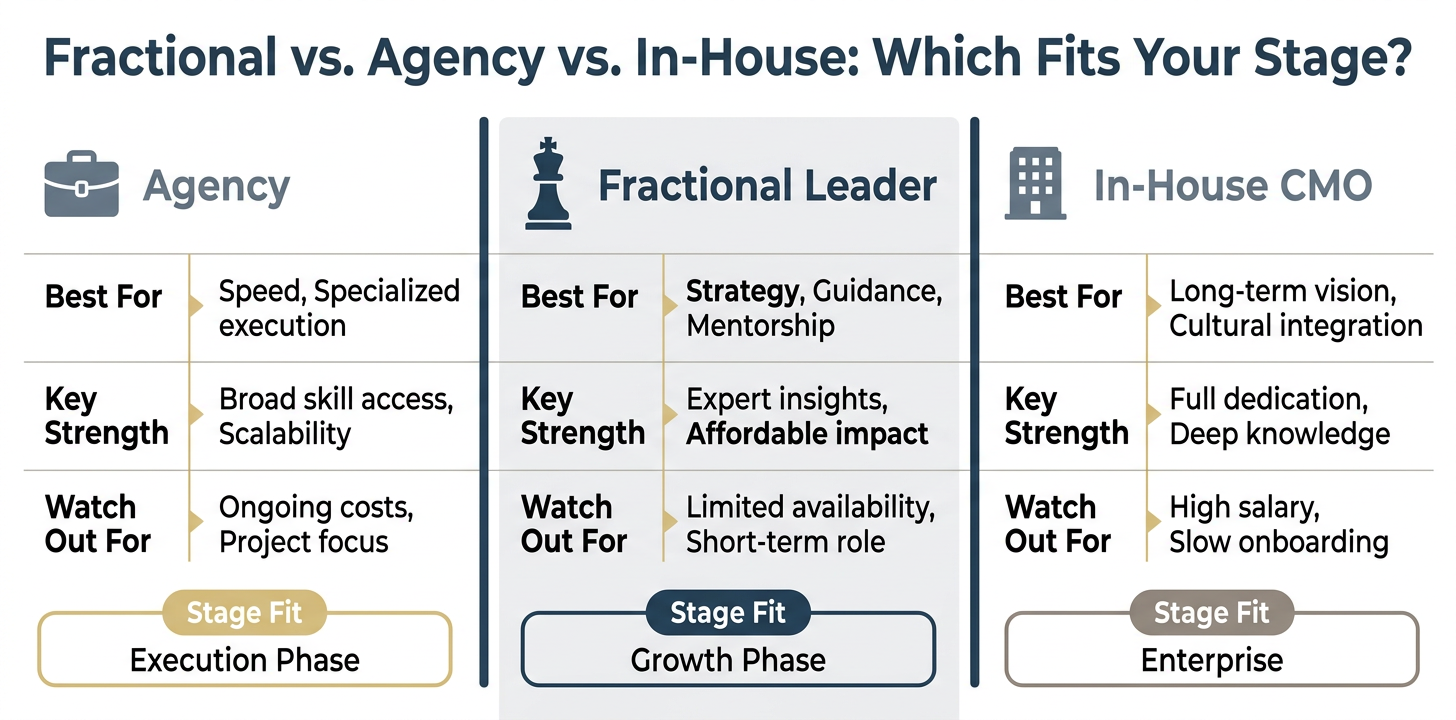
Choosing how to structure your marketing isn't just a hiring decision. It's a strategic one that affects your budget, your speed, and how well your growth efforts actually stick. Let's break down how the three main models compare.
Fractional vs. Agency: Strategy vs. Execution
Marketing agencies are built for execution. They're good at running campaigns, managing ad accounts, and producing content at scale. But most agencies assign your account to junior staff, not the senior strategist who sold you the engagement.
A fractional marketing leader works differently. They sit inside your leadership team, drive strategy, and make decisions. They're not handing off briefs to account managers. They're in the room where priorities get set.
The other big difference is accountability. Agencies track deliverables. A fractional leader tracks outcomes like revenue, CAC, and conversion rates. That shift in focus changes everything about how marketing gets done.
Fractional vs. In-House: Flexibility vs. Overhead
Hiring a full-time CMO is a long-term commitment. You're paying salary, benefits, bonuses, and employer taxes every month, regardless of whether the business needs that level of output right now.
You're also betting on one person's skillset. If your full-time hire is great at brand but weak on performance marketing, that gap shows up fast. And fixing it means another hire.
A fractional arrangement gives you senior-level thinking without that fixed overhead. You can scale the engagement up or down based on what the business actually needs. And a good fractional leader brings a network of specialists, so you're not limited to one person's strengths.
Which Model Fits Which Stage
There's no single right answer here. The best choice depends on where your business is right now.
| Model | Best For | Watch Out For |
|---|---|---|
| Agency | Pure execution: ads, content, SEO at scale | Junior account teams, limited strategic input |
| In-House CMO | Mature companies with stable, large marketing budgets | High fixed cost, single-skillset risk |
| Fractional Leader | Scaling companies needing senior strategy without full-time overhead | Less bandwidth for day-to-day execution |
Agencies make sense when you have a clear strategy and need hands to execute it. In-house hiring makes sense when you're large enough to justify the overhead and need someone embedded full-time.
But for most startups and growing SMBs, the fractional model hits a sweet spot. You get the strategic leadership that agencies can't provide and the flexibility that a full-time hire can't offer. That's the core logic behind the fractional model. For a full dollars-and-cents comparison of all three paths, see our fractional CMO vs. agency vs. first-hire cost breakdown.
Still sizing the spend itself? Our breakdown of SaaS marketing budget by funding stage shows the ranges founders actually commit from Seed through Series B.
When Does a Fractional CMO Fit Your Business?
A fractional CMO fits best at companies that need senior marketing leadership but can't justify a full-time executive salary. It's built for businesses where resources are tight, growth feels stuck, or strategy is missing entirely. But it's not the right fit for every organization.
The Businesses That Benefit Most
This model was practically designed for three types of companies.
Startups from Seed to Series B are the clearest fit. You need go-to-market strategy, but you're not yet ready to commit to a six-figure payroll line. A fractional approach gives you the leadership you need at a cost your runway can handle.
SMBs with stagnant growth are another strong match. If revenue has plateaued and you're not sure why, the problem is usually strategic, not executional. Bringing in senior-level thinking can diagnose what's broken and fix it fast.
Companies entering new markets also benefit. A new geography or customer segment requires fresh strategy. A fractional leader who's done it before can compress your learning curve significantly.
Red Flags That Signal You Need This Model
Not sure if this applies to you? Run through this quick checklist:
- Marketing feels chaotic and reactive, not planned
- You can't measure which efforts are actually driving revenue
- Your agency produces deliverables but not results
- You know you need senior strategy but can't afford a full-time hire
- Your LTV:CAC ratio is below 3:1, which signals weak acquisition efficiency
- Growth has stalled despite continued spending
If two or more of these sound familiar, the model is worth serious consideration.
When It's NOT the Right Fit
Honesty matters here. Fractional leadership isn't for everyone.
Large enterprises with established, complex marketing departments don't need it. If you already have a full CMO, a sizable in-house team, and clearly defined processes, adding a fractional layer creates confusion, not clarity.
Companies that need full-time daily execution support may also struggle with this model. A fractional leader drives strategy. If your biggest gap is hands-on execution bandwidth, a different solution fits better.
The question isn't whether this model is good. It's whether it matches where your business actually is right now.
Questions to Ask Before Hiring a Fractional CMO
- Can you currently connect each marketing line item (channel, tool, vendor) to a measurable business outcome, or do some feel like black boxes?
- What is your current LTV:CAC ratio, and is it above or below the 3:1 healthy benchmark, and what does this signal about your acquisition efficiency?
- How many months does it take to recover your customer acquisition cost through gross profit (your CAC payback period), and is that timeframe sustainable given your cash runway?
- Do you have clear, documented strategic goals for marketing (1-2 primary objectives), or does your marketing feel reactive and scattered across too many initiatives?
- Which of the six red flags resonates most: chaotic/reactive marketing, inability to measure results, agency deliverables without results, need for senior strategy you can't afford, weak LTV:CAC, or stalled growth despite continued spending?
- Are you at a stage (seed-to-Series B, SMB, new market entry) where fractional leadership could move the needle, or do you already have full-time marketing infrastructure that a fractional layer would confuse?
What Does a Fractional CMO's Lean Stack Look Like?
A lean marketing stack is a small, focused set of tools that covers every core function without unnecessary cost or overlap. The goal isn't to use the most software. It's to use the right software, well. For most startups and SMBs, a handful of free or low-cost tools can handle everything a much larger team would need. Setting this up, or fixing the bloated version of it, is usually one of the first things a fractional leader does.
Analytics: Know What's Actually Working
You can't improve what you can't measure. Google Analytics 4 is free and gives you a clear view of traffic, conversions, and user behavior. It's the foundation of any lean marketing setup. Pair it with Google Search Console to track organic search performance at zero cost.
CRM: Keep Your Pipeline Organized
A CRM doesn't have to cost anything to be useful. HubSpot's free CRM tier handles contact management, deal tracking, and basic email sequences. It's more than enough for a growing business that isn't yet running a large sales operation.
SEO: Find the Right Keywords Without Big Spend
Semrush offers a free tier that lets you run keyword research and basic site audits. For teams that want more depth, G2 reviews consistently highlight tools like Semrush and Ahrefs as top-rated for SMB SEO needs. Start with the free tier and upgrade only when you hit real limits.
Social Media Management: Schedule Smarter
Buffer and Later both have free plans that cover basic scheduling across major platforms. They save time and keep your content calendar consistent without adding overhead.
Project Management: Keep the Team Aligned
Trello's free plan handles campaign planning, content calendars, and task management well. For teams that need more structure, Notion offers a free workspace that doubles as a strategy hub and content library.
The Lean Stack at a Glance
| Function | Free or Low-Cost Tool | Key Benefit |
|---|---|---|
| Analytics | Google Analytics 4 | Full traffic and conversion tracking |
| CRM | HubSpot Free | Contact and pipeline management |
| SEO | Semrush Free Tier | Keyword research and site audits |
| Social Scheduling | Buffer or Later | Cross-platform scheduling |
| Project Management | Trello or Notion | Campaign planning and task tracking |
The point of this stack isn't to avoid spending money forever. It's to avoid spending money before you've proven what works. Start lean, measure everything, and invest in upgrades only when a specific tool becomes a real bottleneck to growth.
For businesses looking to further optimize their marketing operations, B2B marketing automation can help streamline repetitive tasks and improve efficiency. Additionally, exploring AI marketing tools can provide cost-effective ways to enhance your marketing capabilities without increasing overhead.
How Do You Measure a Fractional CMO's ROI?
Measuring a fractional CMO's ROI means tracking the metrics that connect marketing spend directly to business growth. Skip the vanity metrics like follower counts and page views. Focus instead on three numbers that actually tell you if your marketing is working: LTV:CAC ratio, Marketing Payback Period, and Marketing Sourced Revenue.
LTV:CAC Ratio: The Health Check
This is the single most important number a fractional CMO gets judged on. It compares what a customer is worth over their lifetime to what it cost to acquire them.
The formula: LTV divided by CAC.A ratio of 3:1 is the widely accepted healthy benchmark. That means for every dollar you spend acquiring a customer, you get three dollars back. According to CAC benchmarks research from ltvcacbook.com, SaaS companies typically target 3:1 or higher, while a ratio below 2:1 signals weak unit economics that need fixing fast.
If your ratio is below 3:1, your acquisition costs are too high, your retention is too low, or both.
Marketing Payback Period: How Fast You Break Even
This metric tells you how many months it takes to recover what you spent acquiring a customer.
The formula: CAC divided by monthly gross profit per customer.For SaaS, a payback period under 12 months is considered strong. For e-commerce and D2C, Maxio's SaaS metrics resource notes that shorter payback periods free up cash to reinvest in growth faster. A long payback period doesn't mean failure. But it does mean you need more working capital to scale.
Marketing Sourced Revenue: Prove the Contribution
Marketing Sourced Revenue tracks what percentage of total revenue can be traced back to a marketing touchpoint. It answers the question leadership always asks: what is marketing actually generating?
Most CRM tools can tag deals by source. Even a basic setup in HubSpot's free tier lets you filter closed revenue by lead origin. Track this monthly and report it to leadership alongside total spend.
Build a Simple Tracking Dashboard
You don't need expensive software to track these numbers. A Google Sheet with three tabs works fine to start.
| Metric | Formula | Healthy Benchmark |
|---|---|---|
| LTV:CAC Ratio | LTV / CAC | 3:1 or higher |
| Marketing Payback Period | CAC / Monthly Gross Profit per Customer | Under 12 months (SaaS) |
| Marketing Sourced Revenue | Marketing-Attributed Revenue / Total Revenue | Track trend over time |
For a more visual setup, Improvado's guide to ROI dashboards recommends keeping the top of your dashboard to four numbers: total revenue, total marketing spend, ROI percentage, and conversions. Everything else supports those four.
Review these numbers monthly. Share them with leadership in a one-page summary. When the engagement is working, these metrics tell the story clearly and fast.
Conclusion: Making the Shift to Smarter Marketing
The core idea behind the fractional CMO model is straightforward. You don't need a massive budget or a full-time executive to get senior-level strategy. You need the right structure, the right expertise, and a clear way to measure what's working.
That combination is what makes this approach different from simply spending less. It's about spending smarter.
Recap: What This Model Actually Offers
Across every section of this guide, one theme keeps coming back. Growing businesses consistently overpay for marketing that underdelivers, not because they lack effort, but because they lack strategic leadership.
The fractional model fixes that. You get experienced strategy, a lean specialist team, and measurable outcomes without the fixed overhead of a full-time hire.
Four Steps to Get Started
If this model sounds like a fit, here's where to begin:
- Audit your current marketing spend. List every channel, tool, and vendor. Note what each one costs and what measurable result it produces. If you can't connect a line item to a result, that's your first problem to solve.
- Define your top one or two strategic goals. Not ten goals. One or two. Customer acquisition, retention, or market expansion. Clarity here drives everything else.
- Check your core metrics. Pull your LTV:CAC ratio and your current CAC payback period. These numbers tell you where your biggest efficiency gaps are before you bring anyone new into the picture.
- Explore whether a fractional arrangement fits your stage. Talk to someone who has done it. Ask about their process, their reporting cadence, and how they've handled businesses at your exact growth stage.
The Direction Marketing Is Heading
The businesses that grow efficiently in the years ahead won't be the ones with the biggest marketing teams. They'll be the ones that build lean, data-driven operations led by experienced strategists.
That shift is already happening. And for startups and SMBs willing to rethink how marketing leadership works, the opportunity is real right now.
A fractional CMO is a senior marketing executive who leads your marketing function on a part-time basis, giving you C-suite strategy and accountability without the full-time executive cost. The model prioritizes marketing ROI and capital efficiency through smart resource allocation. The core principle is being effective (doing the right things) first, then executing efficiently, not being cheap.
What does a fractional CMO do?A fractional CMO acts as a part-time strategic leader of your marketing function, typically working 1-4 days per week. They develop marketing strategy, manage budgets, build and lead lean teams (in-house or freelance), and are accountable for measurable marketing performance and business ROI, acting as an integrated member of your leadership team rather than an external consultant.
How much does a fractional CMO cost?Fractional CMOs typically charge $5,000-$10,000 per month ($60,000-$120,000 annually), depending on hours and scope. By contrast, a full-time CMO costs $200,000-$300,000+ per year in total compensation including salary, benefits, bonuses, and taxes, which makes fractional arrangements 60-70% cheaper while delivering the same strategic output.
Is a fractional CMO worth it?Yes, for companies that need strategic guidance but can't yet afford or don't need a full-time executive. Fractional engagements deliver value by preventing costly marketing mistakes, building scalable marketing engines, and accelerating growth efficiently. Across 500+ businesses, a 3-5x ROI within 12 months is common (5-7x in SaaS and professional services), justified by tracking improvements in LTV:CAC ratio, marketing payback period, and marketing-sourced revenue.
What's the difference between a fractional CMO and a consultant?A consultant typically provides advice or a specific deliverable, then leaves. A fractional CMO integrates as an ongoing member of your leadership team, taking ownership and accountability for executing strategy and managing the marketing function over an extended period (typically 6-12+ months), not just advising from the sidelines.
How do you measure a fractional CMO's success?Success is measured by business impact, not vanity metrics. Track three core metrics: LTV:CAC ratio (target 3:1 or higher), marketing payback period (under 12 months for SaaS), and marketing-sourced revenue percentage (the portion of total revenue attributed to marketing touchpoints). Review these monthly and report to leadership to prove marketing's direct contribution to growth.