
Hannon Brett | Published on: July 26, 2026 | Time to read: 29 min | Updated on: August 31, 2026
This guide helps startup founders choose marketing strategies that match their business model, funding stage, and ideal customer profile. It covers seven core strategies including content marketing, lean SEO, product-led growth, community building, social media, email marketing, and strategic partnerships, plus a 100-day implementation playbook. The key is starting small, staying focused, and doubling down on channels that show measurable results rather than trying to be everywhere at once.
Key Takeaways
- Your marketing strategy must align with your specific business model (B2B, B2C, or SaaS) and funding stage (pre-seed, seed, or Series A) to avoid wasting runway
- Content marketing and SEO provide the highest long-term ROI by building trust and attracting inbound leads, especially when you start with bottom-of-funnel content
- Product-led growth turns your product into the main sales channel through viral loops, freemium models, and usage-triggered automations
- Building a dedicated community creates a defensible moat that increases customer lifetime value by up to 25% and reduces churn significantly
- Focus on one or two channels where your ideal customer actually spends time, rather than spreading thin across multiple platforms
- Email marketing consistently delivers the highest ROI at $36 for every $1 spent, making it essential from day one
- A healthy SaaS business maintains an LTV:CAC ratio of 3:1 or higher, spending no more than one-third of customer lifetime value on acquisition
- The first 100 days should focus on three phases: foundation and validation (days 1 to 30), early content and experiments (days 31 to 60), and analysis with doubling down on what works (days 61 to 100)
Table of Contents
- How to Choose the Right Startup Marketing Strategy for Your Stage
- 1. Content Marketing: The Foundation of Startup Growth
- 2. Lean SEO: A Startup's Guide to Long-Term Traffic
- 3. Product-Led Growth (PLG): The Ultimate SaaS Marketing Strategy
- 4. Community Building: A Defensible Marketing Moat for Startups
- 5. Strategic Social Media and Targeted Ads
- 6. Email Marketing: The Highest ROI Startup Marketing Channel
- 7. Strategic Partnerships & Affiliate Marketing
- Your First 100 Days: A Startup Marketing Strategy Playbook
- Measuring What Matters: Must-Track Marketing KPIs for Startups
- Build Your Startup Marketing Engine for Lasting Success
How to Choose the Right Startup Marketing Strategy for Your Stage
The best startup marketing strategies match your business model, funding stage, and ideal customer. There's no single playbook. A pre-seed B2B SaaS company needs a completely different approach than a Series A direct-to-consumer brand. Picking the wrong strategy wastes runway. Getting it right accelerates growth. If the decision is really about launch rather than ongoing marketing, compare the best go-to-market agencies instead, because a go-to-market strategy agency owns positioning and the sales motion, not just the campaigns.
Match Your Strategy to Your Business Model
Your business model shapes which channels actually work. B2B startups need to reach decision-makers, and platforms like LinkedIn consistently deliver more than 80% of B2B social media leads. B2C brands, on the other hand, thrive on visual platforms like Instagram and TikTok where product discovery happens naturally.
SaaS companies sit somewhere in between. They often benefit from content marketing and SEO early on, then layer in paid channels as they grow. The key is knowing which model you're building before you spend a dollar on marketing.
Let Your Funding Stage Guide Your Tactics
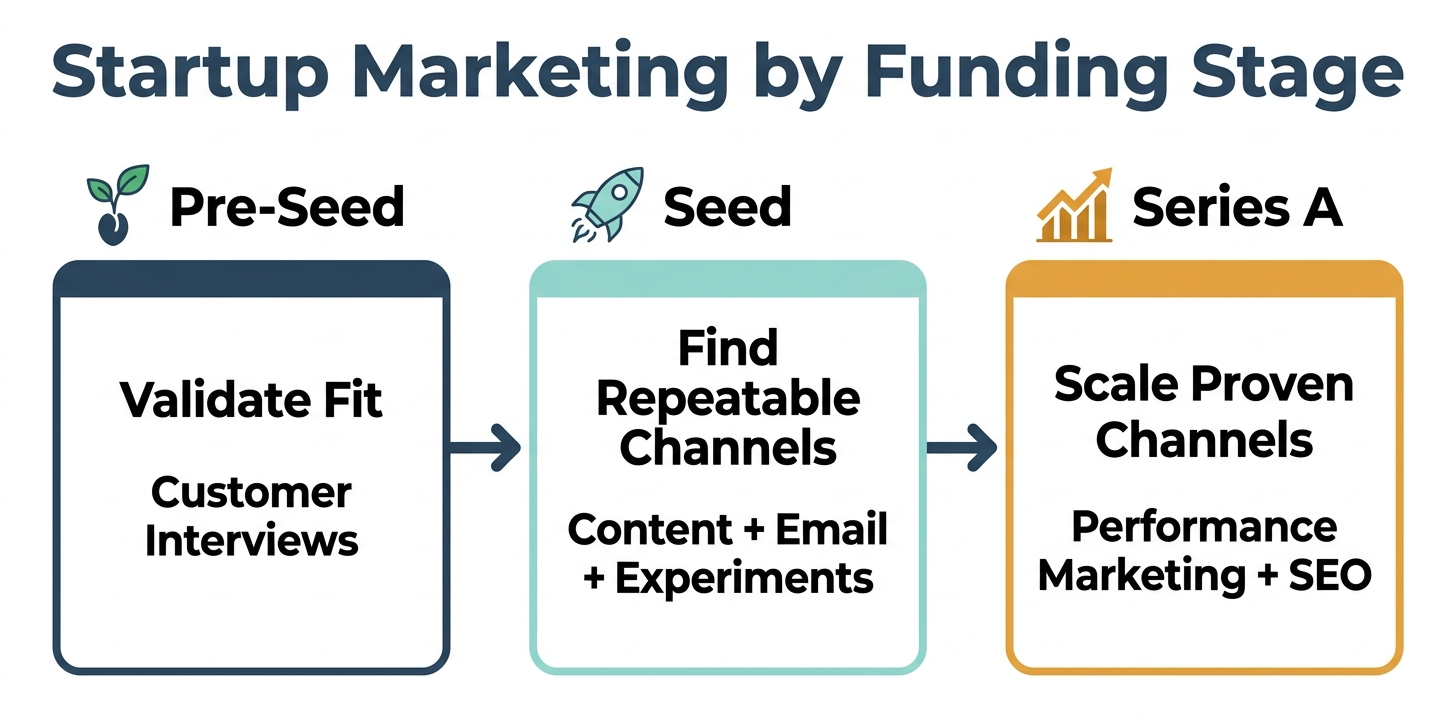
Your stage tells you how much to spend and where. Here's a simple framework from Demand Science's breakdown of startup marketing stages:
| Stage | Primary Goal | Best Tactics | Budget Level |
|---|---|---|---|
| Pre-seed | Validate product-market fit | Customer interviews, direct outreach, beta programs | Very low |
| Seed | Find repeatable acquisition | Content, email, early paid experiments | Low to moderate |
| Series A | Scale proven channels | Performance marketing, advanced SEO, automation | Moderate to high |
At pre-seed, you're not trying to grow. You're trying to learn. Spend time talking to customers, not running ads.
At seed stage, you're running small experiments to find one or two channels that work. The Bullseye Framework from the book Traction is popular here. It pushes founders to test many channels quickly and double down on the ones showing real results.
By Series A, experimentation slows down. You scale what's already working. This is when paid channels, automation, and specialized marketing hires start making sense.
Identify Where Your Ideal Customer Spends Time
Your Ideal Customer Profile (ICP) should drive every channel decision. Ask yourself three things:
- Where do they search for answers? (Google, Reddit, LinkedIn, YouTube)
- What content do they actually consume? (Long-form guides, short videos, newsletters)
- Who do they trust? (Industry analysts, peer communities, specific influencers)
For seed and Series A B2B tech startups, the answer is often a mix of organic content and LinkedIn. Founders at this stage don't have time to build an in-house team from scratch. That's where a focused partner like The Zulu Method can shortcut months of trial and error by bringing a proven go-to-market system built specifically for funded B2B startups.
Getting your ICP right early prevents wasted spend. And at seed stage, wasted spend isn't just a budget problem. It's a runway problem.
1. Content Marketing: The Foundation of Startup Growth
Content marketing is one of the best startup marketing strategies because it builds trust before anyone spends a dollar. It attracts people who are already searching for what you offer. And it keeps working long after you publish it. The key is knowing which content to create first.
Start With Bottom-of-Funnel Content
Most startups make the mistake of writing broad, top-of-funnel content first. That's backwards. Bottom-of-funnel (BOFU) and middle-of-funnel (MOFU) content targets people who already know they have a problem and are comparing solutions.
Think product comparison pages, case studies, and "best [solution] for [specific use case]" articles. These attract readers with real purchase intent. They're much closer to making a buying decision than someone reading a general "what is X" post.
Middle-of-funnel content fills the gap. Guides like "how to choose the right tool" or "what to look for in a [product category]" speak to buyers who are actively evaluating their options. Start here and you'll see faster results from your content investment.
Build a Hub and Spoke Content Model
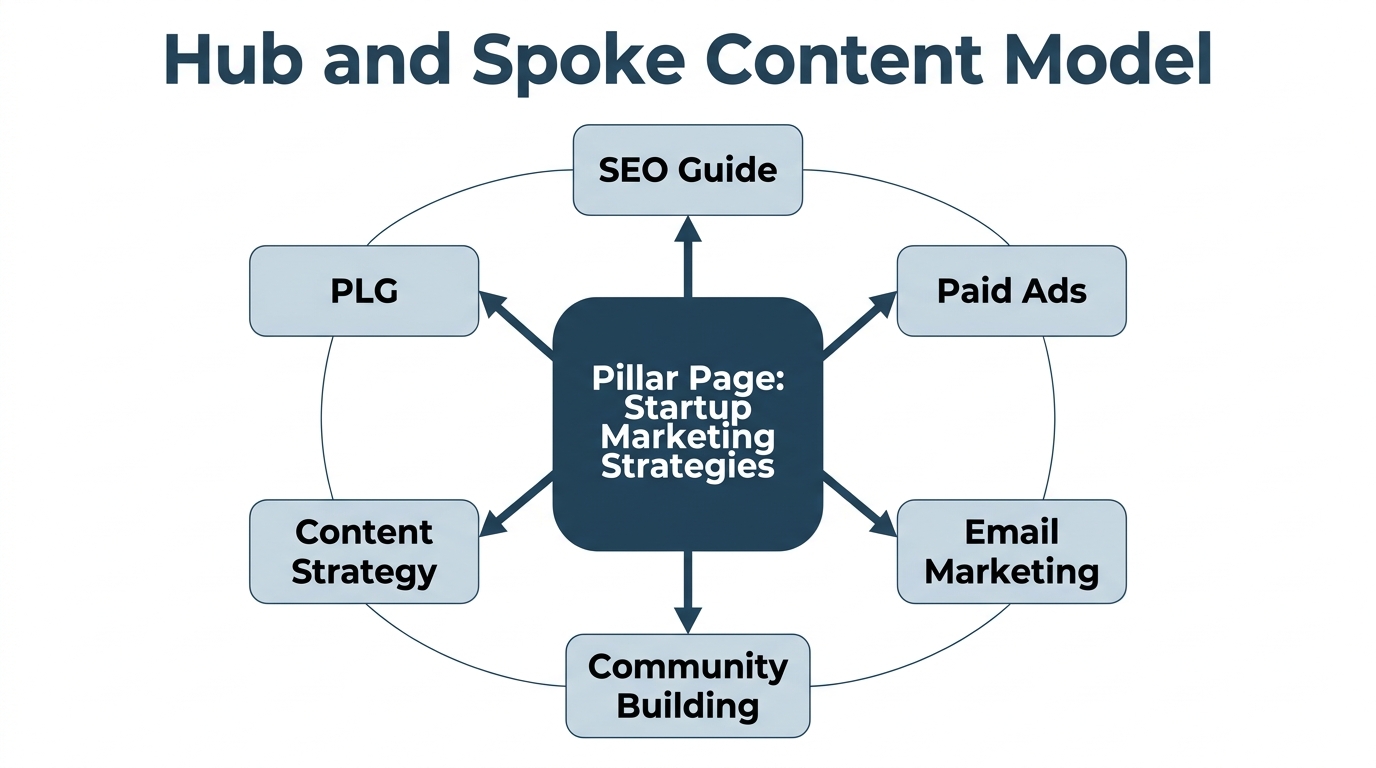
Once you have a few BOFU and MOFU pieces live, build a hub and spoke structure around them. A pillar page (the hub) covers a broad topic in depth. Supporting articles (the spokes) go deeper on specific subtopics and link back to the hub.
This structure does two things. It signals to search engines that you're an authority on the topic. And it gives readers a clear path to explore more content without bouncing off your site.
For example, a pillar page on "startup marketing strategies" might link out to individual posts on SEO, paid ads, email marketing, and community building. Each spoke article stands alone but reinforces the hub's authority.
According to Semrush's organic search research, organic search drives 53% of all website traffic. A hub and spoke model maximizes that organic reach by covering a topic comprehensively.
Repurpose Every Piece of Content
Creating content from scratch every time drains a small team fast. Repurposing fixes that. One well-researched blog post can become a LinkedIn carousel, three social media snippets, an email newsletter, and a short video script.
This approach multiplies your reach without multiplying your workload. A seed-stage startup with one content person can show up consistently across multiple channels by pulling from the same core material.
The goal isn't to be everywhere. It's to be everywhere your ideal customer already spends time, using content you've already created. That's how early-stage teams punch above their weight.
2. Lean SEO: A Startup's Guide to Long-Term Traffic
SEO is one of the best startup marketing strategies for building traffic that doesn't disappear when you stop paying for it. But most early-stage teams waste time chasing keywords they can't win. The smart approach is lean, focused, and built around where you can actually compete.
Target Long-Tail Keywords You Can Actually Rank For
Big competitors own the short, generic keywords. A startup trying to rank for "project management software" is fighting Asana, Monday.com, and Notion from day one. That's a losing bet.
Long-tail keywords are different. Phrases like "project management software for remote design teams" have lower search volume but far less competition. And the people searching them are specific about what they need, which means they convert better too.
Start by building a list of 15 to 20 long-tail phrases your ideal customer actually types into Google. Use free tools like Google Search Console or keyword research tools to check difficulty scores. Pick the ones where you have a realistic shot at ranking in the first three months.
Use Programmatic SEO if Your Model Supports It
If your startup is a marketplace, directory, or platform with lots of structured data, programmatic SEO can be a big win for scale. The idea is simple: you build templates and let your data populate thousands of unique, indexable pages automatically.
Zillow does this with property pages. Tripadvisor does it with restaurant and hotel listings. Early-stage startups with the right business model can apply the same logic on a smaller scale to capture long-tail traffic across hundreds of niche search queries without writing each page by hand.
This only works when your data is genuinely useful to searchers. Thin, repetitive pages will hurt more than they help. But when done right, programmatic SEO can turn a small content team into a traffic machine.
Build Authority Through Digital PR and Guest Posting
Links from trusted websites are still one of the strongest signals Google uses to rank content. A startup with great content but no backlinks will struggle to rank, no matter how well-optimized the pages are.
Digital PR and guest posting are two of the most practical ways to earn those links early. Digital PR means getting your data, research, or founder story covered by industry publications. Guest posting means contributing useful articles to blogs your ICP already reads, with a link back to your site.
According to Ahrefs' link building research, backlinks remain one of Google's top three ranking factors. One strong link from a relevant industry site can do more for your rankings than dozens of links from random directories.
For seed and Series A B2B tech startups, the best targets are niche trade publications, SaaS-focused media sites, and founder communities. Focus on relevance over volume. Ten links from the right sources beat a hundred from irrelevant ones.
3. Product-Led Growth (PLG): The Ultimate SaaS Marketing Strategy
Product-led growth lets your product do the selling. Instead of relying on sales reps or big ad budgets, PLG turns every user into a potential growth driver. For SaaS startups, it's one of the best startup marketing strategies because it scales without scaling your headcount.
Build Viral Loops Into the Product Itself
The most powerful PLG strategies make sharing feel natural. Think of how Slack grows when one person invites their whole team. Or how Calendly spreads every time someone sends a booking link.
These are viral loops baked directly into the product experience. When your tool requires collaboration or benefits from network effects, every new user becomes a distribution channel. Design your onboarding and core features with this in mind from day one.
Use Freemium or Free Trials to Prove Value Fast
A freemium model removes the biggest barrier to adoption: asking someone to pay before they trust you. Users can experience your product's core value before committing a dollar.
According to OpenView Partners' PLG research, companies with strong PLG motions grow significantly faster than sales-led peers. Free access gets users in the door. The product converts them.
The key is making sure your free tier delivers a real win, not a watered-down preview. If users feel the value quickly, upgrades happen naturally.
Trigger Marketing Automations Using Product Data
Once users are in, their behavior tells you everything. When someone completes onboarding, hits a usage limit, or invites a teammate, those signals should trigger targeted emails or in-app prompts.
This is where PLG and marketing automation connect. A well-timed upgrade prompt after a power-use moment converts far better than a generic drip email. Tools like onboarding sequences, feature announcement emails, and expansion nudges all become smarter when driven by real usage data.
For seed and Series A B2B tech startups, setting this up early builds a growth engine that runs without a large team behind it.
4. Community Building: A Defensible Marketing Moat for Startups
Building a community around your startup is one of the most underrated moves in marketing. Unlike paid ads that stop when your budget runs out, a strong community keeps growing on its own. It creates loyalty that's genuinely hard for competitors to copy. And it turns your best customers into your best marketers.
Create a Dedicated Space for Your Users
The first step is giving your community somewhere to live. Tools like Slack, Discord, and Circle let you build a private space where users can connect, share tips, and help each other get more out of your product.
Figma did this brilliantly early on. They encouraged users to share files, templates, and plugins directly inside the product. That turned casual users into contributors. And contributors don't churn. Mixpanel's breakdown of Figma's PLG strategy shows how community-driven product growth creates compounding retention advantages.
For seed and Series A B2B tech startups, a focused Slack community or Circle group is a low-cost way to build this kind of stickiness before you have a big marketing budget.
Host Events That Build Real Belonging
Virtual events, webinars, and workshops do something social media can't: they create real-time shared experiences. When your users learn something together or solve a problem alongside peers, they start to feel like they belong to something bigger than a product.
Start small. A monthly office-hours call or a quarterly virtual workshop is enough to build momentum. The goal isn't a massive conference. It's consistent touchpoints that reinforce why your community exists.
According to research compiled by Common Room on community and customer lifetime value, businesses with engaged communities see up to a 25% increase in retention rates. That kind of churn reduction is worth more than most paid campaigns.
Turn Members Into Advocates
The most powerful thing you can do in a community is make members feel seen. Feature their wins. Share their use cases. Ask for their input on your roadmap.
Notion nailed this early by empowering power users to create templates and tutorials. That community-created content spread across YouTube, Reddit, and Twitter without Notion spending a dollar on it. Common Room's research on community-led growth reinforces that brands with strong communities see higher advocacy rates and more organic referrals.
For founders at seed or Series A stage, community advocacy is one of the most capital-efficient growth levers available. Partners like The Zulu Method can help B2B tech startups build these community foundations as part of a broader go-to-market strategy, so you're not figuring it out alone.
Real World Example: How Figma Built a Community-Driven Growth Engine
Figma turned their user base into their most powerful marketing channel through strategic community building. From the start, they offered a generous free tier, especially for educational institutions, which lowered barriers to entry. They empowered users to create and share plugins, widgets, and design templates directly within the platform, turning casual users into active contributors.
The Community tab became a user-generated library of resources that made the product easier to learn and more valuable for new users. Figma's annual Config conference and smaller events fostered real connections among designers.
This community-first approach created compounding retention advantages. Users who contributed templates or plugins became deeply invested advocates who rarely churned, and their shared content organically attracted thousands of new users without Figma spending a dollar on ads.
5. Strategic Social Media and Targeted Ads
Most startups make the same mistake with social media: they try to be everywhere at once. That burns time and budget with almost nothing to show for it. The smarter move is to pick one or two channels where your ideal customer actually hangs out, and show up there consistently.
Focus on 1-2 Channels Where Your ICP Lives
For B2B tech startups, LinkedIn is usually the right starting point. Decision-makers scroll LinkedIn daily, and the platform's targeting lets you reach them by job title, company size, and industry. According to WordStream's LinkedIn ads benchmarks, LinkedIn's native lead gen forms convert at 10 to 14 percent, which is significantly higher than standard website landing pages.
For B2C or consumer-facing brands, Instagram and TikTok are where product discovery happens. Pick the platform that fits your audience, build a presence there first, and resist the urge to spread thin.
Use Paid Ads for Retargeting First
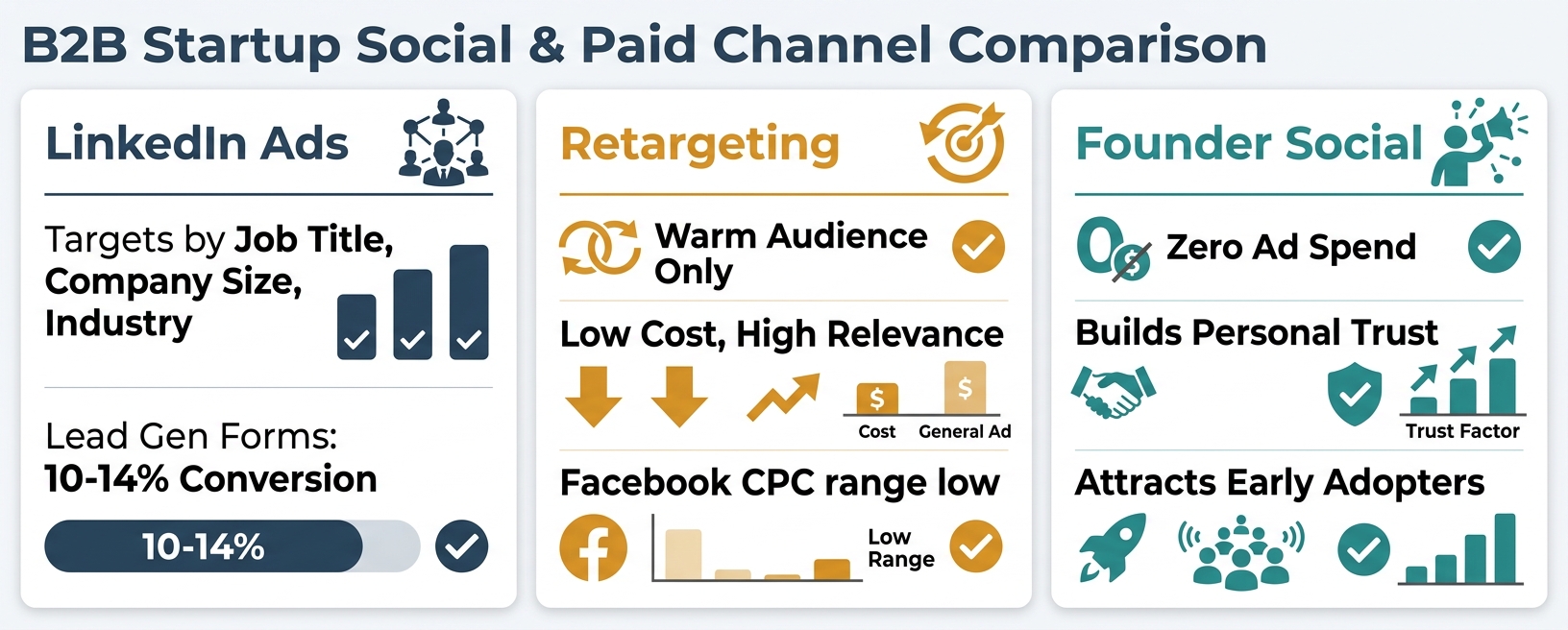
Running cold paid ads before you've built any audience is expensive and rarely works for early-stage startups. A better starting point is retargeting. People who've already visited your site or read your content already know who you are. Showing them a targeted ad costs far less and converts far better than trying to win over cold traffic.
Set up a small retargeting campaign on LinkedIn or Facebook with a budget of a few hundred dollars. Facebook's average CPC across industries runs between $0.80 and $2.00, making retargeting a low-cost way to stay visible to warm audiences while you build organic traction.
Build a Founder-Led Presence on LinkedIn or X
One of the most underused startup marketing strategies is the founder's own social media presence. People buy from people they trust. And a founder who shares real insights, honest lessons, and behind-the-scenes perspective builds trust faster than any brand account.
Posting consistently on LinkedIn or X as a founder attracts early adopters, opens partnership conversations, and gives you an audience you own. It costs nothing but time. And for seed and Series A B2B tech startups without a full marketing team, that kind of organic reach matters a lot.
For founders who need help turning these channels into a real pipeline, partners like The Zulu Method can build the strategy and systems behind a founder-led social presence as part of a broader go-to-market approach.
6. Email Marketing: The Highest ROI Startup Marketing Channel
Email marketing consistently delivers the highest return on investment of any digital channel. For B2B startups, the numbers are hard to ignore: Litmus research on email marketing ROI puts average returns at $36 for every $1 spent. That kind of efficiency matters when you're watching every dollar of runway.
Build Your List From Day One
Don't wait until you have a polished product to start collecting email addresses. A simple lead magnet is all you need. Think a one-page checklist, a short ebook, or a free webinar replay.
The lead magnet should solve one specific problem your ideal customer already has. If your ICP is a seed-stage founder trying to build pipeline, a checklist like "10 Things to Do Before Spending on Ads" will pull the right people in. Small, focused, and genuinely useful beats long and generic every time.
Set Up a Welcome Sequence Immediately
The moment someone joins your list, they're at peak interest. A welcome sequence captures that momentum. Three to five emails over the first two weeks is enough to introduce your brand, share a quick win, and point subscribers toward your best content or a product trial.
This doesn't need to be complicated. Write like you're emailing a person, not broadcasting to a crowd. Seed and Series A B2B tech startups working with a partner like The Zulu Method can get this sequence built and automated in days, not months.
Follow the 80/20 Rule in Every Email
The fastest way to lose subscribers is to sell in every email. People unsubscribe when they feel like a target instead of a person.
A simple rule keeps your list healthy: 80% of your emails should deliver value with no strings attached. Tips, insights, case studies, or tools your audience actually finds useful. The remaining 20% can promote your product, offer a demo, or push a limited offer.
This ratio builds trust over time. And trust is what turns a subscriber into a paying customer.
7. Strategic Partnerships & Affiliate Marketing
Partnerships and affiliate programs let you borrow someone else's audience to grow your own. For early-stage startups without big ad budgets, this is one of the smartest moves available. You tap into trust that's already been built, and you only pay for results.
Find Non-Competing Businesses That Share Your ICP
The best partnership targets serve the same customer you do, without competing for the same sale. Think of a project management tool partnering with a time-tracking app. Same audience, zero overlap.
Reach out with a specific co-marketing proposal. A joint webinar, a shared resource guide, or a content swap all work well. These cost almost nothing to run and put your brand in front of a warm, relevant audience immediately.
Launch a Simple Affiliate Program Early
Affiliate programs don't need to be complicated at the start. Pick a flat commission rate, set up tracking with a tool like PartnerStack or Impact, and recruit five to ten bloggers or niche influencers who already reach your ICP.
According to Influencer Marketing Hub's affiliate marketing research, affiliate marketing now drives over 16% of all e-commerce orders in the US. For B2B SaaS startups, a well-targeted affiliate program can deliver qualified leads at a fraction of typical paid acquisition costs.
The key is recruiting affiliates who genuinely understand your product. Niche beats volume every time.
Integrate With Tools Your Customers Already Use
Product integrations are one of the most underrated growth channels for SaaS startups. When you plug into a platform your ICP already relies on, you get discovered by their existing user base without spending on ads.
And integrations create stickiness. A customer who uses your tool alongside three others in their workflow is far less likely to churn. For seed and Series A B2B tech startups building these partnership foundations, working with a go-to-market partner like The Zulu Method can accelerate the process of identifying the right integration and co-marketing opportunities from day one.
Your First 100 Days: A Startup Marketing Strategy Playbook
The best startup marketing strategies don't start with big ad budgets or complex funnels. They start with a clear plan for the first 100 days. This playbook breaks that window into three focused phases: learn, launch, and optimize. Each phase builds on the last so you're never wasting spend before you're ready.
Days 1-30: Set Up Your Foundation and Validate Your ICP

Your only job in the first 30 days is to learn. Not to grow. Not to run ads. To understand who you're selling to and whether your assumptions are correct.
Start with the technical setup. Install Google Analytics 4, set up your Facebook Pixel and LinkedIn Insight Tag, and configure your CRM. These tools cost nothing to install but create the data foundation everything else depends on. Skip this step and you'll be flying blind for months.
Then go talk to customers. Aim for 10 to 20 conversations with people who match your target profile. Ask about their problems, not your product. Listen more than you talk. These interviews will shape your messaging, your content, and your channel choices far better than any marketing template.
According to The Launch Party's breakdown of startup marketing stages, early-stage marketing works best when it's built around customer discovery first and channel tactics second. The goal at this phase is learning, not launching.
Days 31-60: Create Early Content and Run Your First Experiments
Now you have enough context to start building. Pick one or two channels where your ideal customer actually spends time. Don't try to be everywhere.
Write three to five blog posts that directly address the problems you heard in your customer interviews. These don't need to be perfect. They need to be genuinely useful to someone who has that exact problem. Optimize them for long-tail keywords with low competition so you have a realistic shot at ranking.
Launch one lead magnet. A simple checklist or short guide tied to a specific pain point is enough. This starts building your email list before you have a big content library or paid budget.
Run one small paid experiment. A budget of $200 to $300 is enough to learn something useful. Retargeting website visitors or testing a LinkedIn lead gen form are both low-risk ways to gather real data. You're not trying to generate a pipeline yet. You're trying to see what resonates.
Days 61-100: Analyze What's Working and Double Down
By day 60, you have real data. Now you use it.
Review your analytics. Which blog posts got traffic? What was your email open rate? Did your paid experiment generate any clicks or leads? You're looking for early signals, not big wins. Even a small positive signal on one channel tells you where to invest more.
The Next Web's guide to startup marketing makes a simple but important point: the startups that grow fastest in their first year are the ones that stop doing what isn't working early and double down on what is. Most founders do the opposite.Allocate more budget and time to the one channel showing any positive signal. Stop or pause everything else. This focus is what separates teams that build real traction from ones that stay stuck in experimentation mode permanently.
For seed and Series A B2B tech startups without a full marketing team, having a structured partner to run this playbook makes a real difference. The Zulu Method works specifically with funded B2B startups to build and execute go-to-market plans like this one, so founders aren't figuring it out alone while also running the rest of the business.
Measuring What Matters: Must-Track Marketing KPIs for Startups
Tracking the right numbers separates startups that grow from ones that guess. The best startup marketing strategies aren't just about what you do. They're about knowing if it's working. Focus on a small set of core metrics and check them every week.
The Three Business Metrics That Actually Matter
Before you track anything else, get clear on these three numbers:
- Customer Acquisition Cost (CAC): How much does it cost to bring in one paying customer? Add up all your marketing and sales spend for a period, then divide by the number of new customers you won.
- Customer Lifetime Value (LTV): How much revenue does a single customer generate before they leave? This tells you what a new customer is actually worth.
- LTV:CAC Ratio: Divide LTV by CAC. According to ChartMogul's SaaS benchmarks research, a healthy ratio is 3:1 or higher. That means every dollar you spend on acquisition should return at least three dollars over the customer's lifetime.
If your LTV:CAC ratio is below 3:1, you're either spending too much to acquire customers or losing them too fast. Fix one of those before scaling any channel.
Channel-Specific Metrics to Watch
Once your core business metrics are in place, track these for each channel you're running:
| Metric | What It Tells You |
|---|---|
| Conversion Rate | What percentage of visitors or leads take the action you want |
| Click-Through Rate (CTR) | How compelling your ads, emails, or content headlines are |
| Cost Per Lead (CPL) | How much you're paying to generate each new lead |
These numbers tell you where to invest more and where to cut. A high CPL on one channel and a low CPL on another is a clear signal to shift budget.
Build a Simple Weekly Marketing Dashboard
You don't need a complex reporting setup. A shared Google Sheet or a free Google Analytics 4 dashboard is enough to start.
Pick five to seven metrics. Review them every Monday. Look for anything that moved more than 10% in either direction and ask why. That habit takes 20 minutes a week and catches problems before they drain your runway.
For seed and Series A B2B tech startups without a dedicated analytics person, keeping this simple is the point. Track less, but track consistently.
Build Your Startup Marketing Engine for Lasting Success
The best startup marketing strategies share one thing in common: they match where you are right now. Not where you hope to be in a year. Not what worked for a different company in a different market. What fits your stage, your audience, and your available resources today.
That's the real lesson from everything covered in this guide.
Start Small, Stay Focused
You don't need to run every channel at once. Trying to do everything spreads a small team thin and produces mediocre results across the board.
Pick one foundational strategy, like content marketing or SEO, and one experimental channel, like LinkedIn ads or a community Slack group. Run both for 90 days. Measure what happens. Then decide where to put more energy.
That simple approach beats any complex multi-channel plan that never gets properly executed.
Experimentation Is the Strategy
There's no universal playbook for startup growth. What works for one company at seed stage may completely flop for another. The startups that find traction fastest are the ones willing to test quickly, drop what isn't working, and go deeper on what is.
According to Red Website Design's guide to startup marketing strategy, the most effective approach evolves with your company's growth stage. Pre-seed is about learning. Seed is about finding repeatable channels. Series A is about scaling what's already proven.
Iteration isn't a sign that your strategy is broken. It's proof that your strategy is working.
Your Next Step
If you're a seed or Series A B2B tech startup without a full marketing team, the path forward doesn't have to take six months to figure out.
Start today: choose one foundational channel and one experiment. Run them for 90 days. Check your numbers every week. Double down on any signal that's positive.
And if you want a proven go-to-market system built specifically for funded B2B startups, The Zulu Method helps founders skip the trial-and-error phase and start driving pipeline faster.
Questions to Ask Before Spending Your First Marketing Dollar
- Have we validated product-market fit through at least 10 to 20 customer interviews, or are we trying to market our way to PMF?
- Do we know our current customer acquisition cost (CAC) and lifetime value (LTV), and is our ratio at least 3:1?
- Can we clearly articulate in one sentence what problem we solve and for whom?
- Where does our ideal customer profile actually spend their time online, and are we guessing or do we have evidence?
- What is the one channel where we've seen any positive signal, even small, that we should double down on?
- Do we have basic tracking in place (Google Analytics 4, CRM, email platform) to measure what happens after we spend?
- Are we trying to do too many things at once, or are we focused on mastering one or two channels first?
- What is our CAC payback period, and can we afford to wait that long with our current runway?
- Have we set up a simple weekly review process to check our core metrics and catch problems early?
- If we had to cut our marketing budget in half tomorrow, which single activity would we keep and why?

There is no single best strategy for every startup. The ideal approach combines tactics tailored to your specific product, target audience, and budget. However, most startups benefit from a foundation of content marketing and SEO for long-term growth, paired with one targeted channel like LinkedIn ads or email marketing for shorter-term wins.
How can a startup market with no money?Startups with zero budget should focus on sweat equity strategies that trade time for visibility and credibility. This includes creating valuable content like blog posts and guides, building an organic social media presence, engaging in founder-led selling on LinkedIn or X, participating in relevant online communities, and implementing basic SEO for your website. The goal is to build trust and attract customers through genuine value rather than paid advertising.
How much should a startup spend on marketing?Marketing spend varies widely by stage and revenue. Early-stage, pre-revenue startups typically spend very little cash and focus primarily on free channels. Post-revenue startups often follow the LTV:CAC ratio rule, ensuring customer acquisition cost is at least three times less than customer lifetime value. A common benchmark for growing businesses is allocating 10 to 20 percent of revenue to marketing efforts.
What are the 4 main marketing strategies?The classic 4 Ps (Product, Price, Place, Promotion) represent a marketing mix framework rather than strategies themselves. For modern startups, four key strategic pillars are: inbound marketing through SEO and content, paid acquisition through advertising, product-led growth via freemium or trial models, and relationship marketing through community building and email campaigns.
Should a startup focus on one marketing channel or many?In the beginning, startups should focus on one or two channels maximum. The goal is to master a single channel and prove it can deliver results before diversifying. Trying to be everywhere at once dilutes your efforts and makes it impossible to learn what actually works. Once you have a predictable acquisition engine from one channel, use those profits to experiment with a second and third.
When should a startup hire a marketing agency vs. build a team?Hire an agency when you need specialized expertise for a specific, short-term project like an initial PPC campaign setup, or when you lack the budget for a full-time senior hire. Build an in-house team when you have found product-market fit and need to scale a proven marketing channel with dedicated, internal ownership. Often, the first marketing hire is a generalist who can handle multiple functions.
Startup Marketing Strategy FAQs
How do you choose a marketing strategy for your stage?
Start with your business model, because it decides which channels are even available to you. B2B startups need to reach decision makers, and LinkedIn delivers the large majority of B2B social leads. Consumer brands live on visual platforms. Then let your funding stage set the ambition, and go where your ideal customer already spends time rather than where you would prefer them to be.
Why should startups start with bottom-of-funnel content?
Because it reaches people who are already deciding, which means it can pay back in weeks rather than quarters. Comparison pages, pricing explanations and alternatives content capture demand that exists right now. Top of funnel content matters, but a startup that starts there often runs out of patience before the compounding arrives.
What is a hub and spoke content model?
One thorough piece on a core topic, the hub, surrounded by focused pieces covering specific angles, the spokes, all linked back to the hub. It concentrates authority on the page you most want to rank and gives you a clear map for what to write next. It also stops the common startup problem of thirty unrelated posts that never add up to anything.
When should a startup hire in-house instead of outsourcing?
Once you have found product market fit and need to scale a channel that is already proven, because that is when dedicated internal ownership pays off. Before that, you are usually still learning which channels work, and an outside partner gives you range across several without committing a salary to any one of them. The first hire is typically a generalist.