
Hannon Brett | Published on: June 19, 2026 | Time to read: 24 min | Updated on: August 31, 2026
A digital marketing agency is an external team that runs your online marketing across search, paid ads, content, social and email. In the United States you're choosing between full-service shops and specialists, across four common pricing models, and the gap between a good hire and an expensive one comes down to how well you vet them. This guide covers the services to expect, what a US-based agency gives you that an offshore team can't, what you'll actually pay, and the red flags that should end a conversation early.
Key Takeaways
- Digital marketing agencies come in two forms: full-service (covering SEO, PPC, content, social, email under one roof) and specialist (deep expertise in one channel)
- Core US agency services include SEO (median ROI 748%), PPC ($1,000-$3,000/month management fees), content marketing, social media, and email marketing, most powerful when integrated into a customer journey
- US-based agencies provide local market knowledge, compliance expertise (CCPA), same-timezone communication, and cultural fluency that offshore teams struggle to replicate
- Most small to mid-market businesses pay $3,000-$10,000/month for retainers. Pricing varies by scope, agency size, and industry competitiveness
- Before hiring, prepare by defining your ICP, setting SMART goals, assigning an internal contact, gathering brand assets, and establishing a realistic budget
- Red flags include guaranteed rankings, hidden pricing, poor pre-sales communication, vanity metrics over business KPIs, and frequent account manager turnover
- Longer agency partnerships produce stronger results: 87% of agencies and 73% of marketers report that sustained relationships lead to better brand performance
Table of Contents
- What Is a Digital Marketing Agency and What Do They Do?
- Core Services to Expect from a Digital Marketing Agency in the USA
- Why Your Business Needs a US-Based Digital Marketing Agency
- How to Choose the Right Digital Marketing Agency for Your Business
- Understanding Digital Marketing Agency Pricing in the USA
- Preparing Your Business for a Digital Marketing Agency Partnership
- Red Flags to Spot When Vetting a US Digital Marketing Agency
- Find Your Growth Partner, Not Just a Vendor
- How do you find the best digital marketing agency in the USA?
- Why work with a US-based digital marketing agency?
How do you find the best digital marketing agency in the USA?
Start by defining your goals and the numbers you need to move, then vet each agency's portfolio and case studies, check independent reviews and references, test how they communicate before you sign anything, and confirm the culture fit. Agencies with direct experience in your industry tend to reach results faster, because they're not learning your market on your budget. Work those five steps in order and you'll rule out most of the field quickly.
Why work with a US-based digital marketing agency?
A US-based team knows your local market, works under the same data privacy and compliance rules you do, and keeps your business hours, so approvals don't sit overnight waiting on a time zone. Offshore agencies often cost less per hour, and that saving tends to leak back out through slower turnarounds and rework. If you want a long-term partner rather than a vendor, the shared context usually earns its premium.
What Is a Digital Marketing Agency and What Do They Do?
Digital marketing in the USA runs across search, social, email and paid ads, and the agencies worth hiring behave like a growth partner rather than a channel vendor. A digital marketing agency is an external team that owns your online strategy and the day-to-day execution behind it, so you can keep running the business. This guide covers how to choose a digital marketing agency in the USA, what separates a real partner from a supplier, and the questions that expose the difference before you sign anything.
Full-Service vs. Specialist Agencies
Not all agencies work the same way. It helps to know the two main types before you start shopping around.
Full-service agencies cover a wide range of services under one roof. Think SEO, paid ads, content marketing, social media, email, and web design, all handled by one team. This works well for businesses that want a single point of contact for their entire online presence.
Boutique or specialist agencies focus on one specific area, like SEO or pay-per-click advertising. They go deep rather than wide. If you already have most of your marketing handled but need expert help in one channel, a specialist can be a smart pick.
Their Role as a Strategic Partner
A good digital marketing agency doesn't just run campaigns. They think about your business goals first, then build a plan to hit them through measurable online channels.
They track what's working, cut what isn't, and report back with real numbers tied to real business outcomes. That's the difference between an agency that sends you a report full of traffic stats and one that shows you how many leads and sales came from their work.
For growing companies, finding an agency that thinks like a partner rather than a vendor makes all the difference in long-term results.
Core Services to Expect from a Digital Marketing Agency in the USA
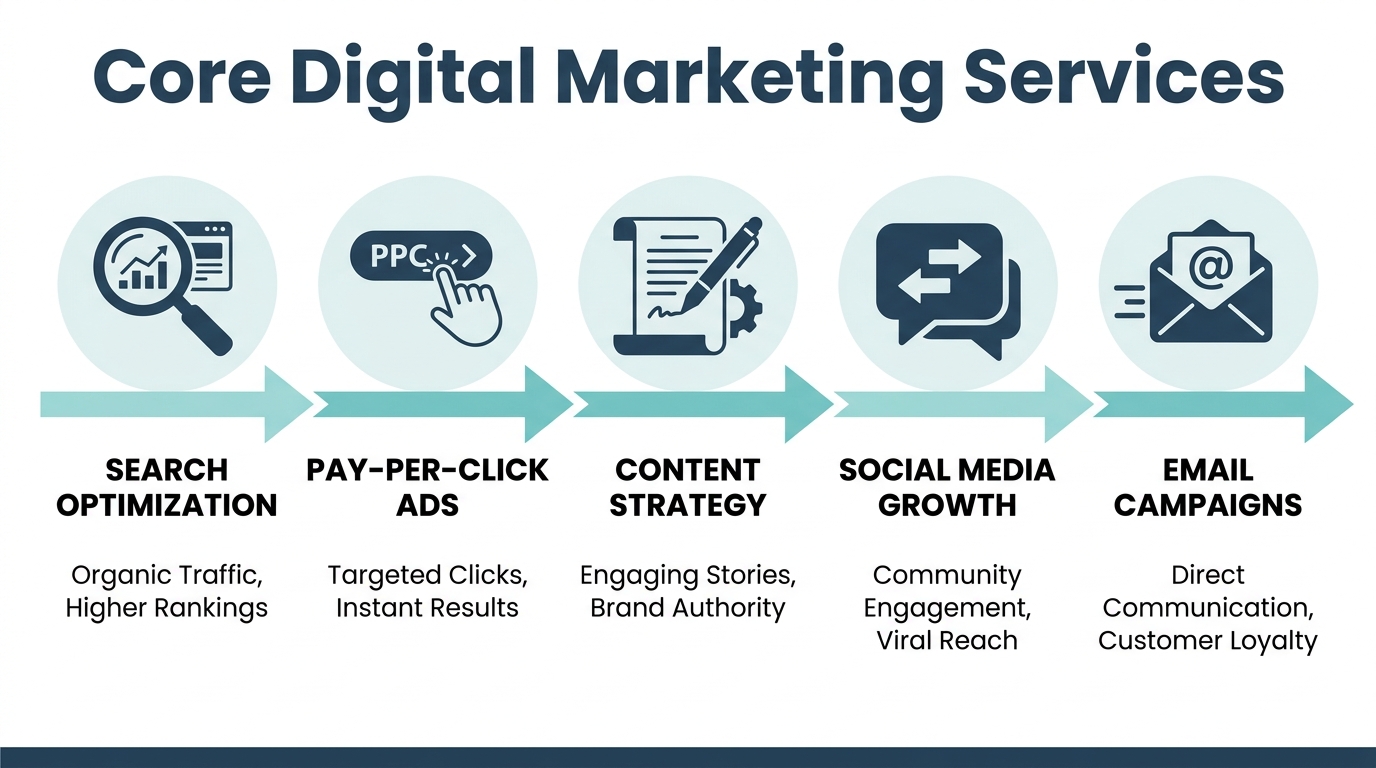
A digital marketing agency in the USA typically offers SEO, PPC, content marketing, social media, and email marketing. These services can run separately or together as part of one connected strategy. Knowing what each service does helps you pick the right agency and the right mix for your business goals.
SEO: Getting Found on Google
Search engine optimization (SEO) helps your website rank higher in search results. It covers things like keyword research, on-page content, technical fixes, and building links from other websites.
SEO takes time, but the payoff is worth it. Research from First Page Sage shows the median ROI for SEO across industries sits around 748%. That means for every dollar spent, businesses get back about $7.48 on average over time.
PPC: Fast Results from Paid Ads
Pay-per-click advertising (PPC) puts your business at the top of search results right away. This includes Google Ads, Bing Ads, and paid social ads on platforms like Facebook or Instagram.
PPC works well when you need leads quickly. Management fees for PPC campaigns typically run between $1,000 and $3,000 per month, on top of your actual ad spend. It's a faster channel than SEO, but costs more upfront.
Content Marketing
Content marketing means creating blog posts, guides, videos, and other resources that attract and educate your target audience. Good content pulls people in naturally and supports your SEO at the same time.It's also a long game. But content that ranks well can keep bringing in traffic and leads for years without extra spend.
Social Media Marketing
This service covers managing your profiles, creating posts, running ads, and engaging with followers on platforms like LinkedIn, Instagram, or Facebook. It builds brand awareness and keeps your business visible to potential customers.
Email Marketing
Email is still one of the highest-ROI channels available. Agencies handle list building, automation, campaign design, and tracking to turn subscribers into paying customers.
How These Services Work Together
The real power shows up when these channels connect. A good agency builds a customer journey where each channel plays a role.
For example, SEO brings someone to your blog. A content piece earns their email address. An email sequence nurtures them toward a sale. Retargeting ads bring them back if they drift off. That's an integrated strategy, not just a collection of separate tactics.
According to an Atomic Digital case study, one client using a combined approach of SEO, PPC, email, and web development saw 438% site traffic growth and over 1,200 qualified leads.
Other Services Worth Asking About
Beyond the core five, many US agencies also offer:
- Web design and development: Making sure your site looks good and converts visitors
- Analytics and reporting: Tracking what's working and tying results to real business outcomes
- Conversion rate optimization (CRO): Testing and improving pages so more visitors become leads or buyers
- AI-driven services: In 2024, top agencies are adding tools like predictive analytics and AI-assisted campaign management to get better results faster
Ask any agency you're considering which of these they offer and how they measure success across each one.
Real World Example: Integrated Strategy Impact
Atomic Digital worked with a client using a combined approach of SEO, PPC, email, and web development. The integrated strategy delivered 438% site traffic growth and over 1,200 qualified leads. This case study demonstrates how connecting multiple channels (where SEO brings someone to your blog, content captures their email, an email sequence nurtures them toward a sale, and retargeting ads bring them back if they drift off) produces far stronger results than running individual tactics in isolation.
Why Your Business Needs a US-Based Digital Marketing Agency
A US-based digital marketing agency gives your business a real edge through local market knowledge, cultural fluency, and same-time zone communication. They understand how American consumers think, what regulations apply to your business, and how to outmaneuver your local competitors. That combination is hard to replicate with an offshore team.
Local Market Knowledge Makes a Real Difference
US consumer behavior doesn't follow a universal playbook. Buying habits, seasonal trends, and regional preferences vary widely. An agency based in the US has already built campaigns around these nuances and knows what works in your specific market.
They also understand the competitive landscape you're actually operating in. That means smarter targeting and faster pivots when the market shifts.
Compliance and Data Privacy Laws
Working with a US agency means they're already familiar with American data privacy laws like the California Consumer Privacy Act (CCPA). These rules affect how your email lists, ad tracking, and customer data are managed.
An offshore agency may not know these laws or prioritize them. Getting this wrong can expose your business to legal risk and fines, and that's a headache no one needs.
Communication Without the Friction
Time zone gaps are a real problem. When your overseas agency is answering emails while you're asleep, quick decisions get delayed. Projects stall. Results suffer.
A domestic agency works your hours. You can hop on a call the same day, share feedback in real time, and keep momentum going without a 24-hour lag between every message.
The Offshore Agency Tradeoff
Offshore agencies often compete on price, and that can look attractive at first glance. But lower fees sometimes come with cultural disconnects that show up in your ad copy, brand voice, or campaign timing.
There's also the legal complexity. Contracts, data handling, and accountability all get harder to manage across international borders. When something goes wrong, fixing it takes longer and costs more.
Long-Term Partnership Value
Building a relationship with a US agency pays off over time. Research from MRL Promotions found that 87% of agencies and 73% of marketers say longer partnerships lead to stronger brand performance.
That kind of compounding value is harder to achieve when you're constantly switching providers or navigating communication barriers.
How to Choose the Right Digital Marketing Agency for Your Business

Choosing the right digital marketing agency comes down to five steps: define your goals, vet their portfolio, check reviews, evaluate communication, and assess culture fit. Get these right and you'll find a partner that drives real growth. Rush the process and you'll likely end up paying for work that doesn't move the needle.
Step 1: Define Your Goals and KPIs First
Before you talk to a single agency, get clear on what you actually want. More leads? Better brand visibility? Higher conversion rates on your website? Knowing your goals helps you filter out agencies that aren't a match before the first call.
Tie your goals to specific numbers. "More traffic" isn't a goal. "100 qualified leads per month at a cost under $50 per lead" is a goal. Agencies worth working with will respond well to that kind of clarity.
Step 2: Vet Their Portfolio and Case Studies
A strong portfolio shows real results, not just pretty work. Look for case studies that include a baseline, a clear strategy, and a measurable business outcome like revenue, leads, or conversion rate.
Beware of vanity metrics. A case study that says "our campaign got 1 million views" without tying those views to sales or profit is a red flag. Good agencies show how their work affected the bottom line, not just the dashboard.
Also look for industry-specific experience. An agency that has worked with SaaS companies thinks differently than one that mostly handles eCommerce or healthcare. Relevant experience shortens the learning curve and gets you results faster.
Step 3: Check Reviews and References
Third-party reviews on platforms like Clutch or Google give you an honest read on what working with an agency actually looks like. Pay attention to comments about communication, transparency, and how the agency handles problems.
Ask for references you can call directly. A confident agency will connect you with past clients without hesitation. If they stall on this, take note.
Step 4: Evaluate Communication and Strategy
Your first call with an agency tells you a lot. According to Pilot Digital's agency hiring guide, the five questions every business owner should ask are:
- What relevant experience do you have for a business like mine?
- How do you measure success and report results?
- What would your strategy look like for us?
- Who will be my day-to-day contact?
- What's included in your fees, and what costs extra?
If an agency can't answer those clearly, they're not ready to manage your marketing.
Also ask directly: do you guarantee rankings or specific results? Eminent SEO notes that no ethical SEO professional can guarantee rankings, because search visibility depends on changing algorithms, competition, and time. Any agency that promises guaranteed page-one rankings in 30 days is waving a red flag.
Step 5: Assess Culture Fit
This one gets skipped too often. You'll be working closely with this team for months or years. If their communication style, values, or pace don't match yours, friction builds fast.
Ask yourself: do they listen more than they pitch? Do they ask smart questions about your business? Do they seem genuinely interested in your goals?
For mid-market and growing B2B companies, this fit matters even more. Teams like The Zulu Method are built specifically around this idea, pairing strategic alignment with hands-on execution so the relationship actually produces results.
Look for Industry-Specific Experience
A generalist agency can do a lot. But if your business operates in a specific vertical like healthcare, SaaS, or eCommerce, an agency that already knows your buyer, your compliance requirements, and your competitive landscape will hit the ground running.
Ask any agency you're considering: have you worked with businesses like mine? What were the results? Their answer will tell you whether they'll be a fit or a learning curve you're paying for.
Critical Questions to Ask Before Hiring
- What relevant experience do you have working with businesses like mine, and can you share a specific case study with measurable business results (revenue, leads, CAC) rather than vanity metrics?
- How do you measure success and what KPIs will you report on, and how do those metrics connect directly to revenue or profit rather than just traffic or impressions?
- Can you guarantee specific rankings or results, and if not, what realistic timeline should I expect for each channel (SEO vs. PPC vs. content) before I see meaningful business impact?
- Who will be my day-to-day contact, how long have they been with your company, and what communication process do you have in place to ensure quick feedback and decision-making?
- What's included in your fees versus what costs extra, and how should I budget separately for management fees versus actual ad spend?
Prefer a leaner, more hands-on partner? See our guide to the top boutique marketing agencies and how to pick one that fits your budget and stage.
Understanding Digital Marketing Agency Pricing in the USA
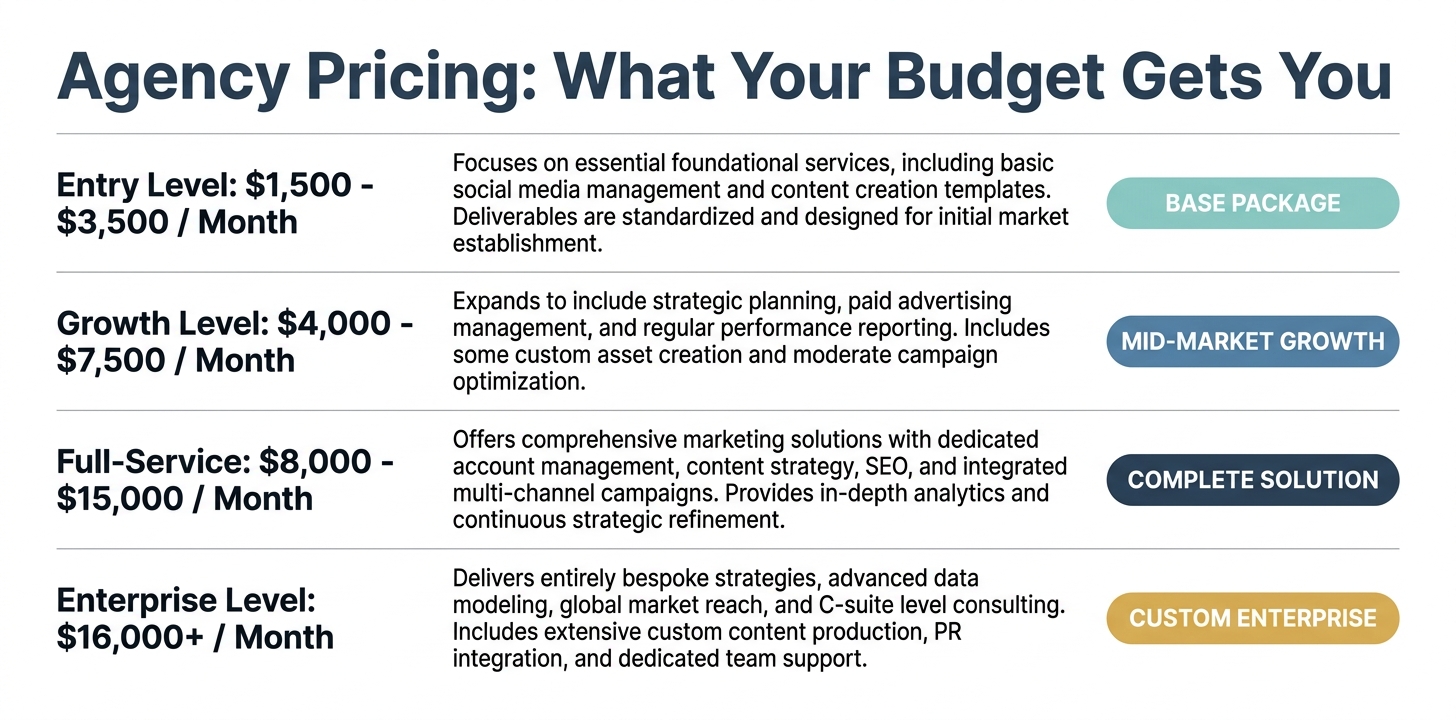
Digital marketing agency pricing in the USA typically falls into four models: monthly retainers, project-based fees, hourly rates, and performance-based pricing. Costs vary widely based on services, agency size, and your industry. Most small to mid-sized businesses pay between $3,000 and $10,000 per month for a solid retainer.
The Four Main Pricing Models
Monthly Retainer is the most common setup. You pay a fixed fee each month for an agreed set of services. Small business retainers often start around $1,500 to $3,000 per month. Mid-market work typically runs $3,000 to $10,000 per month. Enterprise-level engagements can push past $25,000 per month depending on scope.
Project-Based Pricing works well for one-time needs like a website redesign or a single campaign launch. Project fees usually start around $2,500 and can reach $100,000 or more for larger initiatives. You pay for the deliverable, not the ongoing relationship.
Hourly Rates are common for consulting or smaller agencies. According to pricing data compiled by Semrush's agency cost guide, hourly rates in the US range from $50 to $500 per hour. Bigger agencies with proven track records sit at the higher end of that range.
Performance-Based Pricing ties fees to results. This often means a base fee plus a percentage of ad spend, usually 10% to 30%. Some agencies also take a cut of revenue generated. It sounds appealing, but make sure the terms are crystal clear before you sign anything.
What Drives the Cost Up or Down
A few key factors push agency fees higher or lower:
- Scope of services: An agency managing SEO, PPC, content, and email costs more than one handling a single channel
- Agency size and reputation: Larger agencies with well-known clients charge a premium for their brand and bench strength
- Industry competition: If you're in a highly competitive space like legal, finance, or SaaS, more work is needed to move the needle
- Your market geography: Agencies in major cities like New York or San Francisco often charge more than regional firms
What You Actually Get at Each Price Point
Here's a simple breakdown of what different budget levels typically buy you:
| Monthly Budget | What to Expect |
|---|---|
| $1,500 to $3,000 | Basic SEO or social media management, small team |
| $3,000 to $7,000 | Multi-channel strategy with dedicated account manager |
| $7,000 to $15,000 | Full-service execution across SEO, PPC, content, and email |
| $15,000 and above | Enterprise campaigns, custom reporting, senior strategists |
Pricing data from Digital Applied's 2026 agency cost breakdown confirms these ranges hold across most US markets, with variation tied to agency specialization and client industry.
For mid-market B2B companies weighing their options, firms like The Zulu Method offer integrated marketing execution at a price point designed to replace the overhead of a full in-house team without the enterprise agency markup.
Preparing Your Business for a Digital Marketing Agency Partnership
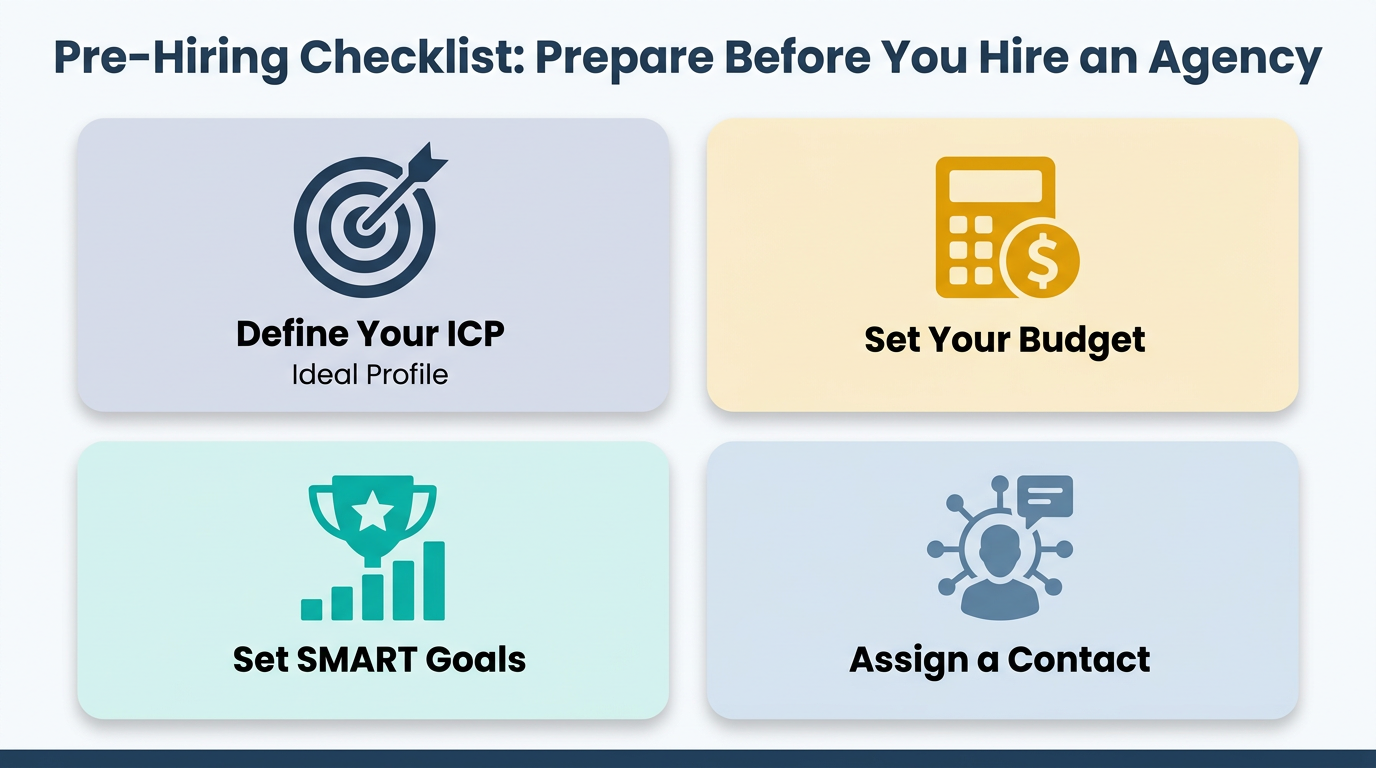
Before you contact a single agency, get your own house in order. Businesses that come prepared with clear goals, a defined budget, and the right internal contacts get far better results from agency partnerships. This pre-hiring checklist covers exactly what you need to have ready before outreach begins.
If you're still weighing an agency against making your first internal marketing hire, our breakdown of first marketing hire vs agency lays out the cost and speed numbers side by side, and our AI growth agency page shows what one partner running every channel looks like.
Build Your Pre-Hiring Checklist
Think of this as your starting point. Four things need to be in place before you talk to any agency:
1. Define your Ideal Customer Profile (ICP)Your ICP describes who your best customers actually are. Job title, company size, industry, pain points, buying triggers. Without this, an agency is guessing who to target. And guessing costs money.
2. Set a realistic budget including ad spendMany businesses forget that agency fees and ad spend are separate costs. If you budget $3,000 per month, clarify how much of that goes to the agency and how much funds the actual ads. Getting this wrong from the start creates friction fast.
3. Set SMART goalsSMART goals are Specific, Measurable, Achievable, Relevant, and Time-bound. "Grow traffic" is not a goal. "Generate 80 qualified leads per month within 90 days" is. Agencies do their best work when the finish line is clearly marked.
4. Assign an internal point of contactSomeone on your team needs to own the agency relationship. This person approves content, answers questions, and shares feedback quickly. Without a clear contact, projects stall and results suffer.
Get Your Marketing Assets Ready
Agencies move faster when you hand them the right materials on day one. Have these ready before your first kickoff call:
- Brand guidelines: Logo files, color palettes, font specs, and tone of voice rules
- Past campaign data: Any analytics, ad performance reports, or email stats from previous efforts
- Customer personas: Written descriptions of your key buyer types, even rough ones help
- Competitor context: A short list of competitors you're aware of and why customers choose them
According to agency relationship research published by Automattic for Agencies, stronger onboarding processes directly reduce ramp-up time and improve early campaign performance. Clients who arrive prepared get to results faster.
Why Preparation Pays Off
When you show up organized, agencies can skip the guesswork and start executing. That means faster results, fewer revision cycles, and less budget wasted on discovery work you could have handled in advance.
For mid-market B2B teams, this preparation also signals to agencies like The Zulu Method that you're ready for a real partnership, not just shopping for someone to hand things off to.
The businesses that struggle most with agency relationships are usually the ones that skipped this step entirely.
Red Flags to Spot When Vetting a US Digital Marketing Agency
Spot these warning signs before signing a contract with any US digital marketing agency: guaranteed rankings, hidden pricing, poor communication during the sales process, and reporting that focuses on vanity metrics instead of real business results. Catching these early saves you time, money, and a lot of frustration.
Guaranteed Results Are a Dead Giveaway
Any agency that promises you a guaranteed #1 ranking on Google is waving a big red flag. Search rankings depend on algorithms that change constantly, competition that shifts, and content that takes time to earn authority. No one controls all of that.
When an agency makes that promise, it usually means one of two things. Either they're using outdated or risky tactics that could get your site penalized, or they're just telling you what you want to hear to close the deal. Neither option ends well for your business.
Ask them directly: "Can you guarantee specific rankings or results?" A trustworthy agency will explain what they can influence and what they can't.
No Transparency in Pricing or Process
If an agency won't clearly explain what's included in their fee, that's a problem. Vague proposals that say "full digital marketing services" without breaking down hours, deliverables, or channels are designed to give the agency wiggle room later.
You should know exactly what you're paying for. Ask for an itemized breakdown. If they resist, move on.
The same rule applies to their process. A good agency can explain what they'll do, when, and why. If the answer sounds like a sales pitch rather than a real plan, trust your gut.
Watch How They Communicate Before You Hire Them
How an agency treats you during the sales process tells you everything about how they'll treat you as a client. Slow replies, vague answers, or a rush to skip your questions are all warning signs.
If they're hard to reach before you've signed anything, imagine what happens once they have your retainer. Good agencies are responsive, ask smart questions about your business, and take time to actually understand your goals.
Vanity Metrics Over Business KPIs
Beware of agencies that lead with impressive-sounding numbers that don't connect to revenue. Follower counts, page views, and impression totals can all look great on a report while your actual sales stay flat.
A strong agency ties their work to outcomes that matter: leads generated, cost per acquisition, conversion rates, and pipeline value. According to Clutch's digital marketing agency research, businesses that clearly define success metrics upfront are far more likely to report satisfaction with their agency.
Ask any agency you're considering: "What KPIs will you report on, and how do those connect to revenue?" Their answer will tell you whether they think like a partner or a vendor.
Frequent Account Manager Turnover
Another sign of a "churn and burn" agency is high staff turnover on your account. If you're getting handed to a new account manager every few months, continuity breaks down fast.
Your agency contact should know your business, your goals, and your history. Ask upfront: "Who will manage our account, and how long have they been with the company?" That single question can save you months of frustration.
Find Your Growth Partner, Not Just a Vendor
The right digital marketing agency in the USA does more than run campaigns. It becomes a true growth partner that understands your business, works toward your goals, and delivers results you can measure. Use this guide's checklist and questions to start evaluating your first three potential agencies this week.
Here's a quick recap of the key steps:
- Understand the services: Know what SEO, PPC, content, social, and email can do for your business before you shop
- Define your needs: Set SMART goals, assign a budget, and name an internal point of contact
- Vet thoroughly: Check portfolios, read third-party reviews, ask the hard questions, and watch for red flags
- Prioritize fit over flash: A flashy pitch means nothing if the agency can't communicate, report on real KPIs, or stay accountable
Choosing an agency is an investment, not just an expense. The businesses that get the most from their agency relationships are the ones that treat it like a partnership from day one.
For mid-market B2B teams ready to scale, firms like The Zulu Method are built around exactly this model: strategic alignment, hands-on execution, and results tied to revenue. That's what separates a real growth partner from just another vendor.
As businesses increasingly explore modern alternatives, AI marketing agencies are emerging as powerful options that combine human expertise with automated execution. Additionally, implementing marketing automation can help streamline your campaigns and improve efficiency regardless of which agency model you choose.
Start your search this week. Use the questions and checklists from this guide, shortlist three agencies, and go into those first calls prepared. The right partner is out there.

Digital Marketing Agency FAQs
What does a digital marketing agency do?
A digital marketing agency plans, executes, and manages your company's online marketing efforts across channels like SEO, PPC, social media, content creation, and email marketing. They're focused on increasing brand awareness, generating leads, and driving sales, with the best agencies acting as strategic partners who measure success against your actual business goals, not just vanity metrics.
How much does a digital marketing agency cost in the USA?
Most small to mid-sized businesses pay between $3,000 and $10,000 per month on a retainer basis. Costs vary widely depending on the scope of services, agency size, and your industry's competitiveness. Hourly rates range from $50 to $500/hour, project-based fees typically start around $2,500, and performance-based pricing often involves a base fee plus 10-30% of ad spend.
What should I look for in a digital marketing agency?
Look for proven experience in your industry, transparent reporting tied to business outcomes (not vanity metrics), strong communication, and clear case studies showing measurable results like revenue, leads, or conversion rates. Most importantly, ensure they take time to understand your specific goals and ask smart questions about your business during the sales process.
Is it worth hiring a digital marketing agency?
Yes, for most businesses. Hiring an agency is worthwhile if you lack in-house expertise, time, or tools to execute a competitive digital strategy. It provides access to a team of specialists for significantly less than hiring a full marketing department, and when chosen correctly, delivers a higher ROI.
What is the difference between a full-service and a specialist agency?
A full-service agency offers a broad range of services under one roof (SEO, PPC, social, content, email, web design), ideal if you need a single point of contact for your entire online presence. A specialist agency focuses deeply on one or two specific areas like SEO or PPC, making them the smart choice if you already have most marketing handled but need expert help in one critical channel.
How long does it take to see results from a digital marketing agency?
Timelines vary by service. PPC campaigns can show results within 1-3 months, while SEO is a long-term investment typically requiring 6-12 months to show significant impact. A good agency will set clear expectations for each channel's timeline during onboarding and tie those results to real business outcomes, not just traffic numbers.