
Hannon Brett | Published on: August 31, 2026 | Time to read: 23 min
A startup marketing agency is a specialized growth partner built for early-stage companies that need speed, tight budgets, and measurable ROI. Unlike traditional agencies, they optimize for traction over polish, offering strategic support across multiple channels for less than the cost of a single senior hire.
Choosing the right agency requires vetting case studies, meeting the actual team, understanding pricing models, and ensuring your startup has product-market fit and a committed budget before engagement.
Key Takeaways
- Startup marketing agencies differ from traditional agencies by optimizing for traction and ROI instead of reach and polish, moving faster with flexible retainers and focusing on revenue metrics rather than vanity metrics
- A specialized agency typically costs $5,000 to $10,000 per month, which is less than half the fully loaded cost of hiring one senior marketing director ($151,000 to $162,000 per year in base salary)
- Core services include growth strategy and funnel development, content and SEO, paid acquisition (PPC and paid social), and marketing automation, all integrated into one system
- Red flags to avoid include agencies that promise specific results upfront, can't explain their process, use mostly junior staff, lock you into long contracts with no exit clause, or report only vanity metrics
- Before hiring an agency, ensure you have product-market fit, a dedicated marketing budget beyond the retainer, a stable product that can handle new users, and an internal point of contact with time and authority to manage the relationship
Table of Contents
- What Exactly is a Startup Marketing Agency (and What Isn't It)?
- Why Your Startup Needs a Specialized Marketing Agency
- Core Services an Effective Startup Marketing Agency Offers
- How to Choose the Right Startup Marketing Agency
- Red Flags: Warning Signs to Avoid When Hiring an Agency
- Understanding Startup Marketing Agency Pricing Models
- Are You Ready? A Quick Checklist Before You Hire a Marketing Agency
- Your Next Step to Finding the Right Growth Partner
What Exactly is a Startup Marketing Agency (and What Isn't It)?
A startup marketing agency is a specialized growth partner that helps early-stage companies build awareness, attract customers, and scale revenue fast. Unlike general agencies, they're built for speed, tight budgets, and measurable ROI. They understand that a startup's priorities are completely different from a Fortune 500 company's priorities.
Built for Speed and Scalability
Traditional marketing agencies often work in slow, process-heavy ways. They run months-long discovery phases, charge large retainers, and build campaigns designed for established brands with predictable audiences.
Startup-focused agencies operate differently. They're designed to move quickly, test ideas fast, and adjust based on real data. Every decision is tied to growth metrics that actually matter for an early-stage business.
More Than Just Execution
A common misconception is that a startup marketing agency just does stuff, like running ads or posting on social media. But that's not the full picture.
The best agencies act as strategic partners. They help you figure out your go-to-market strategy, define your target customer, and build a repeatable engine for growth. They bring outside perspective that founders often lack because they're too close to their own product.
This matters most in the earliest stages, when the wrong strategy can burn through a limited runway in months.
How They Differ From Traditional Agencies
The difference comes down to what they optimize for. Traditional agencies optimize for reach and polish. Startup agencies optimize for traction and ROI. They move faster, charge flexible retainers, and focus on revenue metrics rather than vanity metrics like impressions or followers.
Why Your Startup Needs a Specialized Marketing Agency
A specialized startup marketing agency gives early-stage companies access to a full team of experts across SEO, paid ads, and content. All for less than the cost of hiring one senior in-house marketer. That cost advantage alone makes it worth serious consideration.
You Get a Full Team for Less
Hiring a senior marketing director in the US costs around $151,000 to $162,000 per year in base salary alone, according to data from Indeed's senior marketing salary benchmarks. That doesn't include benefits, equity, or the months it takes to hire and onboard someone.
A startup marketing agency retainer, by contrast, typically runs $5,000 to $10,000 per month for solid execution across multiple channels. That's often less than half the fully loaded cost of one senior hire. And with an agency, you're not getting one person. You're getting a team of specialists.
That team usually covers paid media, SEO, content strategy, analytics, and creative work. A single in-house hire simply can't match that breadth, especially at the early stage when your needs shift fast.
No Learning Curve Costs
One of the biggest hidden costs in early-stage marketing is paying for someone to figure things out as they go. A new in-house hire needs time to understand your market, test channels, and build a strategy. That takes months you may not have.
A good startup-focused agency already has a tested playbook. They've worked through the same problems with other early-stage companies. They know which channels work for your type of business, what messaging tends to land, and where most startups waste money first.
This shortcut is real. You're buying their accumulated experience, not just their hours.
Market Insights From the Startup Ecosystem
Agencies that work exclusively with startups build up something most in-house teams can't match: pattern recognition across dozens of companies at once.
They see what's working in your competitive space right now. They know which acquisition channels are heating up and which are getting expensive. They track shifts in buyer behavior across industries because they're running campaigns for multiple clients at the same time.
That kind of cross-portfolio insight is hard to put a price on. But it can make the difference between a campaign that flops and one that finds traction quickly.
The Real Value Proposition
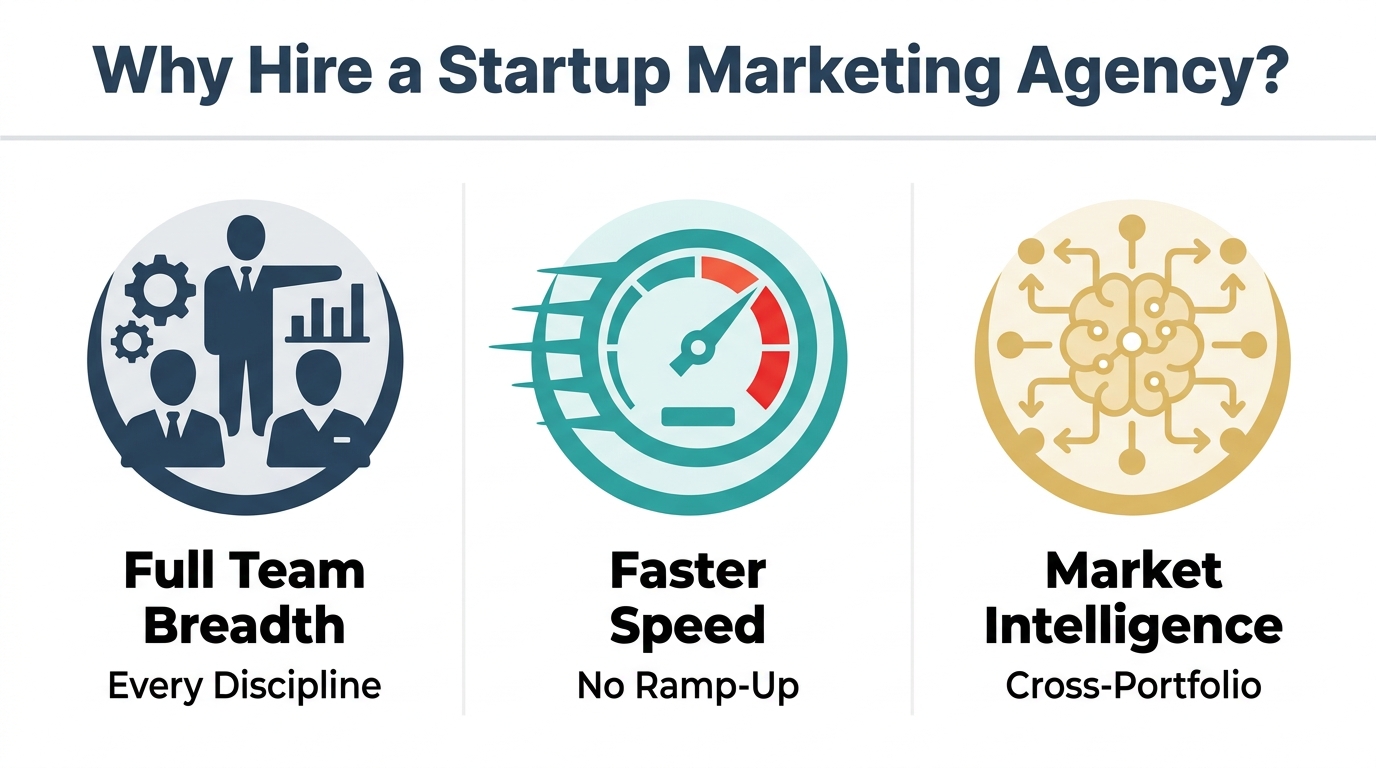
When you add it up, a specialized agency offers three things that are genuinely hard to replicate in-house at the early stage:
- Breadth: A team of specialists across every major marketing discipline
- Speed: A tested playbook with no ramp-up period
- Intelligence: Real-time market insight from working inside the startup ecosystem
For most seed and Series A companies, this combination beats hiring a single senior marketer by a wide margin. It's not about whether agencies are better than in-house teams in general. It's about what makes sense when you're early, moving fast, and every dollar needs to work hard.
Core Services an Effective Startup Marketing Agency Offers
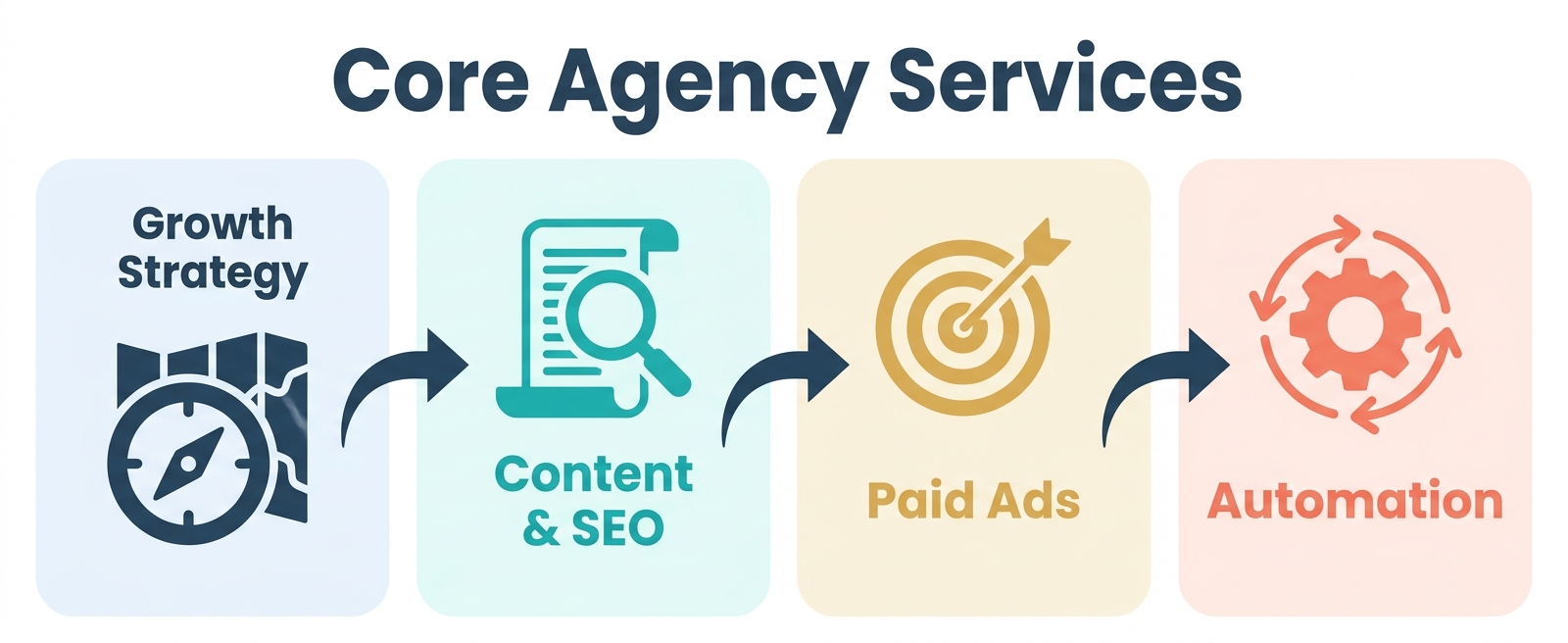
A startup marketing agency typically covers four core areas: growth strategy, content and SEO, paid acquisition, and marketing automation. The best agencies don't run these as separate tracks. They connect them into one integrated system where each service feeds the others and every effort points toward the same growth goal.
Growth Strategy and Funnel Development
This is where everything starts. Before running a single ad or writing a single blog post, a good agency maps out your full funnel from awareness to conversion.
Typical deliverables here include an ideal customer profile, a positioning statement, a channel mix recommendation, and a 90-day go-to-market roadmap. These aren't nice-to-haves. They're the foundation that makes every other service more effective.
Content and SEO
Content and SEO work together to build long-term organic traction. Rather than one-off blog posts, a strong agency builds a structured content engine.
Expect deliverables like a keyword strategy, topic clusters organized around your core product themes, a content calendar, and a link-building plan. According to Databox's research on what marketing leaders want from agency partners, clients increasingly prioritize data-driven content approaches tied directly to measurable pipeline outcomes.
Paid Acquisition (PPC and Paid Social)
Paid channels give you speed. A startup agency uses paid ads to test messaging quickly and find your most efficient customer acquisition path.
Deliverables typically include audience targeting strategy, ad creative, landing page recommendations, and weekly performance reporting. The agency should be tracking cost per acquisition and return on ad spend, not just clicks or impressions.
Marketing Automation and Operations
This is often the most overlooked service. But it's what turns one-time campaigns into a repeatable revenue engine.
A good agency sets up lead nurturing sequences, CRM integrations, and attribution tracking. Without this layer, you're flying blind on which campaigns actually drove revenue. Forbes Agency Council notes that agencies consistently wish clients had clearer measurement frameworks in place before engagement starts.
Why Integration Matters
Each of these four services is more powerful when connected. Your SEO content should feed your paid ad copy. Your paid ad data should inform your content strategy. Your automation should nurture leads that organic content brings in.
When services are siloed, you get activity. When they're integrated, you get growth.
How to Choose the Right Startup Marketing Agency

Choosing the right startup marketing agency comes down to four things: verified results, team alignment, business model fit, and cultural match. Get these right and you'll find a partner that accelerates growth. Get them wrong and you'll lose months of runway on the wrong strategy.
Step 1: Check Their Case Studies First
Don't take an agency's word for anything. Ask for case studies from companies that look like yours. Same stage, similar model, comparable market.
Good case studies show before and after metrics. Things like cost per lead, organic traffic growth, or pipeline generated. If an agency can't show you numbers, that's a red flag worth taking seriously.
Step 2: Interview the Actual Team
Here's a mistake founders make all the time. They get sold by a senior partner during the pitch. Then the work gets handed off to a junior team they've never met.
Always ask who will actually work on your account day to day. Meet them before you sign. Check their experience level and whether they've worked on accounts similar to yours.
Step 3: Ask for a Sample Report
Reporting tells you a lot about how an agency thinks. Ask to see a real client report, with the client's details removed if needed.
A strong agency tracks metrics tied to business outcomes. Things like qualified leads, cost per acquisition, and revenue influenced. If their reports only show impressions and follower counts, that's a sign they're optimizing for vanity over value.
Step 4: Run Reference Checks
This step gets skipped more than it should. Ask for two or three client references and actually call them.
Ask the references specific questions. Did the agency communicate well when things went wrong? Did they hit the timelines they promised? Would you hire them again? You'll learn more in a 10-minute call than in any sales pitch.
Match the Agency to Your Business Model
Not every startup marketing agency is built for every type of startup. A team that excels at B2B SaaS demand generation may have no idea how to run a D2C e-commerce growth engine.
Ask directly: have you worked with companies in our category? What channels drove the most growth for them? The answers will tell you fast whether they're a real fit or just trying to close the deal.
Don't Overlook Cultural Fit
This one's harder to measure but it matters a lot. Early-stage startups move fast and change direction often. You need an agency that matches that energy.
Do they respond quickly during the sales process? Do they push back with their own thinking, or just agree with everything you say? A good agency challenges your assumptions. A bad one just tells you what you want to hear.
According to Udjat Agency's guide on questions to ask before hiring, one of the most revealing questions you can ask is: who is NOT an ideal client for your agency? An agency that can answer this honestly understands its own strengths and limits.
A Quick Vetting Checklist
Before you sign with any agency, run through these questions:
- Do they have case studies from companies at your stage and in your category?
- Will you meet the team actually doing the work?
- Can they show you a real performance report?
- Do they have references you can call?
- Do they specialize in your business model (SaaS, D2C, marketplace, etc.)?
- Does their communication style match your team's pace?
- Are their contract terms flexible with a clear exit clause?
Taking the time to vet properly upfront saves you from the most common founder mistake: signing with the wrong agency, burning budget for three months, and starting over.
Questions to Ask Before You Sign
- Can you show me case studies from companies at my exact stage and in my industry with real before-and-after metrics?
- Who will actually work on my account day to day, and can I meet them before signing?
- Can you walk me through a sample client report showing how you track business outcomes versus vanity metrics?
- Do you have two or three client references I can call to ask about communication, timelines, and results?
- What companies are not ideal clients for your agency, and why?
- What is included in the monthly retainer, and are there setup fees, markups, or hidden costs I should know about?
- What does the first 90 days look like in terms of deliverables and strategy milestones?
- What are your contract terms, and is there a reasonable notice period or exit clause if things don't work out?
Red Flags: Warning Signs to Avoid When Hiring an Agency
Not every startup marketing agency is worth your time or budget. Some will overpromise, underdeliver, and burn through your runway before you see a single result. Knowing the warning signs before you sign saves you months of frustration and thousands of dollars.
They Promise Specific Results Upfront
If an agency guarantees you'll rank #1 on Google or promises a specific number of leads before they've done any research on your business, walk away. No honest agency can guarantee specific outcomes in marketing. Too many variables are outside their control.
This kind of promise is a sales tactic, not a strategy. Agencies that lead with guarantees are usually trying to close the deal fast rather than set realistic expectations.
They Can't Explain Their Process
A good agency can walk you through exactly how they work. They'll show you their onboarding steps, how they build a strategy, and how they report results. If an agency is vague about their methods or treats their approach like a trade secret, that's a problem.
This "black box" style means you have no visibility into where your money goes or what decisions are being made on your behalf. According to The Stacc's agency hiring guide, transparency in process and reporting is one of the top factors that separates trustworthy agencies from risky ones.
The Team Is Mostly Junior Staff
Some agencies win business with senior partners in the pitch room. Then the actual work gets handed to entry-level employees with little real-world experience.
Always ask who will work on your account day to day. If the team doing the execution is mostly junior, you're paying senior prices for junior output. That's a bad deal at any stage, but it's especially damaging when you're early and every decision matters.
The Contract Locks You In With No Exit
Long contracts with no performance clauses are one of the biggest traps for early-stage startups. A 12-month agreement with no out-clause means you're stuck even if the agency stops delivering after month two.
Push for shorter initial terms, a 30 to 60 day notice period, and clear performance benchmarks written into the contract. If the agency refuses to add any accountability terms, that tells you a lot about how confident they are in their own work.
Their Reports Only Show Vanity Metrics
If a sample report is full of impressions, follower counts, and page views but has no data on leads, cost per acquisition, or revenue influenced, be cautious. Those metrics look good in a slide deck but don't tell you whether the agency is actually driving growth.
A results-focused agency reports on what moves the business forward, not what makes the dashboard look busy.
Understanding Startup Marketing Agency Pricing Models
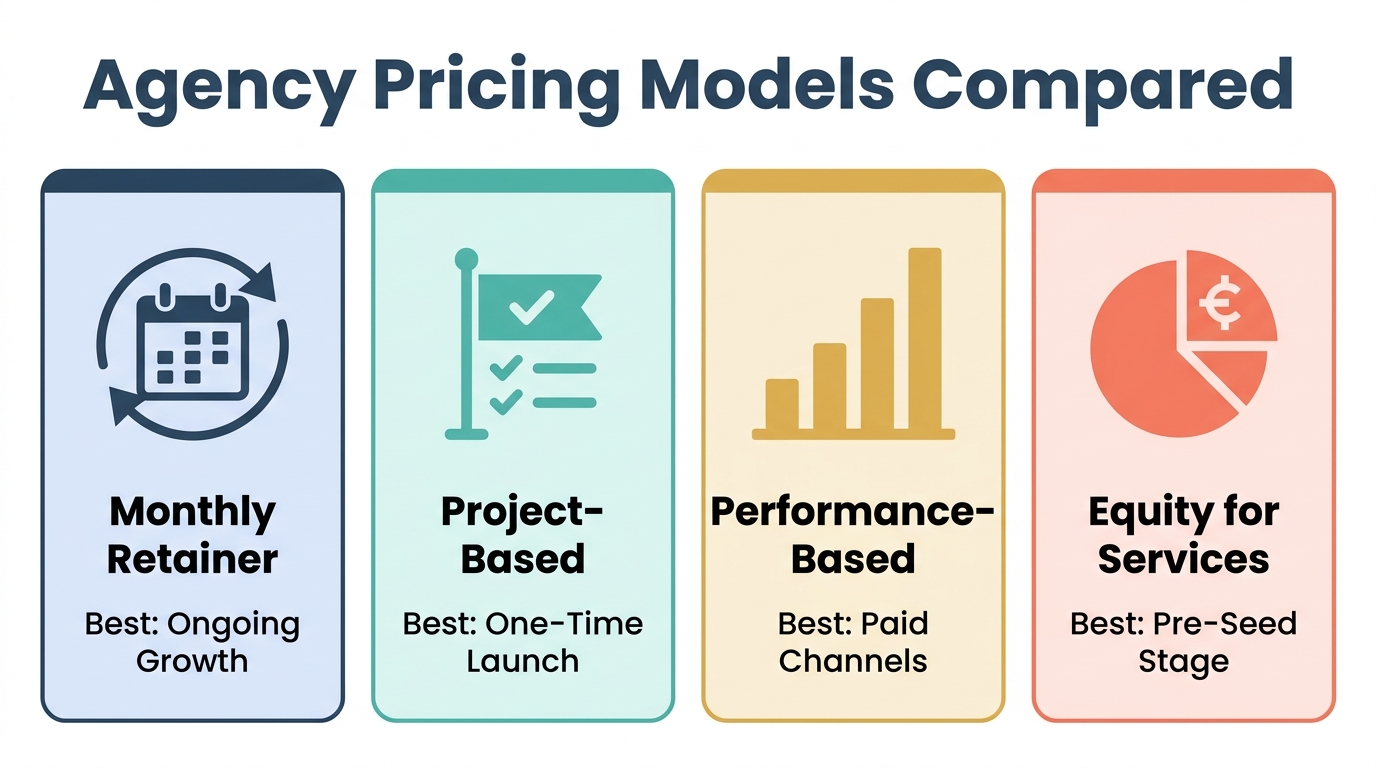
Startup marketing agency pricing usually falls into three main models: monthly retainers, project-based fees, and performance-based arrangements. Each works differently depending on your stage, goals, and how much budget predictability you need. Knowing the difference helps you pick the model that fits your startup best.
Monthly Retainer: The Most Common Model
A monthly retainer means you pay a fixed fee each month for ongoing work. This is the most popular structure for early-stage startups because it's predictable and covers continuous strategy plus execution.
For seed-stage companies in North America, retainers typically range from $2,500 to $10,000 per month for focused work on one or two channels. More comprehensive growth support across paid media, SEO, and content can run $8,000 to $25,000 or more per month, according to Stackmatix's breakdown of agency pricing models.
Pros for startups: Predictable costs, ongoing strategic support, and no project-by-project negotiation.
Cons for startups: You're paying even in slower months, and a vague scope can leave you unsure what you're actually getting.
Project-Based: Good for Specific Goals
Project-based pricing works well when you have a defined, one-time need. Things like a product launch campaign, a website redesign, or a go-to-market strategy document.
You pay a flat fee for a specific deliverable with a clear end date. This model gives you cost control for discrete goals. But it's not ideal for ongoing growth work, since campaigns need continuous testing and optimization to perform well.
Performance-Based: Aligning Incentives
Performance-based models tie agency compensation to outcomes. Common structures include a base retainer plus bonuses for hitting lead or pipeline targets, or a percentage of ad spend (usually 10% to 15%) on top of a management fee.
This model sounds appealing because the agency only wins when you win. But it can create problems. Attribution gets messy fast, especially at early stages when your tracking isn't mature yet. And agencies may focus only on easy-to-measure wins rather than longer-term brand-building work.
Equity for Services: A Special Case
Some agencies, especially those working with pre-seed or idea-stage startups, will take equity instead of (or alongside) cash. This can work when your cash runway is extremely tight and the agency genuinely believes in your trajectory.
But it comes with real risks. You're giving up ownership in your company before you've proven the model. And if the agency relationship doesn't work out, unwinding an equity arrangement is far more complicated than ending a retainer contract.
Equity deals make the most sense for advisory-level relationships where the agency is helping shape strategy over the long term. They rarely make sense for routine execution work.
Choosing the Right Model
Here's a quick way to think about it:
| Model | Best For | Watch Out For |
|---|---|---|
| Monthly Retainer | Ongoing growth and execution | Vague scope and unclear deliverables |
| Project-Based | One-time launches or audits | No continuity between projects |
| Performance-Based | Paid media and lead gen | Attribution complexity at early stage |
| Equity for Services | Pre-seed with no cash budget | Giving up ownership too early |
Most seed and Series A startups do best with a straightforward retainer. It keeps things simple, holds the agency accountable to a consistent scope, and makes it easier to compare results month over month.
Are You Ready? A Quick Checklist Before You Hire a Marketing Agency
Hiring a startup marketing agency before you're ready is one of the most common ways founders waste early budget. Before you sign anything, run through this quick self-assessment. It takes five minutes and can save you tens of thousands of dollars.
Do You Have Product-Market Fit?
This is the most important question. If customers aren't sticking around, an agency can't fix that. Marketing amplifies what's already working. It doesn't create traction where none exists.
If you're still figuring out who your customer is or why they buy, you're not ready for a marketing agency. Spend that budget on customer research and product iteration first.
Do You Have a Dedicated Marketing Budget?
An agency retainer is only part of what you'll spend. You also need budget for paid media, tools, and creative assets. If you don't have a clear, committed monthly number set aside specifically for marketing, an agency relationship will hit friction fast.
According to Envision Creative's agency hiring guide, one of the most common early breakdowns between startups and agencies is misaligned budget expectations. Know your number before you start talking to agencies.
Is Your Product Stable Enough for New Users?
Bringing in new customers through a paid campaign or SEO push only works if your product can handle them. If your onboarding is broken or your support team is overwhelmed, more traffic will just expose more problems.
Make sure your core product experience is solid before you pour fuel on growth.
Do You Have an Internal Point of Contact?
This one gets overlooked a lot. An agency needs someone on your side who has the time and authority to review work, give feedback, and make decisions. Without that person, campaigns stall, revisions pile up, and you lose weeks waiting for approvals.
That point of contact doesn't need to be a full-time marketer. But they do need to be available and empowered to move things forward.
A Quick Pre-Agency Readiness Checklist
Before you reach out to any agency, check these off:
- You have evidence that customers want your product and come back to it
- You have a committed monthly marketing budget (not just leftover runway)
- Your product is stable enough to support new user growth
- You have one internal person with time and authority to manage the relationship
- You can clearly describe your target customer and what problem you solve
- You know what success looks like in measurable terms
If you can't check most of these boxes, hiring an agency now will likely waste money. Get the foundations right first. Then bring in an agency to accelerate what's already working.
Your Next Step to Finding the Right Growth Partner
Finding the right startup marketing agency comes down to four things: specializing in your stage, vetting thoroughly, understanding pricing models, and honestly assessing your own readiness. Get those right and you'll have a real growth partner, not just a vendor burning through your runway.
The article covered a lot of ground. So here's the short version of what to take away.
Specialization matters more than size or reputation. An agency with deep experience in your business model, whether that's B2B SaaS, D2C, or marketplace, will outperform a generalist every time. Case studies from companies at your exact stage are the best proof of fit you can find.
Vetting takes real effort, but it's worth it. Meet the actual team. Check references. Ask to see a real performance report. The agencies worth working with will welcome that scrutiny. The ones that don't are telling you something important.
Pricing should match your goals. A monthly retainer works best for most seed and Series A startups. Keep the scope clear and make sure the contract has a reasonable exit clause.
Readiness is your responsibility. No agency can fix a product that customers don't want. Get your foundations right first, then bring in outside help to accelerate what's working.
Your next step is simple: shortlist three to five agencies that have published case studies in your industry and at your stage. Browse directories like Clutch or UpCity to find agencies filtered by startup focus, growth marketing, or your specific category.
Then run them through the vetting checklist from earlier. Ask the hard questions. Check references. And remember: the best agency relationship feels less like a vendor contract and more like adding a skilled team to your side.
That's the kind of partner worth investing in.

What should I look for in a startup marketing agency? Focus on three critical factors: relevant experience with case studies from companies at your stage and in your industry, a transparent and data-driven process they can clearly explain, and strong cultural fit with a team you're excited to work with. The best agencies should feel like an extension of your own team rather than just another vendor.
How much does a startup marketing agency cost? Typical retainers for seed or Series A startups range from $5,000 to $25,000 or more per month, not including ad spend. Pricing depends on the scope of services, team size, and agency reputation. Always clarify exactly what's included in the retainer and watch for hidden fees or markups.
When is the right time for a startup to hire a marketing agency? The ideal time is after you've achieved initial product-market fit and have a stable product ready for new users. You should also have a dedicated marketing budget set aside and an internal team member who can manage the agency relationship. Hiring too early, before you know who your customer is, wastes both time and money.
How quickly can I expect to see results? Be cautious of agencies promising instant results, as foundational work like strategy, SEO, and content typically takes three to six months to show significant traction. Paid campaigns can deliver leads faster, but sustainable growth is a long-term effort. Expect a 90-day onboarding and strategy phase before major results appear.
What's the difference between a growth agency and a startup marketing agency? The terms are often used interchangeably in practice. However, growth agency or growth marketing agency can sometimes imply a heavier focus on full-funnel experimentation and product-led growth tactics, while startup marketing agency is a broader term covering all early-stage marketing needs.
Should I give equity to a marketing agency? This can work for very early-stage startups with extremely limited cash, but approach with caution. The deal must be structured carefully with clear deliverables, performance milestones, and a vesting schedule. Equity arrangements are rare and typically reserved for agencies with proven venture-partnering models or long-term advisory relationships.
What metrics should I track with my startup marketing agency? Your agency should help define KPIs, but focus on business outcomes rather than vanity metrics. Key metrics include Customer Acquisition Cost (CAC), Lifetime Value (LTV), marketing qualified leads (MQLs) and sales qualified leads (SQLs), conversion rates through the funnel, and ultimately revenue generated from marketing efforts.