
Hannon Brett | Published on: July 01, 2026 | Time to read: 22 min | Updated on: August 31, 2026
B2B startups are building AI-native platforms that reshape how companies sell, market, and operate. The best B2B tech startups don't bolt AI onto old software. They make it the foundation. This guide covers the B2B SaaS startups leading that shift, a framework for telling an AI-native platform from an AI-washed one, and what a founder should actually buy. Adoption isn't the differentiator anymore: 64% of organizations are actively using AI in their operations, and 76% of large companies are. For a Series A or B founder, that's the whole problem. The incumbents you're selling against already have it.
Key Takeaways
- AI is no longer a feature. It's the foundational architecture of winning B2B platforms, with startups like 6sense, Clari, Jasper, and Mutiny leading transformation across sales, marketing, and operations
- Sales teams using AI tools are 3.7x more likely to hit quota. AI-driven lead scoring improves conversion rates by 20-30%, and sales professionals save 1-5 hours weekly through automation
- B2B marketing AI enables hyper-personalization at scale, with relevant targeting lifting click-through rates by up to 72%, customer acquisition cost down 17%, and win rates improving from 1-in-9 to 4-in-9
- Operations AI platforms like Blue Yonder, AKASA, and Airwallex automate back-office functions, reduce costs, and provide predictive insights that traditional ERP systems cannot match
- Evaluating AI startups requires assessing problem-solution fit, proprietary data moat, integration capabilities, and demonstrable ROI, not just marketing claims
- Major obstacles facing B2B AI startups include cold-start data challenges, GDPR/CCPA compliance costs, expensive AI talent competition, and the critical need for explainable AI (XAI) in enterprise deployments
- B2B startups that skip AI-native platforms are handing incumbents a widening head start, so founders should be plugging into these intelligent systems now
Table of Contents
- The New B2B Landscape: How AI is Redefining Business
- Spotlight: Top B2B Tech Startups Using AI for Sales & Revenue
- Spotlight: The Smartest B2B Tech Startups Using AI in Marketing
- Spotlight: AI-Powered B2B Startups Streamlining Operations
- A Framework for Evaluating B2B Tech Startups Using AI
- Beyond the Hype: Key Challenges Facing B2B AI Startups
- Navigate Your Next Steps in the B2B AI Ecosystem
The New B2B Landscape: How AI is Redefining Business
B2B tech startups using AI are reshaping how companies buy, sell, and operate. These aren't just software tools with a few smart features. They're fully intelligent platforms built from the ground up on artificial intelligence. Here are the top startups leading this shift and why they matter right now.
What is a B2B startup using AI?
A B2B startup using AI is an early-stage company selling AI-powered software to other businesses, where the AI does the core work of the product instead of decorating it. The test is simple. Take the AI out. If the product still basically works, the AI was a feature. If the product stops existing, it's AI-native.
That single distinction separates a vendor whose product compounds from a wrapper a competitor could rebuild in a weekend.
From Traditional Software to Intelligent Platforms
For decades, B2B software meant static tools. A CRM stored contacts. An ERP tracked inventory. A marketing platform sent emails. People still made all the real decisions.
That model is changing fast. Today's B2B startups aren't adding AI as a bonus feature. They're building AI as the actual foundation of their products. The platform thinks, predicts, and acts on its own.
This shift matters because business problems don't wait. Buyers move quickly, data piles up fast, and teams are stretched thin. AI-native platforms handle the complexity that traditional software simply can't.
The Market Numbers Tell the Story
 The growth here is hard to ignore. The global AI market hit $233.46 billion in 2024 and is projected to reach $1.06 trillion by 2030, growing at a CAGR of 29.2%, according to Exploding Topics AI market research.
And that growth is being driven mostly by enterprise and B2B adoption. Businesses are the ones pouring money into AI tools, agents, and platforms because the ROI is real and measurable.
AI Is the Core, Not a Feature
The biggest mindset shift happening right now is this: AI is no longer something you add to a product. It's the reason the product exists.
Startups building in this space aren't asking "how can we use AI?" They're asking "what problems can only AI solve?" That's a completely different starting point, and it's producing a completely different class of tools.
For founders of B2B startups, this distinction matters more than it does for anyone else. You're picking infrastructure you'll live with for years. Partnering with an AI-native platform, or with a marketing function built around these intelligent systems, is very different from bolting AI onto an old workflow.
The companies winning in this space right now are the ones who understood early that AI isn't a trend. It's the new infrastructure.
Spotlight: Top B2B Tech Startups Using AI for Sales & Revenue
AI is changing how B2B companies find, qualify, and close deals. The best B2B tech startups using AI are replacing slow manual sales tasks with smart automation, predictive lead scoring, and real-time revenue insights. The result? Faster pipelines, better conversion rates, and reps who actually hit quota. Founders comparing the tooling should also read our guide on how B2B SaaS startups can use AI tools for growth.
How AI Is Transforming the B2B Sales Process
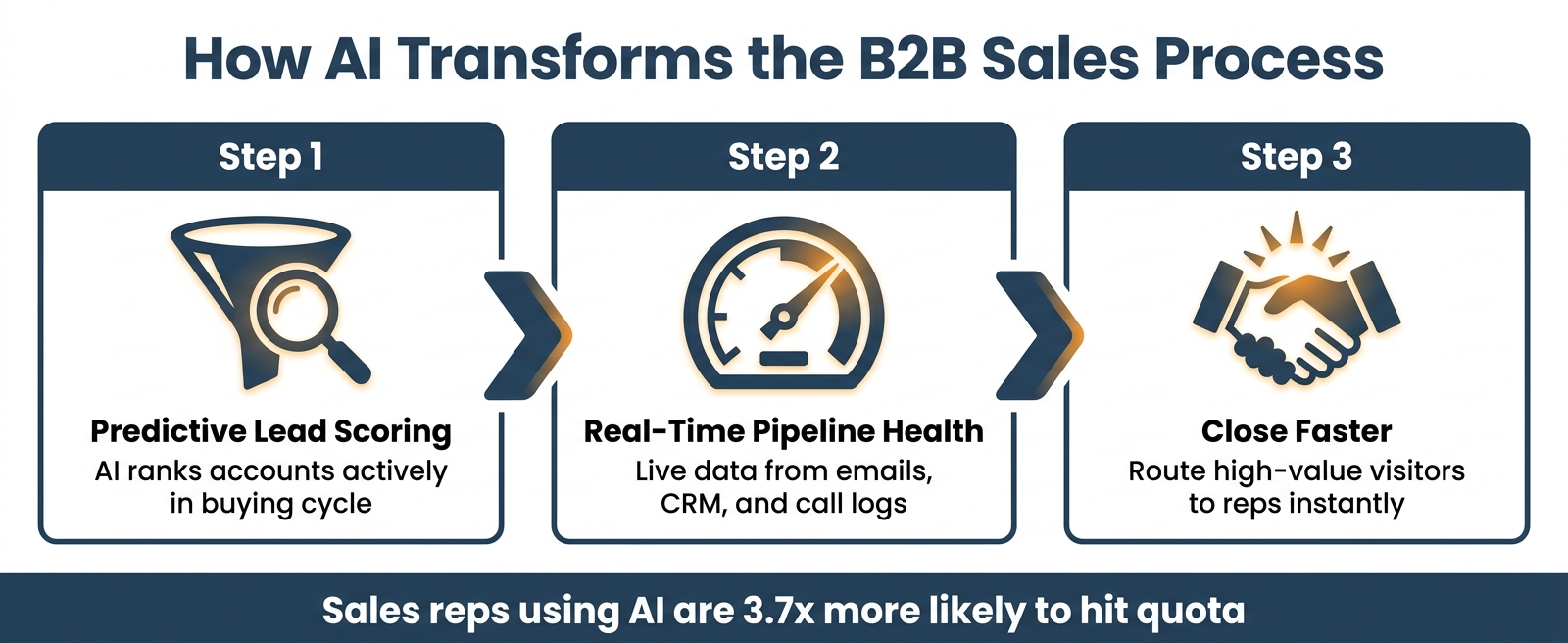
Traditional sales teams relied on gut instinct and spreadsheets. Today's AI-powered tools do the heavy lifting instead. They score leads automatically, forecast revenue with real data, and flag the right accounts to contact at the right time.
The impact is measurable. Sales reps using AI tools are 3.7x more likely to hit their quota compared to those who don't. And 64% of sales professionals say AI saves them between one and five hours every single week.
That's time back for actual selling.
3 B2B Startups Winning in AI-Powered Sales
6sense is one of the most talked-about names in B2B sales AI. It uses predictive intelligence to identify which accounts are actively in a buying cycle, even before those buyers reach out. Sales teams stop guessing and start prioritizing.
Clari focuses on revenue intelligence. It pulls data from emails, CRM entries, and call logs to give sales leaders a clear, real-time picture of pipeline health. No more relying on reps to manually update records. Clari spots risks in the forecast automatically.
Qualified takes a different angle. It sits on your website and uses AI to engage high-value visitors in real time. When a target account lands on your site, Qualified routes them instantly to the right sales rep. It turns passive web traffic into active pipeline.
The Numbers Behind the Shift
The ROI from AI in B2B sales isn't theoretical. Companies using AI for lead scoring are seeing 20 to 30% higher conversion rates compared to traditional methods. And in NVIDIA's 2026 survey, 53% of organizations named improved employee productivity as one of the biggest impacts AI had on their operations.
For B2B teams stuck in outdated workflows, that gap is only going to get wider.
What This Means for B2B Companies
If founders and early reps are still spending hours on data entry, manually qualifying leads, or guessing at forecast accuracy, you're competing at a disadvantage. The tools to fix all of that already exist. Our practical growth guide for B2B startups covers where to start.
The Zulu Method is built specifically to help Series A and B startups plug into these AI-native systems. Instead of bolting AI onto old workflows, it rebuilds the marketing engine around them from the start, and runs it as a permanent replacement for an in-house team rather than a stopgap. If you're mapping that move, our guide to building a GTM strategy at Series A covers the sequencing.
That's how modern B2B revenue engines get built now.
Spotlight: The Smartest B2B Tech Startups Using AI in Marketing
AI is changing B2B marketing from the ground up. The best B2B tech startups using AI in marketing are doing more than automating emails. They're building systems that personalize content for thousands of accounts at once, predict which campaigns will convert, and cut customer acquisition costs in the process.
How AI Is Changing B2B Marketing
Marketing used to mean broad campaigns sent to big lists. Today's AI-powered tools flip that model. They analyze intent signals, segment audiences in real time, and deliver the right message to the right person at exactly the right moment.
The results speak for themselves. One European cybersecurity company using an AI-led marketing model saw a 17% reduction in customer acquisition cost within just two quarters. Win rates jumped from 1-in-9 to 4-in-9. That's not a small improvement. That's a completely different business.
3 Startups Leading AI-Powered B2B Marketing
Jasper is one of the most recognized names in AI content generation. It helps marketing teams produce on-brand content at scale, from blog posts to ad copy. Instead of waiting weeks for content, teams ship it in hours.
Mutiny focuses on website personalization for B2B companies. It uses AI to serve different homepage experiences to different accounts based on industry, company size, and behavior. Instead of one homepage for every visitor, a target account lands on a page written for its industry and stage.
Writer is built specifically for enterprise teams who need AI writing that stays on brand and compliant. It's not a general-purpose tool. It learns your company's voice, terminology, and guidelines, then applies them automatically across every piece of content your team produces.
Hyper-Personalization at Scale: A Real Example
Hyper-personalization at scale is no longer a theory. It's happening right now across B2B marketing teams.
Here's how it works in practice. A company using an account-based marketing platform feeds it firmographic data, intent signals, and behavioral data from website visits. The AI builds a unique content experience for each target account. The message a VP of Finance sees is different from what a CTO sees, even if they work at the same company.
This kind of precision used to require a huge team. Now it runs automatically. And relevant targeting can lift click-through rates by up to 72% compared to generic campaigns.
What B2B Marketing Teams Should Do Next
The gap between companies using AI in marketing and those that aren't is growing fast. Tools like Jasper, Mutiny, and Writer are making it possible for lean teams to compete with much larger ones.
For B2B SaaS startups with no marketing leader yet, plugging into these systems isn't a future goal. It's a right-now decision. AI marketing agencies like The Zulu Method integrate these AI-native marketing tools without the trial and error of doing it alone.
The companies pulling ahead aren't spending more on marketing. They're spending smarter, powered by AI. That's also the only way demand generation works on a Series A budget.
Spotlight: AI-Powered B2B Startups Streamlining Operations
AI isn't just changing how B2B companies sell and market. It's completely reshaping how they run. Supply chains, finance, HR, and logistics are all getting smarter. And a new wave of B2B tech startups using AI is making that transformation faster and cheaper than most companies expected.
Where AI Is Making the Biggest Operational Impact
Back-office functions used to be slow and manual. Invoices sat in queues. Supply chain disruptions caught teams off guard. Hiring took weeks longer than it should have.
AI-native startups are fixing all of that. They're automating the repetitive work, predicting problems before they happen, and giving operations teams real-time data to act on. The results aren't small. According to Bernard Marr's analysis of AI in B2B companies, AI-driven automation is reducing operational costs and improving decision-making speed across industries from manufacturing to finance.
3 B2B Startups Leading AI-Powered Operations
Blue Yonder is one of the most recognized names in AI-powered supply chain management. It uses machine learning to predict demand, optimize inventory levels, and flag disruption risks before they hit. Instead of reacting to supply chain problems, companies using Blue Yonder get ahead of them.
AKASA focuses on healthcare finance. It uses generative AI to automate the revenue cycle, specifically reducing claim denials that cost healthcare organizations millions every year. It's a great example of AI solving a very specific, very expensive operational problem at scale.
Airwallex takes AI into expense management. It automatically pulls details from receipts, suggests expense categories, and speeds up the reimbursement process. For finance teams drowning in manual data entry, that kind of automation adds up fast.
A Real Example: Predicting Supply Chain Disruptions
Here's how it works in practice. A mid-market manufacturer feeds live supplier data, shipping timelines, and historical order patterns into an AI platform like Blue Yonder. The system spots a pattern. A key supplier in Southeast Asia is showing early signs of delay based on weather data and shipping capacity signals.
The operations team gets an alert three weeks early. They adjust orders, find a backup supplier, and avoid a production halt. No spreadsheet or traditional ERP would have caught that in time.
That's the real value of AI in operations. It's not just faster. It's predictive.
Why Operations AI Is Getting More Attention
Sales and marketing AI tools get a lot of press. But the ROI from operations AI is often bigger and more immediate. According to Built In's roundup of leading AI companies, startups tackling finance automation, supply chain optimization, and HR workflows are attracting serious investment because the cost savings are measurable and fast.
For B2B startups, this is where a lot of hidden value still sits. The Zulu Method helps identify which operational workflows are the best candidates for AI integration, so founders don't burn months testing tools that were never going to fit their setup.
The operations layer is where AI is quietly delivering some of its biggest wins right now.
Real World Example: Hyper-Personalization at Scale
A mid-market manufacturer feeds live supplier data, shipping timelines, and historical order patterns into an AI platform like Blue Yonder. The system detects early warning signals. A key supplier in Southeast Asia starts showing delays based on weather data and shipping capacity. The operations team receives an alert three weeks early, allowing them to adjust orders and find a backup supplier, avoiding production halt. Traditional ERP systems would never catch this pattern in time. This demonstrates AI's real value: it's faster than manual processes, and it's predictive, turning reactive operations into strategic advantage.
A Framework for Evaluating B2B Tech Startups Using AI
Not every B2B tech startup using AI is worth your time or money. Some are genuinely powerful. Others are thin wrappers around existing models dressed up in impressive marketing. Knowing how to tell the difference matters, whether you're a buyer choosing a vendor or an investor picking your next bet.
Here's a simple, practical framework to evaluate any AI startup before you commit.
1. Problem-Solution Fit: Does the AI Actually Solve Something Real?
The first question is the most obvious one, but it's often skipped. What specific problem does this AI solve? And is AI actually the best way to solve it?
Strong B2B AI startups target a real, costly business problem. They don't just automate a task that was already easy. They fix something that was genuinely broken, slow, or expensive.
Weak ones dress up basic automation in AI language. If the product could do the same job with a simple rule-based script, that's a red flag.
2. Data Moat: Where Does the Intelligence Actually Come From?
This is where most buyers and investors miss something important. The quality of an AI product depends almost entirely on the quality of its data.
According to CB Insights' State of AI research, vertical AI startups that own proprietary, domain-specific data create far stronger competitive positions than those relying on general-purpose models. The data advantage is what makes the AI smarter over time.
Ask the vendor: Where does your training data come from? How is it curated? And how does the model get better as more customers use it?
3. Integration Capabilities: Will It Actually Work Inside Your Stack?
Even the smartest AI platform is useless if it can't connect to your existing tools. Integration is often the difference between a product that transforms your workflow and one that sits unused.
Before committing to any vendor, confirm it integrates natively with your CRM, your data warehouse, and your core ops platforms. APIs matter. So does implementation support.
4. Demonstrable ROI: Can They Show You Real Numbers?

This is the clearest signal of a mature AI product. The best B2B AI startups can point to customers like you and show measurable results. Not vague efficiency gains. Actual numbers.
The Stanford HAI AI Index Report 2026 highlights that industry AI adoption is being driven by demonstrable, measurable productivity outcomes, not just potential. The bar for proof is rising fast.
AI-Native vs. AI-Washed: A Side-by-Side
Nearly every B2B startup using AI falls into one of two camps. Here's how they diverge on the things that actually cost you money.
| What you're checking | AI-native B2B startup | AI-washed B2B startup |
|---|---|---|
| Where the intelligence lives | The model is the product | A chat box bolted onto a database |
| Training data | Proprietary, domain-specific, compounding | Whatever the foundation model already knew |
| It gets better when | More customers use it | The vendor ships a new prompt |
| Failure mode | Documented, with human review built in | "The AI did that" |
| Pricing logic | Tied to usage or outcomes | Per seat, same as the tool it replaced |
| Take the AI away | The product stops existing | The product barely changes |
If a vendor lands in the right-hand column on four of these six rows, you're looking at a wrapper with a good deck.
Vendor Evaluation Checklist
Before signing anything, run through these questions with any AI vendor:
| Question to Ask | What You're Testing |
|---|---|
| How does your model retrain over time? | Data moat and continuous improvement |
| Can you quantify results for a similar customer? | Demonstrable ROI |
| Is the AI self-hosted or built on a third-party API? | Proprietary tech vs. a wrapper |
| What integrations are native vs. custom builds? | Real-world fit with your stack |
| How do you handle model errors or bad outputs? | Governance and reliability |
| What does implementation actually look like? | Time to value |
These questions cut through the marketing noise fast. Vendors with real products can answer them clearly. Vendors without real products can't.
For founders running these evaluations alone, working with a partner like The Zulu Method makes the process a lot smoother. Instead of spending months testing vendors that don't fit, you get guidance upfront on which AI tools actually match your workflows and goals. Our B2B SaaS CAC benchmarks are a useful way to sanity-check whatever a vendor claims it will improve.
More Critical Questions to Ask Before Choosing an AI Startup
- Does this AI startup have a clear problem-solution fit, or are they just wrapping a general-purpose model in business jargon? Can they articulate the specific, costly problem they solve?
- What is their data moat? Where does training data come from, how is it curated, and does the model improve as more customers use it, or are they entirely dependent on third-party APIs like OpenAI?
- Will this platform actually integrate with our existing tech stack (CRM, data warehouse, ERP)? What integrations are native versus requiring expensive custom builds?
- Can they show measurable ROI from customers similar to our company? Request specific metrics like conversion lift, time saved, and cost reduction, not vague efficiency claims.
- How transparent is their AI? Can they explain why the system made a specific decision (e.g., flagged a lead as low-priority or rejected a claim)? Enterprise buyers increasingly demand explainability.
- What happens if the AI produces errors or bad outputs? What governance and human-in-the-loop safeguards do they have in place?
- Is the AI truly proprietary and self-hosted, or is it essentially a wrapper around OpenAI/Claude/other foundation models that competitors could replicate overnight?
Beyond the Hype: Key Challenges Facing B2B AI Startups
Not every B2B tech startup using AI will make it. The ones that do are working through real, difficult problems right now. And understanding those challenges is actually a good sign. It means the market is maturing and separating serious companies from the noise.
Here are the four biggest obstacles these startups face today.
The Cold Start Problem
AI products need data to work. But new startups don't have data yet. This creates a painful catch-22: you need customers to get data, but you need data to impress customers.
The best startups solve this by partnering with early anchor clients or licensing third-party datasets to bootstrap their models. It's hard, but it's also a filter. Companies that crack the cold start problem early tend to build stronger products over time.
Navigating Data Privacy Rules
GDPR in Europe and CCPA in California aren't optional. Any B2B AI platform handling customer data has to comply with both, and the rules are strict.
This creates real costs. Legal reviews, compliance teams, data governance systems. It slows things down. But it also weeds out lazy builders. Startups that invest in privacy infrastructure early end up being more trustworthy vendors, which matters a lot in enterprise sales.
The Talent Cost Problem
Hiring experienced AI engineers is expensive. According to NVIDIA's State of AI Report 2026, demand for AI talent continues to outpace supply across every major industry, driving up salaries and making it harder for smaller startups to compete with big tech for the same people.
The startups winning this battle are usually the ones with strong founder credibility, a compelling mission, and equity packages that make the risk worthwhile for top engineers.
The Black Box Problem

Enterprise buyers want to know why the AI made a decision, not just what it decided. When an AI flags a lead as low priority or rejects a claim, the buyer needs to explain that to their team.
This is why explainable AI (XAI) is becoming a bigger priority. CB Insights' AI Trends research highlights that accuracy, reliability, and transparency are the top areas where AI tools still fall short in real enterprise deployments. Startups that build in explainability from day one are far easier to trust and adopt.
These challenges aren't reasons to avoid AI tools. They're exactly what separates the real players from the pretenders.
Navigate Your Next Steps in the B2B AI Ecosystem
B2B tech startups using AI are changing how companies sell, market, and operate. The best ones don't just sell technology. They solve specific, costly business problems with AI built into the core of what they do. Here's how to move forward with confidence.
The Big Takeaway
AI isn't coming to B2B. It's already here and moving fast. From predictive sales tools to automated supply chains, intelligent platforms are replacing slow manual workflows across every function.
The startups winning right now are solving real problems. Not demo problems. Not theoretical ones. They're fixing the exact pain points that cost companies time and money every single quarter.
What to Do Right Now
Start by using the evaluation framework from this article. Before you talk to any AI vendor, ask the hard questions. Where does their data come from? Can they show real results from a company like yours? Is the AI actually proprietary or just a wrapper?
Those questions cut through the noise fast.
Next, explore the company websites mentioned throughout this article. 6sense, Clari, Jasper, Mutiny, Blue Yonder, and the others covered here all offer demos. Seeing the product in action for your specific use case is worth more than any report.
Don't Go It Alone
Testing AI tools without a clear strategy is expensive and slow. Plenty of B2B startups burn an entire quarter evaluating vendors that were never a good fit to begin with.
That's exactly where The Zulu Method helps. Instead of trial and error, you get a clear roadmap built around your actual workflows and goals, plus an AI-native marketing function with 10+ channels to choose from, run as a permanent replacement for an in-house team. Building an effective AI marketing strategy takes understanding both the technology and your own business context. If you'd rather start small, the GTM Foundation Pilot is $4,995.
The gap between companies using AI well and those still figuring it out is growing. The best time to close that gap is now.

B2B Tech Startups Using AI FAQs
What is a B2B AI startup?
A B2B AI startup is a company that primarily sells AI-powered software, services, or platforms to other businesses rather than consumers. Their core goal is solving specific business problems like increasing efficiency, reducing operational costs, or generating revenue through intelligent automation and predictive capabilities.
What are some examples of successful B2B AI companies?
Established players include Salesforce Einstein, UiPath, and Datadog. Emerging startups leading specific domains include 6sense (predictive sales intelligence), Clari (revenue intelligence), Qualified (conversational engagement), Jasper (AI content generation), Mutiny (website personalization), Writer (enterprise AI writing), Blue Yonder (supply chain optimization), AKASA (healthcare finance automation), and Airwallex (expense management).
Which industries are most impacted by B2B tech startups using AI?
Financial Services (fraud detection and claims processing), Healthcare (diagnostic support and revenue cycle management), Retail and Manufacturing (supply chain optimization and predictive maintenance), and Sales/Marketing (lead scoring and personalized engagement) are seeing the most significant impact from AI startups.
How do you invest in B2B AI startups?
Direct investment typically requires accreditation and access to VC funds or angel syndicates. For average investors, consider investing in public tech companies with strong AI divisions or B2B SaaS-focused ETFs that hold portfolios of AI-enabled businesses.
What are the ethical considerations for B2B tech startups using AI?
Key concerns include data privacy (GDPR/CCPA compliance), algorithmic bias in decision-making (hiring, lending, account prioritization), and explainability, meaning AI decisions can be understood and justified to stakeholders. Responsible startups implement clear governance policies and transparency mechanisms.
How can a non-tech company partner with a B2B AI startup?
Start with a well-defined pilot project targeting a specific, costly business problem. Success requires clean, accessible data and a dedicated internal champion to drive adoption and integration across workflows.
Is AI going to replace B2B jobs?
AI excels at handling repetitive, data-heavy tasks, which frees human workers to focus on strategic, creative, and interpersonal aspects of their roles. The trend is augmentation, not replacement. AI amplifies what skilled professionals can accomplish rather than eliminating their value.