
Hannon Brett | Published on: July 20, 2026 | Time to read: 25 min
AI marketing for customer growth and retention shifts businesses from reactive to predictive strategies by analyzing customer behavior patterns to prevent churn before it happens. This approach is significantly more cost-effective than traditional methods, with customer acquisition costing 5 to 7 times more than retention, yet 44% of businesses still prioritize acquisition in 2025. By using predictive analytics, hyper-personalization, and integrated AI systems, companies can reduce churn by 12 to 15% on average while increasing profitability by 25 to 95% with just a 5% improvement in retention.
Key Takeaways
- Acquiring new customers costs 5 to 7 times more than retaining existing ones, with acquisition costs climbing 40 to 60% since 2023 while retention costs grew only 12%
- AI predictive analytics reduces customer churn by an average of 12 to 15%, with some companies achieving reductions of 25 to 40% when paired with automated retention actions
- Product usage decline, support ticket spikes, payment delays, and relationship disengagement are the top indicators AI catches earliest, often 2 to 4 weeks before actual churn
- Hyper-personalization drives 10 to 15% revenue lift on average, with 76% of consumers more likely to repurchase from brands that personalize communications
- The AI marketing flywheel connects retention and acquisition by using data from loyal customers to create lookalike audiences, making acquisition spend more efficient
- Starting with one focused use case (like churn prediction or email personalization) and proving value before expanding is critical for successful AI implementation
- Clean, unified customer data in your CRM is the foundation: AI without solid data infrastructure only scales existing problems rather than solving them
Table of Contents
- Why AI Is a Big Step Forward for Customer Growth and Retention
- Using Predictive Customer Analytics to Slash Churn
- Achieving Hyper-Personalization at Scale with an AI Marketing Strategy
- Building Your AI Marketing Flywheel for Continuous Growth
- Choosing the Right AI Tools for Your Customer Growth Strategy
- Integrating AI with Your CRM: A Practical Roadmap
- Your Blueprint for Lasting Customer Growth and Retention
Why AI Is a Big Step Forward for Customer Growth and Retention
AI marketing for customer growth and retention works by shifting your strategy from reactive to predictive. Instead of responding to problems after they happen, AI spots patterns in customer behavior early, so you can act before someone leaves. This approach makes retention smarter, faster, and far more cost-effective than traditional methods.
Keeping Customers Beats Chasing New Ones
Here's a number worth knowing: acquiring a new customer costs 5 to 7 times more than keeping an existing one. And the gap is growing. According to data from Artisan Growth Strategies, average customer acquisition costs have climbed 40 to 60% since 2023, while retention costs grew only about 12% in the same period.
Existing customers convert at 60 to 70%. New prospects? Only 5 to 20%. That difference alone makes retention the smarter investment. But here's the surprising part: 44% of businesses still put acquisition first in their 2025 strategies, even with these numbers staring them in the face.
From Reacting to Predicting
Traditional marketing waits for a problem to show up. A customer stops buying, and then you send a discount code. AI flips that model completely.
As noted by Copy.ai's guide on customer lifecycle management, AI "replaces reactive approaches with proactive intelligence... transforming this relationship from something you react to into something you orchestrate." That's the real shift. You're not chasing customers anymore. You're anticipating what they need before they know they need it.
This predictive model works because AI can process data at a scale no human team can match.
Spotting Patterns Humans Simply Can't See
Think about everything a customer does before they leave. They log in less often. They open fewer emails. They stop using key features. Each signal alone looks small. Together, they tell a clear story.
AI models track the trajectory of these behaviors over 14 to 30 day windows. Research on churn prediction frameworks shows that product usage decline, support ticket spikes, and payment delays are the top indicators AI catches earliest, often 2 to 4 weeks before a customer actually churns.
No marketing team can monitor thousands of accounts that closely. AI does it automatically, around the clock.
The Real Strategic Advantage
The business case is simple. Predictive analytics reduces customer churn by an average of 12 to 15%, and a 5% improvement in retention can increase profitability by 25 to 95%.
That's not a small optimization. That's a strategic shift in how your business grows. And it starts by using AI to turn customer data into decisions you can act on right now.
Using Predictive Customer Analytics to Slash Churn
Predictive customer analytics uses historical data to forecast future behavior, specifically who is likely to leave and when. AI models analyze patterns across thousands of customers to flag churn risk before it becomes a lost account. Done right, this gives your team time to act, not just react.
What Data AI Models Actually Use
AI churn models don't rely on one signal. They pull from multiple data sources at once to build a complete picture of each customer's health.
The most common inputs include:
- Purchase history: Frequency, recency, and average order value trends
- Website and app engagement: Login frequency, session duration, and feature usage depth
- Support ticket activity: Volume spikes and unresolved issue patterns
- Email behavior: Open rates, click-throughs, and response gaps
According to research on churn indicators from Mosaic's churn signal analysis, the trajectory of these metrics over 14 to 30 day windows matters more than any single data point. A slow decline across several signals is far more telling than one bad week.
The Signals AI Catches First
Product usage decline is the single strongest predictor of churn. A drop in login frequency or feature adoption often shows up two to four weeks before a customer actually cancels.
Support ticket spikes are the second big indicator. When customers hit friction repeatedly and don't get resolution, frustration builds fast. Payment delays also matter. Companies under budget pressure often let invoices age before making a final decision to leave.
None of these signals alone triggers an alert. But when AI sees two or three trending together, that's when the churn risk score rises.
Proactive Interventions That Actually Work
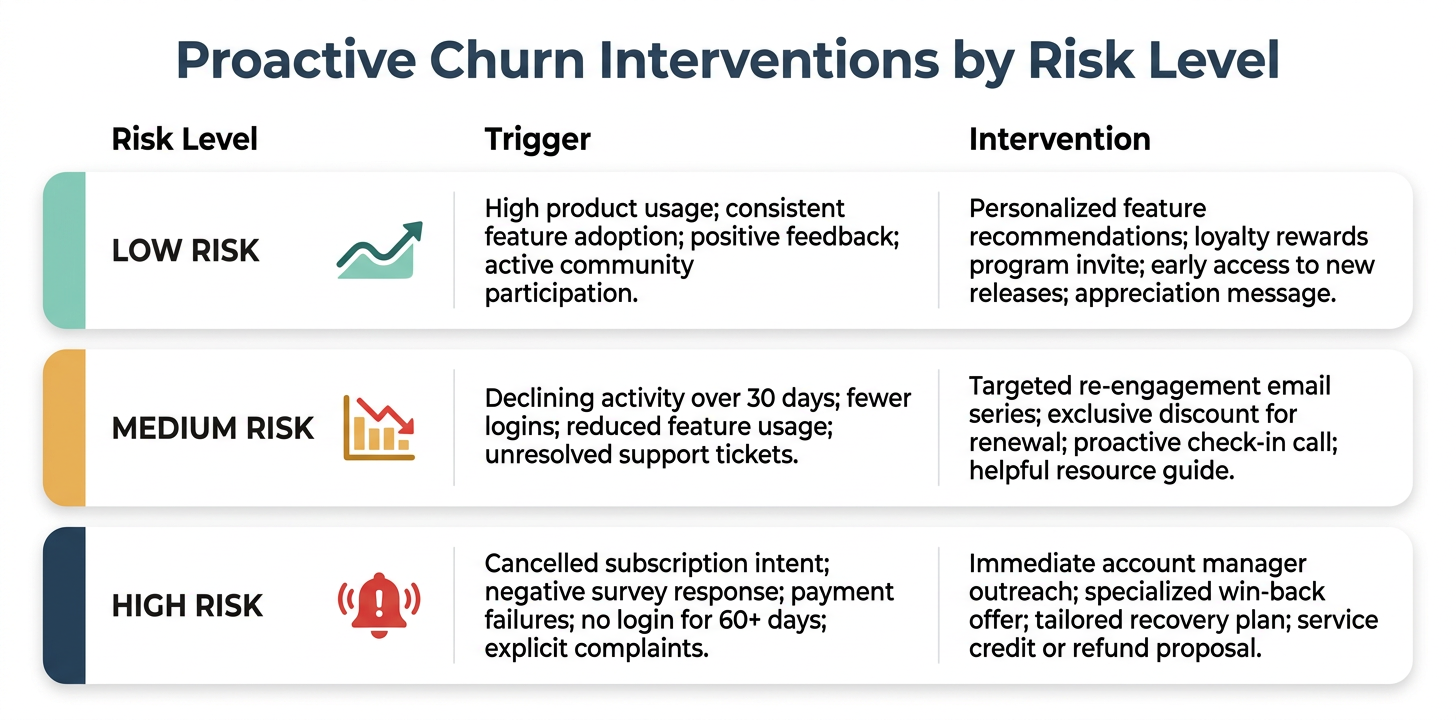
Once AI flags a at-risk customer, the goal is to intervene before they decide to leave. The timing and type of outreach depends on the risk level.
Here's how interventions typically scale:
| Risk Level | Trigger | Intervention Example |
|---|---|---|
| Low | Slight engagement dip | Automated educational email or feature tip |
| Medium | Usage decline plus support spike | Personalized check-in email from a success rep |
| High | Multiple signals trending down | Direct outreach with tailored offer or escalation |
These aren't generic drip emails. They're timed responses based on what each customer is actually doing, or not doing, inside your product.
Research from SaaS churn reduction case studies at Big Block Solutions shows that AI usage scoring based on login activity and feature engagement can cut churn by 40% when connected to automated CRM workflows.Why Timing Changes Everything
The window between risk detection and customer decision is narrow. Most customers don't announce they're leaving. They just go quiet and then cancel.
AI closes that window by turning data into real-time alerts. Your team doesn't need to monitor every account manually. The system does it for you and surfaces only the customers who need attention right now.
Deloitte's 2024 consumer research found that consumers are 37% to 50% more likely to spend with brands that deliver personalized experiences. That stat matters here. Timely, relevant outreach doesn't just stop churn. It reinforces loyalty at exactly the right moment.Predictive analytics doesn't replace human judgment. It gives your team better information so every interaction counts more.
Achieving Hyper-Personalization at Scale with an AI Marketing Strategy
An AI marketing strategy for customer growth and retention uses machine learning to treat every customer as an individual, not a demographic group. Instead of sending the same message to thousands of people, AI customizes content, offers, and timing for each person in real time. This drives both higher conversions and stronger long-term loyalty.
From Segments to Segments of One
Traditional marketing sorts people into buckets. Age 25 to 34, lives in the Midwest, bought once in Q3. Everyone in that bucket gets the same email. It's efficient, but it's also generic.
AI flips this entirely. Instead of grouping customers by who they are, AI personalizes based on what each person actually does. What did they click? What did they ignore? How long since their last purchase? This creates what marketers call a "segment of one," where every customer gets an experience built just for them.
The difference isn't small. McKinsey's research on personalization value shows that 76% of consumers are more likely to repurchase from brands that personalize their communications. And the revenue lift from getting personalization right typically runs between 10% and 15%.
What AI Actually Personalizes in Real Time
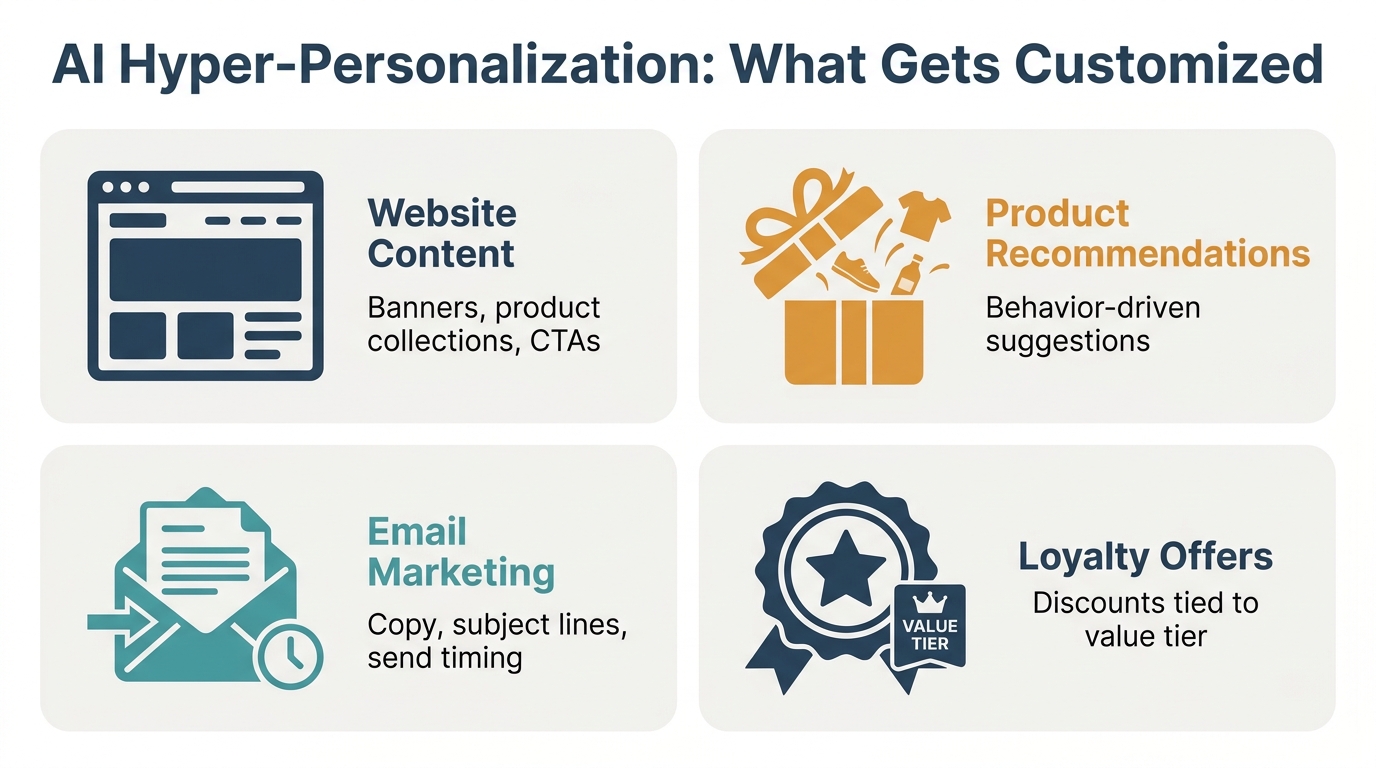
Here's where the strategy gets practical. AI doesn't just swap out a first name in an email. It customizes across multiple touchpoints at once.
Website content: AI can surface different homepage banners, product collections, or calls to action depending on who is visiting. A returning customer who browsed winter gear sees something different from a first-time visitor.Product recommendations: This is where AI earns its keep. By analyzing purchase history, browsing patterns, and similar customer behavior, AI suggests products with far higher conversion rates than generic bestseller lists.Email copy and timing: AI can generate subject lines, body content, and send times optimized for each individual's past behavior. Someone who opens emails at 7 a.m. on Tuesdays gets their message then, not in a Tuesday batch send at noon.Netflix is the most cited example of this in action. According to analysis of Netflix's AI personalization system, over 80% of content streamed on the platform comes from AI-driven recommendations. The system even adjusts which thumbnail artwork it shows each user based on their viewing history, boosting click-through rates by around 20%.
The Growth and Retention Impact
Hyper-personalization does two things at once. It helps you grow by converting more of the people already in your funnel. And it keeps customers longer by making every interaction feel relevant.
Think about the retention side first. A customer who gets generic emails gradually tunes them out. A customer who gets messages tied to what they actually care about keeps engaging. That engagement compounds over time into higher lifetime value.
Research from BCG on consumer personalization expectations found that customers exposed to personalized marketing show significantly higher lifetime value compared to those who aren't, and they're far more likely to recommend the brand to others.On the growth side, personalized product recommendations and content directly lift conversion rates. When AI matches the right offer to the right person at the right moment, the friction of buying drops.
The Flywheel Effect
The real power here is compounding. Better personalization drives more engagement. More engagement generates more behavioral data. More data makes the AI model smarter. Smarter models produce even better personalization.
HubSpot's flywheel model captures this loop well. Delighted customers become advocates, which reduces acquisition costs and feeds growth from the top down. Personalization is what keeps that flywheel spinning.Without AI, this loop breaks down fast. No human team can monitor individual behavior at scale and respond in real time. AI makes the loop automatic.
| Personalization Type | What AI Customizes | Primary Benefit |
|---|---|---|
| Website content | Banners, product collections, CTAs | Higher conversion rates |
| Product recommendations | Suggestions based on behavior patterns | Increased average order value |
| Email marketing | Copy, subject lines, send timing | Better open and click-through rates |
| Loyalty offers | Discounts and perks tied to value tier | Stronger retention and LTV |
The shift from demographic segments to real-time individual personalization isn't a nice-to-have anymore. It's how AI marketing strategy separates brands that grow from brands that plateau.
Building Your AI Marketing Flywheel for Continuous Growth
The AI marketing flywheel for customer growth and retention is a self-reinforcing cycle where data from your happiest customers feeds back into finding and winning new ones. AI automates every stage of this loop, making the whole system faster and smarter over time. The result is compounding growth that gets easier, not harder, to sustain.
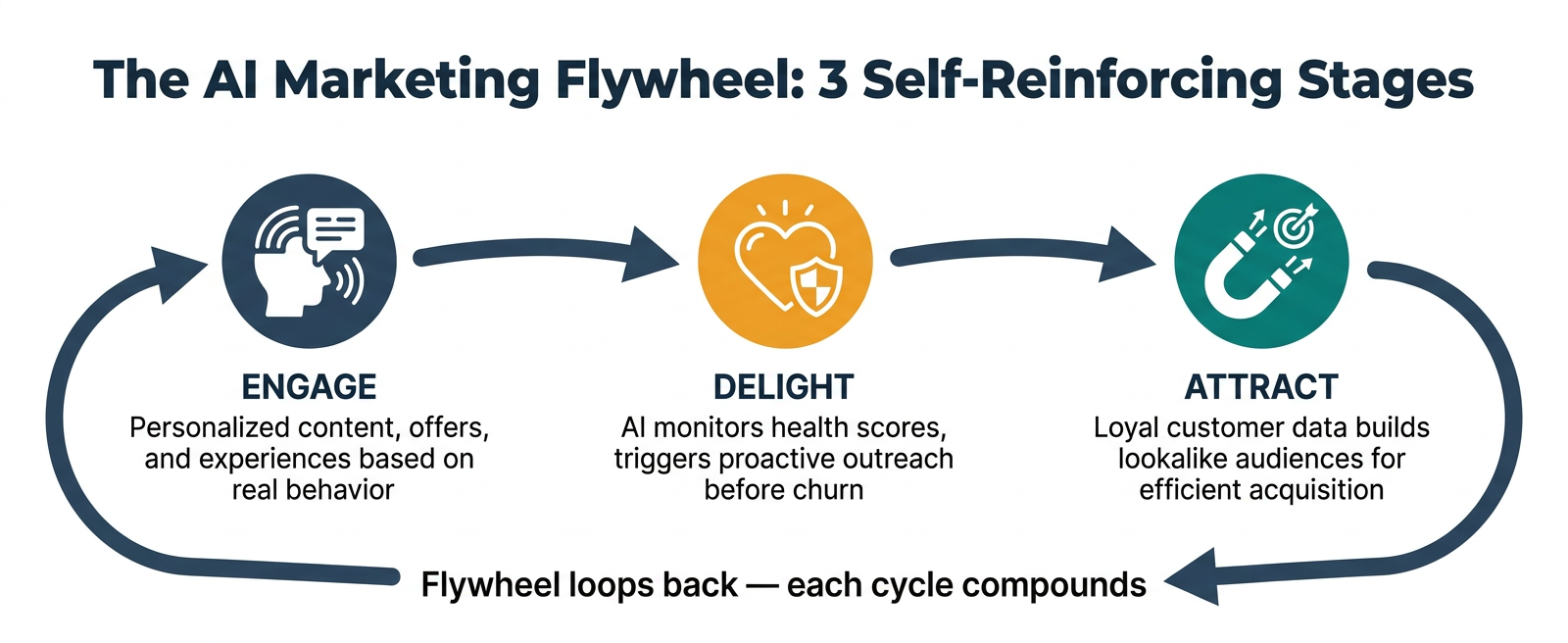
The Three Stages of the Flywheel
The flywheel runs on three stages that feed into each other continuously.
First is Engage. This is where AI delivers personalized content, offers, and experiences to existing customers based on their actual behavior. Not what demographic they belong to. What they actually do.
Second is Delight. AI monitors customer health scores and triggers proactive outreach before problems turn into churn. A timely check-in or a relevant offer at the right moment turns a passive customer into a loyal one.
Third is Attract. This is where the flywheel gets really powerful. Data from your most loyal, highest-value customers gets used to find new prospects who look just like them.
Using Loyal Customer Data to Fuel Acquisition
This last stage is where most businesses leave serious money on the table. They treat retention and acquisition as separate strategies with separate budgets. The flywheel model connects them.
Here's how it works in practice. Your AI system identifies customers with the highest lifetime value, strongest engagement, and longest retention. That profile becomes the template for top-of-funnel targeting.
Latin American super-app Rappi used exactly this approach. According to Amplitude's analysis of their growth strategy, Rappi identified loyal users as those making two purchases within a month or staying active after 30 days. They synced that profile to ad platforms to build lookalike audiences. The result was acquisition spend focused on people most likely to become high-value customers, not just any customers.
That's the flywheel in action. Retention data improving acquisition efficiency.
How AI Automates the Entire Loop
Without AI, this cycle breaks down fast. A human team can't monitor engagement signals across thousands of customers, identify your top-value profiles, sync them to ad platforms, and update everything in real time. It's too much data moving too fast.
AI handles all of it automatically. Here's what that looks like across each stage:
| Flywheel Stage | What AI Does | Business Outcome |
|---|---|---|
| Engage | Personalizes content, timing, and offers per user | Higher conversion and retention rates |
| Delight | Monitors health scores, triggers proactive outreach | Reduced churn, stronger loyalty |
| Attract | Builds lookalike audiences from top-value customers | More efficient acquisition spend |
The system doesn't need someone to check dashboards every morning. It runs continuously, surfaces what needs attention, and acts on the rest automatically.
The Compounding Effect Over Time
Here's what makes the flywheel different from a standard marketing funnel. A funnel ends at the sale. The flywheel keeps spinning.
Every delighted customer generates better data. Better data improves personalization. Better personalization creates more delighted customers. And those customers become the source material for your next wave of acquisition.
SparkToro's analysis of why marketing flywheels work describes this well: repeatable tactics lead to compounding effects over time, which is exactly what separates brands that scale from brands that plateau.AI doesn't just make each stage faster. It keeps the momentum from losing energy between stages, which is where most manual marketing strategies fall apart.
The flywheel isn't a concept for large enterprises with big budgets. It's a framework any team can build once the right data connections are in place.
Real World Example: How Rappi Uses Loyal Customer Data to Fuel Acquisition
Latin American super-app Rappi identified loyal users as those making two purchases within a month or staying active after 30 days. They synced this precise 'ideal customer' profile to Facebook as a custom audience. Facebook's algorithms then generated lookalike audiences, enabling Rappi to target new users who were most likely to exhibit similar high-value behaviors. This strategy ensured top-of-funnel ad spend was efficient, focused on quality acquisition, and prioritized bidding based on expected lifetime value rather than broad demographics. This is a perfect example of the AI marketing flywheel in action: retention data improving acquisition efficiency.
Choosing the Right AI Tools for Your Customer Growth Strategy
Choosing AI tools for your customer growth strategy means starting with your goals, not a feature list. The right tool solves a specific problem you already have, fits your existing tech stack, and your team can actually use it. Start focused, prove value fast, then expand.
Match the Tool Category to Your Goal
There are three main categories of AI tools that support customer growth and retention. Each one serves a different strategic purpose.
Customer Data Platforms with AI unify all your customer data into a single profile. Instead of behavior sitting in separate tools that never talk to each other, a CDP pulls it together so AI can actually act on it. According to CDP.com's analysis of AI-driven customer data platforms, the shift toward AI-native CDPs means platforms now do more than store data. They predict behavior and trigger actions autonomously.AI-powered marketing hubs sit on top of that data and handle multichannel execution. Think personalized email sequences, SMS, push notifications, and in-app messages, all timed and tailored automatically. These platforms use AI to decide what to send, when to send it, and to whom.Specialized predictive analytics tools focus on scoring. They take your customer data and output a number: how likely is this person to churn, convert, or upgrade? That score then feeds into your CRM or marketing hub to trigger the right action.Questions to Ask Before You Buy
Vendors will all claim their tool does everything. Here's what actually matters when you're evaluating options:
- Does it integrate with what you already use? A tool that doesn't connect to your CRM or data warehouse creates more work, not less.
- Can your marketing team run it without engineering support? Tools that require constant developer help slow everything down.
- What does proven ROI look like for companies your size? Ask for case studies with real numbers, not marketing copy.
- How clean does your data need to be for it to work? Some tools are forgiving with messy data. Others aren't.
- What does onboarding and support actually look like? The first 90 days make or break adoption.
One expert caution worth keeping in mind: marketing operations specialists note that "AI does not fix bad processes. It scales them." If your data is fragmented or your team doesn't have clear ownership over campaigns, AI will amplify those problems, not solve them.
Start Small and Prove It Works
The biggest mistake teams make is trying to build a complete AI stack before proving any of it works. That leads to expensive tools sitting idle and no clear owner.
Instead, pick one specific pain point. Cart abandonment is a common starting place for e-commerce. Churn prevention for a high-value segment works well for SaaS teams. Improving email open rates is a low-risk first win for almost anyone.
Solve that one problem well. Measure the result. Then use that proof of value to justify expanding the stack.
Forrester's Wave report on Customer Data Platforms for B2C highlights that the platforms earning top marks are the ones combining data unification with built-in AI for prediction and activation, not just data storage. That's the direction the whole category is moving.But even the best platform fails without a clear use case behind it. Define the problem first. Then find the tool that solves it.
Questions to Ask Before Choosing AI Tools
- Does it integrate with what you already use? A tool that doesn't connect to your CRM or data warehouse creates more work, not less.
- Can your marketing team run it without engineering support? Tools that require constant developer help slow everything down.
- What does proven ROI look like for companies your size? Ask for case studies with real numbers, not marketing copy.
- How clean does your data need to be for it to work? Some tools are forgiving with messy data. Others aren't.
- What does onboarding and support actually look like? The first 90 days make or break adoption.
Integrating AI with Your CRM: A Practical Roadmap

Integrating AI with your CRM gives your team a single, intelligent hub where customer data drives every decision. When your CRM and AI tools share data in both directions, your sales, support, and marketing teams all work from the same picture. That shared view is what turns raw data into real growth.
Start with a Unified Data Source
AI is only as good as the data it learns from. If your customer information lives in five different tools that never sync, your AI model will make predictions based on an incomplete picture.
Your CRM should be the central hub. Every interaction, purchase, support ticket, and email response should flow into one place. Research from CDP.com on single customer view benefits shows that 90% of companies report that a unified customer view reduces costs, and 62% adopt it specifically to eliminate data duplication across teams.
Before you add any AI layer, make sure your CRM is actually capturing the right data consistently.
A Step-by-Step Integration Roadmap
Here's a practical four-step process for connecting AI to your CRM without overcomplicating it:
Step 1: Data Audit and CleaningGo through your CRM records and identify gaps, duplicates, and inconsistencies. Messy data going in means bad predictions coming out. Fix the foundation before building anything on top of it.
Step 2: Choose an AI Tool with Native CRM IntegrationPick an AI tool that connects directly to your existing CRM without requiring custom engineering. Native integrations reduce setup time and lower the risk of sync errors. Check that the tool supports the specific use case you want to tackle first.
Step 3: Define Your Data Sync RulesDecide which data fields the AI reads from your CRM and which fields the AI writes back. Clear sync rules prevent data conflicts and keep both systems accurate.
Step 4: Pilot One Use CaseDon't try to automate everything at once. Pick one specific problem, like lead scoring or churn prediction, and run a focused pilot. Measure the result. Then expand from there.
The Goal: Bidirectional Data Flow
The real payoff comes when data moves in both directions. Your CRM feeds behavioral signals to the AI. The AI sends its insights back to enrich each customer record.
That means your sales rep opening a contact record sees the AI's churn risk score. Your support team sees a flag that this customer's engagement dropped last week. Everyone acts on the same intelligence at the same time.
Forbes Business Council's analysis of AI-driven CRM strategy highlights that AI tools excel at identifying patterns, delivering personalized experiences at scale, and lifecycle mapping to anticipate who is ready to take the next step. But that only works when the AI and CRM are genuinely in sync.Keep It Simple at the Start
The biggest mistake teams make is trying to build a full AI stack before proving any single piece works. That leads to expensive tools sitting idle with no clear owner.
Start with one pain point. Churn prevention for your top accounts is a strong first pick. So is lead scoring for inbound contacts. Solve that one problem well, measure the outcome, and use that proof to justify the next step.
A clean CRM plus one well-integrated AI tool beats a complex stack built on messy data every time.
Your Blueprint for Lasting Customer Growth and Retention
AI marketing for customer growth and retention works best when you stop treating it as a collection of separate tactics and start building it as one connected system. The technology isn't the strategy. Your business goal is. AI is the tool that helps you get there faster, with less guesswork and less wasted spend.
From Isolated Tactics to One Integrated System
Every section of this guide covers a different piece: churn prediction, hyper-personalization, the flywheel, CRM integration, tool selection. But they only create real value when they work together.
Predictive analytics feeds your CRM with risk scores. Your CRM triggers personalized outreach. That outreach keeps customers longer. Loyal customers become the template for your next acquisition campaign. Each stage makes the next one smarter.
When these pieces are disconnected, you get activity without compounding results. When they're connected, you get a system that grows on its own momentum.
Technology Serves the Goal. Not the Other Way Around.
It's easy to get caught up in what a tool can do. But the right question is always: what problem does my business need to solve right now?
McKinsey's research on AI-powered customer interactions frames this well. The best-performing teams ask "what does this customer need most in this moment?" first. Then they build the AI layer to answer that question at scale.Start with your goal. The technology follows.
Your One Actionable Next Step
Don't try to build everything at once. Pick the single biggest opportunity in your business right now and focus your first AI effort there.
Not sure where to start? Ask yourself three questions:
- Is churn your biggest problem? Start with predictive churn scoring connected to your CRM.
- Is lifetime value too low? Start with AI-driven personalization for your existing customer base.
- Is your messaging too generic? Start with behavioral segmentation and automated content targeting.
Solve one problem well. Measure it. Then expand. That's how an integrated AI strategy gets built: one proven win at a time.

AI improves retention primarily by enabling proactive interventions. It analyzes customer behavior to predict who is at risk of churning, allowing you to engage them with targeted offers or support before they leave. It also enhances loyalty through deep personalization, making customers feel understood and valued, which strengthens their relationship with your brand.
What is a simple example of AI marketing for customer growth?A great example is AI-powered lookalike audiences. An AI platform analyzes the characteristics of your best, most loyal customers (high LTV). It then identifies and targets new prospects on platforms like Facebook or Google who share those same deep behavioral traits, leading to more efficient customer acquisition and higher quality leads.
Can AI replace my marketing team?No, AI is a tool to augment, not replace, marketing teams. It automates repetitive, data-heavy tasks like audience segmentation and campaign analysis. This frees up marketers to focus on what they do best: strategy, creativity, brand building, and interpreting the 'why' behind the data AI provides.
How much does an AI marketing strategy cost to implement?Costs vary widely. It can range from a few hundred dollars per month for an AI-enabled feature within your existing email platform to tens of thousands for an enterprise-level Customer Data Platform. The key is to start with a clear ROI goal. If a tool costs $1,000 per month but can measurably reduce churn that's costing you $5,000 per month, the investment is justified. Start with a pilot project to prove value before scaling.
What's the first practical step to get started with AI for retention?The best first step is a data audit. Identify your number one retention problem (e.g., first-month churn). Then, look at what data you're already collecting that could predict this behavior (e.g., product usage, support tickets, login frequency). Understanding your existing data and a clear goal is the crucial foundation before you even evaluate tools.
What are the ethical considerations of using AI in customer marketing?The main ethical considerations are data privacy and transparency. It's crucial to be transparent with customers about how their data is used, provide clear opt-out options, and ensure compliance with regulations like GDPR and CCPA. Avoid creating 'filter bubbles' that are overly manipulative and ensure AI models are audited for biases that could lead to unfair treatment of certain customer segments.