The best predictor of agency success is not their portfolio or their pitch. It is how they diagnose your problem. Agencies that ask deep questions about your business before proposing solutions are more likely to deliver results than agencies that jump straight to tactics. Look for specific B2B experience, transparent reporting, willingness to be measured on pipeline (not just deliverables), and clear communication about what they will and will not do. Avoid agencies that promise guaranteed results, refuse to explain their process, or cannot articulate how their work connects to revenue.
When Does a B2B Company Need a Marketing Agency?
Not every company needs an agency. Before evaluating agencies, make sure you are solving the right problem:
You need an agency when:
- You have product-market fit but no marketing engine. Your sales team is generating revenue, but growth is limited by the lack of a systematic marketing operation. An agency can build the infrastructure (website, content, paid media, analytics) that your team does not have the bandwidth or expertise to build internally.
- You need specialized expertise you cannot hire for. SEO, paid media, content production, and marketing technology require deep specialization. Hiring a full-time specialist in each area is expensive. An agency provides access to a team of specialists at a fraction of the cost of building the team internally.
- You need to move faster than hiring allows. Building an internal marketing team takes 6-12 months (recruiting, onboarding, ramping). An agency can start producing within weeks. If speed matters more than long-term organizational development, an agency is the right choice.
- You need a specific project done well. Website redesign, brand positioning, market research, or campaign launch. These are bounded projects with clear deliverables that do not justify permanent headcount.
You do NOT need an agency when:
- You do not know what you want marketing to accomplish. An agency needs a clear objective to be effective. If you cannot articulate what success looks like, an agency cannot deliver it.
- You are looking for someone to "just handle marketing." Agencies are partners, not replacement marketing departments. They need your input on strategy, your approval on creative, and your feedback on performance.
- Your budget is under $5,000 per month. Most B2B agencies cannot deliver meaningful work at this budget level. The overhead of client management alone consumes a significant portion. At lower budgets, freelancers or part-time hires are more efficient.
Types of Marketing Agencies: Which Model Fits Your Needs
Marketing agencies come in five models. Each has strengths and trade-offs. Choosing the wrong model wastes money even if the agency itself is competent.
| Agency Type | What They Do | Best For | Watch Out For |
|---|---|---|---|
| Full-service | Strategy, content, paid media, SEO, design, web development. End-to-end marketing operations. | Companies needing a complete marketing engine built or run. | Jack-of-all-trades risk. Some channels may be stronger than others. |
| Specialist / channel | Deep expertise in one channel: SEO, paid media, email, social. | Companies that have strategy covered and need execution excellence in a specific area. | Silo risk. They optimize their channel without considering the full funnel. |
| Strategic / consulting | Marketing strategy, positioning, go-to-market planning. Minimal execution. | Companies that need strategic direction before execution. | Strategy without execution. Deliverables are documents, not results. |
| AI-native / modern | AI-powered production, data-driven optimization, modern tech stack. | Companies wanting maximum efficiency and speed with AI marketing approaches. | Newer model. Verify track record and ensure human oversight exists. |
| Fractional CMO + team | Part-time strategic leadership with an execution team attached. | Companies needing senior marketing leadership without the full-time executive cost. | Split attention. The fractional CMO serves multiple clients. |
How to Evaluate a Marketing Agency: The Signals That Matter
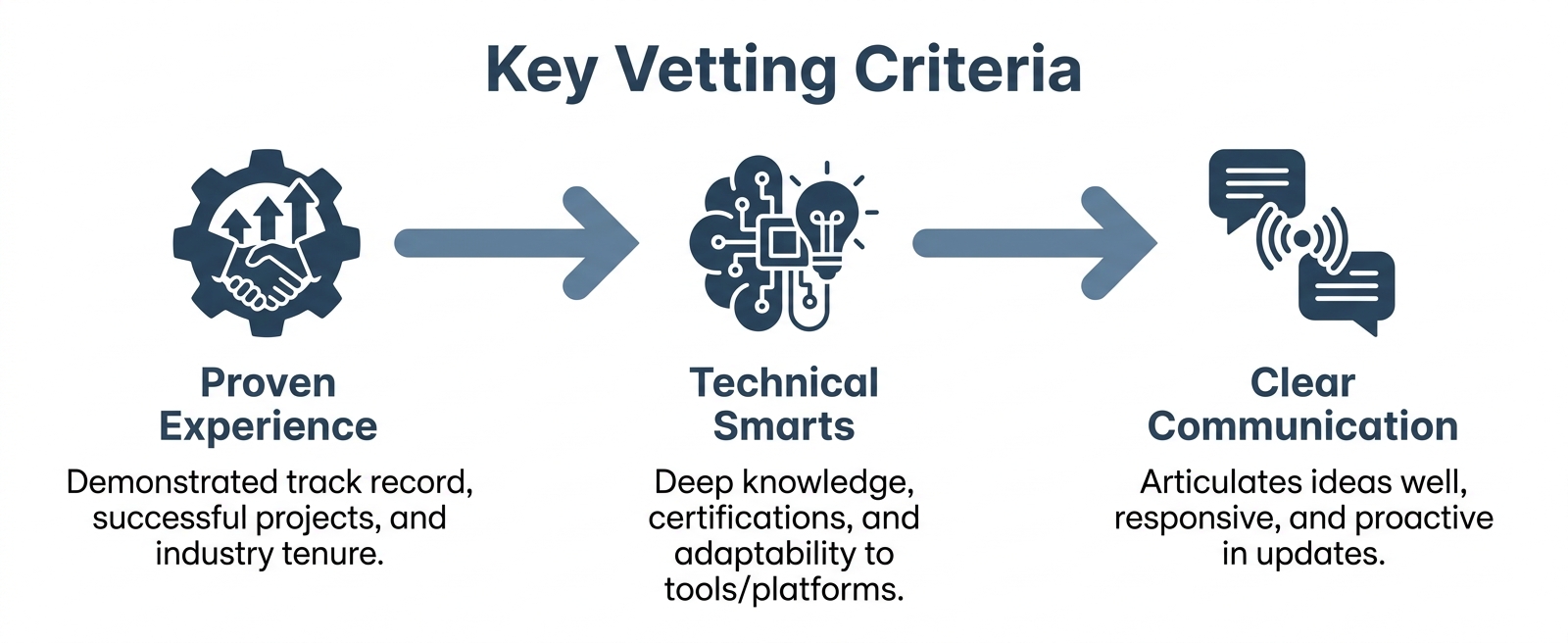
The evaluation process should test three things: can they diagnose your specific situation, have they solved similar problems before, and can they communicate clearly about what they will do and why.
Signal 1: How they diagnose your problem. The best agencies ask more questions than they answer in the first conversation. They want to understand your business model, your sales process, your current marketing performance, your competitive landscape, and your growth goals before proposing anything. Agencies that jump to tactics ("You need more content!" or "Let's run LinkedIn ads!") without understanding your situation are guessing.
Signal 2: B2B-specific experience. B2B marketing is fundamentally different from B2C: longer sales cycles, buying committees, complex products, and revenue measured in pipeline, not purchases. Ask for B2B case studies specifically. An agency with great B2C results may have no idea how to operate in a B2B environment.
Signal 3: How they talk about results. Good agencies talk about business outcomes: pipeline generated, cost-per-lead, conversion rates, revenue influenced. Mediocre agencies talk about deliverables: blog posts produced, emails sent, impressions generated. Deliverables are not results. They are activities that should lead to results.
Signal 4: Transparency about what they do not do. No agency is excellent at everything. The ones that claim to be are either lying or mediocre across the board. Look for agencies that clearly articulate their strengths and are honest about their limitations.
Ten Questions to Ask Before Signing With an Agency
These questions separate agencies that will deliver results from agencies that will deliver deliverables:
- "What B2B companies similar to ours have you worked with, and what pipeline results did you generate?" You want specific examples with specific metrics, not general claims about expertise.
- "Who will actually be working on our account?" The senior people in the pitch meeting are not always the people doing the work. Ask who your day-to-day contact will be and what their experience level is.
- "How do you measure success, and how often do you report?" The answer should reference business metrics (pipeline, revenue), not just activity metrics (posts published, ads run). Reporting should be at least monthly, ideally biweekly.
- "What does your first 90 days look like?" Good agencies have a structured onboarding process. They should be able to describe specific milestones and deliverables for the first three months.
- "What do you need from us to be successful?" Honest agencies tell you what they need: access to your CRM data, time with your sales team, regular feedback loops, approval turnaround times. Agencies that say "nothing, we handle everything" are setting up unrealistic expectations.
- "What happens if the strategy is not working after 90 days?" Listen for adaptability. Good agencies pivot based on data. Bad agencies stick to the original plan regardless of results.
- "How do you handle AI and automation in your work?" In 2026, every agency should have a clear position on how they use AI in their marketing operations. The answer reveals whether they are innovating or stuck in 2020 workflows.
- "What is your pricing model, and what is included?" Understand exactly what you are paying for: retainer scope, overage policies, and what counts as out-of-scope. Ambiguity in pricing leads to surprise invoices.
- "Can we speak with a current client and a former client?" Current clients tell you what the experience is like. Former clients tell you why they left. Both perspectives are valuable.
- "What would you NOT recommend for our situation?" This tests honesty. An agency that recommends everything is not being strategic. An agency that says "You do not need X because Y is a better use of your budget" is thinking about your business, not their revenue.
Want to see how we would answer those ten questions?
We are transparent about what we do, what we do not do, and how we measure results. Let us show you.
Agency Pricing Models: What You Should Expect to Pay
Understanding pricing models helps you compare agencies fairly and avoid overpaying for the wrong structure.
Monthly retainer. The most common B2B agency pricing model. You pay a fixed monthly fee for an agreed scope of work. Typical B2B retainers range from $5,000 to $25,000+ per month depending on scope and agency size. The advantage is predictable cost. The risk is scope creep if the agreement is not clearly defined.
Project-based. A fixed price for a defined project: website redesign ($15,000-$100,000+), brand positioning ($10,000-$50,000), market research ($5,000-$30,000). The advantage is clear deliverables and timeline. The risk is that the project ends without ongoing support.
Performance-based. The agency's compensation is tied to results: cost-per-lead, pipeline generated, or revenue share. This model aligns incentives but is rare for full-service engagements because marketing results depend on factors the agency does not control (product, sales team, market conditions). Performance components layered on top of a base retainer are more common and more practical.
Hourly. You pay for time spent. Typical agency rates range from $150-$350/hour depending on seniority and specialization. The advantage is flexibility. The risk is unpredictable costs and incentive misalignment (the agency earns more by working slower).
Red Flags That Predict Agency Failure
These warning signs during the evaluation and early engagement phases predict poor outcomes:
- Guaranteed results. No agency can guarantee specific revenue or ranking outcomes because results depend on too many variables they do not control. Agencies that guarantee results are either lying or defining "results" in meaningless ways.
- No discovery process. Agencies that propose a strategy before understanding your business are guessing. A thorough discovery phase (2-4 weeks) is a sign of a serious agency.
- Vague reporting. If the agency cannot clearly explain how they will measure and report results, they are likely to deliver impressive-looking but meaningless reports.
- Long-term contracts with no exit clause. Annual contracts with no performance-based exit clause trap you with an underperforming agency. Look for monthly or quarterly contracts, or annual contracts with 30-60 day termination provisions.
- Pitch team is not the work team. If the senior people who pitched the engagement disappear after the contract is signed and you are handed off to junior staff, the quality of work will not match the quality of the pitch.
- They do not ask about your sales process. Marketing that is not connected to sales produces leads that go nowhere. An agency that does not ask how your sales team works is building marketing in a vacuum.
- No POV on AI. In 2026, an agency without a clear position on how they use AI in marketing is behind. They should be able to explain how AI fits into their workflow.
Agency vs. In-House: When Each Makes Sense
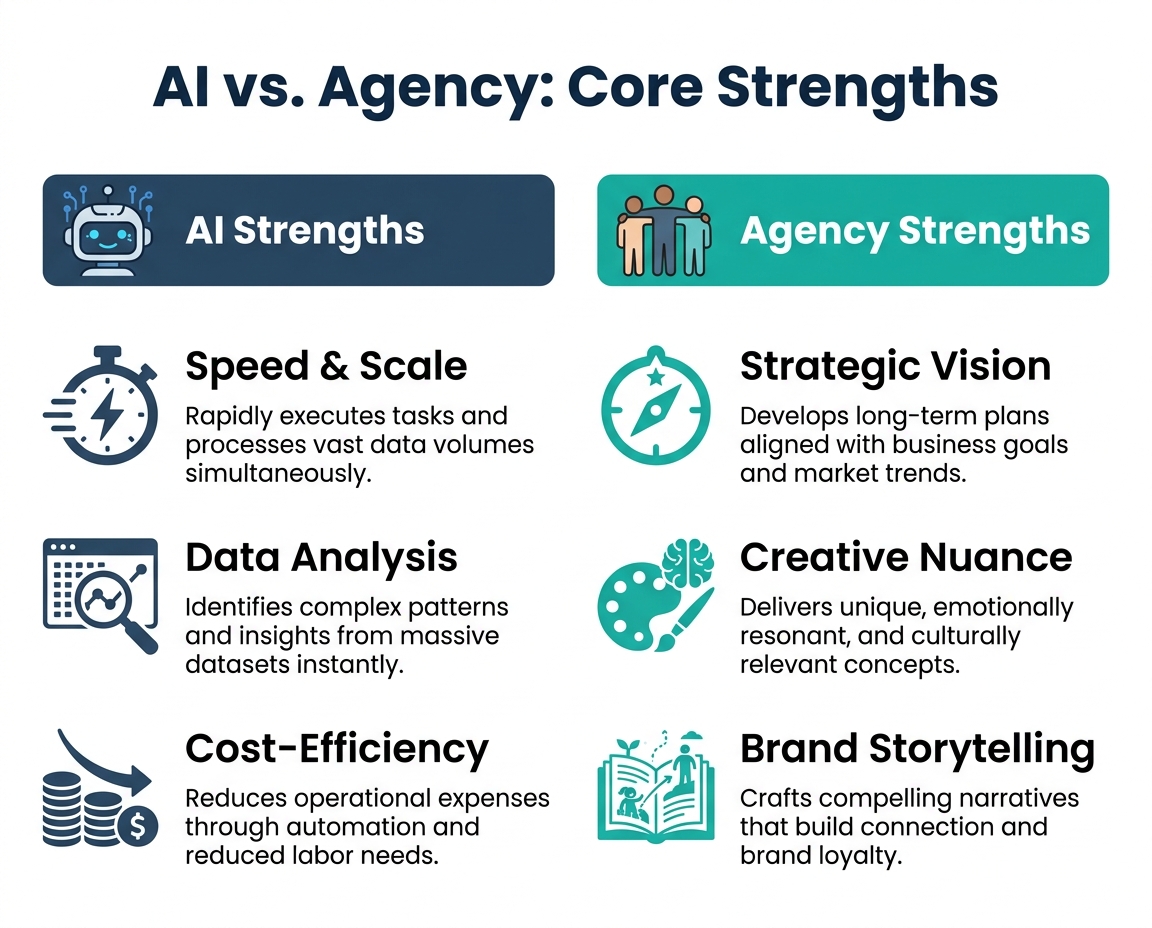
This is not a binary choice. Most successful B2B marketing operations combine both: in-house for strategic leadership and brand ownership, agency for execution and specialized expertise.
Agency advantages: Access to a team of specialists without hiring each role. Speed to start (weeks vs. months). Cross-client pattern recognition. Easier to scale up or down. No management overhead for the team.
In-house advantages: Deeper product and market knowledge. Faster internal communication. Full control over priorities and quality. Lower long-term cost for high-volume ongoing work. Institutional knowledge stays in the company.
The hybrid model (most common in B2B): An in-house marketing leader (VP Marketing or fractional CMO) owns strategy, brand, and measurement. An agency handles execution: content production, paid media management, SEO, and design. The in-house leader directs the agency, and the agency provides the bandwidth and expertise to execute at scale.
How to Onboard an Agency for Success
The first 90 days of an agency engagement determine whether it succeeds or fails. A structured onboarding process sets the foundation.
Week 1-2: Discovery. Share access: CRM data, analytics, ad accounts, content assets, brand guidelines. Schedule stakeholder interviews. Provide competitive context. Define success metrics: what does a successful 6-month engagement look like in numbers?
Week 3-4: Strategy and planning. Agency presents strategic assessment and proposed plan. Align on priorities, timelines, resource allocation. Agree on reporting format, frequency, and specific metrics. Establish communication cadence.
Month 2-3: Execution and feedback loops. Agency executes the first phase. Weekly check-ins. First monthly performance report with data-driven adjustments. At 90 days: formal performance review. Decide whether to continue, adjust, or exit.
How Modern Agencies Use AI
In 2026, AI adoption is a meaningful differentiator between agencies. How an agency uses AI reveals their operational sophistication and directly affects the value you get for your investment.
What AI-forward agencies look like:
- Content production. AI-assisted content creation with human editorial oversight. More output at the same quality level.
- Data analysis. AI-powered analytics that identify patterns, anomalies, and opportunities across channels.
- Ad optimization. AI-managed paid media campaigns with human strategic oversight.
- SEO and GEO. AI-automated technical SEO auditing, keyword research, and content optimization.
What AI-forward agencies do NOT look like: Publishing AI content without human review. Replacing strategic thinking with AI outputs. Using AI purely as cost-cutting. Claiming AI makes them 10x better without explaining specific workflows.
Managing the Agency Relationship
Agency relationships fail more often from poor management than from poor agency performance. The client-side behaviors that predict success:
- Designate a single point of contact. One person who can make decisions, provide feedback, and approve work.
- Provide feedback quickly. Set and enforce 48-hour feedback turnaround times.
- Share business context. Treat them as an extension of your team, not a vendor.
- Hold them accountable to metrics, not hours. Measure outcomes, not activity.
- Give the strategy time to work. Most B2B marketing strategies take 3-6 months to show pipeline impact.
When to Fire Your Agency
Not every agency relationship works out. These are the signals that it is time to move on:
- 90+ days with no measurable progress toward agreed metrics.
- Consistently missed deadlines without proactive communication.
- Reports that do not connect to business outcomes.
- Team turnover without disclosure.
- They stopped challenging you. A good agency pushes back on bad ideas. An order-taking agency just says yes to everything.
What Makes a Great Agency Partnership
The best agency relationships share common characteristics:
- Shared definition of success. Both sides agree on what metrics matter, what timeline is realistic, and what "good" looks like.
- Proactive communication. The agency shares results, flags problems, and proposes adjustments before you have to request them.
- Data-driven decision making. Both sides use data to evaluate what is working and what is not.
- Mutual respect for expertise. You respect their marketing expertise. They respect your business and industry expertise.
- Willingness to be wrong. The best agencies say "that did not work, here is what we learned, and here is what we will try next."
Agency Evaluation Checklist
- Do they have specific B2B case studies with pipeline metrics?
- Did they ask deep questions about your business before proposing?
- Is their reporting focused on business outcomes, not just deliverables?
- Can you speak with both a current and a former client?
- Do they have a clear position on how they use AI?
- Is the team working on your account the same team that pitched?
- Are contract terms reasonable (no long lock-in without exit provisions)?