AI marketing is not "using ChatGPT for marketing." It is the complete redesign of your marketing operation around AI capabilities, with human experts focused on strategy and quality control. The global AI marketing market is projected to grow from $36 billion in 2024 to over $107 billion by 2028. Companies running AI-native marketing systems today are seeing 5X pipeline output at 70% lower cost, deploying full campaigns across 6+ channels in days instead of months. The companies that win are the ones that pair AI execution with experienced human strategy, not the ones trying to remove humans from the loop entirely.
What Is AI Marketing?
AI marketing is the practice of building marketing operations around artificial intelligence capabilities from the ground up. Instead of bolting AI tools onto traditional workflows, AI marketing redesigns the entire system so that AI handles research, content creation, distribution, personalization, and optimization, while human strategists focus on brand direction, quality control, and creative judgment.
This is not the same thing as "using AI tools for marketing." That distinction matters. Using ChatGPT to write a blog post is like using a calculator to balance your books. Helpful, sure. But AI marketing is the whole accounting system: integrated, automated, and running at a speed and scale that manual processes simply cannot match.
Think of AI as a core operating layer, not an add-on. AI (artificial intelligence) is the main concept. Machine Learning (ML) is one branch of it where systems learn from data. Deep Learning is an even more advanced type that finds complex patterns, similar to how a human brain works. Together, they power the modern marketing tools that are reshaping the industry.
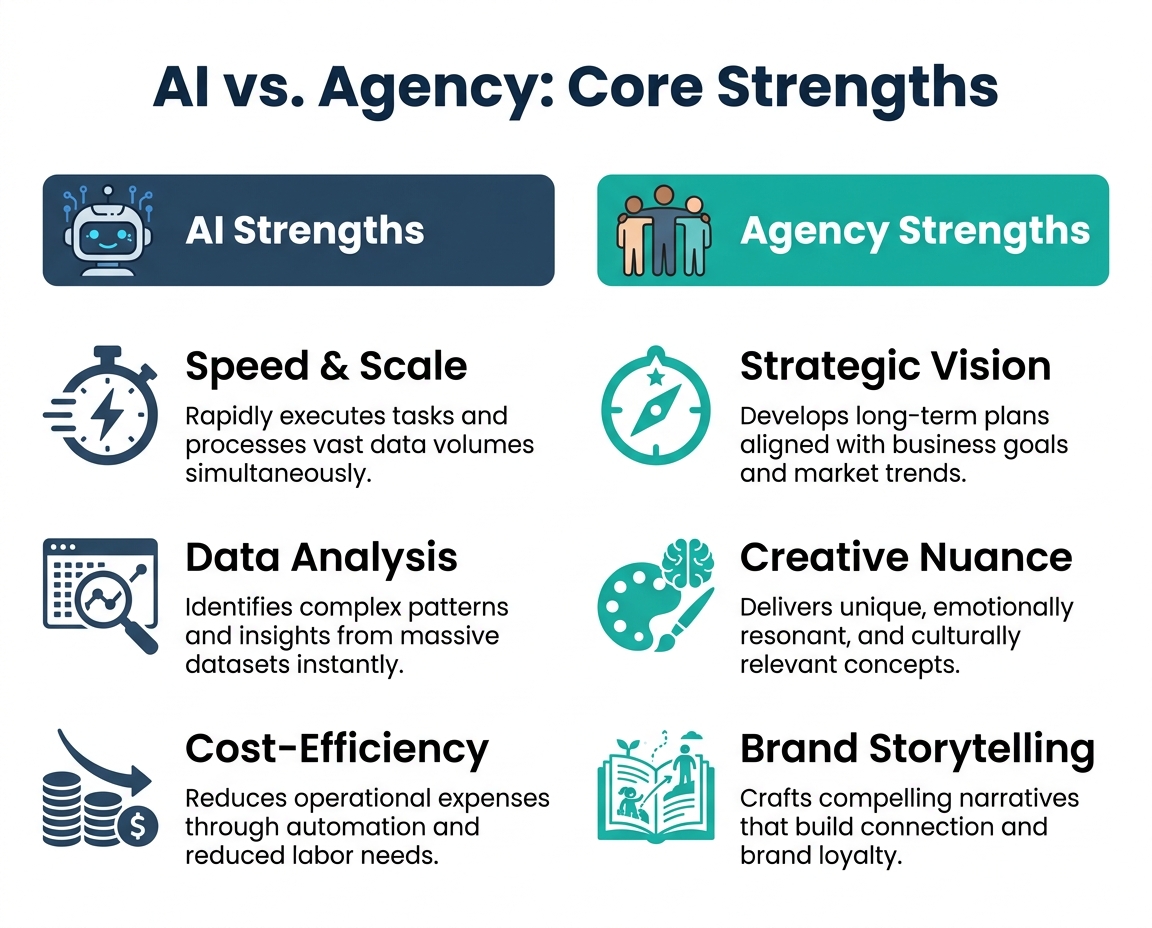
The companies pulling ahead right now are not the ones with the best prompts. They are the ones who rebuilt their marketing operations around what AI does well (volume, speed, data processing, personalization at scale) and kept humans focused on what AI does poorly (strategic thinking, brand taste, relationship building, knowing when something sounds like AI slop).
The AI Marketing Landscape: $107 Billion and Growing
The numbers tell the story. The global AI marketing market is expanding at roughly 47% compound annual growth rate. Research compiled by Influencer Marketing Hub projects growth from $36 billion in 2024 to over $107 billion by 2028. The broader AI software market is on pace to reach nearly $467 billion by 2030, according to Grand View Research.
This is not speculative technology anymore. It is the operational backbone of forward-thinking marketing departments worldwide. And the adoption curve is steep:
- 78% of marketers believe AI will intelligently automate over 25% of their work within three years (State of Marketing AI Report, 2024)
- 36% of marketing workflows are projected to be AI-handled by 2028 (Gartner)
- 74.2% of newly detected web pages already contain some form of AI-generated content (Ahrefs, April 2025)
- 30% of outbound marketing messages from large organizations are expected to be AI-generated (industry analysis)
AI Marketing Market Growth (Billions USD)
The question is no longer whether to adopt AI marketing. It is whether you can afford to wait while your competitors are already running it. The gap between companies using AI-native marketing and those still on traditional models is widening every quarter, and it is not a gap that closes with effort alone. It closes with a fundamentally different operating model.
AI-Powered Content and SEO That Dominates Search
One of the most immediate and measurable applications of AI marketing is content creation and search engine optimization. AI tools can study what people are searching for, analyze competitor content to find weak spots, and identify opportunities to rank higher. It is about working smarter, not just harder.
Instead of guessing which topics might perform well, AI provides actual data. It examines the top-ranking pages for your target keywords, identifies content gaps, and helps you create articles that perfectly match user intent from the start. One B2B marketing firm documented a 3,000% increase in organic traffic after using AI to guide content creation and build topical authority, as analyzed by AIMultiple.
But traditional SEO is only part of the equation. Smart AI marketing now optimizes for three types of search simultaneously:
- SEO (Search Engine Optimization): Traditional Google rankings. Still critical. Still the foundation of organic traffic.
- GEO (Generative Engine Optimization): Optimizing content to appear in AI-powered search engines like ChatGPT, Perplexity, and Gemini. This is the new battleground that most companies are ignoring entirely.
- AEO (Answer Engine Optimization): Structuring content so AI systems can extract and cite your expertise in their answers. This means clear definitions, structured data (JSON-LD), FAQ sections, and content that directly answers specific queries.
AI content tools can also tailor your website for each visitor in real time. They analyze user behavior as it happens and can show personalized headlines, product suggestions, or calls to action. This creates a unique and more engaging experience for everyone who visits your site. The result: better visibility in search, more website traffic, and stronger connections with the people who actually matter to your business.
STACK Media: 80% Organic Traffic Growth in 4 Months
STACK Media, a fitness and sports content publisher, implemented AI-driven keyword analysis tools to overhaul their SEO strategy. Instead of manual keyword research that took weeks, AI identified high-volume fitness terms their competitors were underserving.
- 61% increase in total website visits within 4 months
- 80% growth in organic search traffic
- AI redesigned landing pages around high-volume fitness terms automatically
- Reduced the manual SEO workload that would have required a full agency team
Hyper-Personalization: Marketing That Feels Like a Conversation
Generic marketing is dead. AI marketing makes it possible to create unique experiences for each customer at scale. This is hyper-personalization, and the data behind it is compelling.
When emails are personalized using AI, they perform significantly better than generic campaigns. Analysis from Stripo shows that personalized email campaigns see a 60% increase in conversion rates. AI email systems can test different subject lines automatically, determine the optimal send time for each recipient, and dynamically adjust content blocks based on the recipient's behavior and interests.
The best real-world example of AI-powered personalization at scale is Netflix. Their recommendation engine analyzes viewing history, personal ratings, time of day, and device preferences to suggest content. It even personalizes the thumbnail artwork shown for each title to different users based on what is most likely to grab their attention. The result: over 75-80% of content watched on Netflix is discovered through AI recommendations, directly translating to higher retention and lifetime value.
For B2B marketing specifically, hyper-personalization means moving beyond broad segments (like "enterprise" or "mid-market") to account-level targeting. Instead of sending the same case study to 5,000 contacts, an AI marketing system can send each contact a version tailored to their industry, role, company size, and stage in the buying journey. That specificity is what separates campaigns that generate pipeline from campaigns that generate unsubscribes.
60%
Higher conversion from AI-personalized emails
75-80%
Netflix viewing from AI recommendations
40%
More revenue from personalization leaders
Want to see what AI marketing looks like for your company?
Talk to our team about building an AI marketing system tailored to your market. Get a custom channel plan in your first call.
Predictive Analytics and Intelligent Lead Scoring
AI marketing does not just look backward at what happened. It looks forward at what is about to happen. Predictive analytics uses past customer data to make informed forecasts about future behavior, and the practical applications for marketing teams are enormous.
Churn prediction: AI identifies patterns suggesting a customer may stop using your service. Maybe they are logging in less frequently, or their support ticket volume has dropped. The marketing team can then automatically trigger a retention campaign, a special offer, or a personal check-in before the customer decides to leave.
Lead scoring: Instead of manually rating leads based on arbitrary criteria, AI automatically scores prospects on their likelihood to buy. It considers dozens of signals: website behavior, email engagement, company firmographics, content consumption patterns. According to analysis from Directive Consulting, this kind of AI-driven focus has delivered a 10% lift in revenue simply by prioritizing outreach to the highest-probability leads first.
Customer lifetime value forecasting: AI predicts the total revenue you will earn from each customer over time. This helps you identify your most valuable segments and invest disproportionately in keeping them. It also tells you which acquisition channels are bringing in high-value customers versus low-value ones, so you can reallocate budget accordingly.
The shift from reactive to predictive marketing changes everything about how you allocate resources. Instead of spending the same amount on every lead and hoping for the best, you invest your budget where the data says it will actually produce pipeline.
How an AI Marketing System Actually Works
An AI marketing system is not a single tool. It is an integrated operation where AI handles execution across every channel while experienced marketers handle strategy, quality assurance, and the creative decisions that actually move the needle. Here is what that looks like side by side:
| Capability | Traditional Marketing | AI Marketing System |
|---|---|---|
| Campaign deployment | 4-6 weeks | 3-5 days |
| Channels managed simultaneously | 2-3 channels | 6-8 channels |
| Content output (monthly) | 8-12 pieces | 50-100+ pieces |
| Personalization depth | Segment-level (3-5 segments) | Account-level (unlimited) |
| Optimization cycle | Monthly or quarterly reviews | Continuous, AI-driven |
| Lead scoring | Manual, rule-based | Predictive, multi-signal |
| Monthly cost (fully loaded) | $40K-$80K | $15K-$50K |
The key channels in a modern AI marketing system include:
- Email Suite: Cold outreach, warm nurture sequences, and newsletters, all personalized at the account level with dynamic content blocks. AI determines optimal send times, subject lines, and content variations for each recipient.
- SEO, GEO, and AEO: Traditional search rankings plus optimization for AI-powered search engines. Content is structured for both Google and generative AI platforms like ChatGPT and Perplexity.
- Paid Advertising: LinkedIn, Meta, and Google Ads with AI-generated creative variants and continuous A/B testing. AI-powered ad targeting can match the full meaning of user intent, not just keywords or demographics.
- Content Platform: Technical blogs, lead magnets, whitepapers, and case studies. AI-drafted, then reviewed and refined by senior marketers for quality and brand voice.
- PPC Campaigns: Intent-focused Google AdWords with AI-driven optimization based on actual pipeline data, not vanity metrics like impressions and clicks.
- Organic Social: Consistent publishing across 7+ platforms with engagement-driven scheduling and intelligent response management.
Each channel runs simultaneously. That is the part most people miss. Traditional marketing forces you to choose between channels because you do not have enough people to run them all well. AI marketing systems remove that constraint entirely.
The AI Slop Problem (And Why Your Approach Matters)
Here is the uncomfortable truth about AI marketing: most of it is terrible. The internet is flooding with what the industry now calls "AI slop", low-quality, unoriginal content produced by generative AI tools with little or no human review. It is published in bulk, wastes the reader's time, and adds no real value.
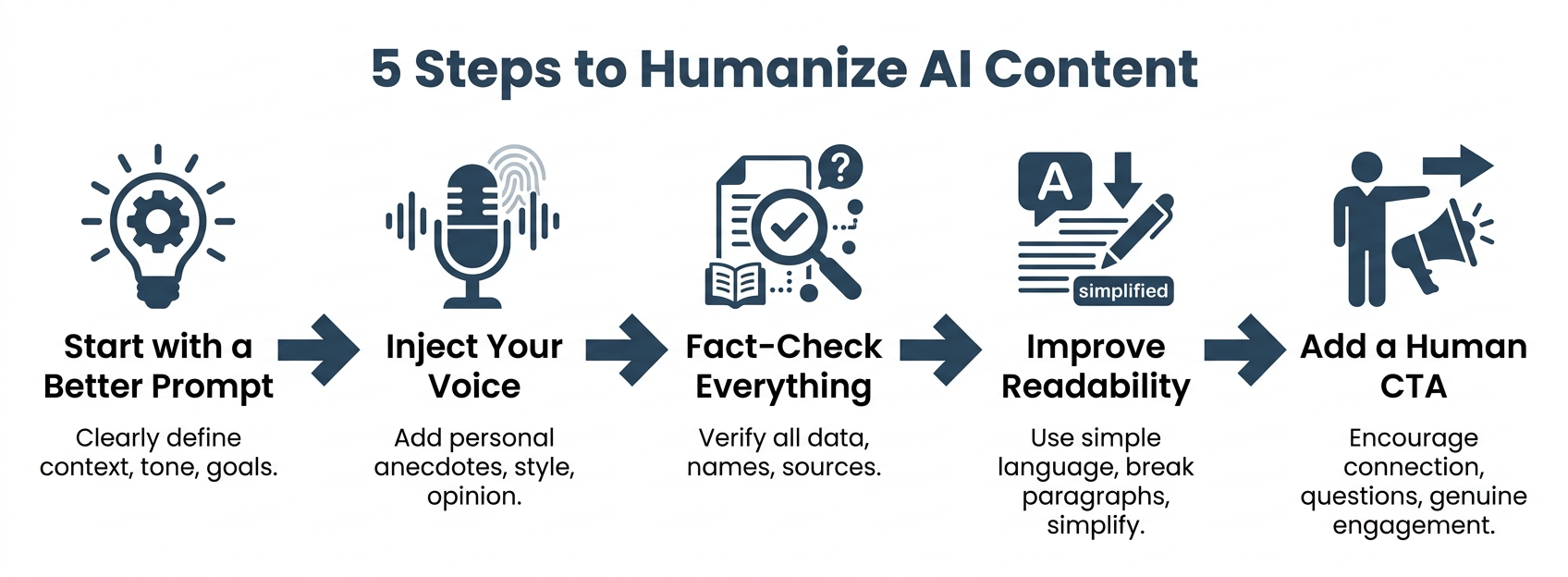
AI slop is not about the tool. It is about the output and the intent behind it. Useful AI-assisted content is guided by human expertise. A writer uses AI to draft ideas, then edits, fact-checks, and shapes the work with real knowledge. AI slop is the opposite: it skips all of that and gets published anyway.
Google is cracking down hard. The March 2024 core update introduced tighter rules around "scaled content abuse," which means generating large numbers of pages designed primarily to manipulate rankings rather than help users. Critically, the policy applies regardless of whether content was written by a human, an AI, or a mix of both. Volume alone can now trigger a penalty.
This is why the human-in-the-loop model is not just an ethical nice-to-have. It is a business requirement. Google's algorithm is getting better at spotting content that exists to rank rather than to inform. The companies that will dominate AI marketing are the ones that use AI for speed and scale while keeping experienced humans in charge of strategy, quality, and brand voice.
The telltale signs of AI slop are easy to spot once you know what to look for: opening lines like "In today's fast-paced world," repetitive sentence structures, confident statements that are factually wrong, and text that is grammatically perfect but says absolutely nothing. If you finish reading something and cannot identify a single new insight, you probably just read slop.
At The Zulu Method, we are unapologetically anti-AI slop. Every piece of content that leaves our system goes through senior-level human review. AI drafts. Humans with 20+ years of experience perfect and approve. That distinction is the difference between content that ranks and content that gets penalized.
Tired of AI slop from your current agency?
See what AI marketing looks like when experienced humans actually run the strategy. Get a free audit of your current marketing operation.
Building Your AI Marketing Team
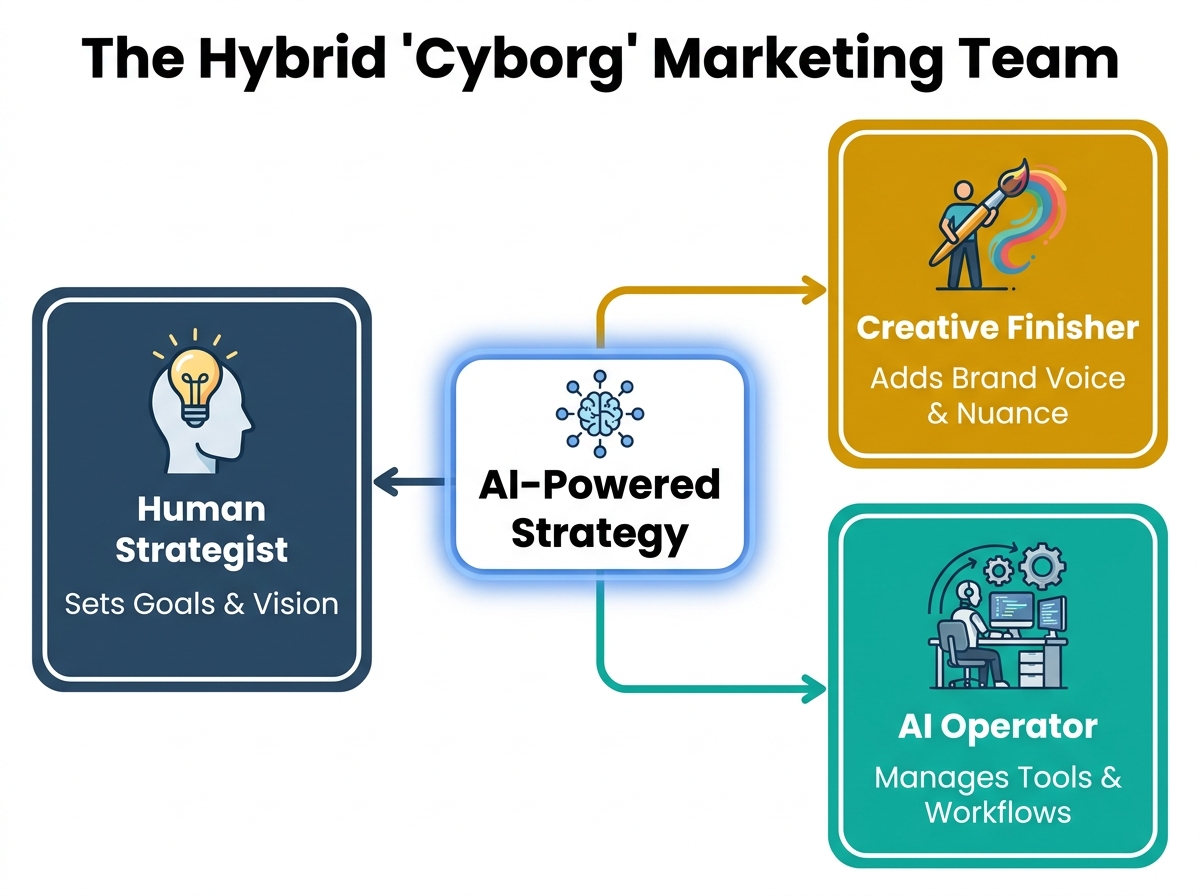
Traditional marketing teams were organized by channels: an email person, a social person, an SEO person. That structure is becoming obsolete. Modern AI marketing teams organize around four core pillars, with AI handling execution and humans handling strategy:
| Pillar | Key Roles | What They Do |
|---|---|---|
| Strategy & Leadership | AI Marketing Strategist | Aligns AI initiatives with business goals and revenue targets |
| Technology & Implementation | Prompt Engineer, AI Tools Specialist | Manages the AI stack, crafts prompts, integrates systems |
| Analytics & Insights | AI Analyst, Data Scientist | Turns raw data into actionable insights and predictive models |
| Creativity & Content | Content Creator, Campaign Manager | Uses AI to enhance and scale creative work with human quality control |
The AI Marketing Strategist is arguably the most critical new role. This person bridges AI capabilities with business objectives, ensuring technology is applied to drive meaningful growth rather than being used as a novelty. Without strong strategy leadership, even the best AI tools underperform.
On the technical side, Prompt Engineers are emerging as high-value specialists. These are the people who know how to communicate with AI models effectively. General prompt engineering roles already command $85,000 to over $150,000 annually, according to career data from Jobright. That salary range signals how important these skills have become to the market.
Three organizational models have emerged for structuring these teams:
- Centralized Center of Excellence (CoE): A single team of AI experts supporting the entire organization. Strong governance, deep expertise, but can become a bottleneck.
- Decentralized Embedded Specialists: AI experts placed directly inside each marketing team. Fast and flexible, but risks inconsistent standards.
- Hybrid Hub-and-Spoke: A small central team provides strategy and governance while embedded specialists handle day-to-day execution. The best of both worlds for most organizations.
You do not necessarily need to hire entirely new people. Many of these roles can be filled by training your existing staff. A channel manager can become a strategist. A tech-savvy marketer can learn prompt engineering. The key is investing in the right skills development.
The ROI of AI Marketing: Real Numbers, Not Hype
Let's talk specifics. Here is what the numbers look like when you move from traditional marketing to an AI-native operation.
A typical mid-market company (50-500 employees) spending $300K per year on marketing usually has:
- 2 marketing FTEs ($180K total compensation)
- 1 agency retainer ($8K-$15K per month)
- 5-8 SaaS tools ($2K-$5K per month)
- Ad spend ($3K-$10K per month)
That $300K buys you 2-3 channels, moderate content volume, and maybe 50-100 MQLs per month. Under an AI marketing model, the same budget delivers 6+ active channels, 5-10X the content volume, account-level personalization, and typically 3-5X the pipeline output.
Traditional vs. AI Marketing: What $300K/Year Delivers
The cost savings alone (usually 40-70% compared to the traditional model) can be reinvested into ad spend, events, or additional campaigns. Most companies running AI marketing systems see meaningful pipeline impact within 60-90 days. SEO and content channels take 3-6 months for full compound returns, but paid, email, and social channels generate leads from day one.
When measuring ROI on your AI marketing investment, track three categories:
- Efficiency gains: Time saved, cost reduction, increased output volume. AI tools have been documented to save marketing users 3.5 hours per day on routine tasks.
- Performance uplift: Higher engagement rates, better conversion, improved content quality scores. Track brand consistency and how often your content appears in AI-generated search answers.
- Strategic impact: Revenue growth, market share gains, customer lifetime value improvements. This is the language CFOs and boards understand, and it is what separates AI marketing from a science experiment.
For a detailed breakdown of what this looks like for your specific situation, our free marketing audit maps your current spend against what an AI-native model would deliver. For specifics on investment levels, view our pricing plans.
How to Build an AI Marketing Strategy That Delivers
You do not need to fire your team or cancel every vendor contract tomorrow. Trying to change everything at once is risky and can alienate your team. A phased approach reduces risk and builds buy-in. Companies using focused pilot projects see a return on investment 3 to 5 times faster than those attempting company-wide transformation, according to The AI Consulting Network.
Phase 1: Audit and Strategy (Days 1-5). Map your current channels, identify gaps, and build a prioritized deployment plan based on your ICP and competitive landscape. This is where you figure out which channels will move the needle fastest. Critically, start with a data quality check. AI learns from data. If your CRM is messy, your AI outputs will be too.
Phase 2: Build and Test (Days 5-20). Configure AI systems, build campaign templates, generate initial content batches, and run internal quality reviews. Nothing goes live without human approval. Pick one or two high-impact, low-risk pilot projects. Maybe AI-assisted email copy or AI-guided blog topic research. Track time saved and quality improvements rigorously. These small wins are powerful proof of concept for leadership.
Phase 3: Launch and Optimize (Days 20-30). Deploy campaigns across channels, establish reporting baselines, and begin the continuous optimization cycle. Weekly reviews with a dedicated marketing manager ensure everything stays aligned with pipeline goals. Then scale what works.
This is not a 6-month digital transformation project. It is a 30-day deployment with immediate results because the AI system handles the heavy lifting that would normally take a team months to execute.
Evaluating AI Marketing for Your Business
- Which of your current marketing tasks are the most repetitive and data-intensive?
- What unique creative or strategic value does your agency provide that AI genuinely cannot replicate?
- Do you have team members with the curiosity and adaptability to manage AI tools effectively?
- How will you measure the ROI of AI tools compared to your current marketing spend?
- What governance systems will you need to maintain brand consistency across AI-generated content?
- Do you have the data infrastructure necessary to feed AI systems effectively, or is your CRM a mess?
- What is your contingency plan if an AI tool fails to deliver expected results?
- Are you optimizing for traditional search only, or also for AI-powered search engines like ChatGPT and Perplexity?
The Future of AI Marketing: What Is Next
AI marketing is evolving fast, and the companies paying attention now will have a significant advantage as new channels open up.
Conversational AI advertising is on the horizon. OpenAI has explored ad-supported models for ChatGPT, and patent filings hint at contextual ad formats tied to conversation topics. When a user asks ChatGPT where to buy running shoes, a sponsored recommendation could appear alongside the organic answer. That is targeting based on what a person is actively thinking about right now, not a cookie from three weeks ago.
AI search is replacing traditional search behavior. More users are going directly to ChatGPT, Perplexity, and Gemini instead of Google for research queries. Companies that optimize for these platforms now (through GEO and AEO strategies) will capture traffic that competitors do not even know exists yet.
The measurement landscape is shifting. Privacy regulations are pushing the industry toward less invasive tracking. First-party data, UTM parameters, incrementality testing, and aggregated event measurement are replacing third-party cookies and page-level pixels. The AI marketing teams that build privacy-safe measurement stacks now will not need to rebuild when the next regulation drops.
Team structures are being rewritten. As Fortune highlights, AI is already changing corporate org charts across industries. Marketing departments are reorganizing around outcomes (customer acquisition, retention, expansion) rather than channels (email, social, SEO). The hybrid hub-and-spoke model, with a small central AI strategy team supporting embedded specialists across the organization, is emerging as the standard for companies serious about scaling.
The brands that win in new channels are always the ones who show up prepared. Lower cost per click and higher share of voice tend to go to whoever arrives first. That pattern repeated with Facebook Ads, TikTok Ads, Pinterest, and every other new digital channel. AI marketing is next.