Content marketing works when every piece serves a purpose in the buyer journey. The companies that generate pipeline from content do three things differently: they map content to specific buyer questions at each stage, they distribute aggressively instead of publishing and hoping, and they measure content-influenced pipeline rather than vanity metrics. AI has transformed content production speed, but the strategy behind what to produce and why has not changed. This guide covers the strategic framework, content formats, distribution playbook, and measurement model that turn content into a revenue channel.
What Content Marketing Actually Means in B2B
Content marketing is the practice of creating and distributing valuable content to attract, educate, and convert a specific audience. In B2B, that audience is a buying committee (not an individual consumer), the sales cycle is measured in months (not minutes), and the content needs to do real educational work (not just entertain).
The distinction matters because most content marketing advice comes from the B2C and creator economy world, where the goal is attention. In B2B, attention without education is worthless. A blog post that gets 10,000 pageviews but does not help a single reader understand their problem better has failed, no matter what the analytics dashboard says.
Content marketing in B2B serves four specific functions:
- Demand creation. Educational content that helps potential buyers recognize they have a problem worth solving. This is top-of-funnel content that builds awareness of the category and the pain points your product or service addresses.
- Demand capture. Content that helps buyers who already know they have a problem evaluate solutions. Comparison pages, case studies, technical documentation, and product-focused content live here.
- Sales enablement. Content that arms your sales team with the materials they need to advance deals: battle cards, ROI calculators, industry-specific case studies, and objection-handling documents.
- Customer retention and expansion. Post-sale content that helps existing customers succeed and discover additional use cases: onboarding guides, best practice documentation, and success stories.
A complete content marketing strategy covers all four. Most teams over-invest in demand creation (blog posts and social content) and under-invest in demand capture and sales enablement, which are the formats closest to revenue.
Building a Content Strategy That Starts With Revenue
The most common content strategy mistake: starting with topics instead of outcomes. Teams brainstorm blog post ideas, build an editorial calendar, and start producing. Three months later, they have 20 blog posts and no measurable pipeline impact because the content was not connected to how buyers move through their decision process.
The revenue-first content strategy framework:
Step 1: Map the buyer journey. Interview your sales team and recent customers. Identify the specific questions buyers ask at each stage of their journey: awareness ("Do I have this problem?"), consideration ("What are my options?"), and decision ("Why should I choose this provider?"). These questions become your content topics.
Step 2: Audit existing content against the journey. Map every piece of content you have to a buyer stage and question. Identify gaps: stages with no content, questions with no answers, and formats that are missing. Most B2B companies discover they have plenty of awareness-stage blog posts and almost nothing for the consideration and decision stages.
Step 3: Prioritize by proximity to revenue. Build content for the decision stage first (case studies, comparison pages, ROI documentation), then consideration (solution guides, evaluation frameworks), then awareness (educational blog content). This is counterintuitive because most teams start with awareness content, but decision-stage content converts existing demand immediately while awareness content takes months to build traffic.
Step 4: Plan distribution before production. Every piece of content should have a distribution plan before it is written. Where will it be published? How will it be promoted? Which channels will amplify it? Content without distribution is a tree falling in an empty forest.
The Six Content Formats That Drive B2B Pipeline
Not all content formats contribute equally to pipeline. These six formats have the strongest correlation with B2B revenue generation:
1. Long-form educational guides (2,000-5,000 words). Comprehensive guides that thoroughly cover a topic build SEO authority, demonstrate expertise, and serve as evergreen traffic drivers. They work best for awareness and early consideration stages. The key is depth: a guide that covers a topic more thoroughly than any competitor becomes the reference resource for that topic.
2. Case studies with specific metrics. Case studies are the single most influential content format for B2B buyers in the decision stage. The difference between an effective case study and a forgettable one is specificity. "We helped Company X increase revenue" is forgettable. "We helped Company X increase qualified pipeline by 340% in 6 months while reducing cost-per-lead from $180 to $62" is compelling because it is specific and verifiable.
3. Comparison and alternative pages. Buyers actively searching for "[Your Category] comparison" or "[Competitor] alternative" have high purchase intent. These pages capture demand from buyers who are already evaluating solutions. They are bottom-of-funnel content that converts at significantly higher rates than educational blog posts.
4. Original research and data. Content that contains data or analysis unavailable anywhere else is the hardest to produce and the most valuable. Original research earns backlinks (other sites cite your data), builds authority (you become the source of record), and performs well in both traditional SEO and GEO because AI systems must cite unique data.
5. Email nurture sequences. Email is the most direct content distribution channel for B2B because you own the relationship. Well-structured nurture sequences deliver the right content at the right time based on buyer behavior and stage, moving prospects through the journey without requiring them to find content on their own.
6. Video content (webinars, explainers, testimonials). Video builds trust faster than text because buyers see real people explaining real concepts. Customer testimonial videos, product walkthroughs, and expert webinars are particularly effective for the consideration and decision stages where buyers are evaluating credibility.
| Content Format | Best Buyer Stage | Primary Goal | Pipeline Impact |
|---|---|---|---|
| Educational guides | Awareness, early consideration | SEO traffic, thought leadership, email capture | Indirect. Builds audience and trust over time. |
| Case studies | Decision | Prove results, reduce buyer risk | Direct. Most influential format for closing. |
| Comparison pages | Late consideration, decision | Capture high-intent search traffic | Direct. High conversion rates from search. |
| Original research | All stages | Backlinks, authority, unique citations | Indirect but compounding. Builds domain authority. |
| Email sequences | Consideration, decision | Nurture known contacts toward conversion | Direct. Moves known leads through funnel. |
| Video | Consideration, decision | Build trust, demonstrate expertise | Direct for testimonials. Indirect for educational. |
Want content that generates pipeline, not just pageviews?
We build content engines mapped to your buyer journey with AI-powered production and human editorial oversight.
Content Distribution: Where Most B2B Teams Fail
The standard B2B content distribution plan is: publish on the blog, share once on LinkedIn, send to the email list, done. This captures maybe 10-15% of the potential audience for any given piece of content. Distribution should get at least as much attention as production.
The four distribution channels for B2B content:
Organic search (SEO). The long-term traffic engine. Content optimized for search continues generating traffic for months or years after publication. This is the channel where AI SEO and GEO optimization matters most. The investment is upfront (keyword research, content creation, technical optimization), and the payoff compounds over time.
Email. The most controllable distribution channel. You own the list, you control the timing, and you can segment by buyer stage, industry, and engagement level. Every piece of content should have an email distribution plan: newsletter feature, dedicated send, or inclusion in a nurture sequence.
Social media. The amplification channel. AI social media tools make it possible to repurpose each content piece into 10-15 social posts across platforms. Social distribution builds awareness and drives referral traffic, but it rarely converts directly. Its value is at the top of the funnel.
Paid promotion. The acceleration channel. Paid ads put your best content in front of your target audience immediately, without waiting for organic traffic to build. Promote your highest-converting content (case studies, comparison pages, gated guides) to targeted audiences on LinkedIn and Meta. Paid content promotion typically delivers a lower cost-per-lead than direct response ads because the content provides value before asking for anything.
Content Marketing and AI: What Changes and What Stays the Same
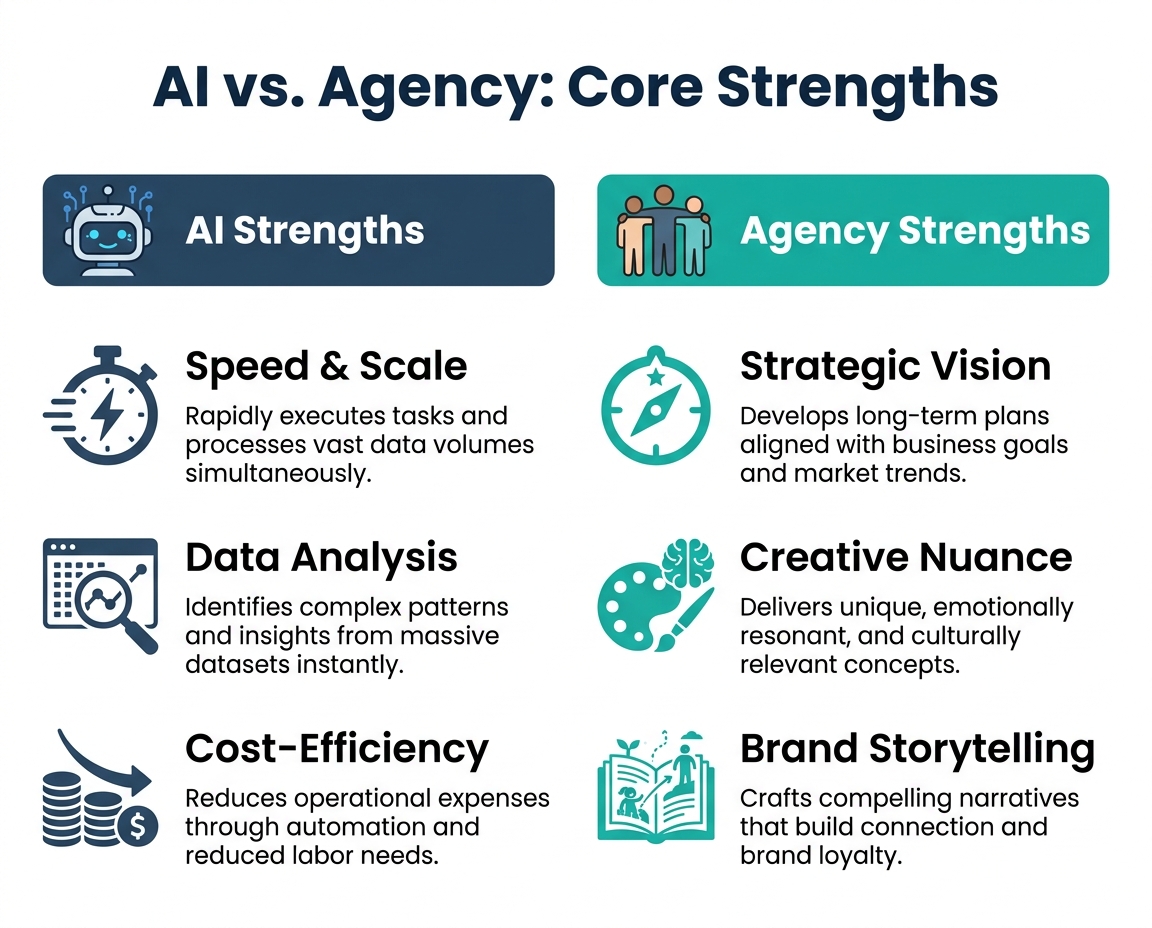
AI has transformed content production. It has not transformed content strategy. The distinction is important because teams that adopt AI for the wrong reasons (producing more content faster) without fixing their strategy end up with more mediocre content, faster.
What AI changes about content marketing:
- Production speed. AI content creation reduces blog production time by 60-70%. A team producing 4-6 posts per month can produce 10-14 with the same headcount.
- Content repurposing. AI transforms one source piece into 15-20 derivative pieces across formats (social, email, video scripts, graphics) in hours instead of days.
- Personalization at scale. AI adapts content for different industries, personas, and buyer stages, creating personalized versions of the same core message.
- SEO optimization. AI handles keyword research, content gap analysis, technical optimization, and performance monitoring with a speed and comprehensiveness that manual processes cannot match.
What AI does NOT change about content marketing:
- Strategy. Which topics to cover, which audiences to target, and how content maps to the buyer journey are strategic decisions that require market understanding, competitive awareness, and business judgment. AI does not make these decisions.
- Differentiation. The opinions, expertise, and unique perspective that make your content worth reading cannot be generated by AI because AI produces statistically average output by design. Differentiation comes from human insight.
- Relationship building. Content marketing's ultimate goal is trust. Trust is built through consistent delivery of genuinely useful content over time, which requires human judgment about what "useful" means for your specific audience.
Measuring Content Marketing: Beyond Vanity Metrics
Most B2B content teams track the wrong metrics. Pageviews, social shares, and email open rates feel productive but do not connect to revenue. A content measurement framework needs three layers:
Layer 1: Engagement metrics (leading indicators). Traffic, time on page, scroll depth, email open rates, social engagement. These tell you whether content resonates. They are necessary but not sufficient. A blog post with 50,000 pageviews and zero pipeline impact is a content marketing failure, not a success.
Layer 2: Conversion metrics (middle indicators). Form fills, content downloads, demo requests, email subscribers. These tell you whether content moves people to act. Track conversion rates by content piece, content format, and buyer stage to understand which content drives action.
Layer 3: Pipeline metrics (lagging indicators). Content-influenced pipeline (total pipeline value from prospects who consumed content before converting), content-attributed revenue, and customer acquisition cost by content channel. These connect content to revenue.
The metric that matters most: content-influenced pipeline. This measures the total pipeline value from prospects who had at least one meaningful content interaction (blog visit, email click, content download) before entering the pipeline. It avoids the false precision of single-touch attribution while giving content credit for its actual contribution to the sales process.
Content Operations: Building a Repeatable Engine
A content engine is a repeatable system that produces, distributes, and measures content at a consistent cadence. It is the operational infrastructure that turns content strategy into content output.
The components of a content engine:
- Editorial calendar. A 90-day rolling content calendar that maps every piece of content to a buyer stage, target keyword, content format, author, and publish date. The calendar is the single source of truth for what is being produced and why.
- Production workflow. A documented process from brief to publish: who writes the brief, who produces the draft (human or AI-assisted), who edits, who approves, who handles distribution. Every step has an owner and a timeline.
- Style and voice guide. A living document that defines your brand's writing voice, tone rules, formatting standards, and quality criteria. This is especially important when using AI for content production because AI needs explicit voice guidance to avoid generic output.
- Distribution playbook. A checklist for each content type that specifies distribution actions: which email lists receive it, how many social posts to create, whether to invest in paid promotion, and what sales enablement actions to take.
- Performance reporting. Monthly or biweekly reporting on all three metric layers (engagement, conversion, pipeline) with specific action items based on what the data shows.
Topic Clusters and SEO-Driven Content Architecture
Topic clusters are the organizational framework that connects individual content pieces into a coherent content architecture. Each cluster centers on a pillar page (a comprehensive guide on a broad topic) linked to multiple subtopic pages that go deeper on specific aspects.
Why clusters matter for content marketing:
- SEO authority. Search engines evaluate topical authority by how comprehensively a site covers a subject. A cluster of 8-12 interlinked pages about a topic signals deeper expertise than a single page, resulting in stronger rankings across the entire cluster.
- GEO visibility. AI answer engines are more likely to cite brands that demonstrate comprehensive topic coverage. The internal linking within clusters helps AI systems understand the relationships between your content and the depth of your expertise.
- User experience. Clusters give readers a natural path through your content: start with the overview, then go deeper on the specific aspects that matter most to them. This improves time on site, pages per session, and return visits.
- Content planning efficiency. Clusters provide a strategic framework for deciding what to create next. Instead of brainstorming random blog topics, you identify which subtopics are missing from existing clusters and fill the gaps.
Building a topic cluster:
- Identify your 3-5 core topic areas based on what your business does and what your buyers search for.
- Create a pillar page for each core topic (2,000-5,000 words, comprehensive overview).
- Identify 8-15 subtopics per cluster based on keyword research and buyer questions.
- Create a content piece for each subtopic, linking back to the pillar and to related subtopic pages.
- Update the pillar page to link to each subtopic page as it is published.
| Metric Layer | What It Measures | Example Metrics | Why It Matters |
|---|---|---|---|
| Engagement | Does content resonate? | Pageviews, time on page, scroll depth, social engagement | Leading indicator. Necessary but not sufficient. |
| Conversion | Does content drive action? | Form fills, downloads, demo requests, email subscribers | Middle indicator. Shows content moves people to act. |
| Pipeline | Does content drive revenue? | Content-influenced pipeline, content-attributed revenue, CAC by channel | Lagging indicator. The metric that justifies the investment. |
Ready to build a content engine that drives pipeline?
We build content operations with strategic frameworks, AI-powered production, and revenue-focused measurement.
B2B Content Marketing Mistakes That Kill Pipeline
These patterns consistently prevent content marketing from generating revenue:
- All awareness, no conversion content. Publishing 20 blog posts per month while having zero case studies, no comparison pages, and no bottom-of-funnel content. The blog drives traffic, but there is nowhere for that traffic to go when buyers are ready to evaluate.
- Publishing without distribution. Creating great content and then sharing it once on LinkedIn is not distribution. Each piece needs a multi-channel distribution plan executed over days or weeks, not a single social share on publish day.
- Measuring pageviews instead of pipeline. If the content team celebrates traffic growth while pipeline stays flat, the measurement framework is broken. Pageviews are a vanity metric for B2B. Pipeline influence is the metric that matters.
- No sales-content connection. Sales teams should know what content exists, which pieces are most effective for each buyer stage, and how to use content in their outreach. If sales does not use marketing content, the investment in producing it is partially wasted.
- Inconsistent publishing. Content marketing compounds. Publishing 3 posts per week for 2 months and then going silent for 6 weeks destroys momentum. A sustainable cadence that you can maintain every week is better than bursts followed by gaps.
- Generic content with no point of view. "5 Tips for Better Marketing" content does not differentiate your brand, does not demonstrate expertise, and does not give readers a reason to come back. Every piece should have a specific angle, a clear opinion, or data that cannot be found elsewhere.
Content Marketing for Different Company Stages
Content strategy should match your company's growth stage. The content engine for a 10-person startup looks different from the engine for a 500-person scale-up.
Early stage (pre-product-market fit). Focus on founder-led content: personal LinkedIn posts, industry hot takes, early customer stories. The content is authentic because it comes directly from the people building the product. Formal blog content is low priority because you are still learning what resonates with your audience.
Growth stage (product-market fit, scaling sales). Build the content engine: editorial calendar, production workflow, distribution playbook. Priority content: case studies (prove results), comparison pages (capture demand), and educational guides (build SEO authority). This is the stage where AI content production tools become valuable because you need volume but may not have a large content team.
Scale stage (established market presence). Expand to thought leadership and original research. Your brand is known enough that people will read your research reports and attend your events. Invest in flagship content (annual reports, benchmark studies, conference talks) that establishes category authority. Content becomes a strategic asset, not just a marketing tactic.
Content Governance and Quality Standards
As content volume increases (especially with AI assistance), quality governance becomes critical. Without explicit standards, the pressure to produce more inevitably leads to producing worse.
Quality standards every content piece should meet:
- Does it say something specific? If the main point could be summarized as "this topic is important," the piece fails. Every piece should make a specific claim, provide specific data, or offer a specific framework that the reader did not have before.
- Would you put your name on it? If the answer is "it's fine, I guess," it is not ready. "Fine" content does not build trust, does not earn links, and does not differentiate your brand from the hundreds of other companies publishing "fine" content.
- Is every fact verified? Every statistic, attribution, and factual claim must be sourced. This is especially critical when using AI for content creation because AI generates plausible-sounding claims that are sometimes wrong.
- Does it serve the buyer? Content that exists to fill an editorial calendar is not content marketing. Content that helps a buyer understand a problem, evaluate options, or make a decision is content marketing. If a piece does not serve the buyer, do not publish it.
Building Your Content Engine: 90-Day Roadmap
Days 1-30: Foundation.
- Interview sales team and recent customers. Map the buyer journey with specific questions at each stage.
- Audit existing content against the buyer journey. Identify gaps by stage and format.
- Build your brand voice and style guide.
- Create your first topic cluster plan (pillar + 8-12 subtopics).
- Prioritize decision-stage content first: 2-3 case studies, 1-2 comparison pages.
Days 31-60: Production and distribution.
- Publish decision-stage content (case studies, comparison pages).
- Begin producing consideration-stage content (solution guides, evaluation frameworks).
- Set up email nurture sequences for each buyer stage.
- Launch content distribution playbook: multi-channel promotion for each piece.
- Implement AI content tools for production acceleration.
Days 61-90: Scale and measure.
- Scale to full production cadence (8-12 pieces per month across formats).
- Launch paid content promotion for highest-converting pieces.
- Implement three-layer measurement (engagement, conversion, pipeline).
- Report first content-influenced pipeline metrics.
- Build the content repurposing cascade to maximize distribution from each source piece.
- Review and adjust: which formats and topics drive the most pipeline?
Content Marketing Readiness Checklist
- Have you mapped the buyer journey with specific questions at each stage?
- Do you have content for all three stages (awareness, consideration, decision)?
- Do you have at least 3 case studies with specific metrics?
- Is there a documented distribution playbook for each content format?
- Does your sales team know what content exists and how to use it?
- Are you measuring content-influenced pipeline, not just pageviews?
- Do you have a brand voice guide that AI tools can follow?