
Hannon Brett | Published on: August 19, 2026 | Time to read: 25 min
B2B demand generation builds awareness and trust long before buyers contact sales, focusing on creating desire for your solution rather than just collecting leads. The best programs combine brand awareness, education-first content, and targeted distribution into a unified system that earns buyer trust throughout the 83% of the purchase journey that happens without sales involvement.
For seed and Series A or B startups, this approach reduces customer acquisition cost over time and builds a defensible brand that competitors cannot easily replicate with larger ad budgets.
Key Takeaways
- Demand generation creates awareness and desire for your solution across the full buyer journey, while lead generation only captures contact information from buyers who already show interest
- Gartner research shows B2B buyers spend only 17% of their purchase journey meeting with suppliers, meaning 83% of the buying process happens before direct sales contact
- The three core pillars of effective demand gen are Brand and Awareness (become known), Content and Education (become trusted), and Capture and Nurture (become chosen)
- Top performing strategies include Account-Based Marketing (delivering 137% average ROI), content-led SEO using topic clusters, LinkedIn thought leadership, and AI-powered predictive analytics
- Pipeline velocity, customer acquisition cost (CAC), lifetime value to CAC ratio (3:1 benchmark), contribution to sales pipeline by source, and share of voice are the metrics that matter most
- MQLs are becoming unreliable because they measure engagement signals rather than true buying intent, making pipeline-based metrics a better choice
- AI tools like 6sense, Bombora, Jasper, and Mutiny accelerate demand gen through predictive analytics, content creation at scale, and hyper-personalized outreach
- For early-stage startups, a hybrid approach works best: start with an agency to build your foundation quickly, then add in-house talent once you know what works and have revenue to support it
Table of Contents
- What Is B2B Demand Generation (And Why It Isn't Just Lead Gen)
- The Core Pillars of a High-Performing B2B Demand Generation Strategy
- Top B2B Demand Generation Strategies That Drive Real Results
- Measuring What Matters: Key Metrics for B2B Demand Generation
- The Role of AI in Scaling B2B Demand Generation
- In-House vs. Agency for B2B Demand Generation
- Your Blueprint for B2B Demand Generation Success
What Is B2B Demand Generation (And Why It Isn't Just Lead Gen)
The best B2B demand generation programs don't just collect leads. They build the kind of awareness and trust that makes buyers want to find you before they ever talk to a salesperson. In short: demand gen is about making your category and your solution something buyers already want.
Demand Gen vs. Lead Gen: They're Not the Same Thing
A lot of marketers use these two terms like they mean the same thing. They don't.
Demand generation is the full process of creating awareness and desire for what you sell. It starts long before a buyer fills out a form. It's about building brand recognition, educating your market, and making people care about the problem you solve.
Lead generation is a smaller piece of that puzzle. It's the act of capturing contact info from someone who has already shown some interest. Lead gen only works well when demand gen has already done its job.
HubSpot puts it this way: demand generation "creates awareness, builds authority, and nurtures trust with your ideal customers, often before they're in the market." Joe Kevens from HubSpot sums it up perfectly: "Lead gen is about taking more slices from the pie, and demand gen is about baking a bigger pie."
Why This Strategic Difference Actually Matters
Here's the hard truth most teams ignore. Gartner's B2B buying journey research shows that buyers spend only 17% of their total purchase journey meeting with potential suppliers. That means about 83% of the journey happens before or outside of any direct sales contact.
So if your whole strategy is lead gen, you're only showing up for the very end of the race.
A strong demand gen strategy fixes this by building a brand buyers already trust when they're ready to buy. And the business results are real:
- Lower customer acquisition cost (CAC) over time as organic awareness replaces expensive paid channels
- More predictable revenue pipeline because buyers come in already warmed up
- A defensible brand that competitors can't easily copy with a bigger ad budget
For seed and Series A/B startups especially, this long-term thinking matters. Building demand early means you're not burning runway chasing cold leads every quarter while trying to prove your model works.
The Core Pillars of a High-Performing B2B Demand Generation Strategy

The best B2B demand generation strategy runs on three pillars: Brand and Awareness, Content and Education, and Capture and Nurture. Each pillar has a specific job. And when they work together, they build a system that fills your pipeline with buyers who already trust you before sales ever calls.
Pillar 1: Brand and Awareness (Become Known)
This is the top of your funnel. The goal is simple: make sure your ideal buyer knows you exist.
Brand awareness isn't just about running ads. It's about showing up consistently in the places your buyers spend time. Think LinkedIn thought leadership, podcast appearances, and industry events. You want your name to be familiar long before someone searches for a solution.
For early-stage startups, this pillar is often skipped. That's a mistake. Without awareness, everything downstream costs more.
Pillar 2: Content and Education (Become Trusted)
Once people know you, they need a reason to trust you. That's what content does.
According to Forrester research, 67% of the B2B buyer journey is completed before any vendor contact happens. That means buyers are doing their homework long before talking to your sales team. If your content isn't there to educate them during that research phase, a competitor's content will be.Good content answers real questions. It's specific, useful, and built around how buyers actually search.
Pillar 3: Capture and Nurture (Become Chosen)
The last pillar is where demand turns into pipeline. Once a buyer is aware of you and trusts your thinking, you need a system to capture that interest and stay top of mind.
This includes lead magnets, email nurture sequences, retargeting ads, and sales-ready signals. The goal isn't to grab every contact you can. It's to convert genuinely interested buyers at the right moment.
As Mark Kilens of Drift explains, the best demand gen teams use "an integrated campaign framework to make sure that we're creating the right content for the right audience" to consistently generate demand and pipeline.
Why All Three Must Work Together
Here's where most teams go wrong. They run all three pillars in isolation.
Marketing runs brand campaigns. A different team produces blog content. Sales follows up on form fills. But nobody connects the dots.
When Brand, Content, and Capture work as one system, the results compound. Awareness gets buyers into your orbit. Content builds trust while they research. Capture converts that trust into pipeline. Each pillar feeds the next.
For seed and Series A or B startups, getting this system right early saves enormous budget later. You're not burning spend on cold outreach to buyers who've never heard of you.
Top B2B Demand Generation Strategies That Drive Real Results

The best B2B demand generation strategies combine brand building, content, and targeted outreach into one connected system. The goal isn't to run more campaigns. It's to build a pipeline of buyers who already know and trust you before sales ever reaches out. Here are the strategies that actually move the needle.
1. Account-Based Marketing (ABM)
ABM flips the traditional funnel. Instead of casting a wide net, you pick your best-fit accounts first and then build campaigns specifically for them.
The numbers back this up. RevenueMemo's ABM research shows ABM programs deliver an average ROI of 137%, and companies with well-aligned ABM strategies see a 208% increase in business revenue. That's not a rounding error. That's a fundamentally different result.
How to run ABM in three steps:
- Build your target account list. Use firmographic data (industry, size, funding stage) plus intent signals to identify accounts that are actively researching your category.
- Personalize your outreach. Create content and ads that speak directly to each account's specific pain. Generic messaging kills ABM campaigns.
- Track account engagement, not just leads. Monitor which target accounts are visiting your site, engaging with ads, and opening emails.
Leading ABM platforms include 6sense (great for intent-led targeting), Demandbase (built for enterprise), and RollWorks (more accessible for mid-market and startup budgets).
2. Content-Led SEO
Content-led SEO is how you earn buyers' trust before they ever talk to a salesperson. You create content that answers real questions your buyers are already searching for, and you build it into a structured topic cluster.
Gong is the textbook example. The revenue intelligence platform built its brand by turning proprietary sales data into pain-point-focused educational content. Assets like their "CFO Cheat Sheet" became some of their most downloaded content within days of publishing, according to Norwest Venture Partners' Gong case study. The key was specificity. Gong wrote for real buyer problems, not broad traffic.
How to do content-led SEO right:
- Map content to buyer intent at each stage of the journey
- Build topic clusters around your core category keywords
- Use original data or insights to stand out from generic content
- Publish ungated content freely, then gate only your highest-value assets
3. LinkedIn Thought Leadership
LinkedIn is where B2B buyers spend time and form opinions. Consistent, opinionated posts from founders and team members build familiarity faster than most paid channels.
The goal isn't follower counts. It's showing up in your buyers' feeds often enough that your name feels familiar when they're ready to buy.
4. Webinars and Virtual Events
Webinars let you educate a room full of in-market buyers in one shot. Done well, they create pipeline directly. Done poorly, they're just a slide deck nobody watches.
The best webinars are specific, short, and tied to a real buyer problem. Co-hosting with a partner or customer adds credibility and doubles your reach.
5. Industry Partnerships and Co-Marketing
Partnering with companies that sell to the same buyer but don't compete is one of the most underused demand gen plays. Joint webinars, co-authored guides, and newsletter swaps let you borrow trust from an audience that already knows your partner.
For seed and Series A startups especially, this can generate real pipeline without a massive budget.
6. Targeted Paid Social and Retargeting
Paid LinkedIn ads work best when they're narrow. Target by job title, company size, and industry. Don't try to reach everyone. Retargeting site visitors and content engagers keeps your brand visible to warm audiences who've already shown interest.
7. Intent Data and Buyer Signal Tracking
Intent data tools like Bombora and 6sense track which companies are actively searching topics related to your category, even before they visit your site. This lets your sales team reach out at exactly the right moment.
The Starr Conspiracy's B2B buyer journey benchmarks show that most B2B buying decisions involve multiple stakeholders and months of independent research. Intent signals help you identify which accounts are entering that research phase right now.Combining intent data with ABM and content gives you a demand gen system that works at every stage of the buyer journey, not just the last mile.
Strategy Deep Dive: Content-Led SEO
Content-led SEO works by building content around the real problems your buyers are already searching for. Instead of writing about your product features, you write about the pain points your buyers type into Google. That shift is what turns organic traffic into actual pipeline.
The best way to structure this is with pillar pages and topic clusters. A pillar page covers one broad topic in depth. Topic cluster pages go deep on specific subtopics and link back to the pillar. This tells search engines you own the entire subject area, not just one page.
For example, if you sell sales forecasting software, your pillar page might be "How to Improve Sales Forecasting." Topic clusters could cover pipeline accuracy, rep performance tracking, and forecasting errors. Ahrefs' guide to topic clusters explains how this internal linking structure builds topical authority and helps users find more of your content naturally.
Keyword research is how you find the right pain-point topics. Tools like Ahrefs, Semrush, or even Google's autocomplete show you exactly how buyers phrase their problems. Search terms like "how to reduce sales cycle length" or "why deals stall in pipeline" tell you what buyers are struggling with right now.
Internal linking is often the most overlooked part. Every cluster page should link to your pillar. Your pillar should link back to key cluster pages. This keeps readers moving through your content while signaling to Google that your site has depth on the topic.
For early-stage B2B startups with limited budgets, content-led SEO compounds over time. You're not paying per click. You're building an asset that keeps generating pipeline months after you publish.
Strategy Deep Dive: Account-Based Marketing (ABM)
ABM is a focused growth strategy where you pick a specific set of high-value accounts first, then build campaigns around them. You're not casting a wide net. You're targeting the exact companies most likely to buy, and treating each one like its own market.
The core ABM framework runs on three stages:
- Identify: Use firmographic and intent data to build a tightly defined target account list. Focus on companies that match your ideal customer profile and show signals they're actively researching your category.
- Engage: Run personalized campaigns at each account. Think custom landing pages by industry, direct mail to key decision-makers, and LinkedIn ads targeted to specific job titles at specific companies.
- Land and Expand: Once an account converts, look for expansion opportunities inside the same organization. ABM doesn't stop at the first deal.
Personalization is what separates ABM from generic outbound. Real examples include sending a physical package with a handwritten note to a shortlisted CFO, building a landing page that speaks directly to a prospect's industry pain, or running ads that reference a target company's recent news.
Forrester's research on ABM ROI found that ABM programs consistently deliver 21% to 50% higher ROI than non-ABM efforts. That's a meaningful return for any startup watching its budget closely.For seed and Series A or B startups especially, ABM makes limited budget go further. Instead of spending on broad awareness that may never reach the right buyer, you concentrate spend where it counts most.
Real World Example: How Gong Used Content-Led SEO to Build Demand
Gong, a revenue intelligence platform, built its brand by turning proprietary sales data into pain-point-focused educational content. Instead of writing generic blog posts, Gong published specific, ungated content that answered real questions buyers were searching for.
One example: their "CFO Cheat Sheet: How to Get Past Your Buyer CFO" became one of their three most downloaded assets within 72 hours of publishing. The key was specificity and using original data from real sales calls to create insights competitors couldn't copy.
Gong wrote for real buyer problems like talk-to-listen ratios and objection-handling patterns, not broad traffic. This content-led approach helped them earn trust, backlinks, and qualified leads while building authority in their category before buyers ever contacted sales.
Measuring What Matters: Key Metrics for B2B Demand Generation

The best B2B demand generation programs track metrics that connect directly to revenue. Skip the vanity metrics. Likes, impressions, and MQL counts feel good on a dashboard but tell you almost nothing about whether your demand gen is actually working.
Here are the five metrics that actually matter.
1. Pipeline Velocity
This tells you how fast deals move through your pipeline. It combines four factors: number of qualified opportunities, average deal size, win rate, and average sales cycle length.
Formula: (Opportunities × Win Rate × Average Deal Size) ÷ Sales Cycle Length
A rising pipeline velocity means your demand gen is attracting better-fit buyers. A dropping number means something's broken upstream.
2. Customer Acquisition Cost (CAC)
CAC is the total cost to win one new customer. Add up all your sales and marketing spend, then divide by the number of new customers in that period.
Formula: Total Sales + Marketing Spend ÷ New Customers Acquired
Benchmarks from The Zulu Method's B2B SaaS research show that mid-market sales-led companies typically see a median CAC between $1,634 and $3,840. Knowing your CAC helps you figure out if your demand gen spend is sustainable.3. Lifetime Value (LTV) and the LTV:CAC Ratio
LTV is the total revenue a customer generates over their relationship with you. On its own, it's useful. But paired with CAC, it becomes a real health check.
Formula: Average Revenue Per Account × Gross Margin % × Average Customer Lifespan
The standard healthy benchmark for B2B SaaS is a 3:1 LTV:CAC ratio. A ratio of 4:1 or higher signals strong efficiency. Below 3:1 means you're spending more to acquire customers than the economics support long-term.
4. Contribution to Sales Pipeline by Source
This metric breaks down how much of your active pipeline came from each channel. Think content, paid social, events, ABM campaigns, or referrals.
It's one of the most important metrics most teams track poorly. When you know which sources drive the highest-quality pipeline (not just the most leads), you can shift budget toward what actually works.
5. Share of Voice
Share of Voice measures how visible your brand is compared to competitors in your category. It covers organic search rankings, social mentions, and share of industry conversation.
This is a longer-term signal. But for early-stage B2B startups, growing Share of Voice early means you're building the kind of brand awareness that reduces CAC over time.
Why MQLs Are a Poor Proxy for Demand Gen Health
MQLs measure engagement signals like content downloads or webinar registrations. They don't measure buying intent. MarTech's analysis on why MQL models are failing B2B marketers makes this clear: MQL counts can rise steadily while pipeline and revenue stay flat.
The shift to pipeline-based metrics is the right move. It keeps your demand gen accountable to outcomes that actually matter to the business.
The Role of AI in Scaling B2B Demand Generation
AI is changing how B2B demand generation works. But it's a performance multiplier, not a strategy replacement. The teams seeing real results use AI to move faster and personalize smarter. They don't use it to skip the hard thinking that makes a demand gen program actually work.
Here are the three areas where AI makes the biggest difference.
Content Ideation and Creation at Scale
AI tools like Jasper and Copy.ai help teams produce more content without sacrificing quality. You can use AI to generate topic ideas, build content briefs, and draft first versions of blog posts, email sequences, and ad copy.
But the teams getting the most out of this aren't replacing strategy with AI. They're using it to execute faster once the strategy is already set.
Predictive Analytics for In-Market Buyers
This is where AI changes the game for pipeline. Tools like 6sense and Bombora analyze buying signals across the web to predict which accounts are actively researching your category right now.
Instead of waiting for a form fill, you can identify warm accounts before they raise their hand. According to ON24's State of AI in B2B Marketing, 87% of marketers were already using or testing AI in 2024. That adoption rate tells you predictive AI isn't a future trend. It's already standard practice.
Hyper-Personalization of Outreach and Web Experiences
AI also powers real-time personalization. Tools like Mutiny can change what a visitor sees on your website based on their industry, company size, or even the specific account they're from.
This means a CFO at a Series B fintech sees different messaging than a VP of Sales at a mid-market SaaS company. That relevance converts better than any generic homepage ever will.
Competitor Content Analysis and Gap Identification
AI tools can crawl competitor content and surface gaps your team can fill. Instead of spending hours on manual research, you get a prioritized list of topics your competitors are missing.
For early-stage B2B startups watching their runway, this kind of automated strategy support is a real advantage. You make smarter content bets faster, without a full research team behind you.
In-House vs. Agency for B2B Demand Generation
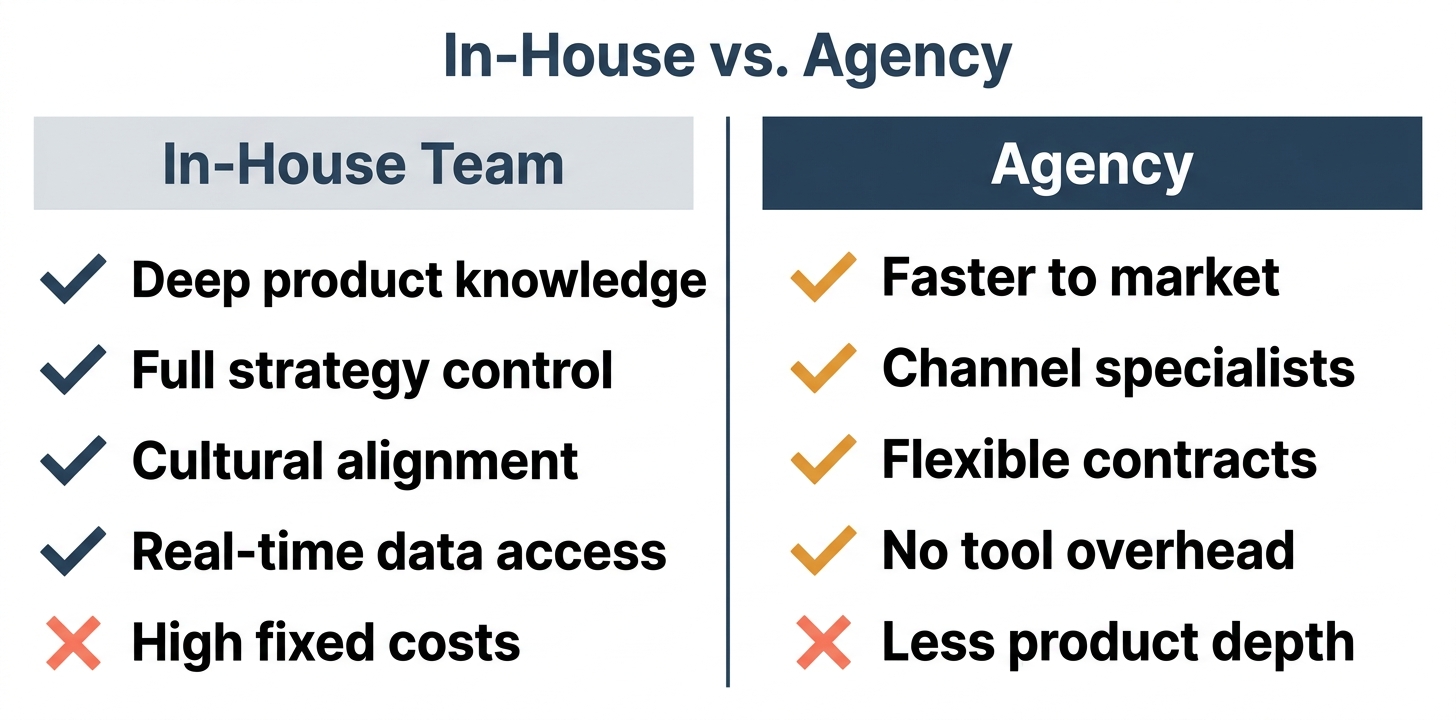
Deciding between building an in-house demand gen team or hiring an agency is one of the most important calls a B2B startup founder makes. The right answer depends on your stage, budget, and how fast you need results. Here's a balanced look at both paths.
The Case for Building In-House
An in-house team lives and breathes your product. They know your customers, your category, and your voice. That depth of knowledge shows up in content, messaging, and campaigns.
Pros of in-house:
- Deep product and customer knowledge
- Cultural alignment with your brand
- Real-time access to company news and data
- Full control over strategy and execution
Cons of in-house:
- High fixed costs. A Demand Generation Manager in the U.S. earns between $100,000 and $120,000 annually, before benefits and overhead
- Slow to hire. Finding strong demand gen talent takes months
- One person rarely covers every channel well
For seed-stage startups, these fixed costs can burn runway before you see results.
The Case for Hiring an Agency
A good B2B demand gen agency brings a full team on day one. You get strategists, writers, paid media specialists, and analysts without hiring each one separately.
Pros of an agency:
- Specialized expertise across channels
- Faster time to market
- Access to premium tools without buying them yourself
- Flexible contracts that scale with your needs
Cons of an agency:
- Less product immersion than an internal team
- You may share their attention with other clients
- Requires a strong onboarding process to get them up to speed
For seed and Series A or B startups without an existing marketing function, an agency can get you to market without spending six to nine months and $500,000+ building an internal team from scratch.
Questions to Help You Decide
Use this checklist before committing to either path:
- What's your runway? Fixed salaries are risky early. Agencies offer more flexibility.
- How fast do you need pipeline? Agencies can move in weeks. Hiring takes months.
- What's your current team's expertise? If nobody internal understands demand gen, an agency fills that gap immediately.
- How complex is your product? Very technical products may benefit from an in-house writer with domain depth.
- Do you have the tools? Agencies often bring their own tech stack. In-house teams need budget for tools on top of salaries.
For most early-stage B2B tech startups, a hybrid approach works well. Start with an agency to build your foundation and generate early pipeline. Add in-house talent once you know what's working and have the revenue to support it.
Your Blueprint for B2B Demand Generation Success
The best B2B demand generation strategy is a unified engine: brand awareness, education-first content, targeted distribution, and pipeline-focused measurement all working together. It's not a collection of disconnected campaigns. It's a system that earns buyer trust long before sales enters the conversation.
The Core Mindset Shift That Changes Everything
The biggest upgrade a B2B marketing team can make isn't a new tool or a bigger ad budget. It's a shift in thinking from chasing leads to building demand.
Lead gen asks: "How do we capture more contacts?" Demand gen asks: "How do we become the brand buyers already want when they're ready?" That's a fundamentally different goal, and it produces fundamentally different results.
This shift puts education and brand building at the center. Your content, your thought leadership, and your positioning all do the selling before sales ever picks up the phone.
The Unified Engine: What 'Best' Actually Looks Like
The best B2B demand generation programs don't win on one channel. They win because every piece works together.
Content builds trust. Distribution gets that content in front of the right accounts. Measurement shows which efforts actually drive pipeline, not just traffic. When these three connect, your demand gen compounds over time instead of resetting every quarter.
For seed and Series A or B startups, this matters even more. You don't have budget to waste on siloed campaigns that don't talk to each other.
Your Next Step: Start With a Content Audit
Before adding new campaigns or tools, audit what you already have.
Pull your existing content and map each piece against your ideal customer's top three pain points. Ask honestly: does this answer a real question your buyer is typing into Google? Does it build trust or just describe your product?
This audit takes a few hours and often reveals quick wins. You'll find gaps where buyers are searching and you have nothing, and you'll find existing content worth updating or promoting harder.
For startups looking to move fast without burning runway, The Zulu Method's B2B demand gen framework is built specifically for this stage: getting to market, building pipeline, and establishing brand visibility without the cost and delay of building an in-house team from scratch.
Start with the audit. Build from what you learn. The best demand gen program you can run is the one that's actually connected to how your buyers make decisions.
Questions to Ask Before Building Your Demand Gen Strategy
- What percentage of our current pipeline comes from buyers who already knew our brand before first contact?
- Are we measuring demand gen success by MQLs or by actual contribution to sales pipeline and revenue?
- Do we have content that answers the top three pain points our ideal buyers are actively searching for right now?
- What is our current customer acquisition cost (CAC) and lifetime value (LTV) ratio, and is it sustainable?
- Are we showing up consistently in the places our buyers spend time during the 83% of their journey that happens without sales?
- Do we have the runway and expertise to build an in-house demand gen team, or should we partner with an agency to move faster?

What is the difference between demand generation and lead generation? Demand generation is the broad process of creating awareness and desire for your product or service in the market. Lead generation is the specific action of capturing contact information from interested prospects. Think of demand gen as making people thirsty, and lead gen as offering them a glass of water.
What are some examples of B2B demand generation? Great examples include publishing in-depth industry research reports, hosting educational webinars with expert guests, creating free tools or templates, running targeted ad campaigns on LinkedIn promoting a valuable ebook, and building a strong brand voice on social media. These tactics educate buyers and build trust before they ever fill out a form.
How do you measure ROI for demand generation? Direct ROI is hard to measure for top-of-funnel activities. Instead, focus on metrics that correlate with revenue, such as contribution to sales pipeline, pipeline velocity (how fast deals close), and the ratio of customer lifetime value (LTV) to customer acquisition cost (CAC). These metrics connect demand gen efforts directly to business outcomes.
What is a B2B demand generation funnel? It's a model showing the buyer's journey from total unawareness to becoming a customer. The stages are typically Top-of-Funnel (TOFU) for awareness, Middle-of-Funnel (MOFU) for consideration, and Bottom-of-Funnel (BOFU) for decision-making. Different content and tactics are used at each stage to guide buyers forward.
How can AI improve B2B demand generation? AI acts as a major accelerator. It helps identify in-market buyers using predictive analytics, personalizes website content in real-time for visitors, drafts content and social media posts to scale up educational efforts, and analyzes data to reveal which channels and topics are performing best. AI is a performance multiplier, not a strategy replacement.
When should I hire a B2B demand generation agency? Consider an agency when you need specialized expertise you don't have in-house, want to launch campaigns faster than you could by hiring, or want to leverage their investment in expensive marketing technology without buying it yourself. It's ideal for companies that have a validated product but lack the marketing engine to scale.