Hannon Brett | Published on: June 24, 2026 | Time to read: 26 min
AI marketing agents are sophisticated goal-driven systems that plan campaigns, execute tasks, and learn from results, fundamentally different from basic automation. While AI excels at speed, scale, and data processing, humans still own strategy, creative direction, and judgment. The smartest approach combines both for a phased transition from traditional agencies.
Key Takeaways
- AI agents differ from automation: they make real-time decisions based on context, not just follow fixed scripts
- AI wins on volume and speed (10,000 keywords in an hour, 500 ad variations simultaneously) but loses on strategy, brand voice, and emotional intelligence
- 40% of enterprise applications will include autonomous AI agents by end of 2026, up from less than 5% in 2025
- Multi-agent systems (like Coca-Cola and Kayo Sports use) drive measurable results: 30% engagement lift, 14% subscription increases
- Total cost of ownership for AI-first setup ($200K-$400K year one) is different from agency retainers but still requires human oversight and governance
- Three-phase transition model (Hybrid → In-Source → Autonomous) protects revenue and builds competency before full shift
- New team roles focus on oversight and direction (AI Systems Overseer, Prompt Engineer, Data and Ethics Supervisor, Human Strategist) rather than channel execution
- Critical risks: loss of strategic judgment, brand voice erosion, black-box decisions, copyright exposure, data privacy violations, algorithmic bias, and overreliance on flawed data
- 70% of marketers reported at least one AI-related incident (factual errors, bias, off-brand content), and 40% required pausing or pulling ads
- AI is not a full replacement tool. It's a powerful augmentation technology that works best paired with human expertise in a hybrid model
Table of Contents
- The Rise of Autonomous Marketing: What Are AI Agents?
- AI vs Marketing Agency: A Head-to-Head Capabilities Showdown
- The Business Case: Analyzing the Cost of AI Marketing vs. an Agency
- A Phased Approach: How to Transition from an Agency to AI Agents
- Building Your New AI-Powered Marketing Team
- The Hidden Risks of Replacing Your Marketing Agency Too Soon
- Is an AI-Powered Team Your Next Growth Engine?
The Rise of Autonomous Marketing: What Are AI Agents?
Can you really replace a marketing agency with AI agents? The short answer is: it depends on what you need. AI marketing agents are goal-driven systems that can plan campaigns, execute tasks, and learn from results. They're not simple automation tools. They're something much more capable.
But let's back up and define what we're actually talking about.
Beyond Basic Automation: What Makes an AI Agent Different
Most people think of marketing automation as tools that send emails when someone fills out a form, or schedule social posts in advance. That's rule-based automation. It follows a fixed script.
An AI agent is different. Think of automation like a train: it runs on a track you built, and if anything blocks that track, it stops. An AI agent is more like a taxi driver. You tell it where you want to go, and it figures out the best route, adjusts for traffic, and gets you there.
According to AWS's strategic guide for business leaders, the key distinction is decision-making power. Automation executes what you pre-defined. Agents make choices in real time based on context, goals, and changing inputs.
The Core Components Inside an AI Marketing Agent
Three main parts power most AI marketing agents:
- Large Language Models (LLMs): These handle understanding and generating language, whether that's writing ad copy, summarizing research, or responding to prompts.
- Task execution engines: These are the action layers. They connect to tools, APIs, and platforms to actually do things, like run a search, pull analytics data, or post content.
- Data analysis modules: These process incoming information, spot patterns, and feed insights back into the agent's decision loop.
Together, these parts allow an agent to receive a goal, break it into steps, take action, review results, and adjust. It's a continuous loop, not a one-time trigger.
Single-Task Bots vs. Multi-Agent Systems
Not all AI agents work the same way. There's a big difference between a single-task bot and a full multi-agent system.
A single-task bot does one thing well. A social media scheduler, for example, posts content at optimal times based on engagement data. Useful, but limited.
A multi-agent system is a team of specialized agents working together. One agent might handle market research, scanning competitor activity and audience sentiment. It then passes structured findings to a second agent focused on ad copy. That agent drafts creative variations and sends them to a third agent running A/B tests.
Real companies are already using this approach. Case studies from brands like Coca-Cola and Kayo Sports show multi-agent systems driving a 30% lift in customer engagement and a 14% increase in subscriptions by dynamically personalizing messages across millions of users.
This is what makes the question of whether to replace a marketing agency with AI agents so interesting. It's not about one tool doing one job. It's about coordinated systems handling complex, interconnected work.
And adoption is accelerating fast. Gartner forecasts that 40% of enterprise applications will include autonomous AI agents by the end of 2026, up from less than 5% in 2025.
So the technology is real, it's scaling, and it's already producing results. The bigger question is where it still falls short, and that's what the rest of this article covers.
Real-World Multi-Agent System Results
Kayo Sports (Australia) deployed a multi-agent system that moved from 300 message variations to 1.5 million dynamically personalized messages. Each agent handled specialized work: one researched subscriber preferences, another crafted messaging variations, a third optimized delivery timing and channel selection. Results: 14% increase in subscriptions, 105% increase in cross-selling, and 20% rise in average subscription price, demonstrating how coordinated AI agents can drive measurable business outcomes at scale.
AI vs Marketing Agency: A Head-to-Head Capabilities Showdown
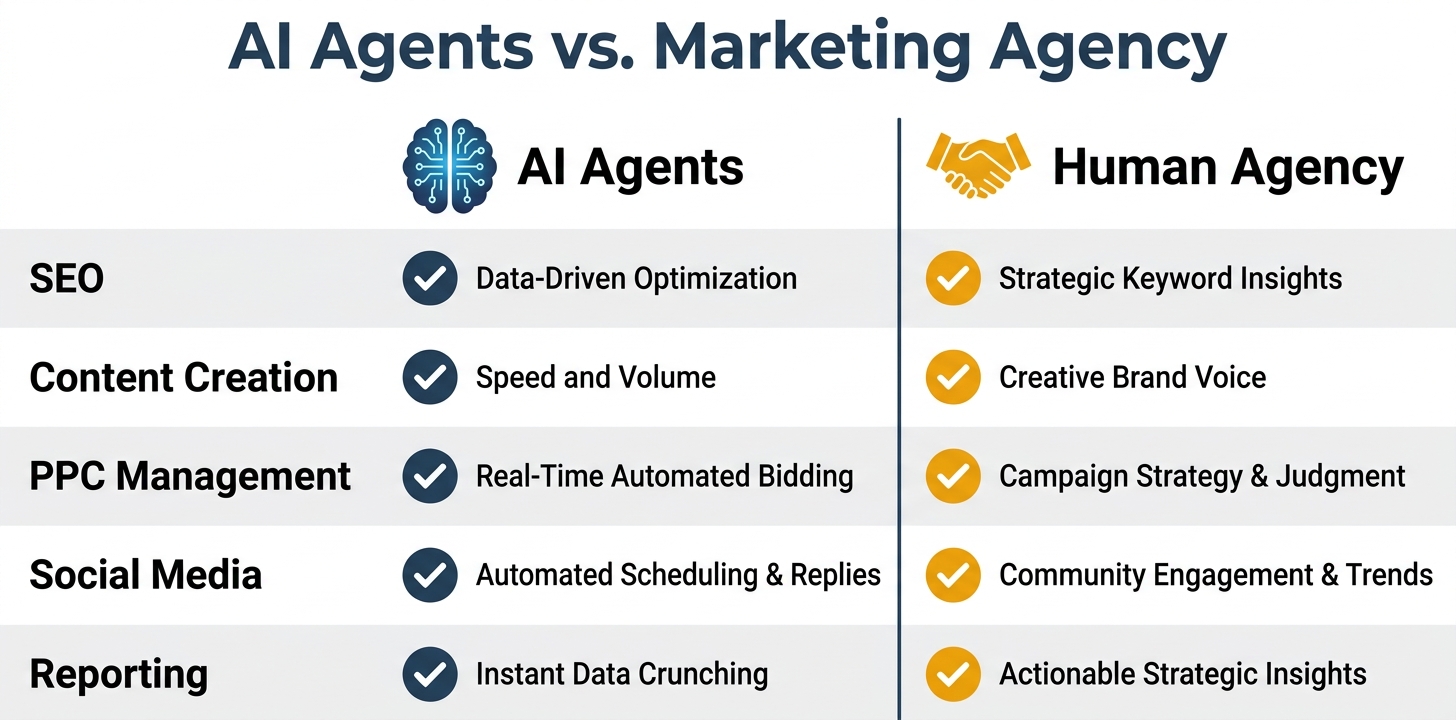
Can AI agents actually replace a marketing agency? For most businesses, the honest answer is: partially. AI agents win on speed, scale, and data processing. Agencies win on judgment, relationships, and creative nuance. The smartest move is knowing which tasks belong to which.
Here is a direct look at how they stack up across five core marketing functions.
SEO
AI agents can scan thousands of keywords in minutes, monitor rankings around the clock, and flag technical issues automatically. What they cannot do as well is identify which keywords actually match business goals based on market nuance and competitive positioning. That judgment call still belongs to experienced strategists.
Content Creation
AI generates high volumes of drafts quickly, maintains consistent formatting, and scales across channels with ease. But defining brand voice, ensuring emotional resonance, and catching subtle messaging errors that confuse or mislead audiences still requires human oversight. Full automation often produces what experts call bland marketing. It is technically correct but emotionally flat.
PPC Management
AI adjusts bids in real time, runs continuous A/B tests, and processes performance data across thousands of ad variations simultaneously. The gap shows up in strategy. Crafting the core offer, spotting when data signals are misleading, and building creative concepts that connect with real buyers still benefits from human experience.
Social Media
AI schedules posts at optimal times, monitors sentiment, and tracks engagement trends across platforms without interruption. Building community relationships, responding to nuanced situations, and creating culturally relevant content is where human teams continue to add value that automation struggles to replicate.
Reporting
AI compiles cross-channel data instantly, surfaces anomalies, and automates dashboards faster than any human team could manage. Interpreting what the numbers mean for the business, prioritizing what to act on, and communicating insights to stakeholders in a way that drives decisions still requires human judgment.
Where AI Agents Pull Ahead
AI agents handle volume and speed in ways no human team can match. An AI can scan 10,000 keywords in an hour. It can run 500 ad variations simultaneously. It never sleeps, never misses a bid change, and does not slow down at the end of a demanding quarter.
For tasks that are repetitive, data-heavy, or time-sensitive, AI wins consistently. SEO audits, email segmentation, ad monitoring, and performance dashboards are real productivity gains, not theoretical ones.
According to research from McKinsey on skill partnerships in the age of AI, the clearest efficiency gains come when AI handles structured, high-volume tasks while humans focus on judgment-intensive work.
Where Agencies Still Have the Edge
Speed is not everything. Some marketing work cannot be reduced to data patterns.
Brand voice is a clear example. AI-generated content often lacks distinct personality, and in crowded markets, personality is frequently what makes the difference between a brand people remember and one they scroll past.
Strategy is another gap. An AI can analyze which keywords get the most traffic. But an experienced strategist knows which ten of those ten thousand keywords are worth targeting, based on buyer intent, competitive gaps, and where the business actually wants to go. That kind of judgment requires context that lives outside any dataset.
Emotional intelligence is a third area where human teams lead. When a campaign hits a cultural nerve or a customer complaint gains attention, you need someone who can read the room and respond appropriately. Layered customer situations and sensitive brand moments still require human judgment to handle well.
The Honest Gap in Creative Work
AI in creative tasks carries real risk. Research from IAB on responsible AI in advertising found that 70 percent of marketers reported at least one AI-related incident involving factual errors, bias, or off-brand content. Forty percent of those incidents required pausing or pulling ads entirely.
That is not a reason to avoid AI in creative work. But it is a reason to keep humans in the review loop. AI can draft at speed. People need to check the output before it goes live.
The Practical Takeaway
Thinking about this as a full replacement misses the point. The better question is which tasks should AI own and which ones still need a human.
Use AI agents for the work that benefits from scale, speed, and consistency. Keep human expertise on strategy, creative direction, and anything that requires reading between the lines. That division is where most businesses will find the real return.
The Business Case: Analyzing the Cost of AI Marketing vs. an Agency

How much does it actually cost to replace a marketing agency with AI agents? The honest answer: it depends on what you count. Most businesses compare software costs to agency retainers and stop there. But the real comparison is total cost of ownership versus total value delivered, and that calculation looks very different.
What an Agency Retainer Actually Costs
Mid-level marketing agency retainers typically fall into three tiers:
| Agency Tier | Monthly Retainer | What's Usually Included |
|---|---|---|
| Small/boutique | $5,000/month | SEO, content, basic reporting |
| Mid-size full service | $10,000/month | Strategy, paid media, creative, analytics |
| Enterprise agency | $25,000+/month | Multi-channel campaigns, dedicated team, brand strategy |
These fees cover strategy, creative direction, account management, tools, and execution. The cost is predictable. But you're paying for hours, not outcomes.
The True Cost of an AI-First Marketing Setup
Switching to AI agents isn't just buying software. The real total cost of ownership includes several layers that businesses often underestimate:
- Software licenses: AI agent platforms range from around $500/month for entry-level tools to $3,000+ for enterprise-grade systems
- Specialized talent: Roles like AI Marketing Systems Manager or Marketing Prompt Engineer command salaries between $115,000 and $200,000 annually, according to current hiring data
- Data infrastructure: Data preparation, integration, and quality assurance can run $20,000 to $40,000 upfront
- Training and change management: Onboarding teams to new AI workflows adds another $30,000 to $60,000 in year one
- Ongoing governance: Human review, quality checks, and model drift correction are recurring costs most budgets miss
Year one for a serious AI-first setup can easily reach $200,000 to $400,000 when all of these are included.
From Cost Per Hour to Cost Per Outcome
This is where the comparison shifts. Agencies bill in hours. AI systems scale in outcomes.
An agency might charge $150 per hour to write ad copy. An AI system can generate 500 variations in minutes, at a fraction of that cost. But you still need a human to review, direct, and approve the output. The cost model changes, but the human layer doesn't disappear.
A smarter framework is to calculate cost per outcome instead:
- Pick one marketing function (say, SEO content or ad copy)
- Measure the current cost per deliverable with your agency
- Estimate the AI cost for the same output, including human review time
- Compare the gap, then multiply across volume
This approach shows where AI creates real savings and where the agency model still wins on value.
Where the Business Case Holds and Where It Doesn't
For high-volume, repeatable tasks like email segmentation, ad monitoring, and keyword tracking, the AI cost model wins clearly. Volume scales without proportional cost increases.
For strategy, creative direction, and brand work, the business case is weaker. You still need experienced humans. The question isn't whether to pay for expertise but whether that expertise lives inside an agency or in-house.
Rushing into a full AI replacement without this analysis is one of the most common mistakes. Forbes research on AI strategy errors found that companies often pursue AI complexity before mastering the fundamentals, leading to budget overruns and disappointing results.
The smartest business case isn't about replacement. It's about finding the tasks where AI delivers more per dollar, and being honest about the ones where it still doesn't.
A Phased Approach: How to Transition from an Agency to AI Agents

The smartest way to replace a marketing agency with AI agents isn't to do it all at once. A phased transition protects revenue, preserves institutional knowledge, and lets your team build real AI competency before you cut the cord. Here's a practical three-phase model that works.
Phase 1 (Hybrid): Augment Your Agency With AI
Don't fire your agency yet. In this phase, you add AI tools alongside your existing agency relationship.
Focus on low-risk, high-volume tasks: automated reporting, keyword tracking, performance dashboards, and email segmentation. These are areas where AI saves time without touching strategy or creative.
Your agency keeps running campaigns. AI handles the data layer. You start learning what AI can and can't do inside your specific marketing environment, without betting the business on it.
You're ready to move to Phase 2 when:- Your data infrastructure is clean, connected, and consistent
- Your team can interpret AI-generated reports without relying on the agency to explain them
- You've identified at least two or three functions where AI clearly outperforms the current process
- Internal stakeholders trust the AI outputs enough to act on them
Phase 2 (In-Source): Bring Specific Functions In-House
Now you start shifting ownership of specific marketing functions from the agency to your internal team, powered by AI.
Content generation is a strong starting point. AI drafts at scale. Your team edits, approves, and publishes. You reduce agency hours on content while building internal creative oversight.
SEO audits, ad monitoring, and basic campaign reporting are also good candidates. According to Adobe's early AI adoption research, companies that focus on early wins with structured workflows are far more likely to reach repeatable scale than those who try to automate everything at once.
You're ready to move to Phase 3 when:- Your team has completed structured AI workflow training, not just tool demos
- You have a governance process: who reviews AI outputs before they go live
- AI-managed functions are hitting performance benchmarks equal to or better than the agency
- You have an in-house strategist who can direct AI agents toward business goals
Phase 3 (Autonomous): AI Manages Campaigns With Human Oversight
In this phase, AI agents plan, execute, and optimize entire campaign workflows. A human strategist sets the goals, reviews performance, and handles anything requiring judgment or brand sensitivity.
This isn't full automation. It's supervised autonomy. The human role shifts from doing the work to directing and reviewing it. That distinction matters, especially for brand safety and legal compliance.
Research from Propagate Media on gradual AI adoption is clear: organizations that validate results at each phase before expanding are far more likely to sustain performance gains than those that rush the transition.
Managing Your Agency During the Transition
How you handle the agency relationship during this shift will determine whether you lose momentum or maintain it.
Be transparent early. Tell your agency you're testing AI tools internally. Most agencies expect this and can help structure a knowledge transfer.
Request documentation on everything: campaign logic, audience segments, creative frameworks, and channel strategies. This institutional knowledge is what your AI systems will need to perform well. Don't wait until the contract ends to ask for it.
Reduce scope gradually instead of canceling outright. Move one function at a time. Keep the agency on strategy and brand work longest, since those are the areas where human expertise still holds the clearest advantage.
As NVIDIA CEO Jensen Huang put it: "If your CEO is using AI to cut headcount, it means one thing: They have no imagination." The point of this transition isn't to replace people. It's to redirect human expertise toward the work that actually needs it.
Building Your New AI-Powered Marketing Team
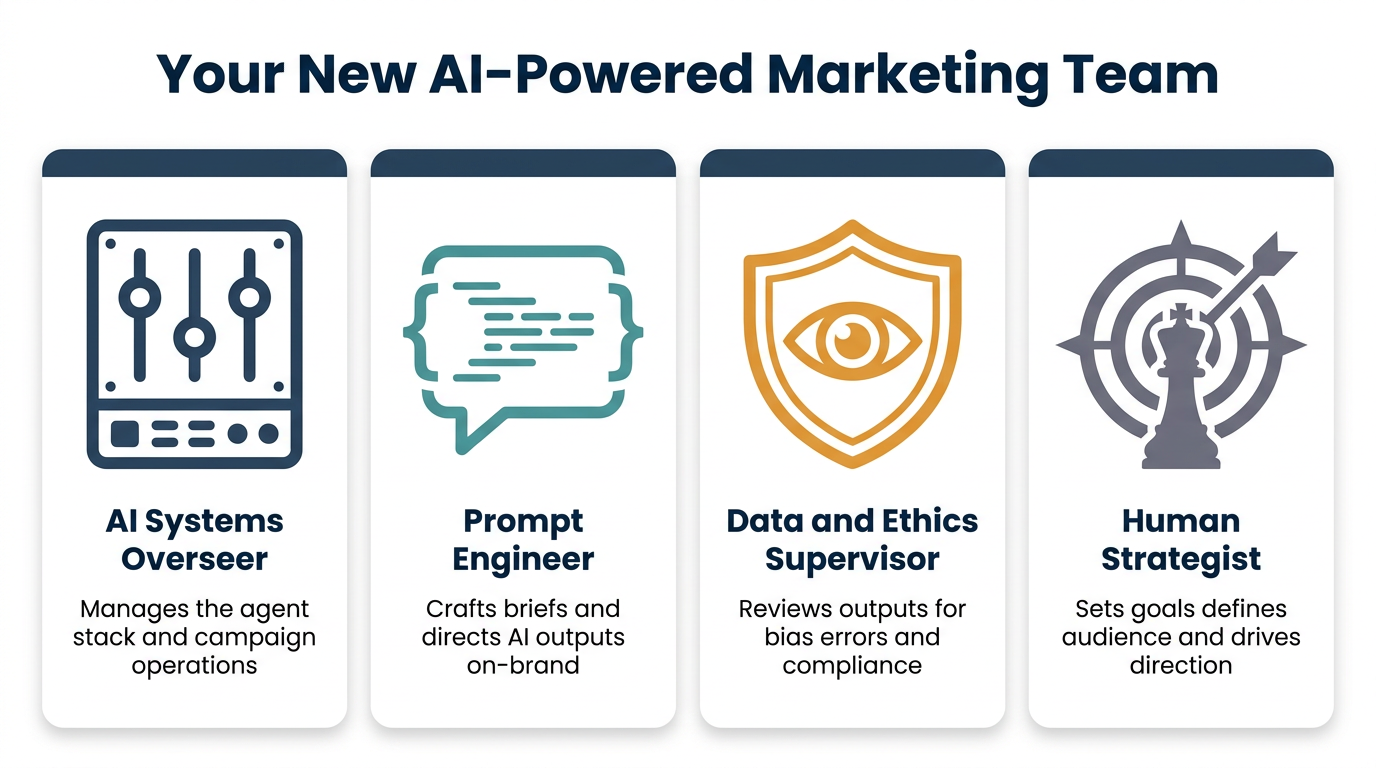
Replacing a marketing agency with AI agents doesn't just change your tools. It changes who you need on your team. The roles that matter most shift from channel execution toward oversight, direction, and judgment. Understanding that shift is what separates a successful transition from a costly one.
The New Roles That Emerge
When AI agents handle execution, humans move into a different kind of work. Four roles become central to an AI marketing team.
AI Systems Overseer manages the agent stack itself. This person makes sure campaigns are running, agents are connecting to the right data sources, and nothing is misfiring. They're less of a marketer and more of an operations lead who understands how AI workflows behave.Marketing Prompt Engineer translates business goals into instructions the agents can actually use. They craft the briefs, set the constraints, and test outputs to make sure the AI stays on-brand and on-message. According to Salesforce's research on agentic AI marketing skills, this role requires strong creative direction skills and a deep understanding of how agentic systems make decisions.Data and Ethics Supervisor monitors what the AI produces before it goes live. They check for factual errors, bias, and compliance issues. This isn't optional. Research from IAB on responsible AI in advertising found that 70% of marketers reported at least one AI-related incident involving errors, bias, or off-brand content.Human Strategist owns the direction. They set the goals, define the audience, and decide which channels and messages actually serve the business. AI can optimize toward a target. Only a human can decide if the target is the right one.How This Compares to a Traditional Team
A traditional marketing team is built around channels and content types. You have an SEO Manager, a Content Writer, a Paid Media Specialist, and a Social Media Coordinator. Each person owns a function and executes within it.
An AI-powered team is built around oversight and direction instead. The AI agents handle execution across those same channels. The humans focus on setting goals, reviewing outputs, and making judgment calls.
The channel expertise doesn't disappear. But it moves up a level. Your SEO person stops writing meta descriptions and starts directing the strategy the AI follows.
Upskilling vs. Hiring New Talent
Most businesses face a real choice here: retrain the team you have, or hire specialists from outside.
Upskilling your current team is often the faster path. People who already know your brand, your audience, and your goals can learn prompt engineering and AI oversight far more easily than a new hire can learn your business.
But some roles are genuinely new. If no one on your team has experience managing AI workflows or reviewing outputs for compliance and bias, you may need to bring someone in. Digital Marketing Institute research on AI skills points to data literacy, AI tool familiarity, and ethical judgment as the skills most worth developing, and most existing marketers can build these with focused training.
The honest answer is usually a mix: upskill the strategists and channel leads you already trust, and hire one or two specialists to manage the AI layer itself. That combination gives you institutional knowledge plus the technical oversight your new setup actually requires.
The Hidden Risks of Replacing Your Marketing Agency Too Soon
Replacing a marketing agency with AI agents carries real risks that go far beyond budget or technical complexity. The subtler dangers include losing strategic judgment, diluting your brand voice, and building on data that quietly misleads you. Understanding these risks is what separates a smart transition from a costly mistake.
When AI Loses the Plot on Strategy
One of the biggest risks is what's called the loss of "human-in-the-loop" decision-making. Experienced agency strategists don't just execute. They notice when a campaign is heading in the wrong direction and say something.
AI agents don't do that. They optimize toward whatever goal you've set, even if that goal turns out to be the wrong one. If the target metric is wrong, the AI will hit it perfectly, and your business will still lose.
That gap matters most during market shifts, competitor moves, or PR moments. Those situations need a human who can read the room, not an algorithm chasing last month's performance data.
The Brand Voice Problem
Automated content at scale creates a specific kind of risk: gradual brand voice erosion. It happens slowly. Each piece of AI-generated content is close enough to your tone. But over hundreds of pieces, the personality drifts.
Real-world examples back this up. Several brands have faced public backlash after AI-generated campaigns felt hollow or off-brand, including widely reported cases involving AI-produced holiday ads that audiences called "soulless" and "inauthentic". The core issue is that AI optimizes for plausibility, not personality.
In crowded markets, personality is often what makes people remember you.
The Black Box Problem
AI agents make decisions you can't always explain. This is the "black box" problem. An agent might shift budget away from a high-performing channel, adjust messaging in a way that hurts conversions, or deprioritize an audience segment without any visible reason.
When you can't see why a decision was made, you can't correct it. You can only watch results change and guess at the cause. That lack of transparency is especially dangerous for brand-sensitive decisions, where the wrong move can be hard to reverse.
Legal and Ethical Risks Most Businesses Overlook
Three legal risks deserve specific attention before any business moves to replace a marketing agency with AI agents.
Copyright exposure is the first. Under current U.S. law, content generated entirely by AI without meaningful human contribution is not eligible for copyright protection, as confirmed by the U.S. Copyright Office's official guidance. That means a competitor can legally copy your AI-generated marketing materials. It also means your AI may inadvertently reproduce protected content from its training data, exposing you to infringement claims.Data privacy violations are the second. AI agents rely on large volumes of customer data to personalize and optimize. Without proper governance, that usage can violate regulations like GDPR or CCPA, especially if the AI processes data in ways your privacy policy doesn't cover.Algorithmic bias is the third. AI systems trained on historical data can reinforce existing biases, excluding certain demographics from ads, underserving specific customer groups, or producing messaging that reads as discriminatory. These aren't hypothetical risks. They're documented failure modes that have forced companies to pull campaigns and issue public corrections.Over-Reliance on Flawed Data
AI agents are only as good as the data they run on. If your data is incomplete, outdated, or poorly structured, the agent will act on it confidently anyway. There's no built-in skepticism.
This is a quiet risk that compounds over time. Decisions built on flawed data produce flawed results. Those results feed back into the system. The errors multiply. By the time you notice something is wrong, it's hard to trace back to the source.
Human strategists catch these problems through intuition and experience. They ask questions like "this doesn't feel right" that an AI system simply isn't built to ask.
Is an AI-Powered Team Your Next Growth Engine?
Should you replace your marketing agency with AI agents? The honest answer depends on four things: your budget, your team's readiness, the complexity of your marketing needs, and how much risk you can absorb. AI agents can handle volume and speed. Humans still own strategy, creative direction, and judgment. The best setups combine both.
Here's a simple checklist to assess where your organization actually stands.
Your Readiness Checklist
| Decision Area | You're Ready for AI-Led Marketing If... | Stick With or Keep Your Agency If... |
|---|---|---|
| Budget | You can invest in year-one setup costs plus ongoing governance | You need predictable monthly costs without upfront infrastructure spend |
| Data | Your customer data is clean, connected, and consistent | Your data is fragmented across platforms with no clear ownership |
| Team Skills | You have people who can direct, review, and correct AI outputs | Your team relies on the agency to interpret results and set direction |
| Marketing Complexity | Your tasks are high-volume and repeatable | You need brand strategy, creative development, and relationship-driven work |
| Risk Tolerance | You have governance processes for reviewing AI content before it goes live | One brand safety incident would cause serious reputational or legal damage |
What the Research Tells Us
Marketing tasks that truly require human expertise are those involving strategy, brand voice, emotional resonance, and final creative judgment. McKinsey's research on skill partnerships in the age of AI is clear: efficiency gains are strongest when AI handles structured, high-volume work while humans focus on judgment-intensive decisions.
And adoption is accelerating fast. The autonomous AI agent market is projected to reach between $6.1 billion and $10.9 billion by 2026, growing at a compound annual rate of nearly 49%, according to market sizing data from Research and Markets.
But fast growth doesn't mean instant readiness. Most businesses will find the real return in a hybrid model, not a full replacement.
The Future Is Human-AI Collaboration
Replacing a marketing agency with AI agents isn't really about choosing one over the other. It's about finding the right division of work.
AI handles execution at scale: content drafts, ad monitoring, keyword tracking, reporting, and segmentation. Humans handle direction: strategy, brand voice, creative oversight, and anything requiring empathy or judgment.
That partnership is where marketing's future lives. Not in full automation. In supervised, intelligent collaboration where each side does what it does best.
Questions to Ask Before Going All-In on AI Marketing
- Is your customer data clean, connected, and consistent across platforms, or is it fragmented with unclear ownership?
- Do you have people on your team who can direct, review, and correct AI outputs, or does your team rely entirely on your agency for interpretation?
- Can you invest in year-one setup costs ($200K-$400K) plus ongoing governance, or do you need predictable monthly costs without upfront infrastructure spend?
- Are your marketing tasks primarily high-volume and repeatable, or do you need heavy strategy, creative development, and relationship-driven work?
- Do you have governance processes in place for reviewing AI content before it goes live, or would one brand safety incident cause serious reputational damage?
- Which specific marketing function would be lowest-risk to pilot first, one where AI can augment but not fully replace human judgment?
- What legal and ethical safeguards do you need around copyright, data privacy (GDPR/CCPA), and algorithmic bias before deploying AI?
- Are you willing to keep human strategists directing AI toward business goals, or are you tempted to full automation without human oversight?

A: No. For most businesses, AI can't fully replicate the strategic insight, creative problem-solving, and relationship management of a good agency. It is best used as a powerful tool to augment human teams or handle specific, data-intensive tasks like SEO audits, email segmentation, and performance dashboards. A hybrid approach is the most effective strategy today.
Q: How much does it cost to use AI for marketing instead of an agency?A: The costs are fundamentally different. Instead of a monthly retainer ($5k-$25k+), you'll have software costs ($500-$5k/mo), specialized talent salaries ($115K-$200K), data infrastructure ($20K-$40K upfront), and governance expenses. Year one can reach $200K-$400K, but ongoing cost per task scales significantly lower if managed properly.
Q: What marketing tasks are AI agents best at replacing?A: AI agents excel at data-driven, repetitive tasks with clear rules: large-scale keyword research, competitive analysis, data reporting and visualization, A/B testing execution, email segmentation, ad monitoring, and initial content drafts. These tasks benefit from volume, speed, and consistency where AI has no peer.
Q: What skills does my team need to manage AI marketing agents?A: Your team needs to shift from 'doers' to 'overseers.' Key skills include strategic thinking to set goals, data literacy to interpret outputs, prompt engineering to give clear AI instructions, AI systems management for oversight, and digital ethics for compliance. Marketing fundamentals remain crucial for directing AI toward business objectives.
Q: How do I start transitioning from an agency to AI without losing momentum?A: Start with a pilot project on one well-defined, data-heavy function like SEO reporting or social analytics. Use AI to augment your agency's work first, letting your team learn and build infrastructure without disrupting primary marketing. Use the three-phase model (Hybrid → In-Source → Autonomous) before making major changes.