
Hannon Brett | Published on: September 10, 2026 | Time to read: 28 min | Last Updated on: September 10, 2026
Series A marketing is about proving your go-to-market model works through validated customer acquisition, repeatable pipeline generation, and tested channels. Series B marketing shifts focus to scaling that proven model efficiently, with predictable revenue contribution, strong unit economics (3:1+ LTV:CAC), and a repeatable growth engine. Applying Series A tactics at Series B wastes budget and slows compounding growth, while scaling too aggressively at Series A burns runway on unproven channels.
Key Takeaways
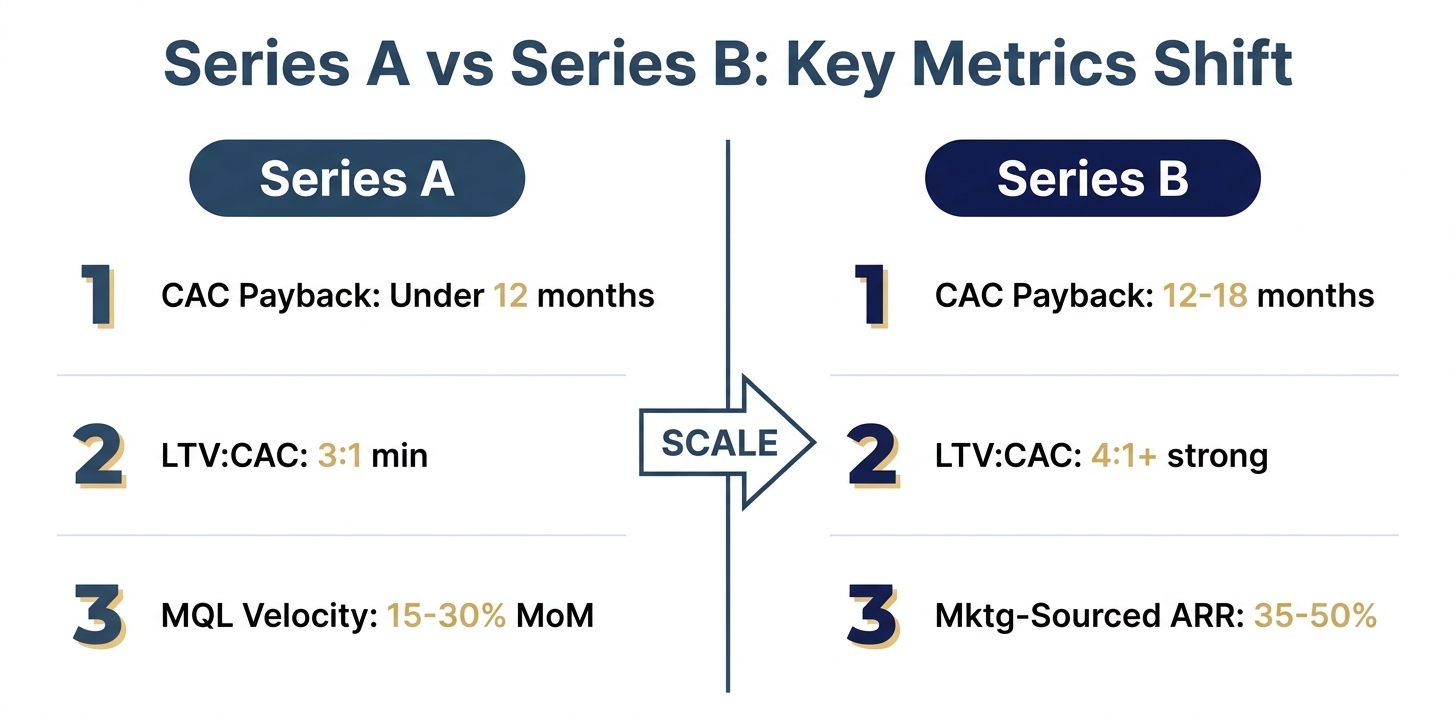
- Series A Goal: Prove your GTM works. Focus on validating product-market fit, building initial pipeline velocity (15 to 30% MoM lead growth), testing 2 to 3 foundational channels for learning, and keeping CAC payback under 12 months.
- Series B Goal: Scale what works. Shift to predictable, efficient growth with an LTV:CAC ratio of 3:1 minimum (4:1+ is strong), CAC payback of 12 to 18 months, and marketing-sourced revenue at 30 to 50%+ of new ARR.
- Use the OKR Framework: Start with a company-level objective, define the marketing objective that supports it, then write 2 to 3 measurable key results per objective. Co-create these with sales and product for alignment.
- Investor Metrics That Matter: Track and report CAC Payback Period, LTV:CAC Ratio, and Marketing-Sourced Revenue. These are the signals boards and Series C investors use to evaluate whether your growth engine is real or fragile.
- Plan the Transition Early: Series B readiness starts 6 months before the raise. Audit your GTM motion, hire your first channel specialists, document your budget model, and build full-funnel attribution and weekly pipeline reviews.
- Report Like a Business Leader: Lead board updates with narrative, not dashboards. Show trends, speak in pipeline and revenue terms, address misses proactively, and keep the whole update to one page with clear next-quarter priorities and asks.
Table of Contents
- Why Your Marketing Goals Must Evolve from Series A to B
- Defining Foundational Marketing Goals for Series A
- Scaling Your Marketing Goals for Series B Growth
- A Practical Framework for Setting Your Startup's Marketing Goals
- Key Marketing Metrics That Matter to Series A & B Investors
- Planning the Transition: From Series A to Series B Marketing Goals
- How to Report Marketing Goal Progress to Your Board
- Your Marketing Goals Can Drive Your Next Funding Round
Why Your Marketing Goals Must Evolve from Series A to B
To set marketing goals at Series A and B, you need to understand one core shift: Series A is about proof and Series B is about scale. The tactics that help you prove your go-to-market works will actively hurt you if you keep running them when investors expect repeatable, efficient growth.
Here's why that distinction matters so much for your team right now.
Series A: Your Job Is to Prove It Works
At Series A, your marketing goal is simple. Show that you can find customers, convert them, and keep them. Nothing more.
Investors at this stage want to see that your go-to-market motion isn't just a theory. They want evidence. As Rock Health put it: "By Series A, we need to see undeniable evidence of product-market fit... and by Series B, you better have all of that plus clear evidence of go-to-market fit, which should come with compelling unit economics."
That means your marketing budget should be teaching you things. Which channels convert? What messaging lands? Who actually buys and why?
Series B: Your Job Is to Scale What Works
By Series B, the learning phase is mostly over. Investors now want to see that you can put fuel in the engine and watch it accelerate, not explode.
Your marketing goals shift from discovery to efficiency. You're expected to show a repeatable, instrumented growth engine, not just promising early signals.
According to benchmarks from The Zulu Method's SaaS marketing budget guide, Series B companies typically allocate around 11-16% of revenue to marketing, compared to 12-18% at Series A. The spend doesn't shrink much. But the expectations for what that spend produces change dramatically.
The Risk of Mixing Up the Two Stages
Applying Series A tactics at Series B is one of the most common and expensive mistakes growing startups make.
- Too cautious at Series B: Continuing to test and explore when you should be scaling proven channels wastes your larger budget and slows the compounding growth your investors expect.
- Too aggressive at Series A: Scaling paid acquisition before you know your unit economics means buying customers you can't afford to keep.
Marketing, like product and engineering, matures with the company. It needs a different mandate at each stage.
Think of it this way: your engineering team doesn't build infrastructure for millions of users before you have hundreds. Your marketing team shouldn't run a Series B growth playbook before you've proven a Series A go-to-market motion.
What This Means for How You Set Goals
The stage you're in should determine everything: which metrics matter, how you allocate budget, how you report to your board, and what success looks like at the end of the quarter.
A marketing goal like "increase brand awareness" means something very different at Series A (test whether your positioning resonates) versus Series B (deploy budget to accelerate a positioning you've already validated).
Getting this wrong doesn't just create misaligned metrics. It burns runway on the wrong activities at exactly the moment when capital efficiency matters most.
Defining Foundational Marketing Goals for Series A

To set marketing goals at Series A, focus on one thing: learning whether your go-to-market motion actually works. Your primary job isn't to grow as fast as possible. It's to prove that customers want what you sell, and that you can reach them repeatably.
Here are the foundational goals that matter most at this stage.
Goal 1: Validate Product-Market Fit Through Early Traction
Product-market fit isn't a feeling. It's a signal you measure. At Series A, your marketing goals should generate the evidence that PMF exists.
Track the number of design partners or early adopters you're actively engaging. These aren't just warm leads. They're your proof points. Investors want to see that real buyers are raising their hands.
A realistic benchmark: aim for 15 to 30% month-over-month growth in qualified leads during your first year post-seed. This lead velocity rate tells you whether demand is building, not just whether your ads are running.
Goal 2: Build Initial Pipeline With MQL and PQL Velocity
At Series A, pipeline generation matters more than pipeline size. You want to see momentum, not just volume.
Set goals around marketing qualified lead (MQL) and product qualified lead (PQL) velocity. How fast is the number growing each month? Are the leads converting to sales conversations?
Don't obsess over CAC payback period yet. But do aim for a CAC payback target of 9 to 12 months as a directional guardrail. It keeps you honest about unit economics before you pour fuel into the engine.
Goal 3: Test Foundational Channels for Learning Value
Not all channels teach you the same things. At Series A, you want channels that give fast feedback on messaging, audience fit, and intent.
The three highest-learning channels for Series A B2B startups are:
- SEO and content marketing: Reveals what problems your buyers are actively searching for. It builds compounding signal on intent and language. Early-stage SaaS teams consistently rank it as the best channel for durable, low-cost learning.
- Founder-led LinkedIn content: Posts and comments give immediate signal on which narratives land. Multiple experts flag this as one of the highest-ROI early-stage tactics for B2B startups.
- Communities and direct outreach: Reddit threads, niche forums, and warm outbound surface real objections and buyer language fast. These channels are especially useful before you know exactly who your best-fit buyer is.
For content and SEO specifically, your Series A goal shouldn't be traffic. It should be topical authority in your buyer's category. Are you showing up for the problems your ICP is searching? That's the signal that matters.
Goal 4: Prove the GTM Motion Is Repeatable
This is the goal that connects everything else. By the end of your Series A period, you should be able to answer: "Can we consistently attract, convert, and keep customers without heroic one-off effort?"
As one GTM framework from Modern GTMs for Founders puts it, Series A is where you solve GTM risk, not scale risk. You're not trying to pour water into a bigger bucket yet. You're checking whether the bucket holds water at all.
If you're a seed or Series A startup without a dedicated marketing team, this is exactly where a fractional or embedded team structure, like what The Zulu Method offers, can help you build and test a repeatable GTM motion without spending six to nine months hiring in-house.
What Good Looks Like at Series A
| Goal Area | What to Measure | Healthy Benchmark |
|---|---|---|
| Lead velocity | MoM qualified lead growth | 15–30% MoM |
| Early adopters | Design partners or pilot customers | 5–15 active accounts |
| Channel learning | Channels tested with conversion data | 2–3 channels with real signal |
| CAC efficiency | CAC payback period (directional) | Under 12 months |
| Content traction | Topical authority for core ICP keywords | First page rankings starting to appear |
These aren't vanity targets. They're the evidence your board and future Series B investors will expect to see baked into your narrative.
Scaling Your Marketing Goals for Series B Growth
At Series B, the core question shifts. You're no longer asking "can we do this?" You're asking "can we do this efficiently, at scale, every quarter?" That one word, efficiently, changes everything about how you set marketing goals.
From Proof to Predictability
Series A is where you solve GTM risk. Series B is where you solve scale risk. Those are two very different problems that need two very different marketing goals.
At Series B, investors don't want to see experiments. They want to see a machine. Your marketing goals should reflect that shift from discovery to predictability.
The Metrics That Matter at Series B
The metrics you track at Series B aren't just bigger versions of Series A metrics. They're different categories entirely. Here's what to focus on:
LTV:CAC Ratio This is your clearest signal of marketing efficiency. For a Series B B2B SaaS company, 3:1 is the healthy minimum and 4:1 to 5:1 is considered strong. If your ratio is above 5:1, you may actually be under-investing in growth.
CAC Payback Period At Series B, a target of 12 to 18 months is the standard benchmark. That's slightly looser than Series A because you're investing in larger channels that take longer to compound.
Marketing-Sourced Revenue This metric shows investors that marketing isn't just supporting sales. It's directly generating pipeline. Tracking marketing-sourced revenue as a percentage of total new ARR gives your board a clear view of marketing's contribution to growth.
Sales Cycle Length As you scale, watch for the sales cycle to lengthen. If it does, that's a sign your targeting or messaging needs tightening. Keeping this metric stable while growing volume is a strong signal of a healthy go-to-market engine.
Channel Expansion Goals
At Series A, you tested two or three channels. At Series B, your goal is to scale the winners and cautiously add new ones. But don't mistake "adding channels" with "testing everything."
A practical Series B channel approach: put 50 to 70% of budget into proven demand generation channels, and reserve 5 to 15% for brand investment. According to a 2026 B2B SaaS budget benchmark, Series B companies typically allocate around 20 to 25% to paid media, 15 to 20% to content, and 5 to 10% to brand.
Brand investment matters more now. A stronger brand lowers CAC over time and supports the higher valuation narrative you're building toward Series C.
Building a Repeatable Growth Engine
The goal that ties everything together at Series B is repeatability. Can you produce predictable pipeline every quarter, not just in months when everything goes right?
That requires marketing systems, not just marketing campaigns. Think documented playbooks, clear attribution, and weekly reviews of leading indicators like pipeline velocity and MQL-to-opportunity conversion rates.
If you're scaling from Series A into Series B without a full in-house team yet, this is often where founders realize they need senior marketing leadership fast. A fractional or embedded approach, like what The Zulu Method provides, can help you put the right systems in place without the six to nine month delay of a full senior hire.
What Good Looks Like at Series B
| Goal Area | What to Measure | Healthy Benchmark |
|---|---|---|
| LTV:CAC Ratio | Customer lifetime value vs. acquisition cost | 3:1 minimum, 4:1+ strong |
| CAC Payback | Months to recover acquisition cost | 12 to 18 months |
| Marketing-Sourced Revenue | % of new ARR from marketing-generated pipeline | 30 to 50%+ |
| Channel Scale | Budget on proven channels vs. new tests | 70/30 split |
| Brand Investment | % of marketing budget on brand | 5 to 15% |
These aren't just internal tracking numbers. They're the signals your board and Series C investors will use to evaluate whether your growth engine is real or fragile.
A Practical Framework for Setting Your Startup's Marketing Goals

To set marketing goals at Series A and B, use the OKR framework: Objectives and Key Results. It's a simple three-step system that connects your marketing activity directly to company growth. Start with what the company needs, define what marketing must do to support it, then create measurable outcomes. That's it.
Why OKRs Work for Startup Marketing Teams
Most early-stage marketing teams struggle not because they lack effort but because their goals aren't connected to anything. They track impressions, email opens, or social followers without asking whether those numbers move the business forward.
OKRs fix that. They force you to start at the company level and work down, so every marketing key result has a clear line to revenue or growth.
As Workboard's marketing OKR guide puts it: "Clear marketing OKRs help teams focus and measure impact" and "shared ownership creates accountability, autonomy, and alignment."
The 3-Step OKR Process for Startup Marketing
Here's how to build your marketing OKRs from scratch:
Step 1: Set the Company-Level Objective
Start with what the whole company is trying to achieve this quarter. Keep it simple and directional. Something like: "Achieve $2M ARR by end of Q4."
Step 2: Define the Marketing Objective That Supports It
Now ask: what must marketing do to make that company goal possible? This becomes your marketing objective. For example: "Generate $1.5M in marketing-sourced pipeline this quarter."
Step 3: Write Measurable Key Results
Key results are the numbers that tell you whether you hit the objective. They should be specific, measurable, and graded at the end of the quarter.
A Concrete OKR Example
Here's what a real startup marketing OKR looks like using this three-step process:
| Level | Statement |
|---|---|
| Company Objective | Achieve $2M ARR by end of Q4 |
| Marketing Objective | Generate $1.5M in marketing-sourced pipeline |
| Key Result 1 | Generate 500 product qualified leads (PQLs) |
| Key Result 2 | Achieve a 20% PQL-to-close rate |
| Key Result 3 | Keep CAC payback period under 12 months |
This structure works because each key result is measurable. You can grade it at quarter end, see where you fell short, and adjust.
Aligning Marketing, Sales, and Product
OKRs are most powerful when marketing doesn't write them alone. Synergita's OKR guidance recommends you "co-create objectives that focus on the shared funnel" and "hold a joint planning session to agree on targets for qualified leads, pipeline generation, and conversion rates."
That joint session matters. If sales expects 500 PQLs but marketing is optimizing for brand awareness, you'll burn runway on the wrong things.
For seed and Series A startups without a dedicated marketing team, frameworks like The Zulu Method can help you build and run this OKR process from day one, without waiting months to hire a senior marketer.
Key Marketing Metrics That Matter to Series A & B Investors
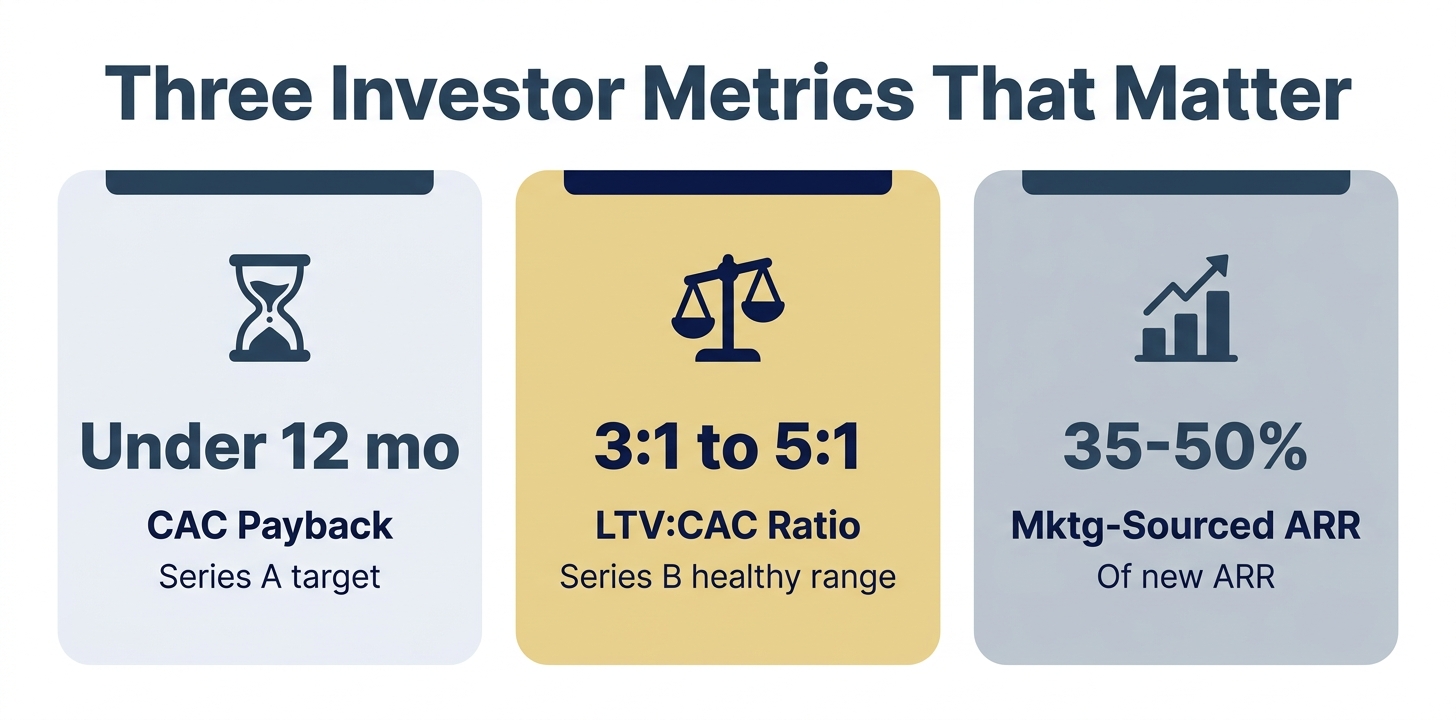
When investors evaluate your startup, three metrics do most of the heavy lifting: CAC Payback Period, LTV:CAC ratio, and Marketing-Sourced Revenue. These aren't just internal tracking numbers. They're the signals your board uses to decide whether your growth engine is real or fragile.
Here's what each one means, why it matters, and how to calculate it.
1. CAC Payback Period
This metric tells investors how long it takes you to recover what you spent to acquire a customer. It's the clearest signal of capital efficiency.
A long payback period means you're burning cash fast and betting on future revenue. A short one means you're getting your money back quickly and can reinvest sooner.
How to calculate it:
CAC Payback Period = CAC ÷ (Monthly Recurring Revenue per customer × Gross Margin %)
What good looks like:
- Series A: target under 12 months
- Series B: target 12 to 18 months
According to CAC payback benchmarks from Foundry CRO, companies hitting under 12 months at Series A are in the top tier for investor readiness. Series B allows a slightly longer window because you're investing in larger, slower-compounding channels.
2. LTV:CAC Ratio
This ratio shows whether the customers you're acquiring are worth more than they cost to acquire. It's the single best metric for showing long-term business viability.
If your LTV:CAC is too low, you're overpaying for customers who don't stick around. If it's too high, you may actually be under-investing in growth.
How to calculate it:
LTV = (Average Revenue per Account × Gross Margin %) ÷ Churn Rate
LTV:CAC = LTV ÷ CAC
What good looks like for Series B B2B SaaS:
- 3:1 = healthy minimum
- 4:1 = strong
- 5:1+ = excellent, but watch for under-investment
According to 2026 LTV:CAC benchmarks from Growth Spree, Series B SaaS companies in the top quartile hit 5:1 or better. But a ratio above 5:1 often signals you should be spending more on acquisition, not less.
3. Marketing-Sourced vs. Marketing-Influenced Revenue
This is the metric that tells your board marketing isn't just a cost center. It shows direct contribution to growth.
Marketing-Sourced Revenue counts deals where marketing generated the first touch. Marketing initiated the relationship.
Marketing-Influenced Revenue counts deals where marketing touched the prospect at any point, even if sales opened the door.
Both matter. But sourced revenue is the harder number and the one that builds board confidence fastest.
How to track it:
Marketing-Sourced Revenue % = (New ARR from marketing-generated pipeline ÷ Total New ARR) × 100
As Growthspree's B2B SaaS board reporting guide puts it: "Communicate marketing's contribution in the language of the business: pipeline, revenue, growth, and efficiency."
That's exactly what this metric does.
Quick Reference: Investor Metrics at a Glance
| Metric | Formula | Series A Target | Series B Target |
|---|---|---|---|
| CAC Payback Period | CAC ÷ (MRR per customer × Gross Margin) | Under 12 months | 12 to 18 months |
| LTV:CAC Ratio | LTV ÷ CAC | 3:1 minimum | 4:1+ strong |
| Marketing-Sourced Revenue | Marketing-gen pipeline ÷ Total New ARR | 25 to 35%+ | 35 to 50%+ |
Knowing these numbers cold before a board meeting isn't just smart. It's the difference between a conversation about strategy and a conversation about survival.
If you're a seed or Series A startup without a marketing leader who speaks this language yet, that's a gap worth closing fast. Teams like The Zulu Method help founders build the metrics infrastructure and reporting cadence that makes these conversations with investors feel straightforward instead of stressful.
Planning the Transition: From Series A to Series B Marketing Goals
To set marketing goals at Series A and B, you need more than two separate playbooks. You need a transition plan. The shift from Series A to Series B doesn't happen at the moment you close the round. It starts six months before, when your marketing team, budget, and systems need to evolve before the pressure is on.
Here's how to plan that transition without scrambling.
The 6-Month Transition Timeline
Most founders treat Series B prep as a fundraising exercise. But the marketing work that makes Series B possible happens long before you open any investor conversations.
Sheet Venture's analysis of Series A vs. Series B pitch shifts puts it plainly: Series A investors want proof you can sell. Series B investors want proof you can scale. That's a different team structure, a different budget model, and a different tech stack.Months 1 to 2: Audit your go-to-market motion
Before you change anything, know what you have. Which channels are producing consistent, qualified pipeline? Which metrics are you actually tracking versus guessing at?
If you can't answer those questions confidently, that's your first gap to close.
Months 3 to 4: Hire your first specialists
Series A marketing is often generalist. A content person who also runs paid. A founder who handles community and outbound. That works until it doesn't.
At Series B, channel-specific expertise matters. A demand generation specialist, a content strategist, and a marketing operations hire are the three roles that move the needle most.
Months 5 to 6: Model your budget and build your systems
Series B investors expect your marketing budget to scale efficiently. That means moving from ad hoc spend to a documented budget model with channel-level targets and attribution.
It also means investing in marketing automation if you haven't yet. Tools that track lead scoring, nurture sequences, and pipeline attribution become table stakes as volume increases.
Team, Budget, and Tech Stack: What to Evolve
| Area | Series A State | Series B Ready State |
|---|---|---|
| Team | 1 to 2 generalists or fractional support | First specialists hired (demand gen, content, ops) |
| Budget model | Experimental spend by channel | Documented allocation with channel targets |
| Attribution | Basic UTM tracking | Full-funnel attribution with pipeline reporting |
| Marketing automation | Email tool only | CRM-integrated automation with lead scoring |
| Reporting cadence | Monthly or ad hoc | Weekly pipeline reviews, monthly board reporting |
If you're approaching Series B without a senior marketing leader yet, this is where a fractional team can bridge the gap. Teams like The Zulu Method are built for exactly this window: helping seed and Series A startups put the systems, reporting, and go-to-market structure in place without waiting six to nine months to hire in-house.
Series B Marketing Readiness Checklist
Use this checklist to identify gaps before investor conversations start:
Metrics and reporting
- [ ] LTV:CAC ratio is tracked and above 3:1
- [ ] CAC payback period is measured and under 18 months
- [ ] Marketing-sourced revenue is tracked as a percentage of new ARR
- [ ] Weekly pipeline velocity report exists and is reviewed with sales
Channels and budget
- [ ] At least two channels have consistent, repeatable conversion data
- [ ] Budget is allocated by channel with documented targets
- [ ] Paid media spend is tracked to pipeline, not just clicks
Team and systems
- [ ] At least one channel specialist is in place or contracted
- [ ] CRM and marketing automation are integrated
- [ ] Lead scoring model is active and reviewed monthly
Narrative and positioning
- [ ] ICP is documented and validated with closed-won data
- [ ] Messaging is tested and consistent across channels
- [ ] Board-ready marketing update exists with pipeline, efficiency, and channel performance
According to Investopedia's breakdown of Series B funding dynamics, Series B rounds typically go to companies that have already proven their business model and now need capital to scale. That means by the time you're in diligence, your marketing engine should already be running, not being built.
The founders who close Series B fastest aren't the ones who scramble to build a growth story during the raise. They're the ones who spent the six months before that building the evidence.
Series A to B Marketing Readiness: Questions to Ask Your Team
- Can we clearly explain which channels are producing consistent, qualified pipeline and which are not?
- Do we have documented unit economics with accurate CAC, LTV, and payback period calculations for each major channel?
- Is our CRM and marketing automation integrated with full-funnel attribution and lead scoring active?
- Can we produce a weekly pipeline velocity report that sales and leadership actually review and act on?
- Have we hired or contracted at least one channel specialist (demand gen, content, or ops) to support scale?
- Do we have a documented marketing budget model with channel-level targets and a clear allocation between proven channels and new tests?
- Is our ICP documented and validated with closed-won customer data, not just assumptions?
- Can we produce a one-page board-ready marketing update that ties our activities directly to pipeline, revenue, and efficiency metrics?
How to Report Marketing Goal Progress to Your Board
Reporting marketing progress to your board comes down to one shift: stop sending dashboards and start telling a story. The most effective board update follows a simple four-part structure: here was our goal, here's our progress, here's what we learned, and here's our plan. That's it.
Lead With the Narrative, Not the Numbers
Raw metrics without context frustrate boards. As Coppett Hill's guide to marketing updates for PE boards puts it: "Numbers without context can be confusing and frustrating." Give every number a story.
Don't read off a list of stats. Show trends. Explain why a number moved. And be honest about misses. Boards respect transparency far more than spin.
TechCrunch's guide to board meeting marketing slides recommends covering priorities, performance, pipeline, positioning, and next-quarter plans. That structure works because it answers what the board actually wants to know.The 1-Page Marketing Board Update Template
Use this structure to keep your update tight and board-ready:
| Section | What to Include |
|---|---|
| **Headline** | On track / ahead / behind plan, in one sentence |
| **Key Metrics** | Pipeline created, CAC trend, LTV:CAC ratio |
| **Wins** | 1 to 2 specific wins with numbers and context |
| **Challenges** | What missed, why it missed, what you're doing about it |
| **Next Quarter** | Top 2 to 3 priorities and what you need (the ask) |
Keep the whole thing to one page or one slide. If it needs more space, you're reporting activities instead of outcomes.
Tips for Presenting Data Effectively
Show trends, not snapshots. A single month's pipeline number means little. Three months of pipeline trend tells the board whether your growth engine is accelerating or stalling.
Speak the language of the business. Sorenson Capital's board deck guide is direct: "Tie marketing to revenue and other positive outcomes." If you're talking about impressions or click rates, you've already lost the room.
Address misses proactively. Don't wait for a board member to spot a problem. Surface it yourself, explain what happened, and come with a plan. That builds more trust than a clean-looking report that papers over problems.
If you're still building the reporting infrastructure to make these updates feel easy, that's exactly the kind of work The Zulu Method helps seed and Series A founders put in place before board conversations get uncomfortable.
Your Marketing Goals Can Drive Your Next Funding Round
To set marketing goals at Series A and B, start with this: Series A is about proving your model works, and Series B is about scaling it efficiently. The right goals at each stage don't just guide your team. They build the investor confidence that drives your next round.
Here's the core journey in three takeaways.
From Proof to Scale: The Journey That Matters
At Series A, your marketing job is to answer one question: can we find, convert, and keep customers repeatably? Every goal you set should generate evidence for that answer.
At Series B, the question changes. Now investors want to know whether you can do that at volume, with efficiency, every quarter. That's a fundamentally different challenge.
As Visible.vc's VC portfolio monitoring guide makes clear, early-stage investors focus on traction and growth signals, while later-stage investors shift their attention to efficiency, retention, and margin. Your marketing goals need to match that shift.
The Right Goals Build Valuation and Investor Confidence
Marketing goals aren't just internal targets. They're your growth story made measurable.
When your LTV:CAC ratio holds above 3:1, your CAC payback is tracking under 18 months, and marketing-sourced revenue is a growing share of new ARR, you're not just hitting benchmarks. You're building a narrative that makes the next funding conversation easier.
According to Harvard Business School's research on how VCs make decisions, investors rely heavily on quantitative signals when evaluating portfolio performance. The metrics your marketing team owns are a direct input to that evaluation.
Take Ownership of This Process
Marketing goal-setting isn't a departmental exercise. It's a strategic business function that belongs at the founder and CEO level.
The startups that close rounds fastest aren't the ones who scramble to build a growth story during diligence. They're the ones who spent the prior six months building the evidence.
If you're a seed or Series A startup without a marketing leader who can drive this process yet, that gap doesn't have to slow you down. Teams like The Zulu Method are built specifically for this window, helping founders build the marketing goals, metrics infrastructure, and go-to-market systems that make investor conversations feel like a progress update rather than a performance review.
Your marketing goals, set right and communicated clearly, are one of the most powerful tools you have for controlling your fundraising timeline.

What are the top 3 marketing goals for a Series A startup? The top 3 goals are: (1) Generate consistent lead or demo volume to prove demand, targeting 15 to 30% month-over-month growth in qualified leads (Lead Velocity Rate). (2) Build a foundational sales pipeline of 3 to 5x the revenue target to show future revenue potential. (3) Validate one or two primary acquisition channels to prove the GTM strategy is viable and repeatable.
How much should a Series A or B company spend on marketing? Series A companies typically allocate 12 to 18% of revenue to marketing, while Series B companies spend around 11 to 16% of revenue. Some high-growth SaaS companies may spend 40 to 60% of revenue if they have recently raised capital and are prioritizing rapid growth. The key is to tie spend to efficiency metrics like CAC payback period, not just a fixed budget percentage.
What is a good LTV:CAC ratio for a Series B company? Investors typically look for an LTV:CAC ratio of 3:1 or higher for a healthy Series B business. A ratio of 4:1 is considered strong, and 5:1 or higher is excellent and indicates strong potential for profitable growth. A ratio below 3:1 may suggest issues with pricing, churn, or customer acquisition costs that need attention.
How do marketing goals differ for B2B vs. B2C at Series A? B2B goals often focus on pipeline value, account-based engagement, and sales cycle length, with a smaller number of high-value customers driving success. B2C goals focus on user acquisition volume, lower CAC, engagement rates like DAU/MAU, and viral coefficients, dealing with a much larger user base and faster transaction cycles.
What role do 'brand' goals play at Series A? Should we even focus on it? At Series A, brand goals are not about expensive advertising campaigns. They are about achieving narrative-market fit, becoming known within a niche, and earning early customer love. Goals could include getting featured in 3 key industry podcasts, increasing direct or branded search traffic by 50%, or securing 20 positive G2 or Capterra reviews to build trust signals.