
Hannon Brett | Published on: July 06, 2026 | Time to read: 25 min
What Is a Fractional Chief Marketing Officer?
A fractional chief marketing officer is a senior marketing executive who works with your company on a part-time or contract basis. You get real C-suite strategy and leadership without hiring someone full-time. It's the same expertise, just a fraction of the commitment and cost.
How It Differs From Other Marketing Help
A lot of business owners confuse fractional CMOs with agencies or freelancers. But they're actually very different types of support.
| Type | What They Do | Strategic Leadership? | Cost Level |
|---|---|---|---|
| Full-time CMO | Leads all marketing, full-time employee | Yes | $200K–$700K+ salary |
| Fractional CMO | Leads strategy part-time, on contract | Yes | $5K–$25K/month |
| Marketing Agency | Executes campaigns and creative work | Rarely | Varies widely |
| Freelance Consultant | Advises on specific tasks or projects | Sometimes | Hourly or project fee |
According to chief compensation data from ChiefJobs, a full-time U.S. CMO typically earns $400,000 to $2 million or more in total compensation per year. A fractional CMO, by contrast, generally runs $5,000 to $25,000 per month. That's a massive difference for growing companies watching their budgets.
The Core Value Proposition
Think of it like hiring an experienced architect. You bring them in to design the plan, set the vision, and make sure everything is built correctly. But you don't need them on-site every day hammering nails.
A fractional CMO does the same thing for your marketing. They set the strategy, lead the team, and make the big calls. And they do it without the overhead of a full-time executive hire.
This is why the fractional model is growing so fast. Businesses get real strategic leadership at a price that actually makes sense for where they are right now.
What Does a Fractional Chief Marketing Officer Actually Do?

A fractional chief marketing officer handles the full range of senior marketing responsibilities, just on a part-time or contract basis. They build your strategy, lead your team, and use data to drive decisions. Here's a breakdown of exactly what that looks like in practice.
Strategic Planning and Brand Positioning
The biggest job a fractional CMO takes on is building your marketing plan from the ground up. That means figuring out where your brand sits in the market, who you're talking to, and how to stand out from competitors.
They'll define your positioning and messaging. They'll set priorities for where to invest your marketing budget. And they'll map out a clear plan that ties marketing activity directly to business growth goals.
This isn't guesswork. A good fractional CMO brings years of pattern recognition from working across many companies and industries. They know what works and what wastes money.
Leading Teams and Managing Execution
Fractional chief marketing officers don't just hand you a strategy document and disappear. They actually lead the people doing the work.
That could mean managing your internal marketing staff, directing external agencies, or building out a mix of both. They set priorities, run team meetings, review creative work, and make sure campaigns ship on time and on budget.
Think of them as the person holding everything together. Without that leadership layer, even a great strategy falls apart in execution.
Analytics, KPIs, and Data-Driven Decisions
A fractional CMO also owns the measurement side of marketing. They set up the right tracking systems, define which metrics actually matter, and build reporting that tells you what's working.
According to fractional CMO success metrics research from SaaSHero, the most important KPIs in the first six months include marketing-sourced pipeline, customer acquisition cost payback period, and MQL-to-SQL conversion rates. These are real business metrics, not vanity numbers like follower counts.
This analytical function is where a lot of growing companies see immediate value. Many businesses are flying blind without clear data. A fractional CMO fixes that fast.
A Quick Summary of Core Responsibilities
Here's what a fractional chief marketing officer typically owns:
- Marketing strategy: Building the overall plan, setting direction, and aligning marketing to revenue goals
- Brand and positioning: Defining how your company is perceived in the market
- Budget allocation: Deciding where to spend and where to cut
- Team leadership: Managing internal staff, agencies, and contractors
- Campaign oversight: Making sure execution matches the strategy
- KPI tracking: Setting up measurement and reporting on what matters
- Data analysis: Using performance data to adjust and improve over time
The scope can flex based on what your business needs most. Some companies need heavy strategy work upfront. Others need stronger team leadership. A fractional CMO adapts to where the real gaps are.
Top Reasons Your Business Should Hire a Fractional CMO
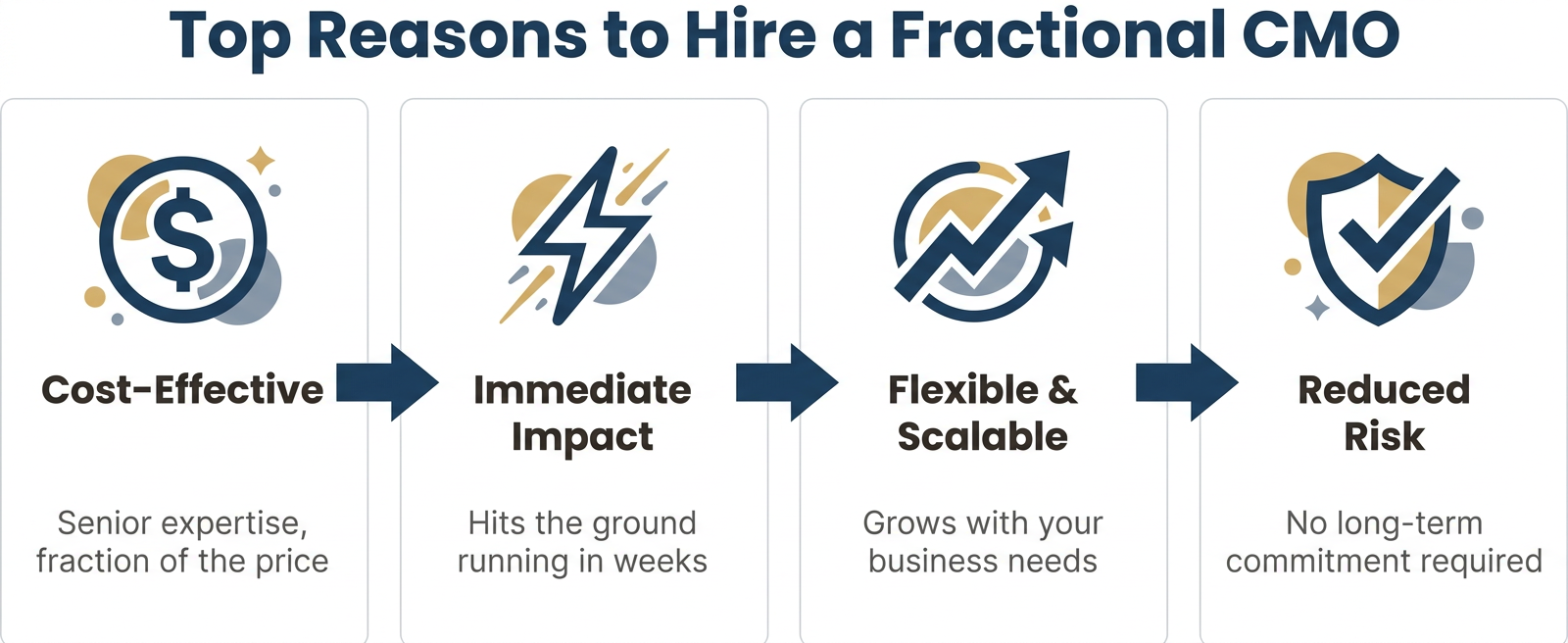
Hiring fractional chief marketing officers gives growing businesses access to C-suite marketing leadership without the cost or commitment of a full-time executive. You get senior strategy, team leadership, and measurable results right away. Here are the top reasons more companies are making this choice.
Cost-Effectiveness: Big Talent Without the Big Price Tag
Full-time CMO compensation is expensive. When you factor in base salary, bonuses, benefits, stock options, and equity, you're looking at a significant budget commitment before a single campaign launches.
Fractional chief marketing officers flip that equation entirely. You pay a monthly retainer for the exact hours and scope you need. No benefits packages. No equity dilution. No recruiter fees.
According to compensation data from MyPersonalRecruiter, total CMO compensation at growth-stage companies routinely runs well into seven figures when stock and bonuses are included. A fractional model gives you the same caliber of strategic thinking at a fraction of that cost.
For companies that need senior marketing leadership but can't justify a full executive salary, this is the clearest reason to go fractional.
Immediate Impact: No Long Learning Curve
Traditional executive hiring takes time. There's the search process, the offer negotiation, the notice period, and then months of onboarding before the new hire makes real decisions.
Fractional chief marketing officers skip most of that. They've done this before, across many companies and industries. They know what questions to ask on day one and what problems to prioritize in the first 30 days.
As Fractionus notes in their executive hiring research, fractional leaders can plug capability gaps in under two weeks compared to the three to six month timeline of a traditional executive search. That speed difference matters when your business is growing fast and can't afford to wait.
You get someone who hits the ground running, not someone still finding their footing after six months.
Flexibility and Scalability: Marketing Leadership That Grows With You
Business needs change. Your marketing leadership should too.
Fractional chief marketing officers work on terms that flex with your business. Early-stage companies might start with lighter-scope engagements. As revenue grows, the scope can expand to cover more channels, bigger budgets, and larger teams.
This scalability matters especially for B2B companies going through growth phases, funding rounds, or major market shifts. You're not locked into a fixed headcount or salary structure.
According to market research from DataIntelo, the global fractional executive market is estimated at $5.7 billion in 2025 and growing at roughly 14% per year. Demand jumped 46% year over year in 2024 alone. Businesses aren't just trying this model. They're doubling down on it.
The flexibility to scale up or pull back based on cash flow and growth stage is one of the biggest reasons companies choose fractional over full-time.
Why the Timing Is Right
The fractional model isn't a workaround. It's a strategic choice that more businesses are making deliberately.
- Cost control: Senior expertise without executive overhead
- Speed: Impact in weeks, not quarters
- Flexibility: Scale the engagement as your needs change
- Reduced risk: No long-term employment commitment or severance exposure
- Breadth of experience: Leaders who've solved similar problems across multiple industries
For mid-market B2B companies in particular, the fractional model solves a real problem. You need someone who can build a real marketing engine, not just manage campaigns. But a full-time CMO hire may not be justified yet.
That's exactly the gap fractional chief marketing officers are built to fill.
Real-World Example: B2B SaaS Growth Impact
A fast-growing B2B SaaS company engaged a fractional CMO to move beyond founder-led marketing and scale strategically. Within twelve months, the company achieved 51% year-over-year revenue growth and a nearly 50% increase in share price. The fractional CMO owned marketing strategy, refined positioning to differentiate from competitors, established clear pipeline targets, and led the internal team to execute consistently. Additional outcomes included 30% increase in lead acquisition, 135% growth in website traffic, and fourfold monthly lead growth, demonstrating how strategic leadership transforms marketing from reactive tactics to a true revenue engine.
Signs You Need a Fractional Chief Marketing Officer
Not every business needs a fractional chief marketing officer right now. But some clear warning signs tell you the gap is real. If any of these three situations sound familiar, it's worth taking seriously.
Your Marketing Results Are Inconsistent
One month brings solid leads. The next month brings almost nothing. There's no clear pattern, no repeatable system, and no one owns the strategy from end to end.
This is sometimes called "random acts of marketing." You run a campaign here, try a new channel there, and hope something sticks. It rarely does.
Fractional chief marketing officers are built to fix exactly this. They bring structure, a clear plan, and a system that produces consistent results instead of lucky wins.
You're the CEO and Also the Marketing Team
A lot of founders end up as the default marketing lead. You're writing copy, approving ads, sitting in on agency calls, and still trying to run the rest of the business.
That's a real problem. Your time should go toward leadership, vision, and growth decisions, not day-to-day marketing tasks.
According to GTM 80/20's fractional CMO statistics, one of the top reasons founders bring in fractional chief marketing officers is to reclaim their own bandwidth. Getting out of the marketing weeds lets you focus on what actually moves the business forward.
Your Junior Team Has No Strategic Direction
Maybe you have a small marketing team that's great at getting things done. They can run social media, write emails, and manage tools. But they don't know what to prioritize or why.
Execution without strategy leads to busy work. Your team works hard but the results don't connect to revenue goals.
Fractional chief marketing officers step into this gap perfectly. They provide the senior leadership your team needs, set clear priorities, and mentor junior marketers to grow their skills over time. The team keeps executing. Now they're executing the right things.
Quick Self-Check: Do You Recognize Any of These?
- Marketing results change month to month with no clear reason
- You, the CEO, are making most marketing decisions personally
- Your team is great at tasks but nobody owns the overall strategy
- New campaigns launch without clear goals or success metrics
- You're not sure which marketing activities are actually driving revenue
If two or more of these hit close to home, you're likely past the point where more freelancers or another agency retainer will fix things. What you need is senior strategic leadership, and that's exactly what fractional chief marketing officers provide.
A fractional CMO is one line in a wider budget. Here's how the rest of it breaks down, stage by stage, in our guide to SaaS marketing budget by funding stage.
How Much Do Fractional Chief Marketing Officers Cost?
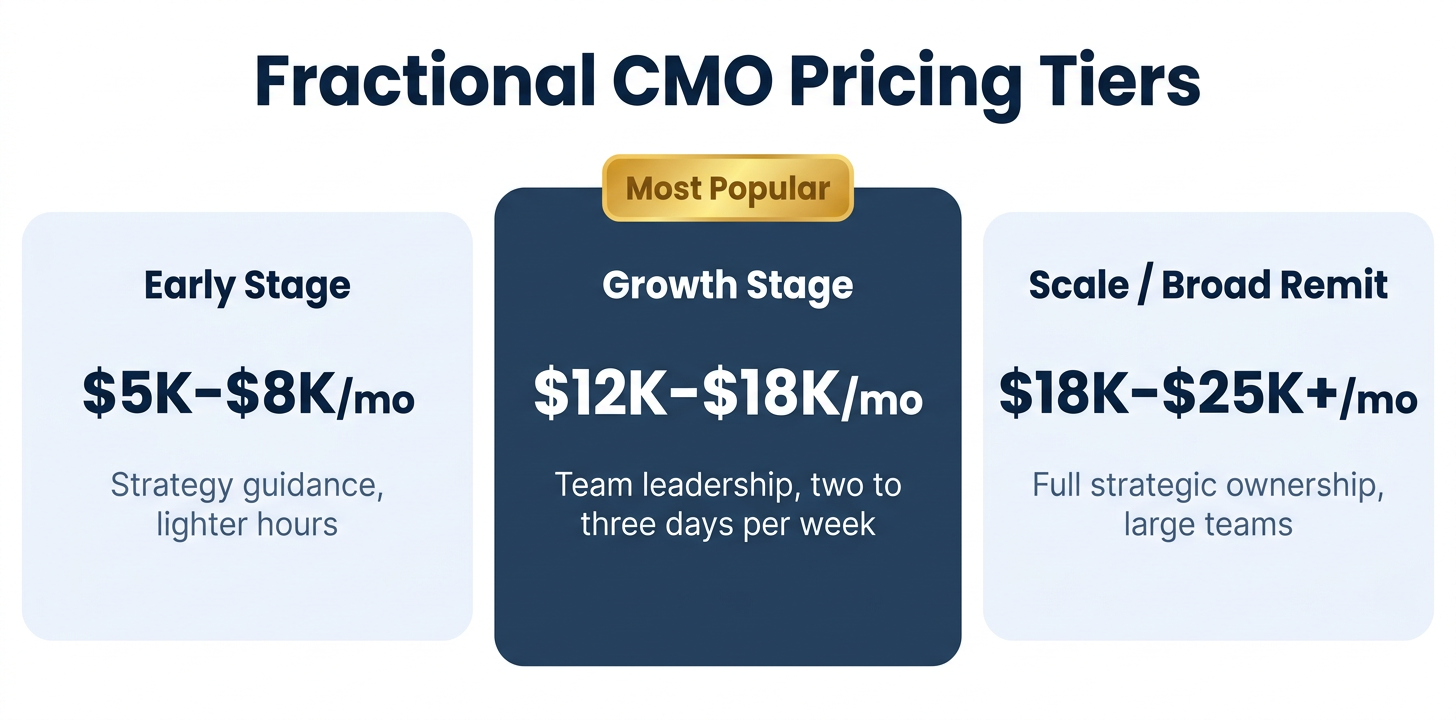 Fractional chief marketing officers typically cost between $5,000 and $25,000 per month on a retainer. You can also find hourly rates from $200 to $500, or project-based fees from $10,000 to $50,000. The right model depends on how much strategic leadership your business needs right now.
The Three Common Pricing Models
There's no single way to pay for fractional marketing leadership. Most fractional chief marketing officers offer three pricing structures:
- Monthly retainer: The most common model. You pay a set fee each month for a defined scope of work and hours. Gives you ongoing strategic leadership without surprises.
- Hourly rate: Works for lighter or early-stage engagements. Rates typically run $200 to $500 per hour, depending on experience and specialization.
- Project-based fee: Best for specific needs like a brand overhaul, product launch, or go-to-market strategy. Usually ranges from $10,000 to $50,000 per project.
Most growing businesses end up on monthly retainers. It creates a consistent relationship and lets the fractional CMO build real momentum over time.
What Retainer Costs Look Like by Engagement Size
According to fractional CMO pricing research from Winston François, retainer costs break down roughly like this:
| Engagement Type | Monthly Cost | Typical Scope |
|---|---|---|
| Early-stage / lighter scope | $5,000–$8,000 | Strategy guidance, fewer hours per week |
| Growth-stage B2B | $12,000–$18,000 | 2–3 days per week, team leadership |
| Scale / broader remit | $18,000–$25,000+ | Full strategic ownership, larger teams |
Established fractional chief marketing officers with strong track records often charge $12,000 to $15,000 for engagements requiring two to three days of work per week.
What Drives the Price Up or Down
A few key factors move the number in either direction:
- Experience level: A CMO who's scaled multiple companies to $50M+ will charge more than someone newer to the fractional model.
- Industry complexity: B2B SaaS, healthcare, and fintech often require deeper expertise and command higher fees.
- Hours per week: More hours mean more cost. Simple as that.
- Scope of responsibility: Managing an internal team and three agencies costs more than pure strategy advising.
For mid-market B2B companies, the $12,000 to $18,000 range tends to be the sweet spot. You get serious strategic leadership with enough hours to actually move things forward.
Is It Worth the Investment?
When you compare the cost of fractional chief marketing officers against full-time executive compensation, the math is clear. You're getting C-suite marketing leadership at a fraction of what a full-time hire would cost in salary alone, before benefits, bonuses, or equity.
If you're working with a team like The Zulu Method, fractional marketing leadership can also be layered into a broader system for scaling B2B marketing operations without the overhead of a full executive build-out.
The key is matching the engagement model to your actual needs, so you're paying for the right level of leadership at the right time.
How to Hire the Right Fractional CMO for Your Business
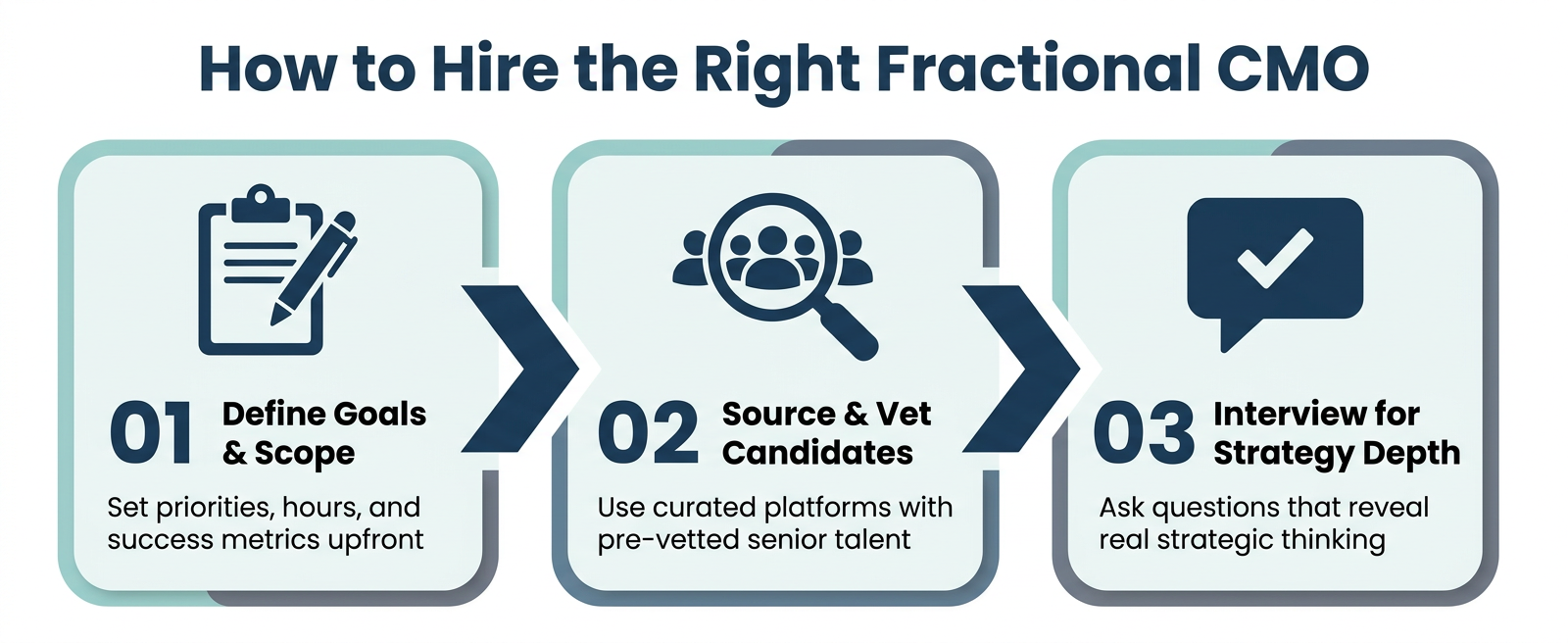
Hiring the right fractional CMO comes down to three steps: define your goals, find vetted candidates through the right sources, and ask the questions that reveal real strategic depth. Get these steps right and you'll bring in a leader who can move fast and make a measurable difference.
Step 1: Define Your Goals and Scope
Before you talk to a single candidate, get clear on what you actually need. Vague goals lead to vague results.
Write down your top two or three marketing priorities for the next six to twelve months. Are you trying to build a pipeline from scratch? Fix a brand positioning problem? Scale a channel that's already working? The answer shapes everything about the engagement.
Also decide on scope upfront. How many hours per week do you need? Will this person manage your internal team, your agency, or both? What does success look like at the end of month six?
This clarity protects you. It also helps candidates quickly tell you if they're the right fit.
Step 2: Sourcing and Vetting Candidates
Not every platform gives you the same quality of talent. Here's where to look:
- GTM 80/20: Highly selective, built for B2B SaaS, with a reported 3% acceptance rate. Talent is pre-vetted by experienced marketers from top tech companies.
- GrowTal: A pre-vetted network that emphasizes senior leadership experience and measurable outcomes.
- Fractionus: Good for businesses in the US, UK, or Australia that want a shortlist of vetted fractional executives fast.
- Arc: Offers pre-screened fractional CMOs with an expedited matching process.
- LinkedIn: The broadest discovery layer for initial sourcing, though less curated than specialized platforms.
According to GrowTal's guide to fractional CMO hiring, the best candidates show up with case studies tied to real business outcomes, not just campaign metrics. Look for measurable results: revenue growth, pipeline growth, CAC reduction.
Skip candidates who lead with impressions and follower counts. Those aren't the numbers that grow a business.
Step 3: The Interview Process
The interview is where you separate strategic thinkers from tactical executors. Ask questions that require real thinking, not rehearsed answers.
Here are five questions that reveal genuine strategic depth, based on interview frameworks from Demand Revenue:
- What would you need to diagnose in the first 30 to 90 days before recommending changes? This shows whether they lead with analysis or jump straight to tactics.
- Where do you usually find the real growth constraint? A strong answer will reference positioning, pipeline, conversion, or retention. Not just "more content."
- How do you decide what marketing should own at a company like ours? This reveals how they think about marketing's role in revenue and sales velocity.
- What would your 90-day priority stack look like, and what would you explicitly not do? Great candidates know that saying no is part of good strategy.
- How do you align marketing with sales, product, and executive leadership? This tests cross-functional experience and whether they can operate inside a real organization.
Pay close attention to how they handle the last question. Fractional chief marketing officers who can't align across departments often struggle to make real impact, no matter how sharp their strategy is.
If you're a mid-market B2B company looking for a structured approach to this process, teams like The Zulu Method help businesses build the right marketing leadership model before they ever hire.
Questions to Ask When Considering a Fractional CMO
- What would you need to diagnose in the first 30–90 days before recommending changes to our marketing strategy?
- Where do you usually find the real growth constraint: positioning, pipeline, conversion rates, retention, or team capability?
- How do you decide what marketing should own versus what sales or product should own in a company like ours?
- What would your 90-day priority stack look like, and what would you explicitly NOT do to maintain strategic focus?
- How do you align marketing with sales, product, and executive leadership to ensure cross-functional collaboration?
- What baseline metrics will we establish on day one, and which leading indicators should we track in the first six months?
- Can you share a case study of a company similar to ours where you improved marketing-sourced pipeline and reduced CAC?
Unique Value: Integrating Your Fractional CMO with an Existing Team
Bringing a fractional CMO into an existing team isn't just a hiring decision. It's a change management moment. Get the integration right and everything clicks. Get it wrong and even a great CMO struggles to make real impact.
Here's how to set it up for success from day one.
Set Expectations With Your Team Early
Your internal marketers and freelancers need to hear clearly who this person is and why they're here. Without that conversation, people fill in the blanks themselves. And they usually fill them in wrong.
Be direct. Explain that the fractional CMO is here to lead strategy and provide senior direction. They're not here to replace anyone. They're here to help the whole team work smarter and toward clearer goals.
According to change management guidance from NMS Consulting, cultural resistance is one of the biggest risks when bringing in a fractional leader. Existing team members sometimes question the person's authority or see them as a temporary outsider. Addressing this upfront removes a lot of friction before it starts.
Define Communication Cadences and Reporting Structures
Vague check-ins lead to vague results. Build a real communication rhythm from the start.
A simple structure that works well for most engagements:
- Weekly check-ins: Short team syncs to review priorities, blockers, and in-flight campaigns
- Biweekly 1:1s: Direct alignment between the fractional CMO and the CEO or key stakeholder
- Monthly strategy meetings: Bigger-picture review of KPIs, pipeline, and what's working
This structure keeps everyone aligned without creating meeting overload. It also gives the fractional CMO clear touchpoints to share progress and adjust priorities as the business evolves.
Give Them Real Authority and Access
This one matters more than most people realize. A fractional CMO who can't access your data, tools, or key team members can't do the job properly.
Make sure they have:
- Full access to your CRM, analytics, and marketing platforms
- A clear seat at leadership conversations that affect marketing decisions
- The authority to direct your team, agencies, and freelancers within their scope
If they're expected to lead but treated like an outside vendor, the engagement stalls. Give them the access and decision-making authority the role requires, and they can move fast and make a real difference.
Unique Value: Measuring the ROI of a Fractional Chief Marketing Officer
Measuring the ROI of fractional chief marketing officers comes down to three things: setting baseline metrics before they start, tracking the right indicators during the engagement, and comparing total investment against real revenue gains.
Establish Your Baseline Before Day One
You can't measure improvement without knowing where you started. Before your fractional CMO begins, document your current numbers.
Key metrics to capture upfront include:
- Customer Acquisition Cost (CAC): How much you spend to win one new customer
- Customer Lifetime Value (LTV): How much revenue that customer generates over time
- MQL-to-SQL conversion rate: How many marketing leads actually become sales opportunities
- Lead velocity: How fast new leads are entering your pipeline each month
These become your comparison points at the 90-day and six-month marks.
Track Leading and Lagging Indicators Together
Not all results show up right away. That's why you need to watch two types of metrics.
Leading indicators show early momentum. Think website traffic growth, engagement rates, and MQL volume. These move first and signal that the strategy is working.Lagging indicators show the real business impact. Revenue growth, pipeline value, and market share take longer to shift. But they're the numbers that actually justify the investment.According to KPI research from Breakthrough3x, the top metrics to watch in the first six months include marketing-sourced pipeline, CAC payback period, and pipeline velocity. These connect marketing activity directly to business outcomes.
Calculate ROI With a Simple Formula
When it comes time to evaluate the engagement, the math isn't complicated.
Use this formula:
ROI = (Revenue from marketing minus total marketing cost) / Total marketing cost × 100So if your fractional CMO retainer runs $15,000 per month and your marketing-driven revenue grows by $90,000 over six months above baseline, you've generated $90,000 in incremental profit against $90,000 in fees. That's a 100% ROI before accounting for pipeline you haven't closed yet.
For a practical breakdown of this approach, Improvado's marketing ROI guide walks through how to tie campaign costs to actual revenue in a way business owners can use without a data team.
Compared to a full-time CMO hire, which carries significant salary, benefits, and equity costs, the math on fractional leadership tends to look even better once you factor in speed to impact and reduced overhead.
Conclusion: Is a Fractional CMO the Right Move for Your Growth?
Fractional chief marketing officers give growing businesses real C-suite marketing leadership without the cost or commitment of a full-time hire. You get senior strategy, team direction, and measurable results at a fraction of the price. If that trade-off sounds right for where your business is today, it probably is.
The Core Benefits at a Glance
Here's what the fractional model delivers:
- Strategic expertise: Senior marketing leadership from someone who's built growth engines before
- Cost savings: Pay only for the scope and hours you need, with no benefits, equity, or recruiter fees
- Flexibility: Scale the engagement up or down as your business changes
- Speed: Impact in weeks, not the months that come with a full-time executive search
- Reduced risk: No long-term employment commitment or severance exposure
According to Conrad Goldstein's analysis on the fractional leadership shift, demand for fractional executives jumped 68% year over year from 2023 to 2024. Businesses aren't experimenting with this model anymore. They're committing to it.
Who This Model Is Actually Built For
Fractional chief marketing officers work best for a specific type of company. You need real marketing strategy, not just campaign execution. But you're not quite at the stage where a full-time C-level hire makes financial sense.
That gap is exactly where fractional leadership fits. Mid-market B2B companies going through growth phases, funding rounds, or market expansion are the clearest fit. So are founders who've outgrown their own ability to lead marketing alongside everything else.
If your team is great at execution but lacks strategic direction, this is the model for you.
Your Actionable Next Step
Don't start by searching for candidates. Start with clarity.
Audit your current marketing efforts and write down your top two or three goals for the next twelve months. What's broken? What's missing? What would a win look like at the end of the year?
That clarity becomes your business case. It also helps you scope the engagement correctly and find a fractional CMO who's actually the right fit for where you're headed.
If you want a structured approach to building that foundation, teams like The Zulu Method help mid-market B2B companies define the right marketing leadership model before making any hiring decisions.
The fractional CMO model keeps growing because it works. The only question is whether now is the right time for your business to use it.
A: A fractional CMO is an individual expert who joins your leadership team to set strategy and provide senior direction, while an agency is a team of specialists focused on campaign execution and creative delivery. Fractional CMOs often manage and direct agencies as part of their strategic leadership role.
Q: How much does hiring a fractional CMO cost?A: Fractional CMOs typically charge monthly retainers ranging from $5,000–$8,000 for early-stage engagements, $12,000–$18,000 for growth-stage B2B companies, and $18,000–$25,000+ for scale or broader remit roles. Hourly rates run $200–$500/hour, and project-based fees typically range from $10,000–$50,000 depending on scope and experience level.
Q: What industries benefit most from a fractional CMO?A: While any industry can benefit, fractional CMOs are especially popular in B2B SaaS, tech, professional services, healthcare, and e-commerce, particularly for companies in high-growth phases. The model works best when companies need senior strategic leadership but haven't yet justified full-time C-level expense.
Q: How long is a typical fractional CMO engagement?A: Most engagements start with a 6–12 month commitment to allow sufficient time for strategy development, implementation, and measurement of initial results. Many successful relationships continue longer or scale up as business needs evolve.
Q: Can a fractional CMO manage my existing marketing team?A: Yes, this is a core function. A fractional CMO will provide strategic direction to your internal team, mentor junior staff, establish clear priorities, and help upskill your entire marketing department to execute more effectively against strategy.
Q: What are the essential skills for a great fractional CMO?A: Key skills include strategic thinking, data analysis, team leadership, budget management, cross-channel marketing expertise (digital, content marketing, product marketing), and strong communication. They must also demonstrate pattern recognition from past experiences and the ability to ask probing diagnostic questions before making recommendations.