
Hannon Brett | Published on: June 29, 2026 | Time to read: 26 min | Updated on: August 31, 2026
AI tools have become essential for B2B SaaS startups to achieve operational leverage, allowing lean teams to compete with larger companies by automating work across marketing, sales, and customer success. With 79% of equity-backed startups and 71% of bootstrapped startups already integrating AI, and 92% planning to increase usage by 2025, the strategic advantage now lies in selecting and implementing the right tools within an integrated tech stack powered by clean data.
Key Takeaways
- AI creates operational leverage, enabling small teams to produce output equivalent to much larger organizations through automation and smart workflows
- AI adoption in SaaS is no longer optional: 79% of equity-backed startups and 71% of bootstrapped startups have integrated AI into their products
- Marketing gains 41% revenue lift through AI personalization, sales sees 10-20% ROI increases, and customer success prevents churn through predictive analytics
- Tool selection must start with identifying your biggest bottleneck first, then evaluate integrations, data quality, and run a 30-60 day pilot before full rollout
- Integration matters more than individual tools. A connected AI stack built on a clean data foundation (CDP) outperforms disconnected tools
- Common pitfalls include poor data quality, lack of team training, and ignoring privacy compliance (GDPR/CCPA)
- Measure AI ROI using: (Time Saved + Revenue Gained + Churn Protected - Tool Cost) / Tool Cost × 100, with realistic 60-90 day evaluation windows
- Start small with one tool solving one real problem, measure results over 30 days, then expand based on proven ROI
Table of Contents
- The New Growth Engine: Why AI Tools Are a Must for B2B SaaS Startups
- Key Areas Where AI Tools Revolutionize B2B SaaS Operations
- How to Select the Right AI Tools for Your B2B SaaS Startup
- Building Your AI-Powered Tech Stack: A Guide for SaaS Startups
- Beyond the Hype: Avoiding Common Pitfalls with AI Tool Adoption
- A Practical Framework for Measuring AI Tool ROI in Your SaaS Startup
- Your Next Steps to Becoming an AI-Driven SaaS Powerhouse
The New Growth Engine: Why AI Tools Are a Must for B2B SaaS Startups
B2B SaaS startups and AI tools are now deeply connected. AI gives small teams the power to move faster, work smarter, and compete with much bigger companies. It turns limited resources into a real growth engine by automating work that used to require entire departments.
Doing More With Less
Every startup faces the same problem: big goals, small teams, tight budgets. AI tools change that equation fast. Instead of hiring 10 people to handle sales outreach, customer support, and content, a lean team can use AI to handle much of that work automatically.
This idea is called operational leverage. It means getting outsized results from the same inputs. A two-person marketing team using AI can produce the output of a team three times its size. That's a real competitive edge against larger, slower-moving companies.
The Numbers Tell the Story
AI adoption in SaaS is no longer optional. It's already the norm. According to SaaS Capital's research on AI adoption among private SaaS companies, 79% of equity-backed startups have already integrated AI into their products. Even bootstrapped startups are keeping pace, with 71% reporting AI integration.
And 92% of companies plan to increase AI usage by 2025. Startups that sit on the sidelines risk falling behind fast.
From Manual Work to Smart Workflows
The shift from manual processes to AI-driven workflows isn't just a tech upgrade. It's a survival strategy. Sales, marketing, and support teams that lean on AI tools move quicker and make better decisions with real data.
Cathy Gao from Sapphire Ventures has pointed out that AI lets companies hit high revenue targets with surprisingly lean teams. That's the kind of capital efficiency that makes investors pay attention and makes startups scale without burning through cash.
Putting AI at the core of daily operations isn't a future plan for B2B SaaS startups. It's the present reality for the ones growing fastest.
Key Areas Where AI Tools Revolutionize B2B SaaS Operations
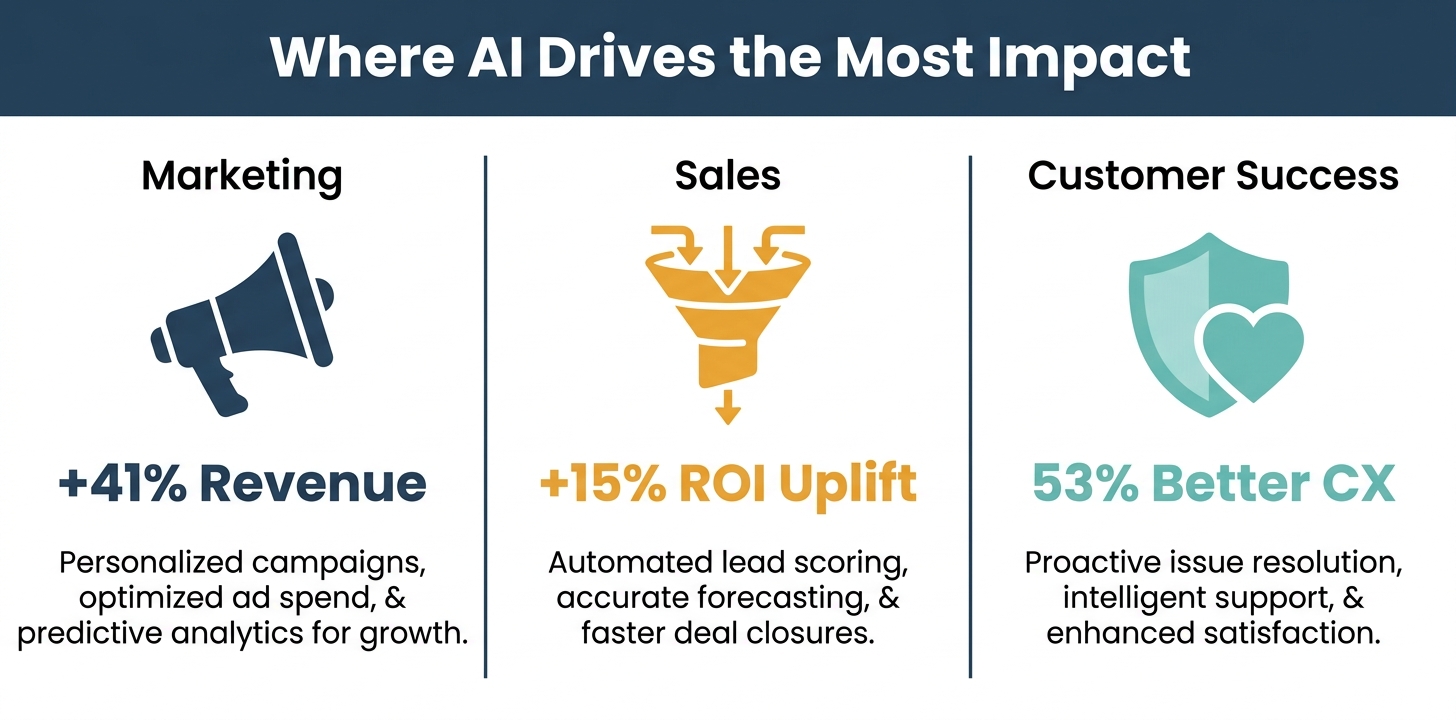
AI tools help B2B SaaS startups work faster across marketing, sales, and customer success. They cut costs, speed up growth, and reduce churn by automating the right work in the right places. Knowing where to apply AI first makes all the difference.
Marketing: Lower Costs, Better Targeting
Marketing is one of the fastest wins for AI in B2B SaaS. AI tools can analyze buyer behavior, personalize outreach, and test content automatically. This means your team spends less time guessing and more time acting on real signals.
The results speak for themselves. According to Omnisend's AI marketing statistics, AI-driven personalization can increase revenue by up to 41% and boost click-through rates by 13%. For a startup trying to lower customer acquisition costs, that kind of lift changes the whole growth math.
AI also helps with content creation, SEO, and ad targeting. Small teams can produce more campaigns, faster, without sacrificing quality. That's a direct path to a lower CAC without adding headcount, and it shows up fast when you measure against what a healthy CAC looks like at your stage.
Sales: Smarter Pipelines and Higher Conversion
In sales, AI tools help reps focus on the leads most likely to close. Predictive scoring, automated follow-ups, and conversation intelligence all remove the guesswork from the pipeline.
McKinsey's State of AI report found that companies investing in AI see a revenue uplift of 3 to 15% and a sales ROI increase of 10 to 20%. For a startup with a lean sales team, those numbers compound quickly.AI also shortens the sales cycle. Automated outreach, instant proposal generation, and smart scheduling free up reps to focus on building real relationships. And relationships close deals.
Customer Success: Reducing Churn Before It Happens
Churn is the silent killer of SaaS growth. AI tools give customer success teams an early warning system. They track product usage patterns, flag at-risk accounts, and trigger automated check-ins before customers quietly walk away.
This shift from reactive to proactive support is huge. Instead of chasing churned customers, you prevent the loss in the first place. That protects your monthly recurring revenue and keeps your net revenue retention healthy.
AI-powered support tools also handle routine questions automatically, cutting ticket volume and response times. Forbes Advisor's AI statistics note that 53% of small businesses report AI tools improve customer experiences. Better experiences mean longer customer lifetimes.
The Strategic Outcome Across All Three Areas
When you look at marketing, sales, and customer success together, a clear picture forms. AI doesn't just save time. It compounds growth by improving every stage of the customer journey.
Lower CAC from smarter marketing. Higher conversion from better sales targeting. Less churn from proactive customer success. Each pillar feeds the next, and AI sits at the center of all three.
This is why B2B SaaS startups that embed AI into core operations early build a structural advantage. It's not about using the latest tools. It's about building a growth engine that gets more efficient over time.
Smarter Marketing: From Content Generation to Lead Personalization
AI tools help B2B SaaS startups do more with their marketing budgets, whatever your funding stage says that budget should be. From writing content to targeting the right buyers, these tools cut the time and cost of reaching your audience. And they keep getting smarter the more you use them.
For content creation and SEO, tools like Jasper speed up blog posts, emails, and ad copy significantly. SurferSEO helps teams optimize content so it actually ranks. Small marketing teams can now produce high-quality content at a pace that used to require a full agency.
On the personalization side, AI-powered platforms analyze how individual leads behave and adjust messaging automatically. Instead of sending the same email to everyone, you send the right message to the right person at the right time. That kind of targeting used to take a data science team. Now it's automated.
According to Digital Marketing Institute's 2025 AI marketing stats, over 80% of marketers now use AI in some form. That tells you how quickly this has become standard practice.
The payoff is real. Better personalization means more clicks, more conversions, and a lower cost to acquire each customer. For a startup watching every dollar, that math matters a lot.
Accelerated Sales: AI-Powered Prospecting and Deal Closing
AI tools help B2B SaaS sales teams find better leads faster and close more deals with less effort. Instead of guessing which prospects are ready to buy, AI scores and ranks them automatically. That means reps spend time on the accounts most likely to convert.
Lead enrichment tools pull firmographic and intent data in real time. They fill in company size, tech stack, and buying signals without manual research. Your team walks into every conversation already knowing who they're talking to and what that person likely needs.
Conversation intelligence platforms take things further. They record and analyze sales calls, flag what top reps say differently, and coach the whole team based on what actually works. Over time, those insights compound into a measurable lift in win rates.
According to Inventive AI's research on AI tools for B2B revenue teams, AI-driven proposal automation has delivered 90% faster proposal cycles and 50% higher win rates for some B2B SaaS companies. Those aren't marginal gains. They're business-changing results.
For a lean startup sales team, this matters a lot. AI handles the repetitive work so reps can focus on relationships. And in B2B SaaS, relationships still close deals.
Proactive Support: Reducing Churn with AI and Automation
AI tools help B2B SaaS startups catch churn before it happens. Instead of reacting after a customer leaves, smart automation flags at-risk accounts early and triggers the right response automatically. That shift from reactive to proactive support is one of the highest-value moves a startup can make.
Intelligent chatbots and AI-powered ticketing tools handle routine support questions around the clock. They categorize incoming tickets, route complex issues to the right team, and resolve common problems without human involvement. This keeps response times fast and support costs low, even as your customer base grows.
Predictive churn tools go a step further. They analyze product usage data, login frequency, and engagement signals to score each account's health. When a customer starts showing signs of disengagement, the system alerts your team automatically so they can step in before the relationship breaks down.
According to Gainsight's research on customer success and AI, teams using AI-driven health scoring respond to at-risk accounts significantly faster than those relying on manual reviews. That speed is everything in SaaS retention.
For a lean startup team, this kind of automation means fewer customers lost and more revenue protected. And that directly improves net revenue retention, which is one of the most important metrics investors watch.
How to Select the Right AI Tools for Your B2B SaaS Startup

Choosing the right AI tools for your B2B SaaS startup means matching tools to real problems, not chasing trends. Start by identifying your biggest bottleneck, check how well each tool fits your existing stack, and always run a pilot before committing. A structured approach saves time, money, and a lot of frustration.
Step 1: Identify the Bottleneck First
Before looking at any tool, ask: where is your team losing the most time or money? Is it slow lead follow-up? High support ticket volume? Inconsistent content output? The answer to that question should drive every tool decision you make.
This is where most startups go wrong. They see a shiny new AI product and buy it without connecting it to a real problem. That's called "shiny object syndrome," and it kills ROI fast. A tool that doesn't solve a specific bottleneck just adds complexity without adding value.
Step 2: Evaluate Integration Capabilities
AI tools only work well when they connect smoothly to your existing systems. A tool that can't sync with your CRM, email platform, or support desk creates data silos instead of solving them.
According to Prismatic's guide on AI integrations for B2B SaaS, poor interoperability between tools is one of the top integration challenges companies face. Before you sign any contract, confirm the tool has native connectors to the platforms your team already uses daily.
Step 3: Assess Data Requirements
AI tools are only as good as the data you feed them. Check what data the tool needs to function well and whether your current setup can provide it cleanly. Poor data quality is one of the leading reasons AI projects fail to deliver expected results.
Also check privacy compliance. If you serve customers in Europe or California, your tools need to meet GDPR and CCPA requirements. Secure Privacy's guide on AI and data protection is a solid resource for understanding what compliance looks like in practice.
Step 4: Run a Pilot Program
Never roll out an AI tool company-wide without testing it first. Pick one team or one workflow, run the tool for 30 to 60 days, and measure the results against a clear baseline. Did ticket volume drop? Did conversion rates improve? Did your team actually use it?
A pilot gives you real data to make a go or no-go decision. It also helps your team build confidence with the tool before it becomes part of daily operations.
Vendor Checklist: Questions Worth Asking
When you talk to any AI vendor, don't skip these questions:
- Security: How is our data stored and protected? Who has access?
- Scalability: Can the tool grow with us from 10 to 1,000 customers?
- Support: What does onboarding look like? Is there a dedicated success team?
- Integrations: What does your native connector list look like for our current stack?
- Compliance: Are you GDPR and CCPA compliant? Can you provide documentation?
- Contract terms: Is there a trial period or a usage-based pricing option?
According to G2's vendor evaluation framework, checking user reviews, integration depth, and support quality before buying significantly reduces the risk of a bad fit.
Taking the time to follow this process isn't slow. It's smart. The startups that pick AI tools carefully are the ones that get lasting results instead of expensive lessons.
Building Your AI-Powered Tech Stack: A Guide for SaaS Startups
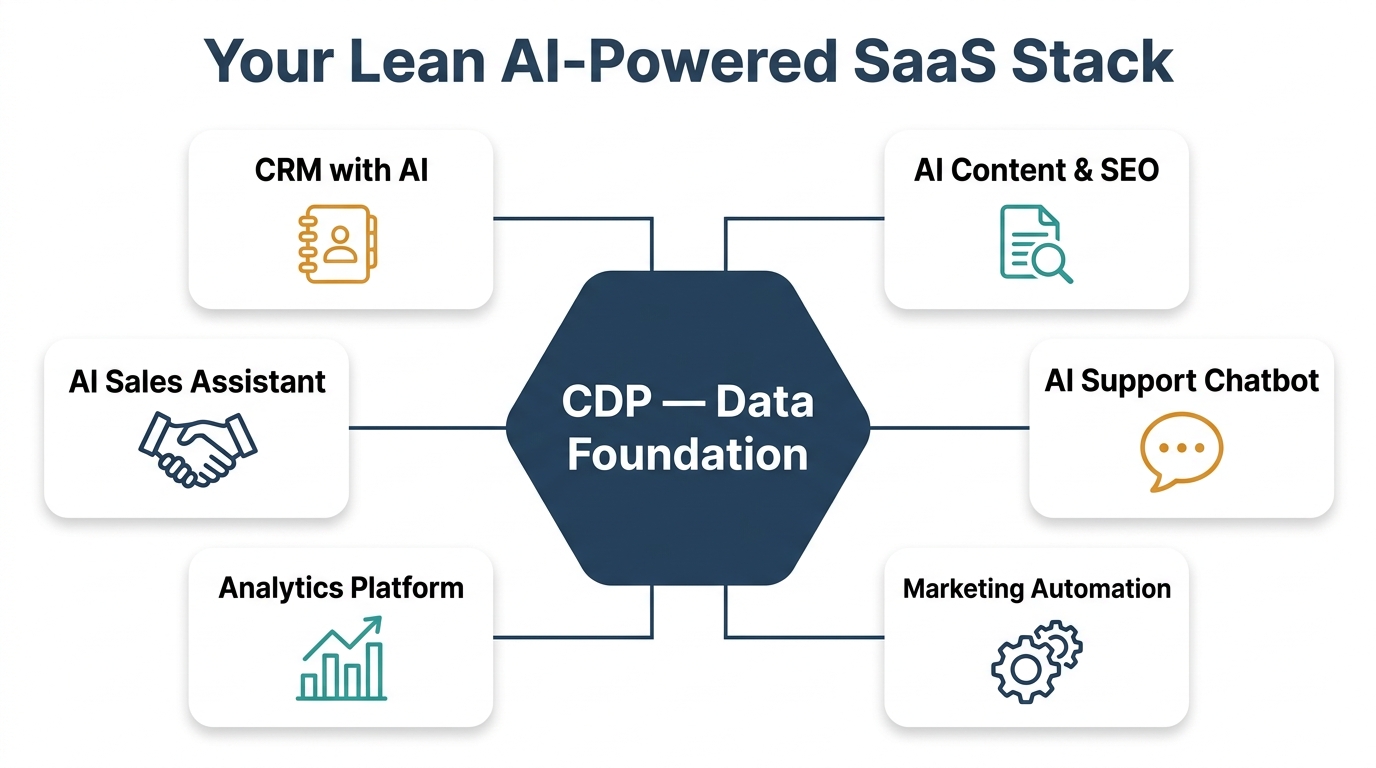
Most SaaS startups think about AI tools one at a time. But the real strategic advantage comes from building an integrated ecosystem where every tool talks to the others. A single AI tool is useful. A connected AI stack is a growth engine.
Why Integration Matters More Than Individual Tools
Here's the core problem with buying AI tools in isolation: they create data silos. Your AI sales tool knows about pipeline activity. Your marketing platform knows about lead behavior. But if those two systems don't share data, you're missing the full picture of your customer journey.
When your AI sales tool connects to your marketing automation platform, something powerful happens. Marketing can see which campaigns produce the leads that actually close. Sales can see which content a prospect engaged with before the first call. That shared context makes every interaction smarter and more relevant.
Poor interoperability between tools is one of the top integration challenges companies face today. Before adding any new tool to your stack, ask: does this connect natively to what we already use?
The Foundation: A Central Data Layer
Every effective AI stack needs a foundation. That foundation is a clean, centralized place where all your customer data lives. This is where a Customer Data Platform, or CDP, comes in.
A CDP pulls first-party data from every touchpoint: your CRM, your product, your support desk, your marketing tools. It creates a single unified profile for each customer. According to Adobe's explanation of what a CDP does, this unified data layer is what allows AI models to deliver accurate personalization and reliable predictions.
Without clean, centralized data, your AI tools are guessing. With it, they're genuinely intelligent. The CDP isn't the flashiest part of your stack, but it's the part everything else depends on.
A Lean AI Stack for a Seed-Stage SaaS Startup
You don't need dozens of tools to build a strong AI-powered stack. Here's a simple, effective setup for an early-stage team:
| Function | Role in the Stack |
|---|---|
| CRM with AI features | Central hub for contact, pipeline, and deal data |
| CDP or data warehouse | Unified customer data foundation for all AI tools |
| AI content and SEO tool | Blog posts, emails, and ad copy at scale |
| AI sales assistant | Lead scoring, outreach, and conversation intelligence |
| AI support chatbot | 24/7 ticket deflection and routing |
| Analytics platform | Measures what's working across every layer |
This stack covers marketing, sales, and support without overlapping or creating gaps. Each tool feeds data into the next, and the CDP sits underneath all of it keeping everything in sync.
The goal isn't to use more AI. It's to use connected AI. A lean, integrated stack built on clean data will always outperform a large, disconnected collection of tools.
Beyond the Hype: Avoiding Common Pitfalls with AI Tool Adoption
B2B SaaS startups and AI tools can be a powerful combination, but only when adoption is done right. The biggest risks aren't the tools themselves. They're the mistakes teams make when rolling them out. Poor data, undertrained staff, and ignored privacy rules turn promising tools into expensive failures.
Pitfall 1: Garbage In, Garbage Out
AI tools are only as smart as the data you give them. If your CRM has duplicate contacts, missing fields, or outdated records, your AI tools will make bad predictions based on that bad data. The technical term is "garbage in, garbage out," and it kills more AI projects than any software bug ever will.
According to research on why AI projects fail from PMI, poor data quality is one of the leading reasons AI initiatives don't deliver expected results. Before you invest in any AI tool, invest in cleaning your data first.
Pitfall 2: Skipping Team Training and Buy-In
A tool your team doesn't use is a tool that delivers zero ROI. This happens more than most startups admit. Leadership buys an AI platform, IT installs it, and then nobody actually changes how they work.
Getting real adoption requires a small change management process. Here's a simple framework:
- Announce the why before the what. Explain how this tool makes their job easier, not just the company's metrics better.
- Train with real examples from your actual workflow, not generic demos.
- Pick a champion on each team who learns the tool deeply and helps others.
- Review adoption weekly for the first month and address blockers fast.
Skipping this process is like buying a gym membership and never going. The potential is there. The results aren't.
Pitfall 3: Ignoring Privacy and Ethics
AI tools often process customer data to do their job. That creates real compliance risk if you're not paying attention. GDPR in Europe and CCPA in California have specific rules about how personal data can be used, stored, and shared.
A startup that signs up for an AI tool without checking its data handling policies could face regulatory trouble down the road. Always ask vendors for their data processing agreements and compliance documentation before you sign anything.
A Cautionary Tale
Imagine a seed-stage SaaS startup that buys an AI-powered lead scoring tool. Excited by the demo, they skip the pilot and roll it out to the whole sales team in week one. But their CRM data is a mess. Scores come back wrong. Reps ignore the tool. Six months later, nothing has changed except the monthly invoice.
The tool wasn't the problem. The process was. A 30-day pilot on one team, with clean data and proper training, would have caught every issue before it spread company-wide.
Avoiding these pitfalls isn't complicated. It just takes intentional planning before you hit "buy."
A Practical Framework for Measuring AI Tool ROI in Your SaaS Startup
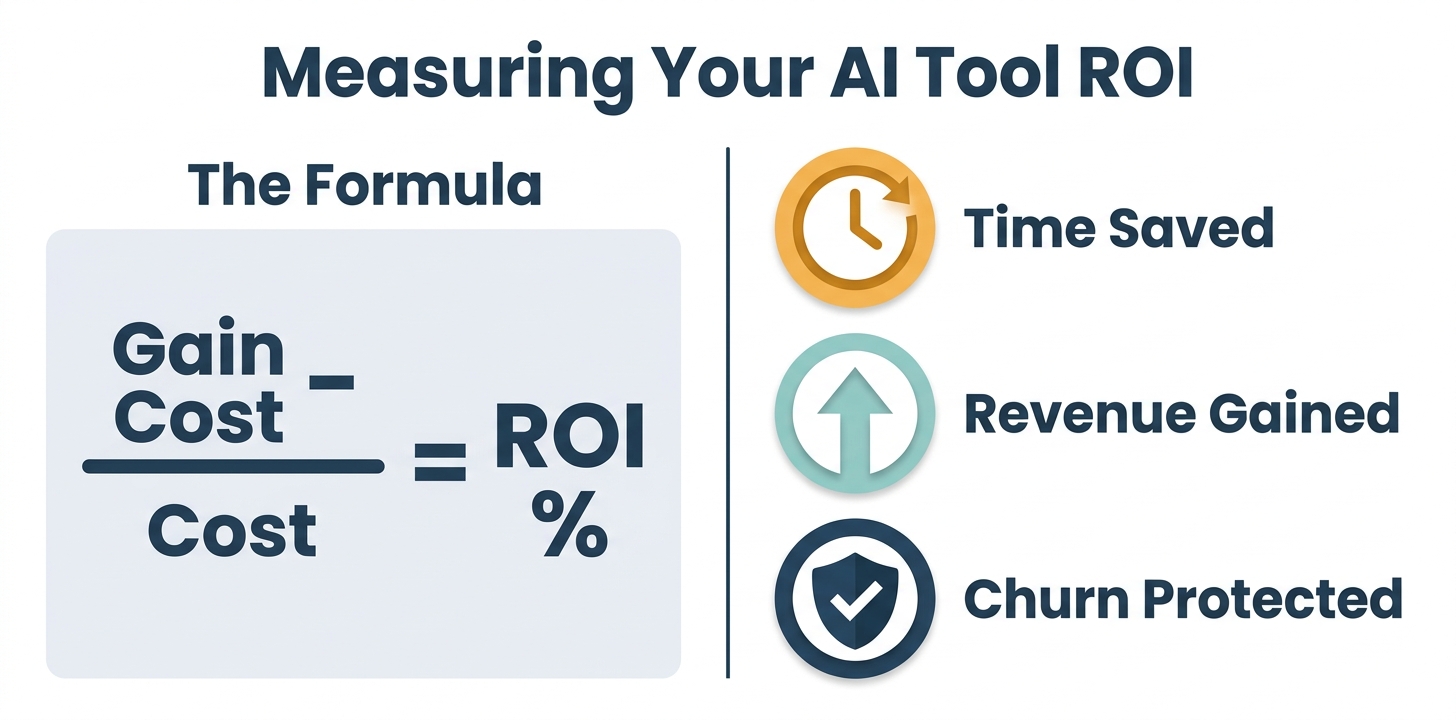
Measuring AI tool ROI doesn't have to be complicated. Use this simple formula: ROI = (Gain from Investment - Cost of Investment) / Cost of Investment. Multiply the result by 100 to get a percentage. A positive number means the tool is paying off. A negative number means it's not earning its keep.
Breaking Down the "Gain" Side of the Equation
The tricky part isn't the math. It's knowing what counts as a gain. Here are the three most common ways AI tools create measurable value for B2B SaaS startups:
Time savings: Track how many hours per week a task used to take. Multiply that by the hourly cost of the employee doing it. If an AI writing tool saves your content manager 8 hours a week at $50 per hour, that's $400 per week, or roughly $1,600 per month in recovered time.Revenue generated: Did AI-powered lead scoring help your team close more deals? Compare your conversion rate before and after using the tool. Multiply the improvement by your average deal value to get a dollar figure.Churn prevented: This one is big in SaaS. If predictive tools help you save even two accounts per quarter at $500 MRR each, that's $1,000 in protected monthly recurring revenue, or $12,000 annualized. That math adds up fast.Your ROI Worksheet
Use this template before committing to any new AI tool:
| Input | Your Numbers |
|---|---|
| Monthly tool cost | $ |
| Hours saved per month | hrs |
| Hourly cost of employee time | $ |
| Value of time saved (hrs x cost) | $ |
| New revenue attributed to tool | $ |
| Churn revenue protected per month | $ |
| Total Monthly Gain | $ _ |
| Monthly ROI % | (Gain - Cost) / Cost x 100 |
Fill this in with your actual numbers before you sign a contract. If you can't estimate even a rough gain, the tool probably doesn't solve a clear enough problem yet.
Setting a Realistic Timeframe
Most AI tools need 60 to 90 days before they show meaningful results. Set your baseline metrics on day one. Then measure again at the 30, 60, and 90-day marks. Kearney's guide on measuring technology ROI recommends phased assessments as the most reliable way to track whether a tech investment is delivering real value over time.
Don't judge a tool at week two. But don't ignore flat results at month three either. The data will tell you what to do.
Real-World Example: The Lead Scoring Impact
A seed-stage SaaS startup with a 2-person sales team implemented an AI lead-scoring tool that analyzed firmographic and intent data in real time. Within 30 days, sales reps spent 40% less time researching prospects and focused only on accounts most likely to convert. Result: conversion rates improved by 15%, and average sales cycle time dropped from 45 to 30 days. The $300/month tool generated an estimated $8,000 in recovered time and accelerated revenue. After the pilot, they expanded the tool across their growing team.
Your Next Steps to Becoming an AI-Driven SaaS Powerhouse
The path forward for B2B SaaS startups and AI tools is straightforward: start small, solve one real problem, measure everything, and build from there. You don't need a massive budget or a data science team. You just need a clear plan and the discipline to follow it.
Step 1: Audit Your Current Processes
Start by looking at where your team loses the most time or money right now. Is follow-up falling through the cracks? Are support tickets piling up? Is content creation slow? Pick the single biggest bottleneck and focus there first.
Don't try to fix everything at once. One well-chosen AI tool solving a real problem beats five tools solving nothing specific.
Step 2: Research One Tool That Fits
Once you know your bottleneck, find a tool built to solve it. Look for native integrations with what your team already uses. Check data privacy compliance. Read real user reviews from people in similar companies.
Ask vendors hard questions about security, scalability, and support. And don't skip the basics: can you try it before you buy it?
Step 3: Run a 30-Day Pilot and Measure ROI
Pick one team. Set a clear baseline. Run the tool for 30 days and track what changes. Did response times drop? Did conversions go up? Did your team actually use it?
Real data from a short pilot will tell you more than any sales demo ever could. If the numbers look good, expand. If they don't, move on without a big sunk cost.
The Road Ahead
AI isn't slowing down. According to Fortune Business Insights on the AI SaaS market, the global AI in SaaS market is projected to grow dramatically through the end of the decade. The startups building smart AI habits now will have a compounding advantage over those who wait.
The best time to start was last year. The second best time is today.
Critical Questions to Ask Before Choosing Your First AI Tool
- What is the single biggest bottleneck costing your team time or money right now, and does this tool solve that specific problem?
- Does this tool have native connectors to your existing CRM, marketing platform, and support system, or will it create data silos?
- Is your CRM and customer data clean enough for AI to work effectively, or do you need to invest in data cleanup first?
- Can you run a 30-day pilot with just one team before rolling out company-wide, and do you have a clear baseline metric to measure success?
- What is the vendor's data handling policy, and are they compliant with GDPR and CCPA if you serve international customers?
- What does onboarding and team training look like, and will you have dedicated support or just self-serve documentation?
- If the tool doesn't deliver measurable ROI within 60-90 days, what is the exit strategy and cost to discontinue?
- How scalable is the tool as you grow from 10 to 100 to 1,000 customers, and do pricing or features change?

B2B SaaS Startups and AI FAQs
What is the best single AI tool for a B2B SaaS startup?
There is no single 'best' tool. The best tool solves your most significant bottleneck right now. Start by identifying your biggest challenge (poor lead quality, high support volume, slow content creation) and find an AI tool designed specifically for that problem. The article's section on selecting the right AI tools provides a framework to guide this decision.
How does AI help with customer retention for SaaS startups?
AI improves retention in two key ways. First, predictive analytics tools analyze user behavior to identify accounts at high risk of churning before they leave, enabling proactive intervention by your customer success team. Second, AI-powered support tools provide 24/7 responses to common questions, improving overall customer experience and reducing churn rates.
Is AI expensive for a B2B SaaS startup to implement?
It doesn't have to be. Most startups should subscribe to existing AI-powered SaaS tools rather than build custom solutions, and many offer startup-friendly pricing tiers, monthly plans, or free trials. The key is measuring ROI: a $200/month tool that saves 20 hours of work or generates $2,000 in revenue is a net financial gain.
Can AI tools replace my marketing or sales team?
No. AI augments rather than replaces human teams. AI handles repetitive, data-heavy tasks like drafting content, analyzing data, and scoring leads at scale, freeing your human team to focus on strategy, creativity, relationship-building, and closing complex deals.
How can a bootstrapped SaaS startup afford to experiment with AI tools?
Be laser-focused on ROI by starting with free AI marketing tools in one specific area and tracking impact on a single key metric. For example, use a free AI writing tool to increase blog output or test a free trial for sales call analysis, then reinvest gains from successful experiments into the next tool.
What's the difference between building vs. buying an AI solution for my startup?
For 99% of B2B SaaS startups, buying (subscribing to existing tools) is correct. Building custom AI requires massive datasets, expensive specialized engineering talent, and long development cycles. Only consider building if AI is your company's core, unique differentiator. Otherwise, leverage the R&D of other companies through their tools.
How do I know if my startup is ready for AI marketing automation?
You're ready when you have clean, organized customer data and a clear understanding of your biggest operational bottleneck. If your CRM is a mess or you don't know where your team wastes the most time, fix those foundational issues first. Check out our guide on AI marketing automation to understand the prerequisites and implementation steps.
What should I prioritize first: AI for marketing, sales, or customer success?
Prioritize based on your biggest pain point, not the function. If you're struggling with lead quality, start with AI sales tools. If content creation is your bottleneck, begin with AI marketing tools. If churn is high, focus on AI customer success tools. The article's ROI framework can help you quantify which area would deliver the highest return on investment first.