Your board does not want a technology lecture. They want to know three things:
1. what AI means for your competitive position
2. What you are doing about it.
3. When they will see results.
The best AI strategy for marketing is not a PowerPoint deck. It is a 90-day deployment plan that shows measurable output within the first month and a clear cost-to-value comparison against what you are doing today. This guide gives you the framework, the numbers, and the talking points to answer the board's question with substance.
Why Every Board Is Asking About AI Strategy Right Now
If your board brought up AI strategy at the last meeting, you are not alone. According to Gartner's 2026 Board of Directors Survey, 72% of boards have added AI strategy as a standing agenda item, up from 28% in 2024. The question is no longer "should we explore AI?" It is "why have we not deployed it yet?"
Three forces are driving this urgency:
Competitive pressure. Board members sit on multiple boards. They are seeing other portfolio companies deploy AI and generate results. When one company in their network cuts marketing costs by 40% while tripling content output, the board wants to know why you have not done the same.
Investor expectations. Institutional investors and PE firms are actively asking about AI readiness during due diligence. Companies without an AI strategy are starting to look like companies without a digital strategy in 2015. Not broken yet, but behind.
The efficiency mandate. In a market where growth at all costs is over, boards are focused on doing more with less. AI is the most obvious lever for that. A marketing department that produces 3-5X the output at 40-70% lower cost is exactly the kind of efficiency story boards want to hear.
The problem is that most marketing leaders are not prepared for this conversation. They know AI matters. They have probably experimented with ChatGPT or approved a Jasper subscription. But "we gave the team access to AI tools" is not a strategy, and the board knows it.
What the Board Actually Wants to Hear (And What They Do Not)
Board members are not technologists. Most do not care about large language models, prompt engineering, or multi-model orchestration. They care about three things:
- Competitive positioning. Are we ahead, behind, or keeping pace with the market on AI adoption? What are our competitors doing that we are not?
- Financial impact. What does AI mean for our cost structure, our output capacity, and our revenue growth? Show me the numbers.
- Execution timeline. What is the plan, and when will we see measurable results? Not "eventually." Not "by end of year." Specific milestones with dates.
What they do not want:
- A vendor technology demo disguised as strategy
- A 50-slide deck about the history of artificial intelligence
- Vague commitments to "explore AI opportunities across the organization"
- A list of tools your team has subscribed to
- A proposal to hire a "Head of AI" and figure it out over the next 18 months
The board wants a business case with numbers and a deployment plan with dates. Everything else is filler. The rest of this guide shows you how to build both.
The AI Strategy Framework That Works for Board Presentations
The strongest AI strategy presentations follow a four-part structure. Each section answers a specific board concern and builds toward a clear ask.
Part 1: The Market Reality (2-3 slides). Start with what the competition is doing, not what AI can theoretically do. Board members respond to competitive threats, not technology possibilities. Show specific examples of companies in your space that have deployed AI and the results they are reporting. If you do not have direct competitor data, use industry benchmarks: content volume increases, cost reductions, time-to-market improvements.
Part 2: The Current State Assessment (2-3 slides). Be honest about where you stand. Show your current marketing cost structure, output volume, and channel coverage. Then show the gap between where you are and where AI-native competitors operate. This gap is your business case. The board cannot argue with their own numbers.
Part 3: The 90-Day Deployment Plan (3-4 slides). This is the core of the presentation. Break the plan into 30-day milestones with specific deliverables, costs, and expected outcomes. The board does not need to understand how AI works. They need to see a project plan they can track.
Part 4: The Financial Model (1-2 slides). Show three scenarios: current state (cost and output), AI-augmented state (same team plus AI tools), and AI-native state (restructured around AI systems). Include the investment required for each and the expected return timeline.
Building Your 90-Day AI Marketing Deployment Plan
The single most important thing you can present to the board is a concrete deployment plan. Not a strategy document. Not a roadmap. A plan with dates, costs, and measurable outcomes at each milestone.
Here is the 90-day framework that works:
Days 1-30: Foundation and First Wins.
- Audit current marketing operations: cost per channel, output volume, team utilization
- Identify the highest-leverage AI deployment (typically content and SEO)
- Deploy an AI marketing agency or build the internal AI stack
- Launch first AI-powered campaigns across 2-3 channels
- Establish baseline metrics for before/after comparison
Days 31-60: Scale and Optimize.
- Expand to 5-6 channels based on Day 1-30 performance data
- Deploy AI-powered personalization in email and ad creative
- Begin A/B testing AI-generated content against existing content
- Build real-time reporting dashboards for board visibility
- Quantify cost savings and output increases vs. baseline
Days 61-90: Prove and Present.
- Full multi-channel deployment: SEO, paid, email, content, social, CRO
- Measure pipeline impact from AI-powered channels
- Calculate actual cost per lead vs. pre-AI baseline
- Build the board update: here is what we deployed, here is what it cost, here are the results
- Present the case for scaling or expanding the AI program
The key to this plan is that the board sees results at every 30-day checkpoint, not a single "big reveal" at the end of a quarter. Board members trust incremental proof. They distrust promises of future transformation.
| Milestone | Deliverable | Board-Ready Metric |
|---|---|---|
| Day 30 | First AI campaigns live on 2-3 channels | Content volume increase (%), deployment speed vs. prior launches |
| Day 60 | 5-6 channels active, personalization deployed | Cost per lead vs. baseline, output volume per dollar |
| Day 90 | Full multi-channel deployment with attribution | Pipeline generated, CAC reduction, LTV:CAC ratio trajectory |
| Day 180 | SEO and content programs at scale | Organic traffic growth, search ranking improvements, revenue attribution |
Need help building your board presentation?
We help CMOs build credible AI strategy presentations with real numbers, not slide decks full of buzzwords.
The Numbers That Make the Board Case: AI Marketing ROI
Boards think in numbers. Here are the ones that matter for an AI marketing strategy, with benchmarks from companies that have already made the transition.
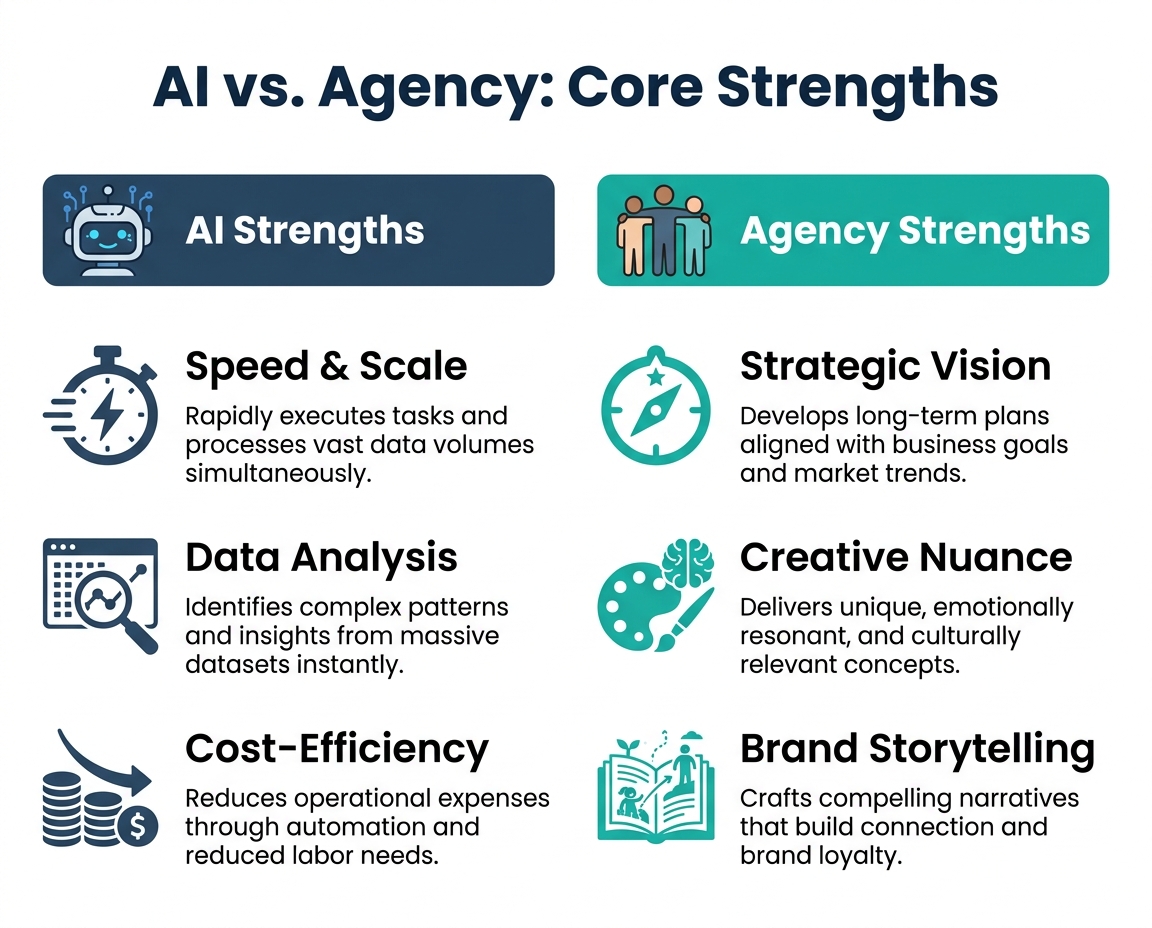
Cost comparison: traditional vs. AI-native marketing. A mid-market B2B company typically spends $30K-$50K per month on marketing (agency fees, tools, and internal team costs) and covers 2-3 channels with 8-15 content pieces per month. The same company using an AI marketing approach can cover 6-8 channels with 50-100+ content pieces per month at $15K-$30K per month.
The math is simple enough for a board slide: more output, more channels, lower cost. But the real story is the compounding effect. AI-generated content and campaigns produce data that feeds back into the system, improving targeting, messaging, and conversion rates over time. This creates a performance curve that traditional marketing cannot match, no matter how talented the team.
Marketing Output per Dollar: Traditional vs. AI-Native
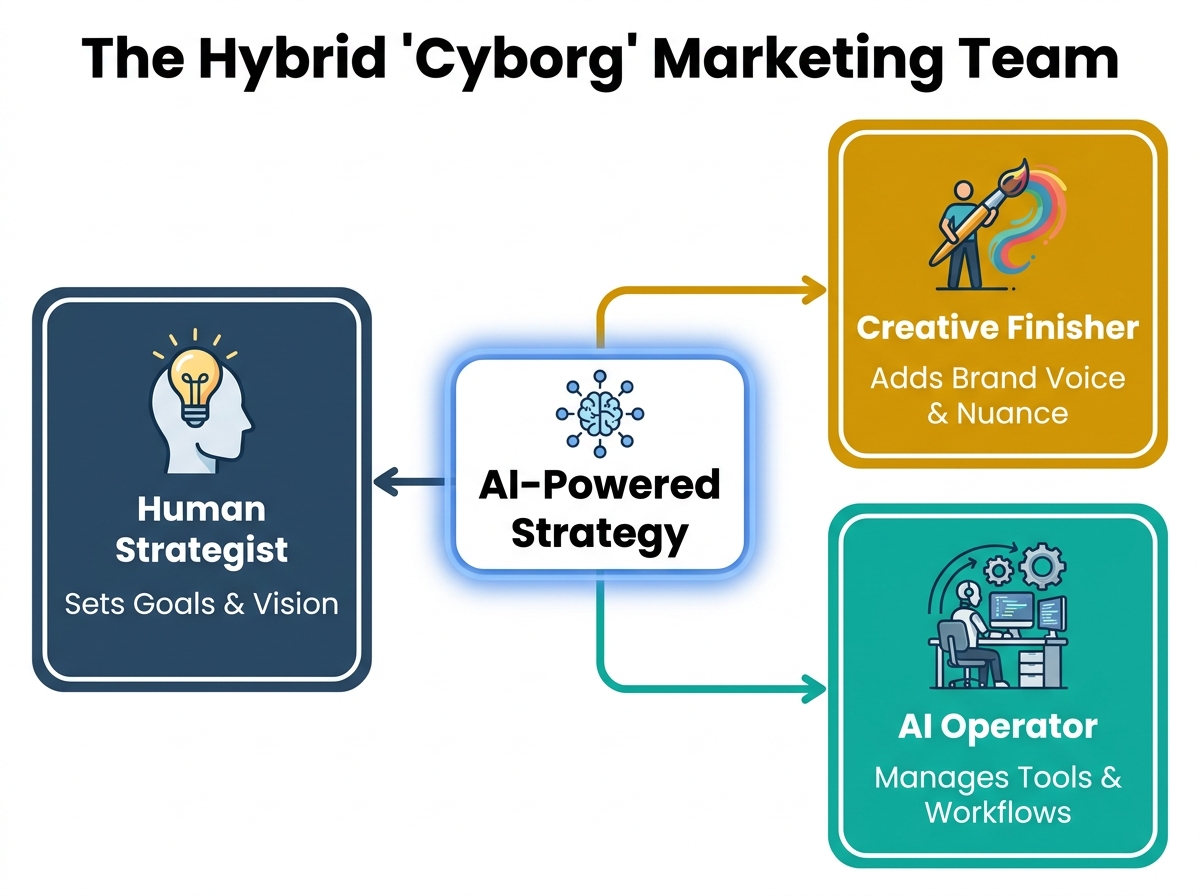
The FTE equivalency argument. This is the number that gets board attention fastest. A three-person AI marketing team (strategist, AI operator, creative finisher) can match the output of a 12-15 person traditional marketing department. For a company paying fully-loaded salaries of $100K-$150K per person, that is $900K-$1.8M annually in team costs being replaced by a $180K-$360K investment in an AI marketing agency. The savings fund themselves from day one.
The Three AI Strategy Options (And Which One to Recommend)
When you present to the board, you need to show options. Boards do not want a single recommendation with no alternatives. They want to see that you considered the tradeoffs and made a reasoned choice. Here are the three paths:
| Option | Investment | Timeline to Results | Risk |
|---|---|---|---|
| Option A: Augment Give current team AI tools |
$2K-$5K/mo in tools + training time | 3-6 months for measurable impact | Low investment, but incremental improvement. May not satisfy board expectations for transformation. |
| Option B: Partner Hire an AI marketing agency |
$15K-$35K/mo agency retainer | 30 days to first campaigns live | Fastest path to results. Proven systems. Moderate investment with clear ROI benchmarks. |
| Option C: Build Hire AI operators in-house |
$300K-$600K annually in new hires + $50K+ in tools | 6-12 months to build and optimize | Highest long-term control. But slowest, most expensive, and highest execution risk. |
The recommended path for most companies is Option B (partner) with a path to Option C (build) over 12-18 months. Start with an AI marketing agency to get results fast and learn how AI-native marketing operates. Use that experience to decide whether to bring capabilities in-house later. This gives the board what they want: fast results, controlled investment, and a clear evolution path.
Option A (augment) sounds safe, but it rarely produces the results boards are looking for. Giving your existing team AI tools is like giving a horse-drawn carriage a GPS. The fundamental model has not changed. The team is still executing manually; they are just doing it slightly faster.
Option C (build) is the right long-term answer for some companies, but the wrong first move. Hiring an AI operator, building automation systems, and training models takes 6-12 months before you see results. Most boards will not wait that long.
Answering the Hard Board Questions
Board members will push back. Good ones always do. Here are the questions you will get and how to answer them:
"Is this just a fad?"
No. AI marketing is a structural shift in how marketing operations work, similar to the shift from print to digital 20 years ago. The companies that adopted digital marketing early gained compounding advantages. The same dynamic is playing out with AI. The global AI marketing market is projected to reach $107 billion by 2028. This is not a trend. It is a new operating model.
"What about the quality problem? I keep reading about AI-generated junk."
The quality concern is legitimate and important. The difference is in the model. Companies that use AI to replace human judgment produce garbage. Companies that use AI to amplify human expertise produce more and better work. The key is having senior humans directing the AI, not junior people prompting ChatGPT. An AI marketing strategy should explicitly address quality controls: brand voice training, editorial review processes, and content standards.
"What happens if we invest and it does not work?"
The 90-day deployment model is designed for exactly this concern. You see results at Day 30, not Day 365. If the metrics at Day 30 are not trending in the right direction, you can adjust, change partners, or pull back before significant capital is committed. This is not a multi-year transformation project. It is a structured test with clear gates.
"Can we just hire a Head of AI and figure this out?"
You can, but it is the slowest path to results. A Head of AI hire takes 3-6 months to recruit, then 3-6 months to assess the landscape, build a team, and deploy. That is potentially a year before you see any marketing output. Meanwhile, your competitors who partnered with an AI marketing agency had campaigns running in 30 days. The Head of AI role makes sense eventually. It does not make sense as a first step.
"What are our competitors doing?"
This is the question you need to research before the board meeting. Identify 3-5 direct competitors and examine their marketing output: content volume, channel presence, website changes, ad activity. If they have suddenly increased content production, launched new channels, or improved site performance, there is a good chance AI is behind it. Bring specific examples.
Real Example: SaaS CMO Answers the Board Question
A B2B SaaS company's CMO received the "what is our AI strategy" question at a Q1 board meeting. Instead of promising to hire and build over 12 months, they partnered with an AI marketing agency and presented a 90-day deployment plan. At Day 30, they reported campaigns live on 4 channels. At Day 60, they showed a 3.2X increase in content output and a 41% reduction in cost per lead. By the Q2 board meeting, they presented a full pipeline attribution report showing $1.2M in AI-generated pipeline from a $75K total investment. The board approved an expanded budget.
Where Marketing AI Has the Biggest Impact (Start Here)
When the board asks about AI strategy, they usually mean "across the whole company." But the smartest move is to start where AI has the most mature capabilities and the clearest ROI: marketing.
Marketing is the ideal AI beachhead for three reasons:
Measurable outputs. Marketing produces content, campaigns, leads, and pipeline. Every one of these can be measured before and after AI deployment. This gives you the before/after story the board wants.
Mature AI capabilities. AI marketing tools are further along than AI in most other business functions. Content generation, ad optimization, email personalization, and analytics are all production-ready today. You are not betting on future technology. You are deploying proven systems.
Speed to results. A marketing AI deployment shows results in weeks, not quarters. An AI-native SEO program can have content ranking within 60-90 days. Paid campaigns optimize within days. Email personalization improves open rates immediately. No other department can show AI results this fast.
Once you prove the model in marketing, you have a template and a track record for expanding AI into sales, operations, and product. Marketing is not just the best place to start. It is the strategic proof point that unlocks AI adoption across the organization.
Preparing for a board conversation about AI?
We can walk you through the framework, share benchmarks, and help you build the 90-day plan before your next board meeting.
The Risk of Doing Nothing (The Slide You Need)
Every board presentation needs a "do nothing" scenario. This is not fear-mongering. It is responsible risk assessment, and boards expect it.
Here is what "doing nothing" looks like in practice:
Cost disadvantage compounds. If your competitor deploys AI marketing and reduces their CAC by 40%, they can outspend you on customer acquisition while maintaining higher margins. Over 12-24 months, this pricing advantage compounds into market share loss that is extremely difficult to reverse.
Talent gap widens. The best marketers are moving toward AI-native organizations because the work is more interesting and the impact is higher. The longer you wait, the harder it becomes to attract talent who can operate in an AI-augmented environment.
Content velocity gap becomes permanent. AI-powered content programs produce 5-10X the volume of traditional teams. Over 12 months, that is thousands of additional pages indexed, hundreds of additional keywords ranked, and a search engine presence that a traditional team cannot close. Search dominance is cumulative. Every month you wait is a month your competitors are building an organic moat.
Board patience runs out. The board asked about AI strategy because they expect action. If your response is a 12-month exploratory plan with no near-term results, do not be surprised when the next board meeting includes a conversation about marketing leadership that you do not want to have.
Board Readiness Check: Can You Answer These?
- What percentage of your marketing execution could AI handle today?
- What is your current cost per lead, and how does it compare to AI-native benchmarks?
- How many channels are you actively managing vs. how many you should be?
- Can you name three competitors who have deployed AI in their marketing?
- What is your plan if the board asks for results within 90 days?
What a Credible AI Strategy Presentation Looks Like
Here is the actual slide structure for a 15-minute board presentation on AI marketing strategy. This is the format that gets approval and budget, not polite interest and a "let's revisit next quarter."
Slide 1: The Market Shift (1 min). "72% of boards are now asking about AI strategy. Here is why, and here is our plan." One stat, one sentence. Set the context.
Slide 2: Competitive Landscape (2 min). Show 3 competitors and their recent marketing activity. Highlight any evidence of AI adoption: sudden content volume increases, new channels, improved ad creative rotation speed. The message: "Our competitors are moving. Here is the evidence."
Slide 3: Our Current State (2 min). Show your current marketing cost structure, output volume, and channel coverage. Be honest. The gap between your current state and the AI-native benchmark IS your business case.
Slide 4: The AI-Native Benchmark (2 min). Show what AI-native marketing operations look like: 6-8 channels, 50-100+ content pieces per month, 40-70% lower cost. Use the comparison table format. Let the numbers speak.
Slide 5-6: The 90-Day Plan (3 min). Three 30-day phases with specific deliverables and metrics. Show the investment required at each phase. Show the expected return. Show the decision gates: "At Day 30, if we see X, we proceed. If not, we reassess."
Slide 7: Financial Model (2 min). Three scenarios: Current State, Option B (Partner with AI agency), Option C (Build in-house over 12 months). Show the monthly cost, expected output, and ROI timeline for each. Recommend Option B with a path to C.
Slide 8: The Ask (1 min). "We are requesting $X per month for 90 days to deploy AI-native marketing across 6 channels. At Day 30, we will report initial results. At Day 90, we will present the full business case for scaling or adjusting." Clear. Specific. Bounded risk.
Common Mistakes CMOs Make with AI Strategy
Having worked with dozens of marketing leaders navigating this exact board conversation, here are the mistakes that derail the discussion:
Leading with technology instead of business outcomes. The board does not care about your AI stack. They care about pipeline, CAC, and competitive position. Start with the business problem, show the financial opportunity, then mention AI as the mechanism for getting there.
Promising transformation without milestones. "We will transform our marketing with AI" sounds great and means nothing. The board wants dates, deliverables, and decision points. A 90-day plan with 30-day checkpoints gives them confidence that you have thought this through.
Underestimating the quality question. Board members have seen the headlines about AI slop. If you do not proactively address content quality, brand voice preservation, and human oversight, the board will assume you are going to flood the market with generic AI content that damages the brand. Address this head-on with specific quality controls.
Trying to build instead of buy first. The instinct to build internally is understandable, but it is the wrong first move. Building AI marketing capabilities from scratch takes 6-12 months and significant hiring. Partnering with a proven AI marketing agency gets you results in 30 days and teaches you what to build later.
Treating AI as a separate initiative. AI marketing strategy should not be a side project running parallel to your "real" marketing. It should be the plan for how marketing operates going forward. The board can smell a pilot program designed to check a box rather than drive results.
After the Board Meeting: The First 30 Days
You got the approval. Now you need to execute. Here is what the first 30 days should look like:
Week 1: Partner selection and kickoff. If you are going the agency route, choose an AI marketing agency that can deploy within their first week. Ask for a specific onboarding timeline. If they say "we need 6 weeks to onboard," keep looking. AI-native agencies should be able to start building campaigns within days of kickoff.
Week 2: Audit and baseline. Establish clear baseline metrics for everything you are measuring: current content volume, cost per lead, channel coverage, team utilization. You cannot show improvement without a credible starting point. This baseline becomes Slide 3 of your Day 30 board update.
Week 3: First campaigns live. You should have at least 2-3 channels with live AI-powered campaigns by the end of week 3. This might be paid search, email sequences, or content publishing. The point is visible activity that the board can see if they ask.
Week 4: First results and Day 30 report. Compile the first 30 days of data. Compare against baseline. Show the board: "We deployed, here is what happened, here is what we are adjusting for Days 31-60." Even if the numbers are early and small, the fact that you have actual data 30 days after approval builds enormous credibility.
The pattern continues in 30-day cycles. Each cycle, the data gets richer, the optimization gets sharper, and the board's confidence grows. By Day 90, you are not asking for budget anymore. You are presenting results that justify expansion.