An AI marketing agency is not a traditional agency that added ChatGPT to its toolbox. It is an entirely different operating model: a small team of senior strategists directing purpose-built AI systems across every marketing channel simultaneously. The result is 3-5X the output at 40-70% lower cost than traditional agencies, with faster deployment and more transparent reporting. The key to finding a good one is separating the agencies that were built around AI from those that bolted it on as a sales pitch.
What Is an AI Marketing Agency?
An AI marketing agency is a marketing services firm that was designed from the ground up around artificial intelligence capabilities. Unlike traditional agencies that employ large teams of specialists to execute marketing manually, an AI marketing agency uses a lean team of experienced humans who direct AI systems to handle the volume, speed, and data-intensive parts of marketing execution.
The distinction matters because the term has become diluted. Every agency with a Jasper subscription now calls itself "AI-powered." The difference between an agency that uses AI tools and an AI marketing agency is structural. It is the difference between a taxi driver who uses GPS and a self-driving car company. Same destination, entirely different engineering.
A true AI marketing agency has three defining characteristics:
- AI-native architecture. The workflows, systems, and delivery model were built around AI capabilities, not retrofitted. This means proprietary automation pipelines, multi-model orchestration, and integrated data flows across channels.
- Senior human leadership. AI handles execution. Humans handle strategy, creative direction, quality control, and client relationships. The humans on the team are not junior coordinators. They are experienced marketers who know what good looks like.
- Full-channel coverage. Because AI removes the per-channel staffing bottleneck, a real AI marketing agency can run 6-8 channels simultaneously rather than specializing in one or two.
If an agency has a large team of account managers, copywriters, and media buyers doing the same work they did five years ago but now mentions AI on their homepage, that is not an AI marketing agency. That is a traditional agency with a marketing update.
AI Marketing Agency vs. Traditional Agency: The Structural Differences
The gap between an AI marketing agency and a traditional agency is not incremental. It is architectural. Traditional agencies were built for a world where every marketing task required a human specialist. AI marketing agencies were built for a world where 80% of marketing execution can be systematized and the remaining 20%, the strategic and creative work, requires experienced humans.
Here is what that looks like in practice:
| Dimension | Traditional Agency | AI Marketing Agency |
|---|---|---|
| Team structure | 15-30 people across account management, creative, media, analytics | 3-5 senior strategists directing AI systems |
| Onboarding time | 3-6 months to full deployment | 30 days to full deployment |
| Channels managed | 2-3 channels (staffing limited) | 6-8 channels simultaneously |
| Content volume | 8-15 pieces per month | 50-100+ pieces per month |
| Personalization | Segment-level (3-5 audiences) | Account-level (unlimited) |
| Reporting cadence | Monthly PDF reports | Real-time dashboards |
| Cost (typical mid-market) | $20K-$50K/month | $15K-$45K/month |
The cost comparison is striking, but the output difference is what matters most. A traditional agency charging $30K per month might run your LinkedIn ads and produce four blog posts. An AI marketing agency at the same price point can run SEO, paid search, paid social, email sequences, content production, and organic social simultaneously, with higher volume and faster iteration on every channel.
This is not because the people at traditional agencies are less talented. It is because the model itself has a staffing ceiling. Every channel you add requires hiring another specialist, which increases overhead, which increases your retainer. AI removes that ceiling.
The Core Services an AI Marketing Agency Provides
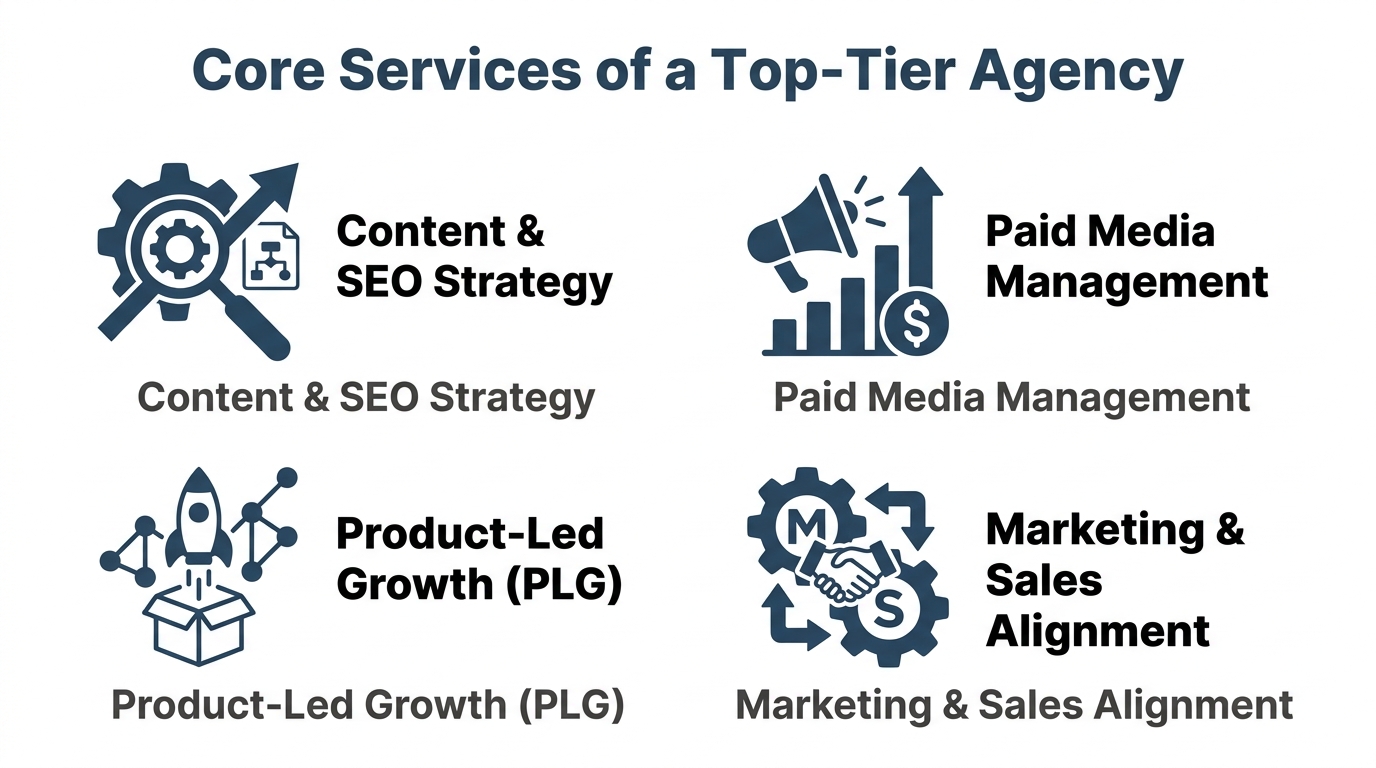
Because AI eliminates the per-channel cost constraint, a good AI marketing agency covers the entire B2B marketing stack rather than specializing in one slice. Here are the core services you should expect:
SEO, GEO, and AEO. AI marketing has transformed search optimization. Beyond traditional SEO (ranking on Google), you now need Generative Engine Optimization (appearing in AI-generated search results from ChatGPT, Perplexity, and Gemini) and Answer Engine Optimization (winning featured snippets and voice search answers). An AI marketing agency handles all three simultaneously because the content systems are integrated.
Email Suite. Cold outreach, warm nurture sequences, newsletters, and automated follow-ups. AI enables account-level personalization at scale, writing hundreds of personalized email variants that would take a human team weeks to produce.
Paid Advertising. Google Ads, LinkedIn Ads, Meta Ads, and programmatic. AI generates creative variants, manages bidding, and optimizes campaigns continuously rather than in weekly review cycles.
Content Platform. Blog articles, whitepapers, case studies, and thought leadership. AI drafts at volume while senior marketers edit for quality, accuracy, and brand voice. This is where the anti-AI-slop discipline matters most.
Organic Social. LinkedIn, X, YouTube, and Instagram with consistent voice and scheduling. AI handles content adaptation across platforms while humans set the editorial direction.
Landing Pages and CRO. Conversion-optimized pages for campaigns, A/B testing at scale, and continuous optimization based on actual pipeline data rather than vanity metrics.
How AI Marketing Agencies Actually Use AI (Behind the Curtain)
This is where the real separation happens. Most agencies that claim to use AI have given their team access to ChatGPT or Jasper and called it innovation. A genuine AI marketing agency operates on an entirely different level of sophistication.
Multi-model orchestration. Real AI marketing agencies do not rely on a single language model. They use 6+ models, each selected for what it does best. One model might handle research and data synthesis. Another handles long-form content drafting. A third optimizes ad copy. A fourth analyzes campaign performance data. The orchestration layer decides which model handles which task automatically.
Agentic automation systems. The AI does not just respond to prompts. It runs autonomous workflows: monitoring campaign performance, flagging anomalies, generating reports, scheduling content, adjusting bids, and routing approvals. A well-built system might have 50-100+ automations running across hundreds of orchestration nodes.
Custom-trained brand voice. Generic AI content is obvious and damaging to your brand. Good AI marketing agencies build custom voice models and style guides that produce content indistinguishable from your best human writer. This is the difference between AI-assisted marketing and AI slop.
Integrated data pipelines. The AI systems connect to your CRM, analytics, ad platforms, and marketing automation tools. This creates a closed feedback loop: campaign results feed back into the AI's optimization decisions in real time, not at the next monthly review meeting.
Curious what this looks like for your company?
Talk to our team about how an AI marketing agency model would work for your specific market and goals.
The Economics: Why AI Marketing Agencies Deliver More for Less
Traditional agencies have a cost problem that is structural, not a pricing decision. Every channel, every campaign, and every deliverable requires human hours. The agency's cost scales linearly with output. More work means more people means higher retainers.
AI marketing agencies break this relationship. Once the systems are built and configured for a client, the marginal cost of additional output is near zero. Running an email nurture sequence and a LinkedIn ad campaign simultaneously does not require double the team. It requires the same AI system doing two things instead of one.
Monthly Cost vs. Channel Coverage
The DIY option looks cheapest, but the hidden cost is your team's time. Someone still has to prompt the AI, review the output, manage the platforms, analyze the data, and make strategic decisions. For most companies, the fully-loaded cost of that internal effort far exceeds the savings on software.
The Team Behind an AI Marketing Agency
One of the biggest misconceptions about AI marketing agencies is that they replaced humans with robots. The reality is the opposite: they replaced junior workers with senior experts and replaced manual execution with AI systems. The humans who remain are more experienced, not fewer.
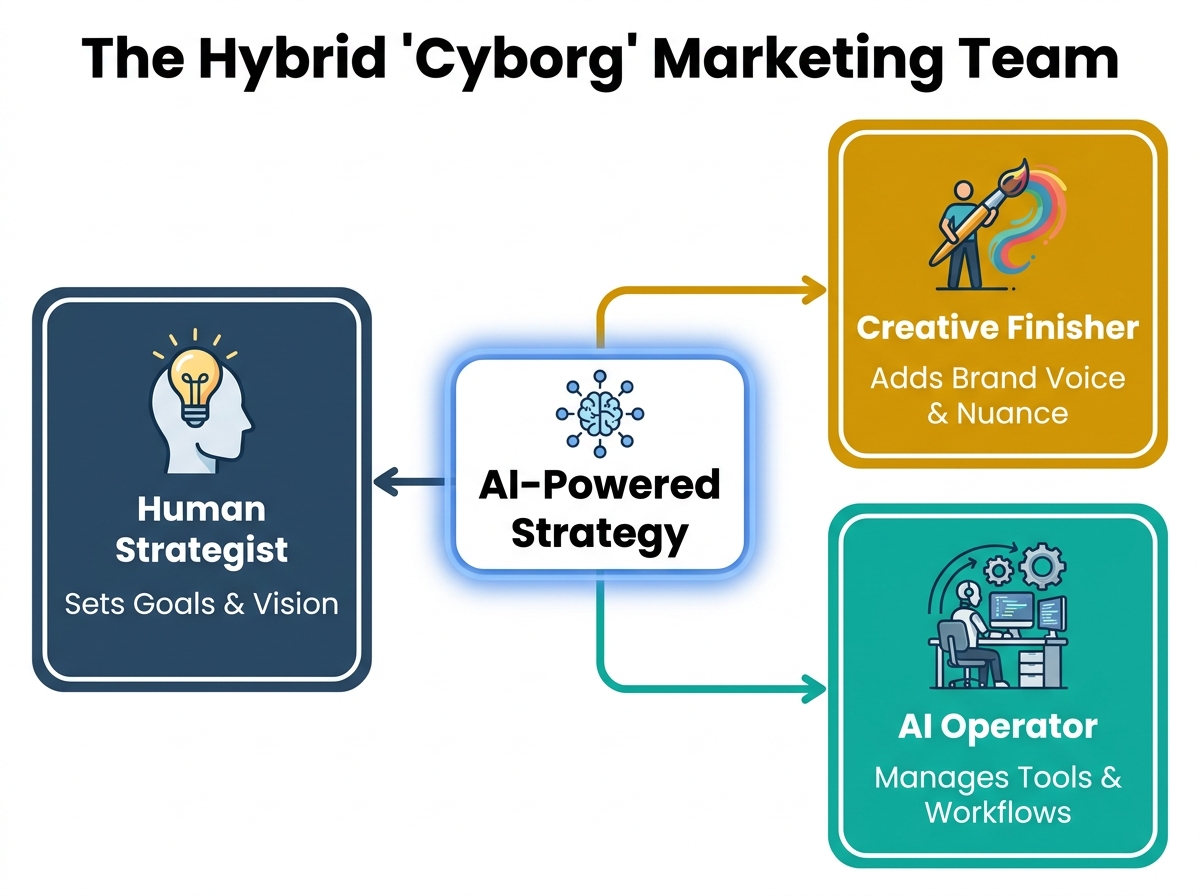
The operating model that works best is what some call the "cyborg" team. It typically has three core roles:
The Human Strategist. This person sets the marketing direction, defines the ICP, chooses the channels, and builds the campaign architecture. They bring 10-20+ years of marketing experience. They are the reason the AI does not produce generic, off-target work. In the best AI marketing agencies, this is a founder or partner-level person, not a junior account manager.
The AI Operator. This person manages the AI systems: configuring workflows, training models on brand voice, monitoring outputs, and tuning performance. They understand both marketing and technology deeply enough to bridge the gap. This role barely existed three years ago.
The Creative Finisher. AI can generate content at scale, but the last 10% of quality requires human judgment. The creative finisher takes AI-drafted content and adds the brand voice, the storytelling nuance, the cultural references, and the editorial polish that separates professional content from AI slop.
Who Should Hire an AI Marketing Agency
AI marketing agencies are not the right fit for every company. They work best in specific situations:
B2B companies with $5M-$500M in revenue that need to scale marketing without building a large internal team. This is the sweet spot: complex enough to benefit from multi-channel marketing, but not so large that they have already built a 30-person marketing org.
Companies currently spending $15K-$50K/month on marketing (whether agency, in-house, or a combination) and are not satisfied with the output relative to the investment. An AI marketing agency can typically deliver 3-5X the volume at the same or lower spend.
SaaS, fintech, and healthtech companies where the buying cycle is complex, the buyer is technical, and content quality directly impacts credibility. These industries punish generic marketing content more than most.
Companies that have tried and failed with traditional agencies. If you have been through two or three agencies and the story is always the same (good pitch, mediocre execution, slow ramp, underwhelming results), the problem might not be the specific agency. It might be the model.
Real Example: Consulting Firm Switches from Traditional Agency
A mid-market consulting firm was spending $22K/month with a traditional agency managing Google Ads and producing 4 blog posts monthly. After switching to an AI marketing agency, they deployed across 6 channels (SEO, paid search, paid social, email, content, organic social) within 30 days. Content volume went from 4 pieces per month to 40+. Lead volume tripled in the first quarter, and their cost per qualified lead dropped by 62%.
How to Evaluate an AI Marketing Agency: 7 Questions to Ask
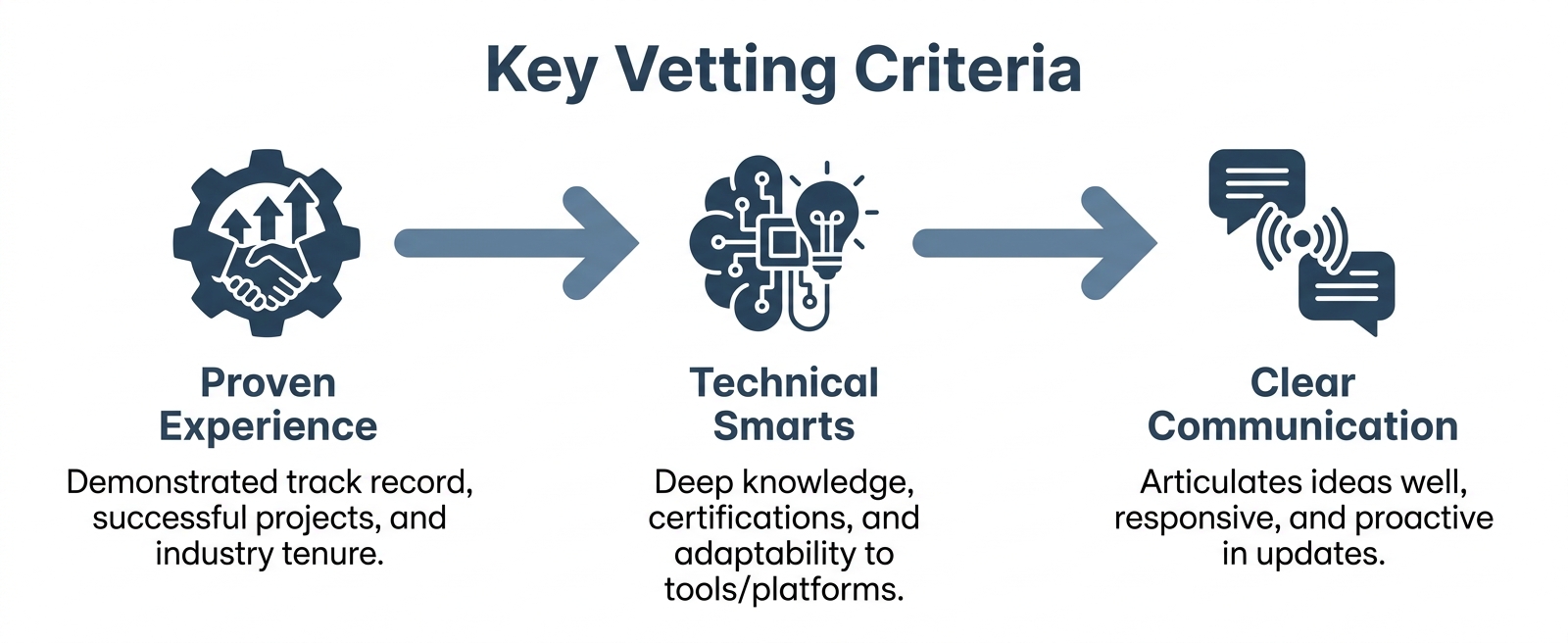
The market is flooded with agencies claiming AI capabilities they do not actually have. Here are seven questions that separate the real AI marketing agencies from the pretenders:
- "How many AI models do you use and for what?" A real AI marketing agency uses multiple specialized models. If the answer is "We use ChatGPT," that is a person with a subscription, not an AI-native operation.
- "How many automations are in your system?" Look for specific numbers. Real AI operations have dozens to hundreds of automated workflows. Vague answers like "we use AI throughout our process" are a red flag.
- "Who will be on my account and what is their experience level?" The best AI marketing agencies put senior people on every account because the team is small by design. If you are getting a junior account manager as your primary contact, the AI claim is probably window dressing on a traditional agency structure.
- "Can I see your reporting dashboard in real time?" AI marketing agencies operate on real-time data. If they only offer monthly PDF reports, their systems are not actually integrated.
- "How long until I see campaigns running?" The answer should be weeks, not months. 30-day deployment is the benchmark. If onboarding takes 3-6 months, the "AI" part is not doing much heavy lifting.
- "How do you prevent AI content from sounding generic?" This question tests whether they understand the quality problem. Look for specific answers about brand voice training, human editorial processes, and content quality frameworks. "Our AI produces great content" is not a real answer.
- "What happens if I cancel?" Good AI marketing agencies are confident enough to work without long-term contracts. Month-to-month (or short commitment periods) signals that they trust their results to keep you.
Have questions about what to look for?
We are happy to walk you through what a real AI marketing agency operation looks like, even if you do not end up working with us.
Red Flags: How to Spot an Agency Faking the AI Part
The AI marketing agency space has attracted a lot of agencies that rebranded without actually rebuilding. Here are the telltale signs:
Large team size. If the agency has 30-50+ employees, they are almost certainly a traditional agency with AI tools. The entire point of the AI model is that you do not need that many people. A genuine AI marketing agency running 20 clients might have 10-15 people total.
Channel specialization. "We are an AI-powered SEO agency" or "We use AI for paid media." A real AI marketing agency covers multiple channels because the systems make that economically viable. Specialization plus AI claims usually means they added AI to one narrow workflow.
No proprietary systems. If their "AI stack" is entirely third-party SaaS tools (Jasper, Copy.ai, Surfer SEO), they are tool users, not AI operators. Real AI marketing agencies build custom automation pipelines that connect and orchestrate across tools.
Guaranteed results. "We guarantee page 1 rankings" or "We guarantee 50 leads per month." No legitimate marketing agency, AI or otherwise, can guarantee specific outcomes. Markets are complex. Anyone promising guaranteed results is either lying or planning to game vanity metrics.
Long contracts with no exit. If they need a 12-month commitment with no cancellation clause, ask yourself why. Agencies that deliver results keep clients through performance, not contracts.
Questions to Ask Yourself Before Hiring
- Are you currently getting enough pipeline from your marketing investment?
- Do you know which channels are working and which are wasting budget?
- Could your marketing team produce 3X more content without sacrificing quality?
- Are you seeing real ROI data, or just activity metrics like impressions and clicks?
- Is your current agency (or team) operating at the speed your market demands?
AI Marketing Agency Pricing: What to Expect
Pricing for AI marketing agencies varies, but the structure is typically simpler than traditional agencies. Most charge a monthly retainer based on the scope of channels and services, rather than billing hourly or per-project.
Here is what the market looks like:
| Service Tier | Typical Price Range | What You Get |
|---|---|---|
| Lead Generation Focus | $10K-$18K/month | Email marketing, paid ads, PPC, reporting. 2-3 core channels with AI execution. |
| Full Marketing Department | $20K-$35K/month | Everything above plus SEO/GEO/AEO, content platform, organic social, landing pages and CRO. 6-8 channels. |
| GTM Operating System | $35K-$50K/month | Everything above plus ABM, premium channel strategy, full-funnel analytics, dedicated strategy sessions. |
Compare this to the traditional model: a full-service agency covering the same scope as the middle tier would typically charge $40K-$80K per month, or you would need to hire 4-6 marketing FTEs at a fully-loaded cost of $400K-$700K annually.
The value equation becomes clearer when you compare output per dollar. An AI marketing agency at $25K/month producing 50+ content pieces, running 6 channels, and deploying account-level personalization is delivering 3-5X the volume of a traditional agency at $40K/month producing 10 content pieces across 2-3 channels.
Measuring Results: The KPIs That Matter
The metrics you track with an AI marketing agency should be the same ones that matter for any marketing investment: pipeline and revenue. The difference is that AI systems can track and optimize against these metrics in real time rather than in monthly review cycles.
Pipeline generated. How many sales-qualified opportunities did marketing create? This is the metric that connects marketing spend to revenue. If your agency reports on impressions and engagement but cannot tell you the pipeline impact, the data systems are not properly integrated.
Customer acquisition cost (CAC). What does it cost to acquire a new customer through each channel? AI marketing agencies should be able to show CAC by channel, by campaign, and by content type. This granularity is possible because the systems track attribution automatically.
LTV:CAC ratio. The relationship between what a customer is worth and what it costs to acquire them. A healthy ratio is 3:1 or higher. Elite performers hit 5:1+. This is the metric that tells you whether your marketing investment is actually building value or just creating activity.
Time to deployment. How quickly does the agency go from kickoff to live campaigns? The benchmark for an AI marketing agency is 30 days. If it takes longer, ask why.
Content quality scores. Volume without quality is AI slop. Good AI marketing agencies track quality metrics: engagement rates, time on page, conversion rates from content, and client satisfaction scores. If they only report word count and publish frequency, quality is not a priority.
The Future of AI Marketing Agencies
The AI marketing agency model is still in its early stages. Most companies have not yet made the switch. But the economics are so compelling that the transition is accelerating. Here is where the model is heading:
Smaller teams, bigger output. As AI systems improve, the ratio of output per human will continue to increase. An agency that currently matches a 15-person team with 4-5 people will likely match a 25-person team within two years.
Outcome-based pricing. As AI enables better attribution and measurement, more agencies will move toward pricing tied to results rather than retainers. This aligns incentives and rewards agencies that actually generate pipeline, not just activity.
Deeper specialization by industry. The next generation of AI marketing agencies will train their models on industry-specific data. An AI marketing agency focused on fintech will produce content and campaigns that reflect deep regulatory knowledge, buyer psychology, and competitive dynamics that a generalist cannot match.
The quality gap will widen. The agencies that invest in human talent and anti-slop discipline will pull further ahead of those that use AI to cut costs by eliminating human oversight. Buyers will get better at spotting the difference, and the market will split into premium AI marketing agencies and commodity content mills.
The companies that move first will have a compounding advantage. AI marketing systems get smarter over time as they accumulate performance data. Starting six months earlier means six months more optimization data. In competitive markets, that head start matters.