AI-native marketing is not "marketing with AI tools." It is a ground-up operating model where a small team of senior strategists directs purpose-built AI systems to execute across every marketing channel simultaneously. The team gets smaller and more experienced, the output multiplies, and the cost drops. The companies adopting this model are pulling ahead of competitors still running traditional marketing operations, and the gap is widening every quarter.
What Is AI-Native Marketing?
AI-native marketing is a marketing operating model that was designed from the ground up around artificial intelligence. The systems, workflows, team structure, and delivery model all assume AI is doing the heavy lifting on execution, while experienced humans handle strategy, creative direction, and quality control.
The term "native" is important. It draws a line between two very different approaches:
- AI-augmented marketing takes an existing marketing team and gives them AI tools. The team structure stays the same. The workflows stay the same. AI helps people work a little faster, but the fundamental model has not changed.
- AI-native marketing starts with a blank sheet. It asks: if we were building a marketing operation today, knowing what AI can do, what would it look like? The answer is radically different from what most companies are running.
Think of it like the difference between a traditional bank that added a mobile app and a fintech company that was born on mobile. Both offer banking. One is fundamentally faster, cheaper, and more responsive because it was designed for the medium, not retrofitted.
An AI-native marketing operation typically has three defining characteristics: a lean team of senior people (3-5 instead of 15-20), multi-model AI systems handling execution across channels, and integrated data pipelines that create closed-loop optimization. The result is more output, across more channels, at lower cost, with faster iteration cycles.
AI-Native vs. AI-Augmented: Why the Distinction Matters
Most companies that claim to be "using AI in marketing" are AI-augmented, not AI-native. The distinction is not semantic. It determines the level of results you can expect.
| Dimension | AI-Augmented | AI-Native |
|---|---|---|
| Team size | Same headcount as before, now with AI tool access | 3-5 senior people directing AI systems |
| Workflow design | Existing processes with AI bolted on at specific steps | Workflows built around AI from scratch |
| AI usage | Individual tools (ChatGPT, Jasper, etc.) used ad hoc | Multi-model orchestration across integrated systems |
| Output increase | 20-40% improvement over baseline | 3-5X improvement over baseline |
| Channel coverage | Same channels as before (staffing still limits scope) | 6-8 channels simultaneously |
| Cost impact | Marginal savings on individual tasks | 40-70% reduction in total marketing operations cost |
| Data integration | AI outputs reviewed manually, no feedback loop | Closed-loop systems where results feed back into optimization |
The AI-augmented approach is where most companies start. It feels safe because nothing changes structurally. The problem is that it leaves most of AI's value on the table. When your team is the same size, using the same processes, but now with ChatGPT open in a browser tab, you get a modest productivity bump. You do not get the step-change in output and cost that the model makes possible.
AI-native is what happens when you take AI's capabilities seriously and rebuild the operation around them. Fewer people, more experienced, directing systems instead of doing tasks. It is uncomfortable for organizations used to measuring marketing investment in headcount. But the output gap between the two approaches is too large to ignore.
The Five Principles of AI-Native Marketing
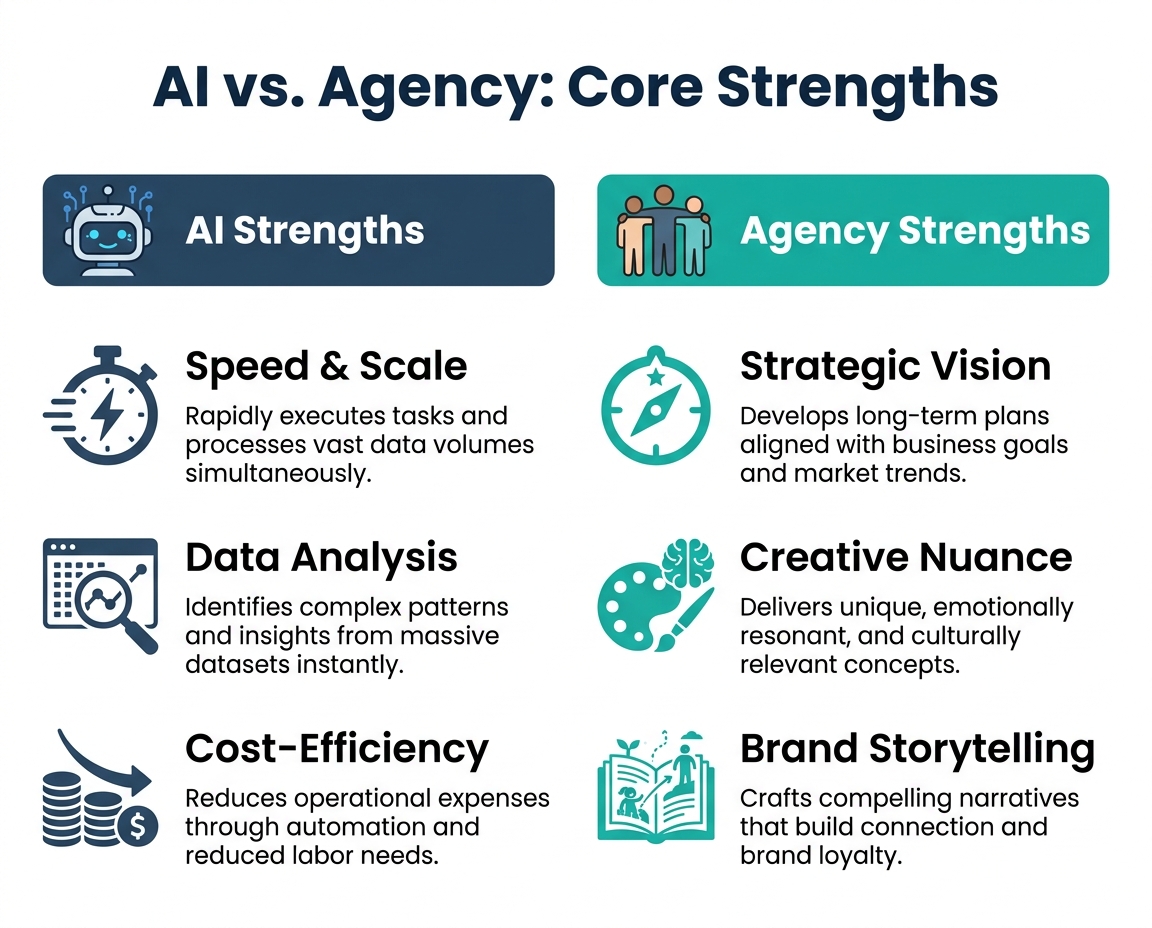
AI-native marketing is not a technology choice. It is an operating philosophy. Five principles define the model:
1. Systems over headcount. Traditional marketing scales by hiring. Need more content? Hire writers. Need more channels? Hire specialists. AI-native marketing scales by building systems. Need more content? Configure the content pipeline to produce more. Need more channels? Add a channel to the orchestration layer. The cost of scaling is configuration, not payroll.
2. Senior humans, not junior executors. In a traditional marketing team, most people are executing: writing copy, setting up campaigns, pulling reports, managing vendors. In an AI-native model, AI handles execution. The humans who remain are strategists, creative directors, and operators with 10-20+ years of experience. They make the decisions that AI cannot: what markets to pursue, what stories to tell, what quality standards to enforce.
3. Multi-model orchestration. AI-native teams do not rely on a single AI tool. They use multiple specialized models, each selected for its strengths. One model handles research and data synthesis. Another drafts long-form content. A third generates ad creative variations. A fourth analyzes performance data. The orchestration layer routes each task to the right model automatically.
4. Closed-loop optimization. Every campaign, piece of content, and ad produces data. In AI-native marketing, that data feeds back into the system automatically. Performance results inform the next round of content creation, targeting, and budget allocation without waiting for a monthly review meeting. The system gets smarter every day because it learns from every interaction.
5. Quality is a system, not a hope. The biggest risk with AI in marketing is producing generic, off-brand content at scale. AI-native operations treat quality control as an engineered system: brand voice training for AI models, multi-step editorial workflows, and senior human review on every piece that goes public. Quality is not an afterthought. It is built into the pipeline.
How AI-Native Content Production Works
Content is where the AI-native model shows its clearest advantage. A traditional marketing team producing 10 blog posts per month needs 2-3 writers, an editor, and a content manager. An AI-native operation producing 50+ pieces per month needs a strategist to set editorial direction and a creative finisher to ensure quality.
Here is how the pipeline works in practice:
Step 1: Strategic brief. The human strategist defines the content calendar: topics, keywords, audience segments, and goals. This is the 20% of work that requires experience and judgment. AI cannot tell you what stories your market needs to hear.
Step 2: Research and outline. AI systems analyze competitor content, search trends, and audience data to generate comprehensive outlines. The strategist reviews and adjusts. This step takes minutes instead of hours.
Step 3: AI draft. Specialized content models produce full drafts, trained on the brand's voice guidelines and style standards. The output is a working draft, not a final product. This is where most companies stop, and it is why most AI content reads like AI content.
Step 4: Human editing. The creative finisher takes the draft and adds what AI cannot: genuine expertise, original insights, cultural references, editorial judgment, and the specific tone that makes content sound like it was written by someone who actually understands the subject. This step is what separates professional AI-native content from AI slop.
Step 5: Quality assurance. Every piece runs through fact-checking, brand voice verification, and SEO/GEO/AEO optimization before publishing. This is systemized, not ad hoc. The same checklist, the same standards, every time.
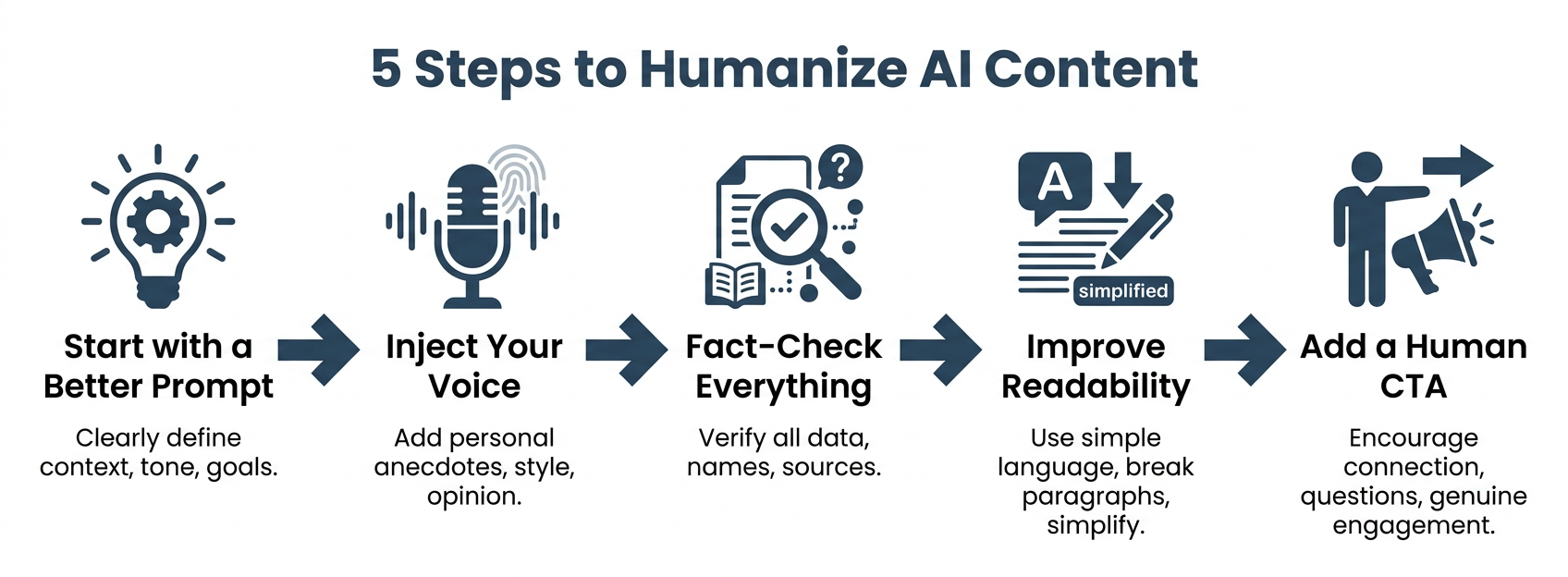
The volume advantage comes from steps 2 and 3 happening in minutes instead of days. The quality advantage comes from steps 4 and 5 being non-negotiable. Companies that skip human editing to maximize volume are optimizing for the wrong metric. The ones that get this right produce more content AND better content than traditional teams.
Want to see AI-native content production in action?
We can walk you through our actual content pipeline and show you what the output looks like for your industry.
The AI-Native Marketing Tech Stack
An AI-native operation runs on a different technology architecture than a traditional marketing team. The stack has three layers:
Layer 1: The intelligence layer. This is where the AI models live. A mature AI-native operation uses 6+ specialized models, not one general-purpose chatbot. Different models handle different tasks: research synthesis, long-form drafting, ad copywriting, email personalization, image generation, and data analysis. The orchestration system routes each task to the right model based on the requirements.
Layer 2: The automation layer. Between the AI models and the marketing channels sit dozens of automated workflows. These handle the operational work that used to require junior team members: scheduling content, routing approvals, distributing across platforms, monitoring performance, flagging anomalies, and generating reports. A well-built automation layer might run 50-100+ distinct workflows.
Layer 3: The channel layer. This is the interface with the outside world: your CMS, email platform, ad accounts, social media tools, CRM, and analytics. In an AI-native operation, these tools are connected through APIs and integrations so data flows automatically between them. There is no manual export-import cycle, no copy-pasting between platforms.
The integration between layers is what creates the closed-loop advantage. When a LinkedIn ad campaign generates leads, that data flows back through the automation layer to the intelligence layer, which adjusts targeting, refines messaging, and optimizes budget allocation, all without a human needing to pull a report and schedule a meeting to discuss it.
Multi-Channel Execution: The Staffing Ceiling Is Gone
In traditional marketing, every channel requires dedicated people. Running SEO needs an SEO specialist. Running paid search needs a PPC manager. Email needs an email marketer. Social needs a social media manager. The cost of covering more channels scales linearly with headcount.
This creates a real constraint for mid-market companies. A $10M-$100M B2B company typically cannot afford a 15-person marketing team, so they pick 2-3 channels and ignore the rest. They know they should be doing more, but the economics do not work.
AI-native marketing removes this ceiling. Once the systems are built and configured, the marginal cost of adding a channel is near zero. The same AI systems that produce blog content can generate email sequences, ad copy, social posts, and landing pages. The same automation layer that distributes content to one channel can distribute to six.
This is why AI marketing agencies can cover 6-8 channels for the same cost a traditional agency charges for 2-3. It is not because they are cutting corners. It is because the per-channel cost structure is fundamentally different.
Channel Coverage: Traditional Team vs. AI-Native Operation
The channels that AI-native operations typically cover simultaneously: SEO and content, paid search (Google Ads), paid social (LinkedIn, Meta), email marketing (cold outreach + nurture sequences), organic social, and landing pages with conversion optimization. Some also add ABM, video content, and podcast distribution depending on the client's market.
The AI-Native Marketing Team
The team structure of an AI-native operation looks nothing like a traditional marketing department. Instead of 15-20 people organized by function (content, paid, email, social, analytics), an AI-native team is organized around three roles:
The Strategist. This person sets the marketing direction: ICP definition, channel strategy, campaign architecture, competitive positioning, and editorial voice. They bring deep marketing experience, typically 15+ years. They are the reason the AI does not produce generic, undifferentiated work. In the best operations, this is a founder or partner-level person who stays close to the client's business.
The AI Operator. This person builds and manages the AI systems: configuring workflows, training models on brand voice, monitoring outputs, tuning performance, and connecting the tech stack. They sit at the intersection of marketing and technology. This role barely existed before 2024. The best AI operators understand both the marketing context (what good looks like) and the technical architecture (how to make the systems produce it).
The Creative Finisher. AI produces competent drafts. The creative finisher transforms them into content that sounds like it was written by a human who actually cares about the subject. They add original insights, fix awkward phrasing, inject brand voice, catch factual errors, and make editorial decisions about what stays and what goes. This role is why the best AI-native content is indistinguishable from the best human-written content.
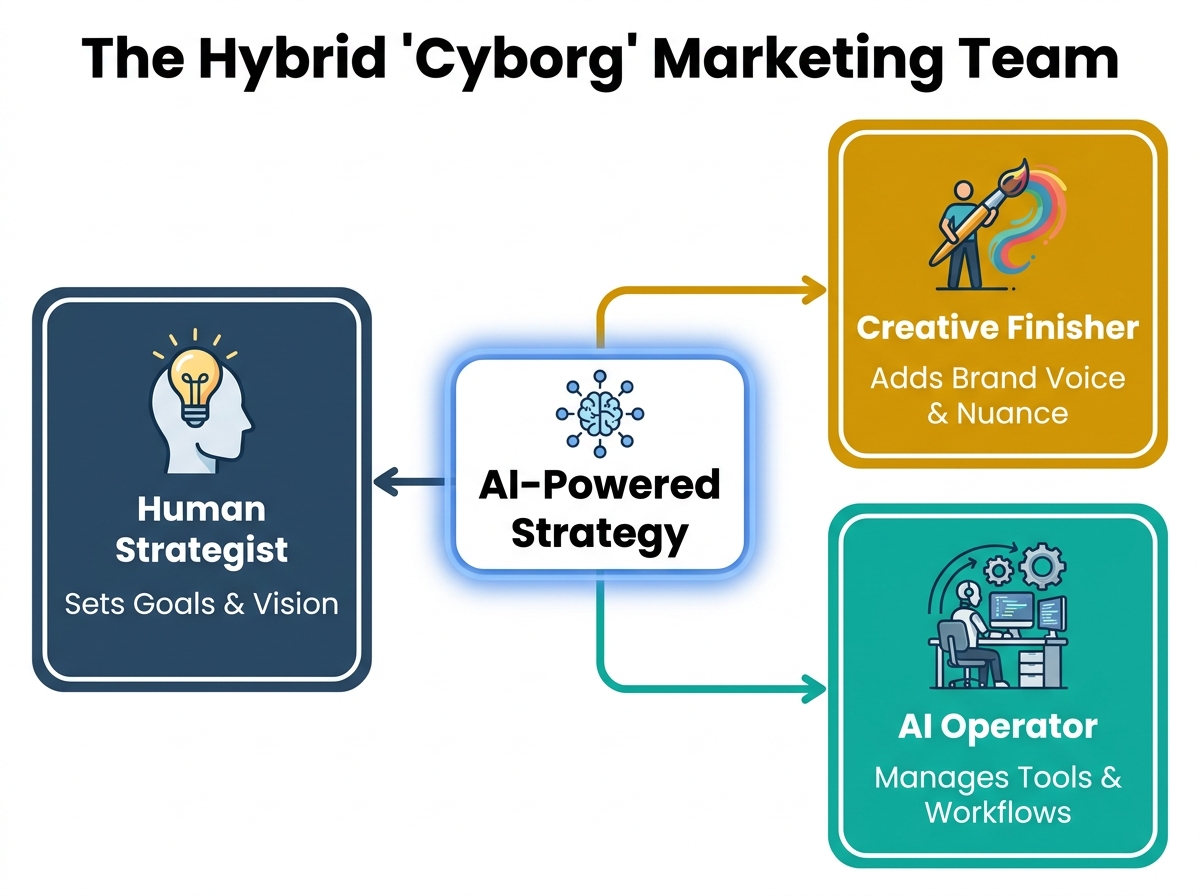
Notice what is missing from this team: junior copywriters, campaign coordinators, social media managers, reporting analysts, and project managers. AI-native operations do not need these roles because the systems handle the work those roles used to do. The humans who remain are more senior, more experienced, and more expensive per person, but the total team cost is dramatically lower because there are so few of them.
Personalization at Scale: From Segments to Individuals
Traditional marketing personalizes at the segment level. You build 3-5 audience personas and create content for each. An email campaign might have 3 variations: one for enterprise, one for mid-market, one for startups. That is the limit of what a human team can maintain.
AI-native marketing personalizes at the account or individual level. Instead of 3 email variations, you send 300, each tailored to the specific company, industry, pain points, and buyer stage of the recipient. Instead of 3 ad creative sets, you run 50, each optimized for a different audience micro-segment.
This is not theoretical. The technology to do this exists today. What has been missing is the operating model to deploy it. A traditional marketing team cannot create 300 email variations. They do not have the time or the people. An AI-native operation generates them in minutes because the AI handles the variation while the human defines the strategy and voice.
The impact on conversion rates is significant. Personalized content consistently outperforms generic content by substantial margins across every channel: email open rates, ad click-through rates, landing page conversions, and content engagement. The companies running AI-native personalization are competing on a different playing field than those still sending the same message to everyone.
The AI Slop Problem (And How AI-Native Operations Solve It)
The biggest objection to AI in marketing is quality. And it is a legitimate concern. The internet is flooding with generic, formulaic, obviously AI-generated content. Marketers call it "AI slop," and it is damaging brands that deploy AI without quality controls.
Here is the uncomfortable truth: AI slop is not a technology problem. It is a management problem. Companies produce AI slop when they use AI to replace human judgment instead of amplifying it. When a junior marketer prompts ChatGPT and publishes the output without meaningful editing, the result is predictable: generic content that sounds like every other company using the same tool.
AI-native operations solve this structurally, not aspirationally. Quality is built into the system, not left to individual discipline:
- Custom brand voice models. The AI systems are trained on the client's best existing content, style guides, and editorial standards. The baseline output already sounds like the brand, not like generic ChatGPT.
- Multi-step editorial pipeline. Every piece passes through AI draft, human edit, fact-check, and brand voice verification before publishing. No exceptions, no shortcuts.
- Senior human oversight. The people reviewing content have 10-20+ years of marketing experience. They know what good looks like because they have spent careers producing it. Junior reviewers catch typos. Senior reviewers catch strategic misalignment, tone failures, and factual errors.
- Feedback loops. Content performance data feeds back into the system. The AI learns which content styles, formats, and approaches generate engagement and pipeline, not just which ones are easy to produce.
The result is counterintuitive: AI-native operations often produce higher quality content than traditional teams, because the quality controls are systemized rather than dependent on the individual writer's skill on any given day.
Worried about quality?
We can show you our editorial pipeline and the difference between AI-native content and AI slop. It is significant.
The Economics of AI-Native Marketing
The financial case for AI-native marketing is straightforward. Traditional marketing has a linear cost curve: more output requires more people requires more budget. AI-native marketing has a step-function cost curve: once the systems are built, additional output costs almost nothing.
Here is what this looks like in practice for a mid-market B2B company:
| Cost Component | Traditional (In-House) | Traditional Agency | AI-Native |
|---|---|---|---|
| Team/retainer cost | $400K-$800K/yr (5-8 FTEs) | $360K-$600K/yr ($30K-$50K/mo) | $180K-$420K/yr ($15K-$35K/mo) |
| Channels covered | 2-3 | 2-3 | 6-8 |
| Content volume | 8-15 pieces/mo | 8-15 pieces/mo | 50-100+ pieces/mo |
| Personalization depth | 3-5 segments | 3-5 segments | Account-level (unlimited) |
| Deployment speed | 3-6 months to hire and ramp | 2-4 months to onboard | 30 days to live campaigns |
| Reporting | Weekly/monthly manual reports | Monthly PDF reports | Real-time dashboards |
The traditional in-house option costs the most because you are paying fully-loaded salaries, benefits, management overhead, and tool subscriptions. The traditional agency option is cheaper per person-hour but limited in scope and speed. The AI-native option costs less than both while delivering substantially more.
The key insight is that AI-native marketing is not cheaper because it cuts corners. It is cheaper because the operating model is fundamentally more efficient. The humans are more experienced (and more expensive per hour), but you need so few of them that the total cost drops dramatically while the output increases.
Real Example: From 3 Channels to 7 in 30 Days
A B2B software company was spending $35K/month on a traditional agency that managed Google Ads, LinkedIn Ads, and produced 6 blog posts monthly. After switching to an AI-native operation, they deployed across 7 channels (adding SEO, email sequences, organic social, and conversion-optimized landing pages) within 30 days. Content volume went from 6 pieces per month to 45+. Their cost dropped to $25K/month. Pipeline from marketing grew from 8 qualified opportunities per month to 23 by the end of the first quarter.
When AI-Native Marketing Works (And When It Does Not)
AI-native marketing is not the right fit for every company. It works best in specific conditions:
Where it works:
- B2B companies with $5M-$500M in revenue that need multi-channel marketing but cannot afford or do not want to build a 15-person marketing team.
- Companies with complex buying cycles where content quality, personalization, and multi-touch attribution matter. SaaS, fintech, healthtech, and professional services are strong fits.
- Companies currently spending $15K-$50K/month on marketing (whether agency, in-house, or a combination) and are not seeing results proportional to the investment.
- Companies under board pressure to show an AI strategy with results that can be measured in months, not years.
Where it does not work:
- Very early-stage startups that have not yet found product-market fit. AI-native marketing amplifies a marketing strategy. If you do not have a strategy yet, there is nothing to amplify.
- Purely local or relationship-based businesses where marketing is primarily referrals, events, and personal networks. AI-native marketing is designed for digital channels at scale.
- Companies that need a single, narrow channel (just SEO, just email). If you only need one channel, a specialist makes more sense. The AI-native model shines when you need coverage across many channels simultaneously.
Is Your Company Ready for AI-Native Marketing?
- Are you currently managing fewer channels than you know you should be?
- Is your content volume limited by your team's capacity, not your strategy?
- Are you spending more on marketing operations than on actual marketing?
- Could your team produce higher quality work if they had more time for strategy and less time on execution?
- Do you have access to AI-native talent, or would you need to hire for it?
How to Transition to AI-Native Marketing
The transition from traditional to AI-native marketing does not have to be all-or-nothing. Most companies follow a phased approach:
Phase 1: Partner and learn (Months 1-3). Work with an AI marketing agency to deploy AI-native marketing across your channels. This gives you immediate results while teaching your team how the model operates. You learn what works, what the quality standards look like, and what the real output capacity is.
Phase 2: Evaluate and extend (Months 4-6). After 90 days of data, you have a clear picture of ROI, output quality, and pipeline impact. Use this data to decide whether to expand the engagement, bring some capabilities in-house, or restructure your existing team around AI-native principles.
Phase 3: Build or scale (Months 7-12). If the results justify it, you can begin building internal AI-native capabilities while maintaining the agency partnership. This hybrid model gives you the best of both: proven agency systems for scale and an internal team building institutional knowledge.
The mistake most companies make is trying to jump straight to Phase 3, hiring an AI operator and trying to build systems from scratch before they understand what "good" looks like. Starting with a partner who already has proven systems, trained models, and operational experience saves 6-12 months of trial and error.
The companies that are winning right now started Phase 1 six months ago. They already have data, optimized systems, and compounding results. Every month you wait is a month your competitors are building an advantage that gets harder to close. The operating model is here. The question is when you adopt it, not whether you should.