
Hannon Brett | Published on: June 18, 2026 | Time to read: 21 min
What is Marketing as a Service (MaaS)?

Marketing as a Service (MaaS) is a subscription-based model where businesses get access to a full marketing team and technology stack through an ongoing partnership. Instead of hiring in-house or commissioning one-off projects, you pay a recurring fee for continuous, integrated marketing support focused on real business outcomes.
A Complete Team, Not Just a Vendor
With MaaS, you're not buying a deliverable. You're gaining a strategic partner that brings together specialists across content, SEO, paid media, analytics, and more.
Think of it as having an entire marketing department available to you, without the cost of building one from scratch. Research from MarketingProfs describes MaaS as a managed-services model where execution and operational work are outsourced so internal teams can focus on higher-value strategy.
Outcomes Over Deliverables
The core philosophy of MaaS is simple: results matter more than tasks completed.
A traditional agency might hand over a finished campaign and call it done. A MaaS partner sticks around, watches the numbers, adjusts strategy, and keeps pushing toward your goals. It's an active, ongoing relationship built around growth.
How MaaS Differs from Project-Based Work
Project-based work is transactional. You define a scope, pay for it, and the engagement ends.
MaaS is the opposite. It's agile and integrated. Your partner learns your brand, stays aligned with your team, and adapts as your business changes. And because the subscription model grows with you, scaling up or down is far easier than hiring or firing staff.
The global subscription economy hit $492.34 billion in 2024 and is projected to reach $1.5 trillion by 2033. That growth reflects a fundamental shift in how businesses prefer to access services, including marketing.
Key Differences: Marketing as a Service vs. Digital Agencies vs. In-House Teams

Choosing how to run your marketing comes down to three main options: Marketing as a Service, a traditional digital agency, or an in-house team. Each has its own cost structure, skill set, and flexibility. Understanding these differences helps you pick the model that actually fits your business.
Cost Structure: What You're Really Paying For
In-house teams carry the heaviest fixed costs. A fully loaded 5-person marketing team in the US can run between $450,000 and $550,000 per year when you factor in salaries, benefits, payroll taxes, tools, and overhead. That's before you account for turnover or training.
Traditional agency retainers vary widely. You might pay a project fee for one campaign, then start over with a new scope the next quarter. There's no continuity built into the model.
MaaS operates on a predictable subscription. SMBs typically pay between $1,500 and $5,000 per month for foundational services. Mid-market companies with broader needs often invest $5,000 to $20,000 or more monthly, depending on the depth of strategy and execution required.
Scope of Expertise: One Specialist vs. a Full Team
In-house teams are only as strong as the people you can afford to hire. A small team might have a content writer and a paid media buyer, but gaps in SEO, analytics, or design are common.
Agencies often specialize. A social media agency is great at social. But if you need integrated SEO and email strategy too, you're either hiring two agencies or settling for gaps.
MaaS brings a broader, integrated team under one subscription. You get access to specialists across multiple channels working together, without managing separate vendors or negotiating separate contracts.
Scalability and Flexibility
This is where MaaS stands apart. Scaling an in-house team means hiring, which takes time. Onboarding a new hire involves recruiting, interviewing, and a ramp-up period before they contribute fully.
With MaaS, scaling up or down is a conversation, not a process. Need more content production for a product launch? Adjust your scope. Slowing down for Q4? Pull back without severance costs.
Here's a quick side-by-side look at how the three models compare:
| Attribute | MaaS | Digital Agency | In-House Team |
|---|---|---|---|
| Cost structure | Fixed monthly subscription | Retainers or project fees | Salaries, benefits, overhead |
| Expertise | Broad, integrated specialists | Often specialized by channel | Limited to current hires |
| Scalability | Fast, adjust scope anytime | Moderate, requires new contracts | Slow, requires hiring |
| Brand intimacy | Built over time through onboarding | Varies by engagement length | Strong from day one |
| Speed to launch | Fast, systems already in place | Fast for defined projects | Slower, depends on team readiness |
| Flexibility | High, adapts to business changes | Moderate | Lower, tied to headcount |
The right model depends on where your business is right now. If predictable costs, broad expertise, and the ability to scale quickly matter to you, Marketing as a Service is worth a close look.
The Core Benefits of Adopting a Marketing as a Service Model
The marketing as a service model offers three big advantages: predictable costs, instant access to a full team of specialists, and the ability to change direction fast. For growing businesses, these benefits can make the difference between a marketing strategy that stalls and one that actually scales.
Financial Predictability and Real Cost Savings
Building an in-house team is expensive. When you add up salaries, benefits, tools, and overhead, costs add up quickly. That level of fixed spending is hard to justify, especially for small and mid-sized businesses that need results but don't have endless budgets.
A MaaS subscription replaces that unpredictable spending with a fixed monthly cost. You know exactly what you're paying each month, and you're not on the hook for benefits, recruiting fees, or onboarding costs. According to Chariot Creative's cost analysis, the savings from outsourcing versus hiring in-house can be significant once you factor in the full employment picture.
Instant Access to a Full Skill Set
Hiring takes time. Finding a great SEO strategist, a creative designer, a paid media expert, and a content writer means months of recruiting, plus the risk of a bad hire.
With MaaS, you skip all of that. From day one, you get access to a team of specialists across every marketing discipline. Content, paid ads, analytics, email strategy, and more come bundled together. And because the team works as a unit, there's no coordination gap between channels.
Agility to Pivot When It Matters
Markets shift. Campaign results don't always go as planned. What worked last quarter might not work today.
The MaaS model is built for exactly this kind of change. Your partner monitors performance data continuously and adjusts strategy in real time. There's no waiting for a new contract or a new agency brief. The team pivots with you, which means your marketing stays aligned with what your business actually needs right now.
This combination of cost control, broad expertise, and built-in flexibility makes the marketing as a service model a strong fit for businesses that want to grow without the overhead of building everything from scratch.
What's Typically Included in a Marketing as a Service Package?
A marketing as a service package gives you access to a full marketing operation under one subscription. Most packages cover three layers: strategy, execution, and support functions. What you get depends on your tier, but the core building blocks stay fairly consistent across providers.
Strategy and Brand Foundation
Every solid MaaS engagement starts with planning. This means building a marketing strategy tied to your business goals, not just running campaigns for the sake of it.
You'll also get brand messaging work. That covers how you talk about your business, your value proposition, and the words you use to connect with buyers. And most packages include persona development, so the team knows exactly who they're targeting before any content gets written or any ad goes live.
Execution Channels
This is where the actual marketing work happens. A typical MaaS package covers a mix of channels, depending on where your audience lives and what drives results for your business.
Common execution services include:
- SEO: On-page optimization, keyword research, and technical fixes to help you rank in search
- Content marketing: Blog posts, ebooks, landing pages, and other assets that build authority and drive traffic
- PPC and SEM: Paid search and display campaigns managed to hit your cost-per-acquisition targets
- Email marketing: Nurture sequences, newsletters, and automated campaigns that keep leads moving through your funnel
- Social media management: Content creation, scheduling, and community engagement across your active platforms
These channels work better together than separately. And because a MaaS team manages them as a unit, there's no gap between your SEO strategy and your content calendar.
Supporting Functions That Tie It All Together
The execution channels get the attention, but the supporting functions are what make MaaS actually work.
Analytics and reporting give you a clear picture of what's working and what isn't. Your team tracks performance data, builds dashboards, and translates numbers into decisions. According to VDigital Services' overview of MaaS, access to integrated reporting is one of the key differentiators that separates this model from traditional agency work.
Marketing automation is another core component. Tools like HubSpot handle lead scoring, email sequences, and CRM integration so no prospect falls through the cracks.You also get access to a professional marketing technology stack. That includes tools for SEO research, competitive analysis, ad management, and performance tracking. These tools cost thousands of dollars per year on their own. With MaaS, they're bundled into your subscription.
| Service Layer | What's Included |
|---|---|
| Strategy | Marketing plan, brand messaging, persona development |
| Execution | SEO, content, PPC/SEM, email, social media |
| Support Functions | Analytics, automation, marketing tech stack |
The specific mix varies by package tier. But the goal is always the same: give you a complete marketing operation without making you hire, manage, or pay for each piece separately.
Understanding Marketing as a Service Pricing Models
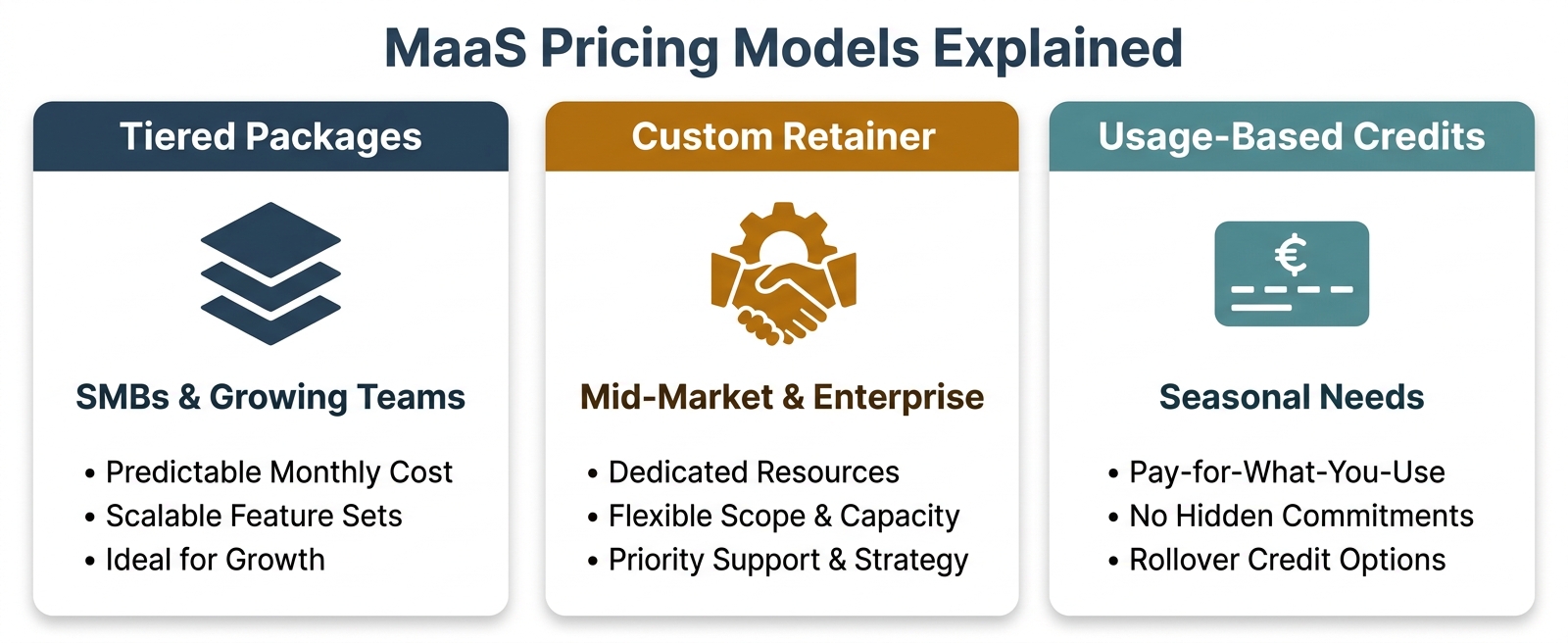
Marketing as a Service pricing typically follows three structures: tiered packages, custom retainers, and usage-based models. Each one fits a different business size and need. Knowing the difference helps you pick the right level of investment before you sign anything, and it helps to know what companies at your funding stage typically budget for marketing.
Tiered Package Pricing
Most MaaS providers offer stacked tiers, often labeled something like Basic, Pro, and Enterprise. Each tier adds more services, more channels, and more strategic depth.
A Basic or Starter package usually covers the fundamentals: SEO, content production, and email marketing. It's built for small businesses that need consistent execution without a big budget.
Pro-level packages expand the scope. You get paid media management, more content volume, deeper analytics, and a dedicated account lead. These packages suit growing companies that need more channels working together.
Enterprise tiers are the most comprehensive. They include advanced strategy, full-funnel execution, marketing automation, and priority support. Pricing at this level reflects the full breadth of resources dedicated to your account.
Custom Retainer Pricing
Larger businesses often don't fit neatly into a preset tier. That's where custom retainers come in.
With a custom retainer, your MaaS provider builds a scope of work around your specific goals. Maybe you need heavy ABM support, multilingual content, or a full demand generation program. The monthly fee reflects the exact resources required.
This model is common for mid-market and enterprise companies. It's more flexible than a fixed tier and often delivers better ROI because you're only paying for what your business actually needs.
According to research from Scale Army on fully loaded employee costs, companies that outsource marketing functions avoid significant hidden costs that come with full-time hires. Custom retainers let businesses capture those savings while getting a scope that fits.
Usage-Based and Credit Models
Some MaaS providers offer a credit or usage-based pricing structure. You buy a block of credits or hours each month and spend them on specific tasks: a landing page, a batch of blog posts, a campaign audit.
This model works well for businesses with unpredictable or seasonal marketing needs. It gives you flexibility without locking you into a fixed scope.
The tradeoff is that credit models can feel transactional. You get less of the integrated, always-on partnership that makes MaaS valuable for most growing businesses.
| Pricing Model | Best Fit | Key Benefit |
|---|---|---|
| Tiered Packages | SMBs and growing companies | Predictable cost, clear deliverables |
| Custom Retainer | Mid-market and enterprise | Tailored scope, stronger ROI alignment |
| Usage-Based / Credits | Seasonal or variable needs | Flexibility, pay only for what you use |
The right pricing model depends on how consistent your marketing needs are and how much strategic depth you want from your partner.
Is Marketing as a Service Right for Your Business?
Marketing as a Service works best for businesses that need a full marketing operation but can't justify building one from scratch. If you want predictable costs, broad expertise, and the ability to scale fast, MaaS is worth a serious look. But it's not the right fit for every situation.
Signs MaaS Is a Strong Fit
Some businesses are natural candidates for this model. Ask yourself these questions:
- Do you need more than one channel? If your business needs SEO, content, paid ads, and email all working together, a single hire won't cut it.
- Is your budget too tight for a senior team? Building a full in-house marketing team carries significant annual overhead. MaaS gives you that same breadth at a fraction of the fixed cost.
- Do you want marketing to grow with revenue? MaaS subscriptions scale up or down without the delay of hiring cycles.
- Are you short on time to manage specialists? With MaaS, one partner handles coordination across all channels.
If you answered yes to most of these, MaaS is likely a good fit.
Business Stages That Benefit Most
Not every stage of growth calls for MaaS. But a few situations make it especially valuable.
Post-seed startups often have product-market fit but no marketing infrastructure. MaaS lets them launch a full strategy fast without committing to a large headcount.Growing SMBs hit a wall when one or two marketers can't cover every channel. MaaS fills those gaps without the cost of five separate hires.Established companies launching new products need speed and breadth. MaaS gives them a team that's ready to execute immediately, without disrupting the core business.When MaaS Might Not Be the Best Choice
MaaS isn't a universal solution. There are situations where a different model makes more sense.
Large enterprises with mature, specialized in-house teams may not benefit much. If you already have dedicated experts in every channel, adding a MaaS layer can create overlap and confusion rather than clarity.
Businesses that only need a one-time project, like a single website redesign or a campaign for one product launch, are better served by a project-based agency. MaaS is built for ongoing, integrated work. Paying a monthly subscription for a task that ends in six weeks doesn't make financial sense.
Companies that need deep operational control over every marketing decision may also find the model difficult. MaaS works best when there's trust in the partner's judgment and some flexibility in how work gets done.
The honest answer is: MaaS fits businesses that want a strategic, ongoing marketing partner and don't have the resources or desire to build that capability entirely in-house.
Key Questions to Ask When Evaluating MaaS
- Do you need more than one marketing channel working together (SEO, content, paid ads, email)? If so, MaaS brings integrated expertise that a single hire cannot deliver.
- Is your budget too tight to justify building a full in-house marketing team with 3-5 specialists? MaaS can provide that breadth for a fraction of the $450K-$550K annual fully-loaded cost.
- Do you want marketing capabilities to scale up or down without hiring cycles or severance costs? MaaS subscription models adjust scope through conversation, not recruitment.
- Are you short on time to coordinate between multiple specialists or vendors? One MaaS partner handles channel integration and reporting across all functions.
- What specific marketing gaps exist in your business today: SEO, content, paid media, email, analytics? A good MaaS partner should address these gaps with integrated solutions.
- How will you measure success? Can you define MQLs, SQLs, pipeline contribution, and attributed revenue? MaaS partners should track business outcomes, not just vanity metrics.
How to Successfully Integrate a MaaS Provider with Your Team
Getting the most from a MaaS provider starts before any work begins. The onboarding process sets the tone for everything that follows. When you align on goals, communication rhythms, and roles early, the partnership runs smoother and delivers results faster.
Start with Clear Goals and KPIs
Before your MaaS provider touches a single campaign, define what success looks like. That means setting specific, measurable goals tied to your business outcomes. Think pipeline generated, cost per lead, organic traffic growth, or conversion rate improvements.
Pair each goal with a KPI so both sides are tracking the same numbers. Vague expectations lead to misaligned work. Clear targets create shared accountability from day one.
Build Communication Into the Structure
Consistent communication keeps the partnership on track. Set up shared channels like a dedicated Slack workspace, a project management board, and a weekly check-in meeting. These aren't optional extras. They're how you catch problems early and keep momentum going.
A partner onboarding best practices guide from Kinavic recommends establishing 30/60/90-day milestones during the onboarding session. That structure gives both teams a clear roadmap and natural checkpoints to assess progress.
Designate a Single Point of Contact on Each Side
One of the fastest ways to slow down a MaaS engagement is too many voices in the room. Assign one point of contact on your team and confirm the same on the provider side.
This person owns communication, approvals, and escalations. It cuts confusion, speeds up decisions, and keeps the relationship from fragmenting across departments.
Treat It Like a Partnership, Not a Purchase
MaaS works best when your provider understands your business at a deeper level. Share your revenue targets, your sales cycle, your competitive pressures, and what's worked before.
The more context your partner has, the better the strategy they can build. This isn't a vendor relationship where you hand over a brief and wait. It's an ongoing collaboration where both sides are invested in the outcome.
Measuring the ROI of Your Marketing as a Service Investment
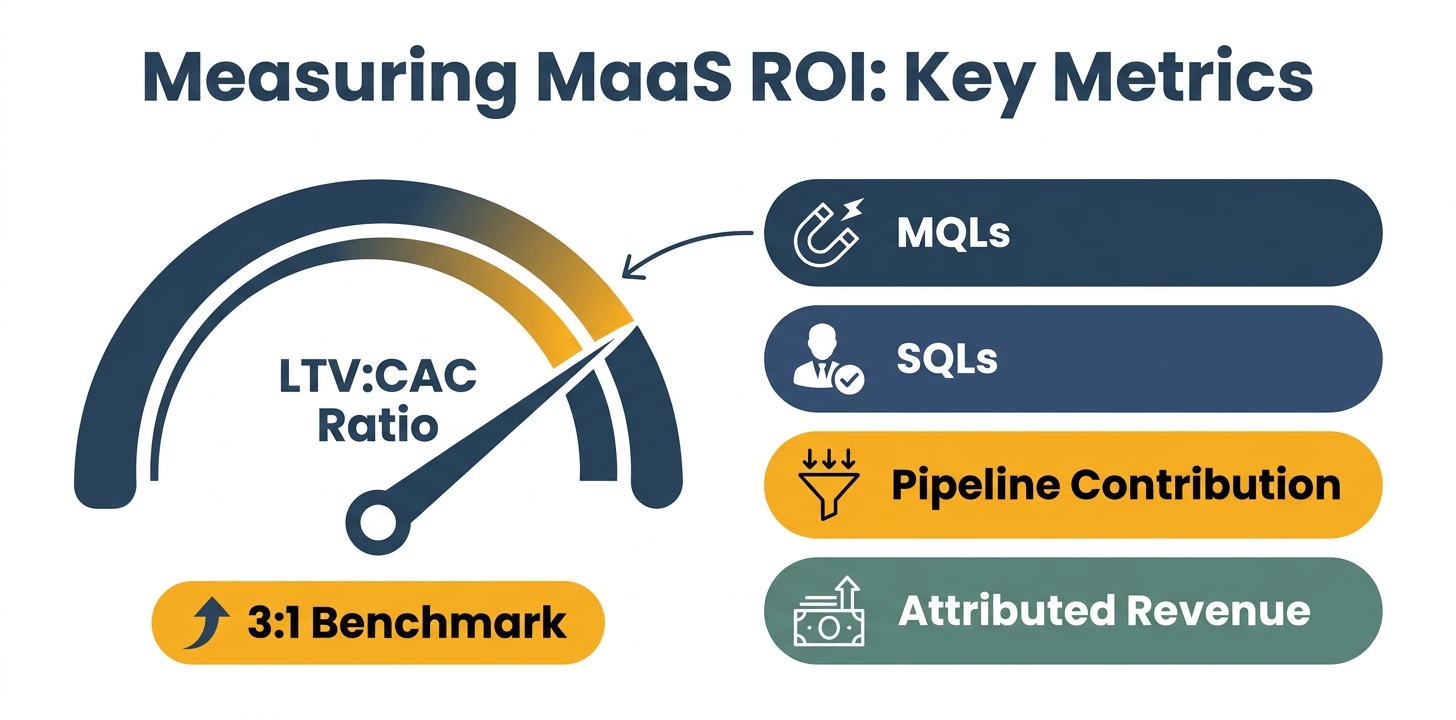
Measuring the ROI of marketing as a service means tracking business impact, not just activity. Move past vanity metrics like likes and impressions. Focus on Marketing Qualified Leads (MQLs), Sales Qualified Leads (SQLs), pipeline contribution, and revenue tied directly to marketing activity.
Focus on Metrics That Actually Matter
Likes and impressions feel good, but they don't pay the bills. The metrics that matter are the ones tied to revenue:
- MQLs: Leads that meet your criteria and are ready for marketing nurture
- SQLs: Leads passed to sales and accepted as genuine opportunities
- Pipeline contribution: Total deal value influenced or sourced by marketing
- Marketing-attributed revenue: Closed deals that marketing directly touched
When your MaaS partner tracks these numbers, you get a clear picture of what the investment is actually producing.
Use LTV and CAC to Evaluate Efficiency
Two metrics from the subscription world apply directly here: Customer Acquisition Cost (CAC) and Lifetime Value (LTV).
CAC measures what you spend to win one new customer. LTV measures the total revenue that customer generates over time. The ratio between them tells you whether your marketing investment is sustainable.
According to PayPro Global's SaaS metrics guide, the industry benchmark for a healthy LTV:CAC ratio is 3:1. That means every dollar spent acquiring a customer should return three dollars in lifetime value. A ratio below 2:1 signals overspending. Above 5:1 may mean you're underinvesting in growth.
Your MaaS partner should help you track both numbers and show how their work is improving the ratio over time.
Close the Loop Between Marketing and Revenue
Closed-loop reporting connects marketing activity directly to sales outcomes. It answers the question: did this blog post, ad campaign, or email sequence actually lead to a closed deal?
To make this work, your MaaS team needs access to CRM data. When a lead converts to a customer, the system traces it back to the original marketing touchpoint. That connection is what turns a marketing report into a business case.
Without closed-loop reporting, you're guessing. With it, you can prove the value of every dollar spent on your MaaS subscription.
Conclusion: Is a Marketing Subscription Service Your Next Best Move?
Marketing as a service gives scaling businesses a smarter path forward. It replaces the high fixed cost of building an in-house team with a predictable monthly subscription. You get broad expertise, built-in flexibility, and a partner that adapts as your business grows.
The model works best for post-seed startups, growing SMBs, and companies launching new products. If you need SEO, content, paid media, and email all working together but can't justify the overhead of five separate hires, MaaS closes that gap fast.
The strategic benefits come down to three things: cost control, agility, and access. You know what you're spending each month. You can scale up or pull back without a hiring cycle. And you get a full team of specialists from day one.
So what's the right next step? Start by auditing your current marketing gaps. Ask yourself which channels you're missing, where leads are falling through, and whether your current setup can actually support your growth targets.
Once you know where the gaps are, you have a clear picture of what a marketing subscription service needs to deliver for your business. That makes it much easier to evaluate providers, compare packages, and ask the right questions before you commit.
The businesses that get the most from MaaS treat it as a strategic partnership from the start. Share your goals, stay engaged, and hold your partner accountable to real business outcomes. That's when the model delivers its full value.

A: MaaS is typically a flat-rate subscription for an integrated, ongoing strategic partnership, like having an outsourced marketing department. Traditional agencies often work on project fees or retainers for specific, sometimes siloed services. MaaS providers build long-term relationships focused on business outcomes, while agencies typically complete a defined scope and move on.
Q: How much does Marketing as a Service cost?A: Costs vary based on scope and business size. SMBs typically pay between $1,500 and $5,000 per month for foundational services, while mid-market companies often invest $5,000 to $20,000+ monthly depending on the depth of strategy and execution channels required. Custom retainers for enterprise clients can exceed these ranges based on specific needs.
Q: Is MaaS a good option for small businesses?A: Yes, MaaS is an excellent option for small businesses because it provides access to a full suite of marketing expertise and technology that would be prohibitively expensive to hire in-house. It offers a scalable way for SMBs to compete with larger companies without the $450K-$550K annual cost of building a 5-person internal team.
Q: What services are usually included in MaaS?A: A comprehensive MaaS package typically includes strategy and planning, SEO, content creation (blogs, ebooks, landing pages), email marketing, social media management, PPC advertising, marketing automation, and detailed analytics and reporting. Most packages also bundle access to a professional marketing technology stack.
Q: How quickly can I expect to see results from a MaaS provider?A: While PPC channels can show results within weeks, foundational strategies like SEO and content marketing typically take 3-6 months to build momentum. A good MaaS provider will set clear expectations, focusing on leading indicators early on and demonstrating business results in the medium term.
Q: Do I lose control over my marketing by using a MaaS model?A: No, you don't lose control. You gain a strategic partner. A successful MaaS relationship is collaborative. You set business goals and approve strategy, while the provider handles execution and reports back on performance, freeing you to focus on your core business.