
Hannon Brett | Published on: July 13, 2026 | Time to read: 32 min | Updated on: August 31, 2026
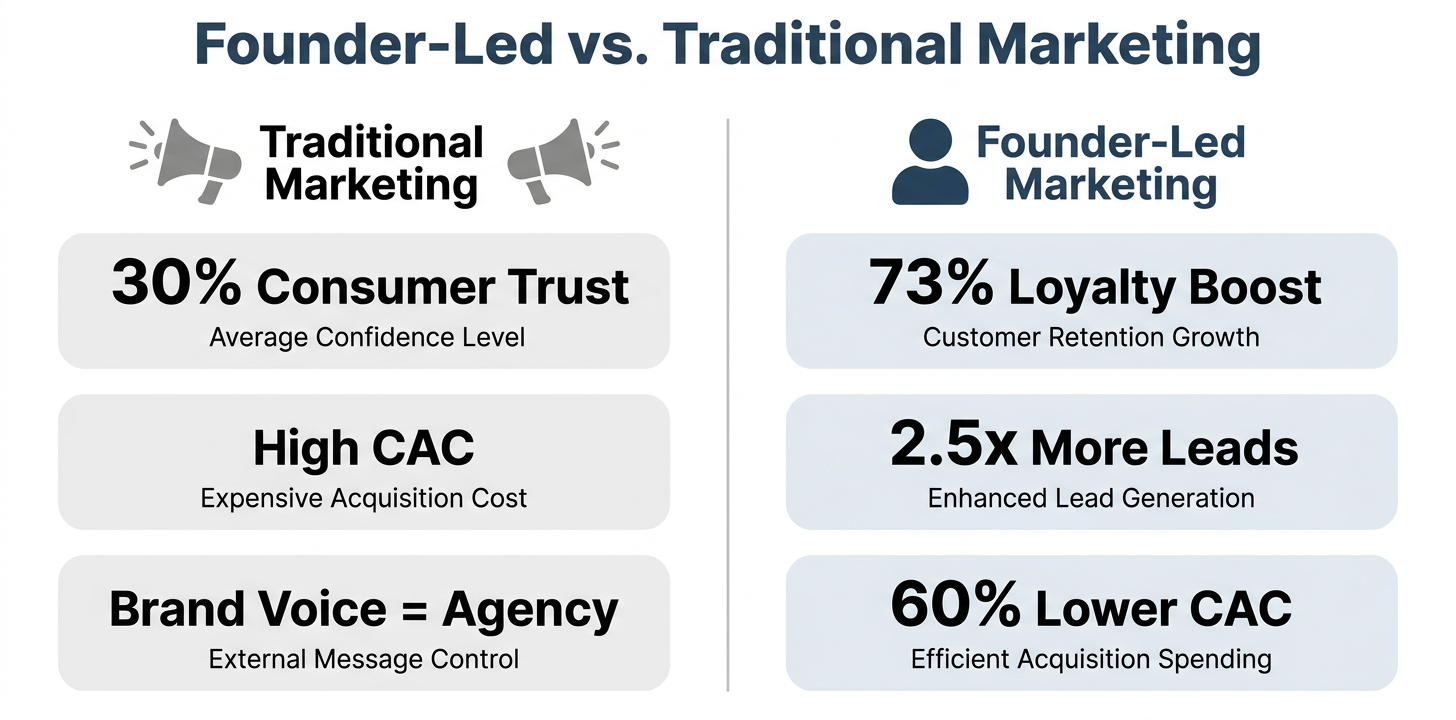
Founder-led marketing places the founder's story, personality, and expertise at the center of a company's growth strategy, replacing faceless corporate messaging with authentic human connection. While consumer trust in corporate brands remains at historic lows (30%), audiences are significantly more loyal to brands perceived as authentic (73%), making founder-led approaches a powerful competitive advantage that generates 2.5x more leads and 60% lower customer acquisition costs.
Key Takeaways
- Founder-led marketing is a deliberate business strategy, not personal branding or a side project, it must be intentional, consistent, and tied directly to company goals
- People connect with people, not logos. Authentic founder voices build trust faster than polished corporate campaigns can
- Your founding story creates an unfair competitive moat that cannot be copied, shifts conversation from product features to company mission, and attracts top talent and partners organically
- A sustainable strategy requires three core steps: (1) Define Your Narrative with a clear archetype (Expert, Challenger, or Visionary), (2) Choose one or two high-use channels where buyers actually spend time, and (3) Build a content engine using atomization to turn one pillar piece into multiple formats
- Content atomization: breaking one long-form piece into 14+ micro-formats, creates compounding returns. Founder content costs 60% less than agency content and never stops working like paid ads do
- Measurement focuses on business impact (inbound leads mentioning the founder, sales cycle speed, dark social attribution) rather than vanity metrics like follower counts
- Scaling requires hiring a brand journalist or content amplifier, not a social media manager, to extract and amplify the founder's thinking while preserving authenticity
- The right tool stack (AI writing assistants, social schedulers, video editors, personal CRM) removes execution friction without replacing the founder's strategic thinking
Table of Contents
- What is a Founder-Led Marketing Strategy? (And Why It Matters)
- The Unfair Advantage: Key Benefits of Founder-Driven Growth
- How to Build Your Founder-Led Marketing Strategy: A 3-Step Framework
- The Founder Amplification Stack: Tools to Scale Your Message, Not Your Time
- How to Measure the ROI of Your Founder-Led Marketing
- Scaling Beyond the Founder: How to Transition to a Marketing Team
- Ignite Your Growth with an Authentic Founder-Led Strategy
What is a Founder-Led Marketing Strategy? (And Why It Matters)
A founder-led marketing strategy is when the founder's story, personality, and expertise become the central engine of a company's marketing. It's not just posting on LinkedIn or building a personal brand. It's a deliberate business decision to use who you are to grow what you've built.
This approach is very different from traditional corporate marketing. Big brands spend huge budgets on polished ads, agency-crafted campaigns, and carefully managed press releases. The message is clean and professional. But it often feels cold and distant.
Founder-led marketing flips that model completely.
Instead of a faceless logo, real customers see a real person. They hear your story. They understand why you started the company. They feel connected to the mission before they ever try the product.
And that connection matters more than most founders realize.
According to data highlighted in PwC's Consumer Trust Survey, only 30% of consumers said they highly trust the companies they buy from, while 90% of executives believed their companies were trusted. That's a massive gap. And it shows exactly why polished corporate messaging is losing the battle for buyer attention.
But here's what the same research also shows: 73% of consumers say they're more loyal to brands they see as authentic. Authenticity isn't something a marketing agency can manufacture. It comes from a real human voice, and that's exactly what founders bring.
The core idea behind this strategy is simple. People connect with people, not logos. When a founder speaks openly about their journey, their mistakes, and their vision, it builds trust faster than any ad campaign ever could.
Think about the difference between reading a company blog post and watching the founder explain the same idea on video. One feels like marketing. The other feels like a conversation.
That's the power of putting the founder at the center of the story.
This strategy works across industries and company sizes. It's not just for venture-backed startups or tech founders. Any business leader with genuine expertise and a clear point of view can use their identity as a growth engine.
The key is treating it as a business strategy, not a side project. It needs to be intentional, consistent, and tied directly to the company's goals.
The Unfair Advantage: Key Benefits of Founder-Driven Growth
A founder-led marketing strategy gives you something no competitor can buy or copy: you. Your story, your personality, your specific way of seeing the world. That's the unfair advantage. And it compounds over time in ways that traditional marketing never can.
Your Story Is a Competitive Moat
Competitors can copy your product features. They can undercut your pricing. They can hire the same agencies and run similar ads.
But they cannot be you.
Your founding story, the specific struggles you went through, the exact insights that led you to build what you built, all of that is unique. When that story becomes central to how you market, it creates a moat that no competitor can cross.
This is why founder-driven growth is a strategic decision, not just a personal preference. It shifts the conversation from "what does your product do" to "why does this company exist and why should I trust them." That second question is much harder to compete against.
Trust Arrives Faster When a Real Person Is Speaking
Building brand credibility from scratch is slow and expensive. A new company has no track record, no reviews, and no reputation. But a founder with genuine expertise and a clear point of view can build trust almost instantly.
When buyers hear a founder speak honestly about the problem they're solving, they feel it. That's not marketing. That's a conversation.
And the numbers back this up. Data from HubSpot's founder content research shows that founder-led content generates 2.5x more leads than standard company content. That's not a small edge. That's a fundamentally different conversion dynamic.
For early-stage companies especially, the founder's credibility often IS the brand's credibility. Leaning into that isn't ego. It's smart business.
Top Talent and Partners Follow Visible Founders
Here's a benefit most founders don't think about until it's already working: people want to work with founders they respect.
When a founder shares their vision openly, whether through LinkedIn posts, podcasts, or video, they attract people who believe in that vision. Those people apply for jobs. They reach out about partnerships. They introduce themselves at events because they already feel like they know you.
This effect is documented in research from Crew.vc's investor perspectives, where VC Kiersten Gaffney notes that founders with an active public presence act as organic category evangelists. They build brand comfort before anyone ever signs a contract.
That kind of pull, where the best candidates come to you, is worth more than any recruiter fee.
The Compounding Effect Nobody Talks About
Paid ads stop the moment you stop paying. Founder content doesn't work that way.
A great LinkedIn post from six months ago is still being discovered today. A podcast interview from last year is still introducing new people to your company. Every piece of content a founder creates becomes a permanent asset.
This compounding effect means the cost of acquiring customers through founder-driven content gets cheaper over time, not more expensive. That's the opposite of what happens with every paid channel.
According to research on founder-led CAC reduction, startups with active founder content spend roughly 60% less to acquire customers compared to those relying on traditional advertising and PR channels. The founder's voice is, in many ways, the most efficient growth channel a company can own.
And unlike a campaign, it never turns off.
How to Build Your Founder-Led Marketing Strategy: A 3-Step Framework
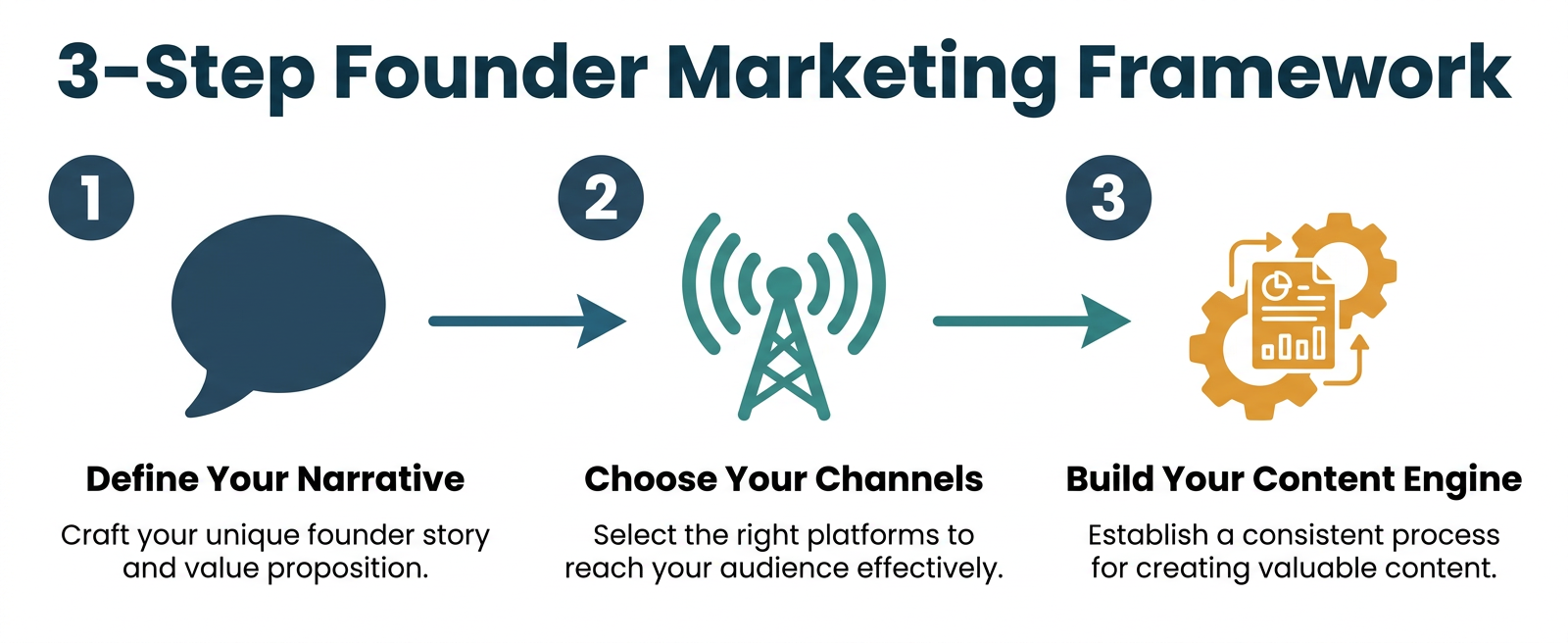
A founder-led marketing strategy works best when it follows a clear, repeatable process. The three core steps are: Define Your Narrative, Choose Your Channels, and Build Your Content Engine. Together, these pillars give you a system you can run consistently, not just a one-time campaign.
Think of this as a business framework, not a creative exercise. Each step builds on the last.
Step 1: Define Your Narrative
Before you post anything, you need a clear story. Who are you? What problem did you set out to solve? Why does it matter? Your narrative is the foundation everything else sits on.
This is not your company's About page. It is a personal point of view that connects your experience to your buyer's pain. The Forbes guide on building a personal narrative recommends a simple structure: reflect on real moments, identify what changed for you, and make it relevant to the people you serve.
Step 2: Choose Your Channels
Not every platform fits every founder. Pick one or two channels where your buyers actually spend time, then go deep before going wide.
For B2B founders, LinkedIn is the clearest starting point. Sociallyin's LinkedIn statistics report shows that 89% of B2B marketers rely on it for lead generation, with the 25 to 34 age group making up over 50% of the platform's user base. That is a highly targeted, decision-ready audience.
Step 3: Build Your Content Engine
A content engine turns one idea into many pieces. Instead of creating from scratch every week, you start with one strong piece of core content and break it into formats that fit each channel.
This is often called content atomization. One founder-level webinar, for example, can become short videos, LinkedIn posts, a newsletter, and a blog post. That system keeps you consistent without burning you out.
The key word is repeatable. A founder-led marketing strategy only compounds when you show up regularly, not just when inspiration strikes.
Step 1: Define Your Founder Narrative & Brand Pillars
Before you write a single post or record a single video, you need to know your story. Not your company's story. Yours. What did you experience, believe, and decide that led you to build this thing? That personal thread is the foundation of your entire founder-led marketing strategy.
This isn't a branding exercise. It's a strategic decision about what makes you different from every other founder in your space.
Why Your Narrative Is the Starting Point
Consumer trust in corporate brands is at a historic low. According to Edelman's 2024 Trust Barometer Special Report on Brand Trust, the trust gap between institutions and individuals continues to widen, with personal voices and authentic experiences driving loyalty in ways that polished brand messaging simply cannot.
That gap is your opportunity. When you show up as a real person with a real point of view, you fill the space that faceless marketing has left empty.
Find Your Founder Angle
Not every founder tells the same kind of story. The most effective narratives usually fall into one of three archetypes. Figuring out which one fits you helps you create content that feels natural and consistent.
Ask yourself these questions to find your angle:
The Expert- Do people constantly come to you with questions in your field?
- Have you spent years solving a specific problem before building your company?
- Do you have data, research, or hard-won knowledge others lack?
If yes, your angle is deep expertise. You build trust by teaching.
The Challenger- Do you disagree with how your industry currently operates?
- Did you start your company because something felt broken or wrong?
- Do you have strong opinions that might ruffle some feathers?
If yes, your angle is disruption. You build trust by being bold and honest.
The Visionary- Do you see a future others haven't imagined yet?
- Is your company solving a problem most people don't know they have?
- Do you think about where your industry is heading more than where it is now?
If yes, your angle is possibility. You build trust by painting a picture people want to live inside.
Real-world examples make this concrete. Richard Branson built Virgin around the Challenger archetype, constantly defying conventions and taking on industry giants. Steve Jobs embodied the Visionary, showing people futures they couldn't yet imagine. Yvon Chouinard of Patagonia became the Expert on sustainable business, building trust through deep conviction and action.
You don't need their fame. You need their clarity.
Align Your Story With Your Buyer's Pain
Your narrative only works when it connects to what your customer actually cares about. The Forbes guide on building a personal business narrative recommends a simple approach: reflect on real moments that changed you, then make those moments relevant to the people you serve.
Here's a practical way to do that alignment:
- Write down the moment you decided to start your company. Be specific.
- Identify the core problem you were frustrated by or passionate about solving.
- Ask: does my ideal customer feel that same frustration?
If the answer is yes, you've found your narrative bridge. Your story becomes their story. And that connection is exactly what turns a stranger into a follower, and a follower into a buyer.
Define Your Brand Pillars
Once your angle and narrative are clear, define three to four brand pillars. These are the recurring themes you'll return to again and again across all your content.
Think of them as the topics where your expertise, your values, and your buyer's pain points all overlap. Every post, talk, or interview you do should connect back to at least one pillar.
For example, a founder in the HR tech space might anchor around: honest hiring, burnout prevention, and the future of remote culture. Everything they create flows from those three themes.
This gives your content direction and makes you easy to follow. People know what they're getting when they come back to you.
Step 2: Choose High-Use Channels for Your Marketing
Once your narrative is clear, you need to decide where to show up. The biggest mistake founders make here is trying to be everywhere at once. That leads to shallow content on five platforms instead of strong content on one or two.
Go deep before you go wide. Master one channel. Then expand.
Match Your Channel to Where Your Buyers Actually Are
Channel selection starts with one question: where does your ideal customer spend time? Not where you feel comfortable. Where they are.
For D2C or consumer brands, TikTok and Instagram Reels tend to outperform. The audiences are younger, more visual, and more likely to buy from someone they feel they know personally.
Match Your Channel to How You Actually Communicate
Here's something most marketing advice skips: the best channel for you is the one that fits how you naturally express ideas.
If you love to write and explain things in detail, start with LinkedIn long-form posts or a newsletter. If you're a natural speaker who thinks out loud, a podcast or short-form video will feel easier and more authentic. If you're concise and punchy, Twitter might be your strongest home.
Forcing yourself onto video when you hate being on camera rarely works. Authenticity comes through. And an awkward video does more damage than no video at all.
What Authentic Founder Content Actually Looks Like
Every channel has a way that founders can show up that feels real, and a way that feels like a press release. Here's the difference:
On LinkedIn, share what happened in your business this week. A hiring decision you struggled with. A client conversation that changed how you think. A mistake you made and what it cost you. That kind of content builds trust fast because it doesn't feel polished.
On podcasts or video, talk through your thinking process, not just your conclusions. Listeners and viewers connect with the how-I-figured-this-out story far more than a finished answer.
In a newsletter, treat it like a letter to a smart friend. Write what you actually believe, not what sounds safe. Opinions earn subscribers. Generic content loses them.
The pattern across all of these is the same: show the process, not just the outcome. Share the person behind the company, not just the company's wins.
Why Depth on One Channel Beats Breadth Across Many
Algorithms reward consistency and engagement signals. When you post regularly on one platform and people respond, the algorithm shows your content to more people. That compounds over time.
When you split your energy across four channels, you get weak signals everywhere. None of the algorithms push your content forward. And your audience never really knows you.
Pick the one channel that fits your buyers and your voice. Post there consistently for 90 days before adding anything else. That's how a founder-led marketing strategy actually builds momentum.
Step 3: Build a Sustainable Founder Content Engine
A sustainable founder content engine runs on one core idea: create once, distribute many times. Instead of starting from scratch every week, you build one strong piece of content and break it into smaller pieces for every channel you use. This approach is called content atomization, and it's the reason some founders seem to be everywhere without burning out.
What Content Atomization Actually Means
Content atomization starts with a single "pillar" piece. Think of a long-form podcast episode, a founder webinar, or a detailed LinkedIn article. That one piece becomes the source material for everything else.
A real example makes this concrete. According to a LinkedIn case study shared by growth marketer Charles Monroe, one founder webinar generated 24,500 leads after being broken into 14 micro-formats. Those formats included short-form videos, social carousels, a newsletter, two blog posts, an infographic, and an email sequence.
That's 14 pieces of content from one conversation. And most of the work was already done.
A Simple Weekly Workflow
The goal here is to make consistency feel manageable. Here's a basic weekly rhythm that works for most founders:
- Monday: Record or write your pillar piece (one podcast, video, or long post)
- Tuesday: Pull out 3 to 5 key ideas or quotes from that pillar
- Wednesday: Turn those ideas into short-form posts for your main channel
- Thursday: Send a newsletter version to your email list
- Friday: Schedule one repurposed clip or graphic for the following week
This keeps you producing content five days a week without creating five original ideas. You're working from one well of material all week long.
Tools like Buffer or Hootsuite with built-in AI writing assistants can help you draft and schedule posts quickly once your raw ideas are out. The tool handles distribution. You handle the thinking.
Where Your Best Content Ideas Already Live
Most founders think content ideas come from sitting down and brainstorming. But your best material is already happening every day, you just haven't captured it yet.
Here's where to look:
Customer conversations. When a customer asks the same question three times in a week, that's a content idea. Their confusion is a sign that others are confused too. Answer it publicly.
Sales calls. Every objection on a sales call is a blog post waiting to happen. Every moment a prospect says "I didn't know that" is a topic your audience needs.
Internal team discussions. Disagreements with your team about how to solve a problem, a hiring decision you wrestled with, a process you changed and why. These behind-the-scenes moments are exactly what audiences connect with.
According to Artemis Strategies' founder content analysis, the most engaging founder content tends to come directly from real business situations rather than manufactured topics. Authenticity isn't just a tone. It's a sourcing strategy.
The compounding effect of this approach is real. Unlike paid channels where costs rise over time, founder content keeps working long after it's published. A post from six months ago still shows up in searches. A podcast interview from last year still introduces new people to your company. You're building an asset, not renting attention.
Start with one pillar piece this week. Break it into three micro-pieces. Post them. Then do it again next week. That's how the engine starts.
Real-World Example: Content Atomization in Action
Marketing growth professional Charles Monroe generated 24,500 leads from a single founder webinar by breaking it into 14 micro-formats:
The Pillar Content: One 60-minute founder webinar addressing a core problem his audience faced.
The Atomized Assets:- 5 short-form social media carousels (LinkedIn, Twitter)- 3 short-form videos (30-60 seconds each for Reels/TikTok)- 2 long-form blog posts expanding different sections- 1 newsletter featuring key insights- 1 podcast episode or interview segment- 1 infographic highlighting framework or data- 1 email sequence nurturing leads who engaged
The Timeline: All assets were created and distributed across a 3-week period following the webinar, with staggered posting to maintain momentum and cross-promote back to the pillar content.
The Result: One conversation turned into a month's worth of content, each piece tailored to its platform's format and audience expectations, all while preserving the founder's authentic voice and core message. This demonstrates how content atomization removes the "starting from scratch" burden while maintaining consistency and reach.
Key Questions to Ask Before Starting Your Founder-Led Strategy
- Which founder archetype resonates most with me: the Expert (deep problem-solving knowledge), the Challenger (disrupting broken industry norms), or the Visionary (painting a future others can't see yet)?
- What specific customer pain or frustration led me to start this company, and does my ideal buyer feel that same frustration?
- Where do my target buyers actually spend their professional time online (LinkedIn, podcasts, Slack communities, Twitter), and which one platform aligns best with how I naturally communicate?
- What are the 3-4 recurring themes where my expertise, company values, and buyer pain points all overlap (these become my brand pillars)?
- Which pieces of content I've already created (emails, presentations, conversations) generated the most engagement or inbound interest, and what common thread connects them?
- If I committed to posting on one channel consistently for 90 days, would I be comfortable with my voice, vulnerability level, and the time investment required?
The Founder Amplification Stack: Tools to Scale Your Message, Not Your Time
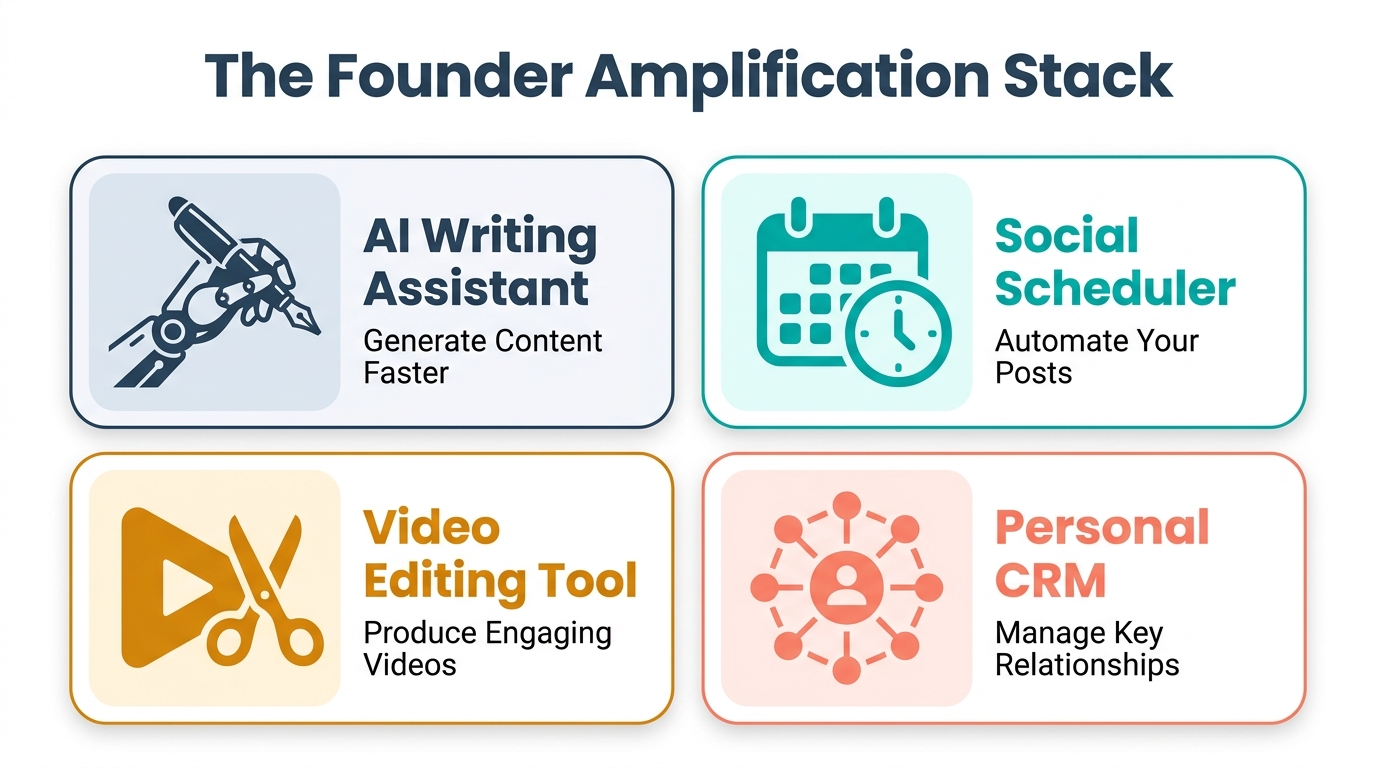
The right tool stack lets you publish more content, reach more people, and stay consistent without adding hours to your day. Think of it as a system where each tool handles one job, and together they turn your raw ideas into a steady stream of founder content.
Here's how to build that system across four tool categories.
AI Writing Assistants: Turn Rough Ideas Into Ready-to-Publish Content
You don't need to write every post from scratch. AI writing assistants help you take a rough idea, a voice note, or a bullet list and shape it into polished content that sounds like you.
Tools like Buffer's AI Assistant let you input a raw idea and generate a first draft in seconds. Hootsuite's OwlyWriter AI goes a step further by suggesting hashtags and creating content ideas based on your existing topics. Both tools support the kind of high-volume content output a founder-led marketing strategy needs.
Think of these tools as a first draft engine. You bring the thinking. The AI handles the formatting.
Social Media Schedulers: Post Consistently Without Logging In Every Day
Consistency is what makes the algorithm work for you. But logging in daily to post manually burns time fast.
A scheduler lets you batch your posting in one session and distribute content all week. Buffer is a great starting point for solo founders because it's simple, affordable, and covers all major platforms. For teams or founders managing higher volume, Hootsuite or Sprout Social add approval workflows and deeper analytics.
The goal is to spend 60 to 90 minutes once a week scheduling everything out, then step away and let the system run.
Video Editing Tools: Make Atomization Fast and Easy
Content atomization only works if you can actually break your pillar content into short clips without spending hours editing. The right video tool removes that bottleneck.
Several lightweight tools now let you upload a long video, auto-generate captions, and cut it into short clips in minutes. This means a 30-minute founder podcast episode can become five short social clips the same afternoon, all without a video editor on payroll.
For founders who aren't comfortable on camera yet, screen recordings and slide carousels are a strong alternative. According to Brenton Way's LinkedIn marketing research, carousel posts on LinkedIn outperform plain text posts by a wide margin on engagement. That's a format even the most camera-shy founder can use right away.
Personal CRM: Keep Your Network Working for You
A founder-led marketing strategy isn't just about broadcasting content. It's also about conversations. And conversations are hard to track without a system.
A personal CRM helps you manage follow-ups with key prospects, partners, and journalists who engage with your content. You can log notes from calls, set reminders to check in, and make sure warm relationships don't go cold.
This doesn't need to be complex. Even a simple spreadsheet can work at first. But as your network grows, a lightweight CRM keeps you from letting high-value connections fall through the gaps.
How These Four Tools Work Together
Here's what the system looks like in practice:
| Tool Category | Job It Does | When You Use It |
|---|---|---|
| AI Writing Assistant | Drafts posts from raw ideas | After your pillar content is recorded |
| Social Media Scheduler | Distributes content automatically | One weekly batch session |
| Video Editing Tool | Atomizes long content into clips | Same day as your pillar recording |
| Personal CRM | Manages relationships and follow-ups | Daily, in 10 to 15 minutes |
Each tool handles one step. Together, they let you show up consistently without letting content creation take over your calendar.
The founder who builds this stack early spends less time on execution and more time on the thinking that only they can do. And that's exactly where your time should go.
How to Measure the ROI of Your Founder-Led Marketing

Measuring ROI from a founder-led marketing strategy means looking beyond likes and follower counts. The real signals are business outcomes: inbound lead quality, sales cycle speed, and whether people mention your name before they ever fill out a form. This section shows you exactly what to track and how to report it, right up to the marketing metrics worth putting in a board deck.
Move Past Vanity Metrics
Followers and impressions feel good. But they do not pay salaries.
Likes tell you that content landed. They do not tell you if it drove revenue. A post with 50 likes from decision-makers in your exact target market is worth far more than one with 5,000 likes from people who will never buy.
The shift is simple: stop measuring activity and start measuring impact.
The Balanced Scorecard: What to Actually Track
A strong measurement system mixes qualitative and quantitative signals. Neither alone tells the full story.
Qualitative signals to watch include unsolicited DMs saying things like I have been following your posts and wanted to reach out, prospects on sales calls mentioning your name before you mention theirs, inbound leads who already understand your point of view and need less convincing, and partners or job candidates saying they found you through your content.
These soft signals are early proof your founder presence is working. Do not dismiss them because they are hard to put in a spreadsheet.
Quantitative signals to track include referral traffic from your personal profiles, leads who mention the founder by name, sales cycle length over time, and dark social attribution.
Dark social is worth special attention. When someone shares your post in a private Slack group or forwards it via email, standard analytics will not capture it. You can surface this by filtering direct traffic in Google Analytics to show only sessions landing on deep pages, which likely came from a private share. Adding a simple How did you hear about us field to your lead forms also catches what the data misses.
A Simple Monthly Reporting Framework
You do not need a complex dashboard. You need a consistent one.
Section one covers activity. How many pieces of content did you publish and on which channels? This is your input log, nothing more.
Section two covers reach and engagement. Track profile views, post impressions, and meaningful engagement such as comments, shares, and DM requests. Flag any standout pieces.
Section three covers business impact. This is the section that matters most. Track the number of inbound leads who mentioned your content or name, referral traffic from your personal profiles, and any deals where the buyer referenced your founder presence.
Section four is the trend line. Compare this month to last month. Are the business impact numbers moving? If yes, keep going. If not, ask what changed.
This four-part format takes under 30 minutes to fill out and gives stakeholders exactly what they need: proof that the founder's time is generating real returns, not just social media activity.
The goal is a system that connects your content directly to your pipeline. When you can show that a post from three weeks ago led to two inbound calls this week, the ROI conversation becomes very easy.
Scaling Beyond the Founder: How to Transition to a Marketing Team
Every successful founder-led marketing strategy eventually hits the same wall. You've built momentum, your content is working, and inbound leads are coming in. But you're also running a company. You can't write every post, record every video, and respond to every DM forever. At some point, scaling the strategy means bringing in help, and if that moment lands right after a raise, we've mapped out what the first 90 days of marketing after a Series A should look like.
The good news is that you don't have to hand over the keys. You just need the right support structure.
Your First Hire Isn't a Social Media Manager
Most founders make the same mistake when they decide to scale their content. They hire a social media manager and hand over the accounts. Then the content gets polished, generic, and loses the voice that made it work in the first place.
The right first hire is a brand journalist or content amplifier. Their entire job is to interview you, extract your thinking, and scale your message without replacing your voice.
According to job research on the Founder's Content Manager role, this position acts as a strategic content partner who mines raw founder material such as meeting transcripts, voice notes, and Loom recordings, then shapes that material into posts, articles, and video across every channel. The founder still brings the ideas. The hire handles the output.
This keeps the content authentic while dramatically increasing your volume and consistency.
A Phased Approach That Won't Break Your Brand
Scaling works best when it happens in stages. Jumping straight from solo posting to a full team almost always creates a voice mismatch. Here's a phased approach that protects what you've built:
Phase 1: Founder OnlyYou create everything. This is how you learn what works, what your audience responds to, and what your voice actually sounds like at scale. Don't skip this phase. It's where your brand gets built.
Phase 2: Founder Plus FreelancerBring in a freelance editor or content writer who can clean up your rough drafts, repurpose your long-form content into short pieces, and handle distribution. You're still the idea source. They handle the execution.
Phase 3: Founder Plus First HireThis is where the brand journalist comes in. You meet once or twice a week. They interview you, pull out stories and insights, and turn that conversation into a week's worth of content. Your time investment drops sharply without losing your presence.
Phase 4: Founder Plus Full TeamAt this stage, you have a small content team that runs the engine. Your job becomes quality control, major strategic pieces, and high-value appearances like keynotes or media interviews. The team amplifies your ethos, not a different brand voice.
Keep the Founder Voice Intact as the Team Grows
The biggest risk in scaling is drift. When more people touch the content, it slowly stops sounding like you. Preventing this requires a simple but important step: document your voice before you scale.
Create a short voice guide. Include examples of posts that felt most like you, topics you'll never cover, phrases you use naturally, and opinions you hold strongly. Give every new hire this document on day one.
This isn't about being controlling. It's about protecting the asset you've spent months or years building. Your voice is the reason the strategy works. Keeping it consistent as the team grows is what turns a founder's presence into a durable company brand.
Ignite Your Growth with an Authentic Founder-Led Strategy
A founder-led marketing strategy works because authenticity can't be faked or purchased. Your story, your expertise, and your genuine point of view are the most powerful growth assets your company owns. And the good news? You already have everything you need to start.
The path forward is straightforward. Define your narrative. Pick one channel and master it. Build a content system that compounds over time. Measure what actually moves your business. And plan for the moment when you're ready to scale beyond yourself.
These aren't complex steps. They're intentional ones.
Consumer trust in corporate brands has hit historic lows. According to Forrester's Global Consumer Trust research, US consumer trust in businesses fell to its lowest level since 2016 by 2024. That gap is your opening. When you show up as a real person with a real point of view, you fill the space that polished corporate marketing has left wide open.
Founders who build in public don't just attract customers faster. They attract the right customers. People who already believe in what you're doing, who need less convincing, and who stick around longer.
You don't need a big team, a big budget, or a media presence to start. You need one honest story and the willingness to share it.
Write your first post this week. Tell the real reason you started your company. Share one thing you got wrong and what it taught you. Describe the problem you wake up every day trying to solve.
That's not marketing. That's a conversation. And conversations are where trust begins.
Start small. Stay consistent. The strategy compounds from there.
Founder Marketing FAQs
What's the difference between founder-led marketing and personal branding?
Personal branding is about building the individual's reputation independent of their company, while founder-led marketing is a specific business strategy that intentionally links the founder's personal brand directly to the company's growth goals. All founder-led marketing involves personal branding, but not all personal branding is founder-led marketing. The key distinction is strategic business alignment.
How much time should a founder dedicate to marketing?
Early-stage founders can dedicate 20-50% of their time, but consistency matters more than raw hours. A sustainable approach involves 2-3 hours per week using systems like content atomization to create an edge, making 3 hours of effort look like 10 hours of output through smart repurposing.
Is founder-led marketing suitable for every business?
It's most effective for early-stage startups, service businesses, and B2B SaaS companies where expertise and trust matter most (consulting, fintech, HR tech). While less critical for large established enterprises or commodity businesses, even large companies benefit enormously from visible, authentic founder presence.
How do you measure the success of a founder-led strategy?
Use a balanced mix of quantitative metrics (referral traffic from founder profiles, leads mentioning the founder by name, sales cycle length) and qualitative signals (unsolicited DMs expressing interest, prospects citing founder content on sales calls, partner inquiries). Avoid vanity metrics like followers. Focus on business impact.
Can an introverted founder still lead an effective marketing strategy?
Absolutely. Founder-led marketing isn't about being the loudest person in the room. Introverted founders excel through writing (blogs, newsletters, thoughtful threads), one-on-one podcast interviews, or controlled environments rather than large public speaking. Authenticity matters far more than extroversion.
What is the very first step to starting a founder-led marketing strategy?
Begin with introspection. Spend an hour answering three questions: (1) What unique perspective can only I bring? (2) What are the top 5 questions my customers always ask me? (3) What is my company's ultimate mission? These answers form the foundation of your narrative before posting anything.