

Hannon Brett | Published on: June 15, 2026 | Time to read: 20 min
What Are AI Jobs and Why Are They in High Demand?
AI jobs are roles where people build, manage, and apply artificial intelligence systems to solve real problems. These positions range from training machine learning models to overseeing how AI tools get used inside a business. If a job involves making AI work, or making it work better, it counts as an AI job.
The demand for these roles has exploded in recent years. Three big forces are driving this growth: more data than ever before, cheaper and faster computing power, and companies wanting to automate tasks and get smarter insights from their information.
The numbers back this up. According to Fast Company, Indeed tracked a 75x increase in generative AI job postings between April 2022 and April 2024. That's not a typo. Postings grew by roughly 7,400% in just two years.
And the broader market keeps expanding fast. The global AI market was valued at around $391.70 billion in 2024, and market research from Market.us projects it will reach over $10 trillion by 2034, growing at a compound annual rate of 38.50%.
With that kind of growth, businesses across every industry are scrambling to hire people who understand AI. The demand isn't slowing down anytime soon.
The Most In-Demand Types of AI Jobs
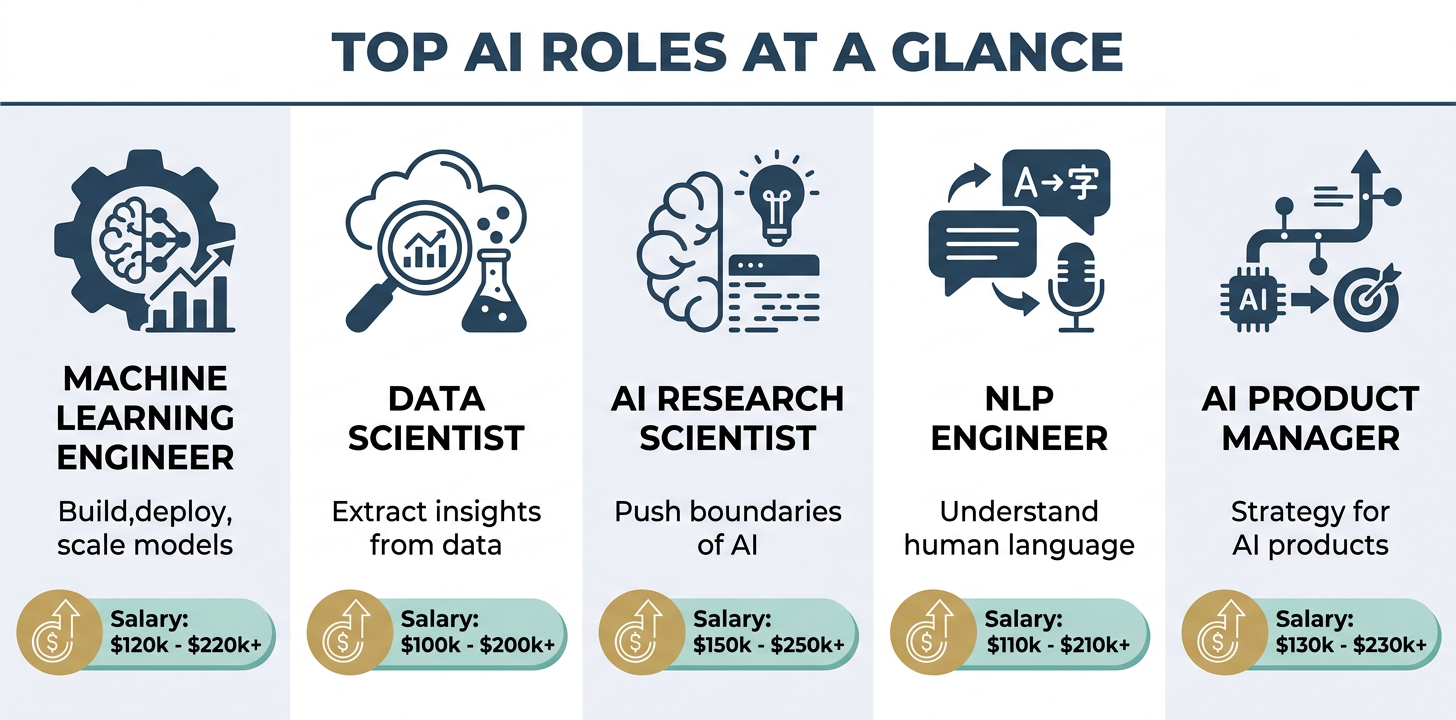
AI jobs span a wide range of specialties, from building models to managing data pipelines. Whether you lean toward research or engineering, there's likely a role that fits your skills. Here are the top types of AI jobs companies are actively hiring for right now.
Machine Learning Engineer
Machine learning engineers build and deploy the models that power AI products. They write code to train algorithms, test their performance, and push them into production environments. It's a mix of software engineering and data science.
Glassdoor reports the average annual salary for a machine learning engineer in the US is around $162,577. That number can climb much higher at top tech companies.A day in the life: You might start the morning reviewing model performance metrics, spend the afternoon debugging a training pipeline, and wrap up by syncing with the product team on what improvements users actually need.Data Scientist
Data scientists find patterns in large datasets and turn those patterns into useful insights. They work closely with business teams to answer questions like "Why are customers leaving?" or "What product should we recommend next?"
According to Levels.fyi salary data, the median total compensation for a data scientist in the US sits at around $190,000, with senior roles reaching $214,000 or more.
AI Research Scientist
AI research scientists push the boundaries of what AI can do. They design experiments, test new approaches, and publish findings that the broader field builds on. Most of these roles are at universities, large tech companies, or dedicated AI labs.
Salaries vary widely based on experience and employer, but research scientists at top firms often earn well into the six figures, with compensation packages that include equity.
Natural Language Processing (NLP) Engineer
NLP engineers work specifically with language. They build the systems that let machines understand text and speech, including chatbots, translation tools, and document summarizers. Demand for this specialty has surged with the rise of large language models.
AI Product Manager
AI product managers sit at the crossroads of technology and business. They define what an AI product should do, prioritize features, and make sure engineering and design teams are aligned. You don't need to write code, but you do need to understand how AI systems work.
This role is growing fast because companies realize that building AI is only half the challenge. Knowing what to build and why is just as important.
What Employers Actually Want
Technical skills matter, but they're not the whole picture. According to HR Dive, communication skills are increasingly non-negotiable for technical AI roles. The ability to explain complex ideas clearly can set you apart from equally qualified candidates.
Here's a quick comparison of these roles at a glance:
| Role | Core Focus | Avg. US Salary |
|---|---|---|
| Machine Learning Engineer | Building and deploying models | ~$162,577 |
| Data Scientist | Analyzing data for insights | ~$190,000 (median total comp) |
| AI Research Scientist | Advancing AI capabilities | Varies, often $150K+ |
| NLP Engineer | Language and text AI systems | Competitive, similar to ML Engineer |
| AI Product Manager | Strategy and product direction | Varies by company and experience |
Each of these roles is hiring right now across industries including healthcare, finance, retail, and tech. And new titles keep emerging as the field evolves.
Machine Learning Engineer
Machine learning engineers build and deploy ML models at scale. They take a model from an idea or experiment and turn it into something that actually runs in a real product. It's one of the most technical AI jobs out there.
This role leans heavily on software engineering. You'll need strong Python skills, and knowing C++ helps too. Most teams also expect hands-on experience with ML frameworks like TensorFlow or PyTorch.
The day-to-day work includes training models, testing how they perform, and pushing them into production systems that handle real traffic. You're not just building something that works once. You're building something that works reliably, at scale, over time.
Because the role sits at the intersection of data science and software engineering, it's one of the harder AI jobs to break into. But it's also one of the most in-demand.
Data Scientist
Data scientists dig into large datasets to find patterns and answer business questions. They use statistical analysis and machine learning to turn raw numbers into real decisions. Think of them as translators between messy data and clear business strategy.
This role requires strong skills in statistics and data cleaning. You'll spend a lot of time making sure data is accurate before you even start analyzing it. Visualization tools like Tableau or Power BI help you present findings in a way that non-technical teammates can actually understand and use.
Strong programming skills matter here too. Python and R are the most common languages for data science work. And knowing how to tell a story with data is just as important as knowing how to crunch it.
Essential Skills You Need for AI Careers
Wanting to break into AI jobs? The skills that get you hired fall into two clear categories: technical and soft. Knowing both is what separates a good candidate from a great one. Companies don't just want someone who can code. They want someone who can think clearly, communicate well, and solve real problems.
Technical Skills
Programming is the foundation of almost every AI role. Python is the most widely used language across data science and machine learning. R is common in research and statistics-heavy work. Knowing at least one of these well puts you in a strong starting position.
Beyond coding, you need hands-on experience with ML frameworks. Tools like TensorFlow and PyTorch are industry standards for building and training models. Employers expect candidates to have used these in real projects, not just read about them.
Data handling is just as important. Most AI work starts with messy, incomplete data. Skills in cleaning, transforming, and preparing datasets save teams enormous amounts of time. Experience with SQL and data pipeline tools is a real advantage.
Soft Skills
Problem-solving is at the core of every AI job. You'll regularly face situations where there's no obvious answer. Being comfortable with ambiguity and breaking big problems into smaller pieces is something hiring managers notice quickly.
Communication matters more than most people expect. According to research highlighted by Dice, technical professionals who can explain their work clearly to non-technical teammates are significantly more valuable to their organizations.
Business acumen ties everything together. Understanding why a project matters, how it connects to company goals, and what trade-offs are worth making helps you work smarter across any team.
Why Both Matter Together
Technical skills get your resume noticed. Soft skills get you the offer. The candidates who land the best AI jobs combine deep technical ability with clear thinking and strong communication. That combination is rare, and companies will pay for it.
Beyond the Code: Exploring Non-Technical AI Jobs
Not all AI jobs require writing a single line of code. The AI ecosystem needs lawyers, marketers, ethicists, and project managers just as much as it needs engineers. If you have strong domain expertise and a curiosity about AI, there's very likely a role waiting for you.
AI Ethicist
AI ethicists make sure AI systems are built and used responsibly. They review how models make decisions, flag potential biases, and help companies create policies around fair and transparent AI use. Backgrounds in law, philosophy, public policy, or social science translate naturally into this role.
Certification programs are making this path more accessible too. Organizations like CertNexus offer the Certified Ethical Emerging Technologist credential, and EC-Council provides Certified Responsible AI Governance and Ethics training. These programs help professionals from non-technical fields build credibility fast.
AI Product Manager
AI product managers decide what gets built and why. They work between engineering teams and business stakeholders, translating real user needs into product requirements. You don't write models. You shape what those models are supposed to do.
Professionals from traditional product management, marketing, or even journalism do well here. The core skill isn't coding. It's asking the right questions and communicating clearly across teams.
AI Sales Engineer
AI sales engineers help companies understand and buy AI tools. They demo products, answer technical questions, and bridge the gap between a vendor's technology and a customer's actual problem. A background in sales, consulting, or a specific industry like healthcare or finance is a real asset here.
This role is growing fast because businesses need trusted guides to help them choose the right AI solutions.
Making the Pivot
Professionals pivoting from other fields often underestimate how transferable their skills are. A lawyer who understands contracts and risk is a natural fit for AI compliance work. A marketer who understands audiences is well-suited for AI content strategy roles.
The World Economic Forum projects a net creation of 78 million jobs by 2030 as AI reshapes the workforce. Many of those jobs won't require a computer science degree. They'll require people who understand how to apply AI thoughtfully in a specific context.
And that's something people from almost any professional background can learn to do.
How to Get an AI Job (With or Without a Degree)
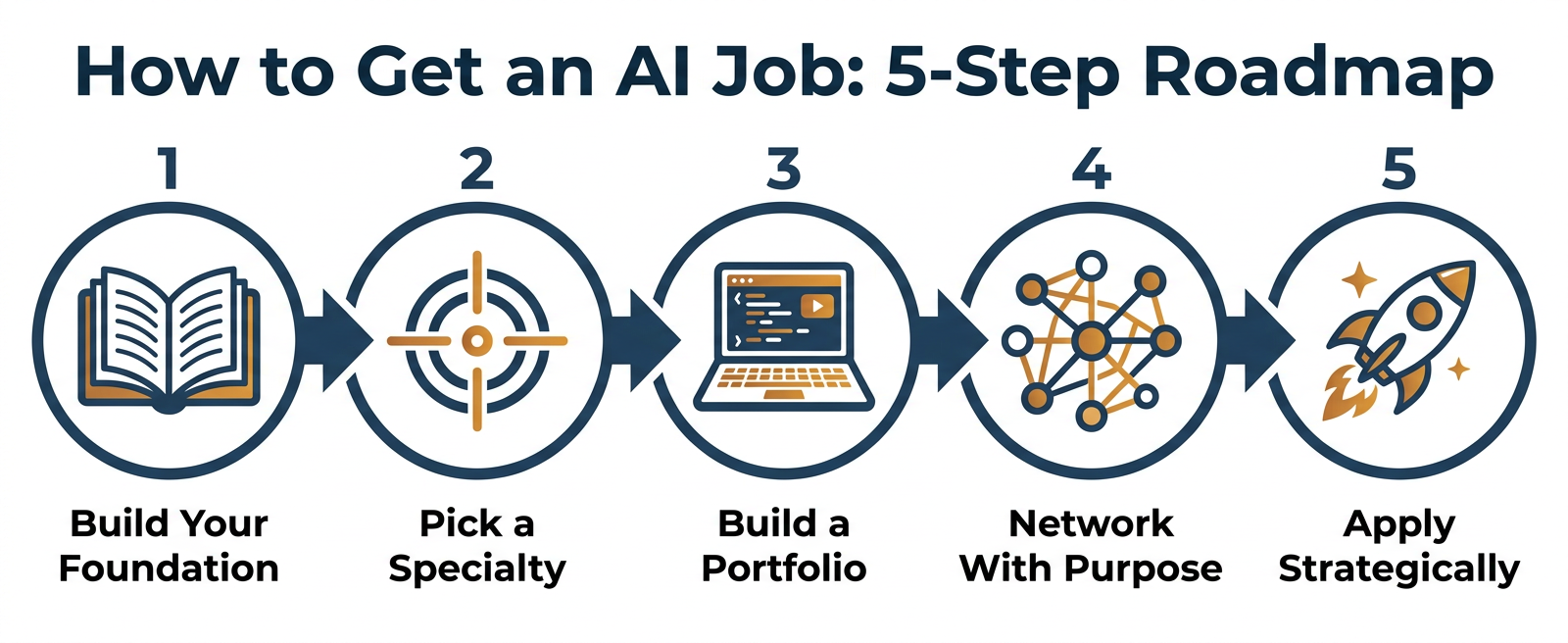
You can get an AI job without a computer science degree. What matters more is what you can actually do. Employers want people who can solve real problems with AI tools, and you can build those skills through bootcamps, online courses, and self-directed projects just as well as through a four-year program.
Here's a practical roadmap to get you there.
Step 1: Build Your Foundation
Start with the basics before specializing. Free and low-cost platforms like Coursera and edX offer courses in Python, statistics, and machine learning fundamentals. Many of these are taught by university professors and carry real weight on a resume.
If you want something more structured, Course Report ranks bootcamps like Noble Desktop and TripleTen among the top-rated AI and machine learning programs, both earning near-perfect reviews from past students.
Step 2: Pick a Specialty
AI is a big field. Narrow your focus early. Are you drawn to language models? Look at NLP roles. Interested in data patterns? Data science might be your path. Prefer working with business teams? AI product management could be a great fit.
Specializing helps you go deeper faster, and it makes your job applications much more focused and effective.
Step 3: Build a Portfolio
This step matters more than your degree status. Hiring managers want to see what you've actually built. Create a GitHub profile with well-documented projects. Include a README that explains what each project does and why it matters.
Good portfolio projects show end-to-end thinking: how you got the data, cleaned it, built a model, and interpreted the results. Quality beats quantity every time.
Step 4: Network With Purpose
Most AI jobs are filled through connections, not cold applications. Attend virtual meetups on platforms like Meetup.com or Eventbrite. Contribute to open-source AI projects on GitHub. Engage genuinely on LinkedIn by commenting on posts, sharing what you're learning, and reaching out to people whose work you respect.
A short, honest message goes a long way. Don't just ask for a job. Ask for a 15-minute conversation.
Step 5: Apply Strategically
Tailor each application. Use the job description's own language when describing your skills. Highlight projects that relate directly to what the company does. And don't wait until you feel "ready." Apply while you're still learning.
Proof that degrees aren't the only path? Marina Wyss landed a role as an Applied Machine Learning Scientist at Twitch after starting in political science, not computer science. Her story, shared on TripleTen's blog, shows that practical project work and continuous learning can carry more weight than a traditional degree.
The path into AI jobs is more open than most people think. Pick a direction, build something real, and show your work.
Real World Success Story: From Political Science to Machine Learning Scientist
Marina Wyss secured a position as an Applied Machine Learning Scientist at Twitch despite starting with a background in political science, not computer science. Her path demonstrates that practical project work, continuous learning through bootcamps and online courses, and a strong portfolio can carry more weight than a traditional degree. By focusing on building real projects and consistently developing her skills, she successfully transitioned into a top-tier tech role, proving that the AI job market rewards demonstrable ability over credentials.
Building Your AI Job Portfolio: Projects That Get You Hired
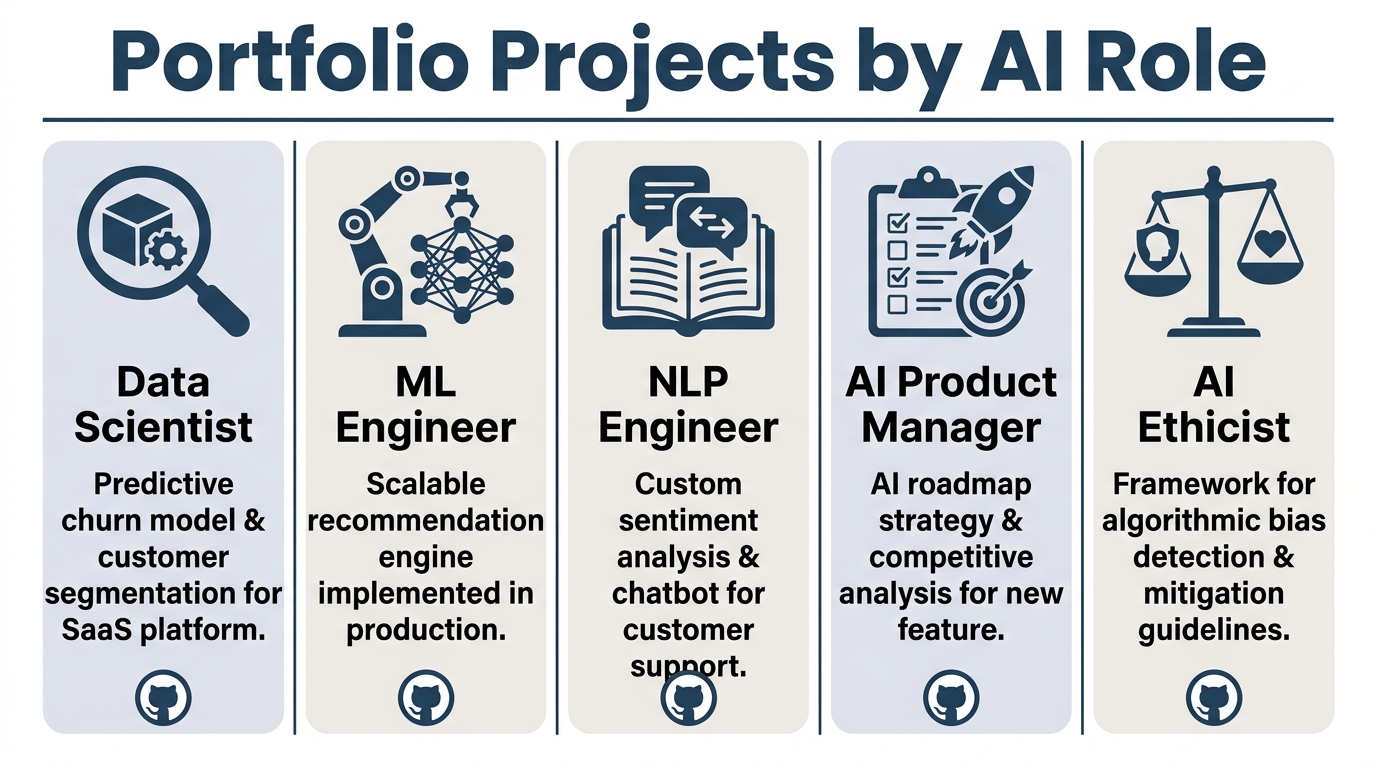
A strong portfolio is the single most powerful thing you can put in front of a hiring manager. It shows you can actually build things, not just talk about them. And for AI jobs specifically, employers want proof of hands-on skills more than almost anything else.
Why Projects Matter More Than Credentials
Many hiring managers review portfolios before they even look at a degree. A well-documented project tells a clear story: here's a real problem, here's how I approached it, and here's what I built. That kind of evidence is hard to argue with.
According to career advice from Machine Learning Jobs UK, the strongest ML portfolios focus on real problems, clean code, and clear documentation. Fancy models mean nothing if a reviewer can't understand what you were trying to solve.
Project Ideas by AI Role
Here are five project ideas matched to specific roles:
- Data Scientist: Build a movie or product recommendation engine using a public dataset from Kaggle. Show how you cleaned the data, chose a model, and measured accuracy.
- ML Engineer: Create a computer vision app that classifies images. Deploy it with a simple web interface so reviewers can actually interact with it.
- NLP Engineer: Build a sentiment analysis tool trained on customer reviews. Bonus points if you show how it handles tricky edge cases.
- AI Product Manager: Document a product strategy for an AI feature. Include user research, success metrics, and tradeoff decisions. No code needed.
- AI Ethicist: Audit a public dataset for bias and write up your findings. Explain what you found and what you'd recommend to fix it.
How to Present Your Work
GitHub is the standard place to host your projects. Keep each repository organized with a clear README that explains the project's purpose, the data you used, and how to run it.
You can also build a simple personal portfolio site. Tools like GitHub Pages make this free and easy. A few well-explained projects beat a long list of half-finished ones every time.
For inspiration, Chris Tran's portfolio is often cited as a strong example. It combines NLP work, clear write-ups, and working code links in a way that's easy for any reviewer to follow.
The goal is simple: make it easy for someone to see what you built and why it matters.
The Future of AI Jobs and Career Growth
AI jobs aren't going away. If anything, they're multiplying. The big question most people ask is whether AI will replace workers or create new opportunities. The research points clearly toward creation, not displacement.
McKinsey's Future of Work research projects that AI could add $13 trillion to global economic activity by 2030. Yes, some roles will change. But entirely new job categories are emerging to replace them, and then some.New Roles Are Appearing Fast
Just two years ago, job titles like Generative AI Specialist, AI Agent Architect, and LLM Ops Engineer barely existed. Now they're showing up on LinkedIn and job boards every day.
According to Onwards Search's 2026 job market analysis, roles like AI Ethics and Compliance Officer, Synthetic Data Specialist, and AI Enablement Lead are gaining real traction across industries. These aren't niche titles. They're filling actual headcount needs at real companies.
Trends Worth Watching
Three emerging areas are shaping where AI jobs are heading next:
- Generative AI: Tools that create text, images, and code are driving demand for specialists who can fine-tune, deploy, and govern these systems responsibly.
- Explainable AI (XAI): As regulations tighten, companies need people who can explain how AI decisions get made. Transparency is becoming a business requirement.
- Edge AI: Running AI directly on devices, not in the cloud, is growing fast in healthcare, manufacturing, and automotive. Engineers who understand edge computing have a real edge in hiring.
Lifelong Learning Is the Real Skill
The AI field moves fast. What's new today may be standard practice in 18 months. Staying relevant means treating learning as a permanent part of your career, not something you do once.
Following resources like the MIT Technology Review or blogs from major AI research labs keeps you informed without requiring hours of daily reading. Even 20 minutes a day adds up fast.
The professionals who will thrive in AI jobs long-term aren't the ones who know the most right now. They're the ones who keep learning, stay curious, and adapt as the field changes.
Conclusion: Your Next Steps in a Career in AI
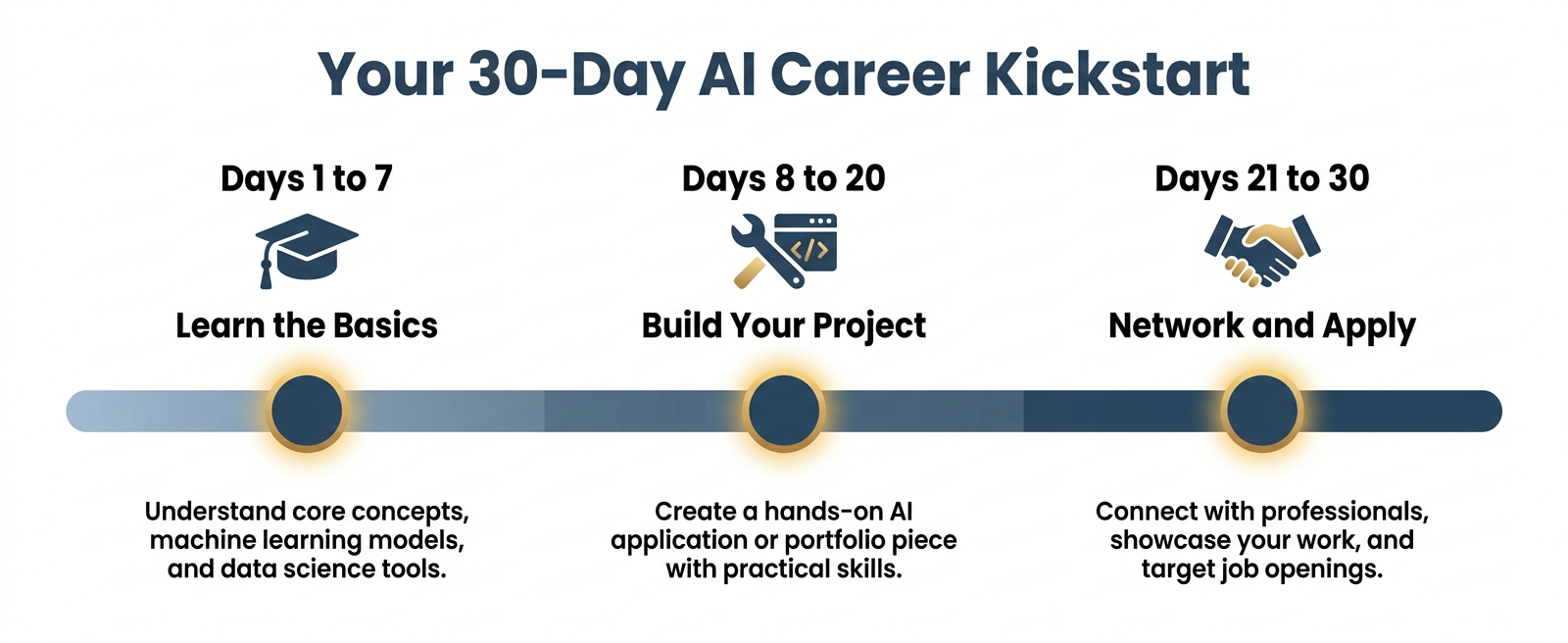
The AI job market is wide open, and it's more accessible than most people realize. Roles exist for coders and non-coders alike. Skills can be built online, through bootcamps, or through self-directed projects. And the field keeps creating new opportunities faster than it retires old ones.
Here's a simple 30-day action plan to get started:
Your 30-Day AI Career Kickstart
- Days 1 to 7: Pick one foundational skill and start learning. A free Python or data science course on Coursera is a solid first move.
- Days 8 to 20: Choose a portfolio project that matches your target role. Build it, document it, and put it on GitHub.
- Days 21 to 30: Update your LinkedIn profile to reflect your new skills. Reach out to 10 people working in AI roles you admire. Ask questions, not favors.
Thirty days won't make you an expert. But it will put you meaningfully ahead of where you are right now.
The opportunities in AI jobs are real and growing. You don't need a perfect background or a prestigious degree to get started. You need curiosity, consistency, and a willingness to keep learning as the field evolves.
Start today. The best time to begin was a year ago. The second best time is now.
Key Questions to Ask Yourself Before Starting Your AI Career
- Do you prefer working with code and building systems, or would you rather focus on strategy, ethics, and product decisions?
- Which of the five main AI roles (ML Engineer, Data Scientist, Research Scientist, NLP Engineer, AI Product Manager) aligns best with your existing skills and interests?
- Are you ready to commit to continuous learning as a permanent part of your career, or do you prefer mastering a static skill set?
- Do you have the time and resources to build a portfolio of 3-5 quality projects, or would you prefer structured bootcamp training with instructors and peers?
- How important is networking to your job search strategy, and are you comfortable reaching out to people in AI roles for informational conversations?
- Can you identify one emerging AI specialty (Generative AI, Explainable AI, Edge AI) that excites you and could differentiate you from other candidates?

A: Roles like AI Research Scientist and Director of AI at large tech firms often command the highest salaries, sometimes exceeding $300,000 or more. Salary depends heavily on location, experience level, company size, and equity packages, with top tech companies typically offering the most competitive compensation.
Q: Can I get an AI job with no experience?A: 'No professional experience' is different from 'no experience.' While entry-level AI jobs are competitive, a strong portfolio of personal projects, academic work, internships, and demonstrable skills can substitute for formal job experience. The article shows that Marina Wyss landed a role at Twitch without a CS degree by building real projects.
Q: Do you need a PhD for an AI job?A: A PhD is typically only required for highly specialized AI Research Scientist roles at universities or dedicated labs. For most applied roles like Machine Learning Engineer or Data Scientist, a Bachelor's degree, Master's degree, or strong bootcamp experience with a solid portfolio is sufficient.
Q: Will AI take all the jobs?A: While AI will automate certain tasks, most experts believe it will be a net job creator. McKinsey projects AI could add $13 trillion to global economic activity by 2030, and the WEF projects 78 million net new jobs by 2030. It will augment existing roles and create entirely new job categories we cannot yet imagine.
Q: What is the easiest AI job to get into?A: Roles with lower technical barriers to entry include Data Analyst, QA for AI systems, and AI Annotator roles. These positions are good starting points to enter the industry before transitioning into more complex engineering roles like Machine Learning Engineer or Data Scientist.
Q: How important is math for AI jobs?A: While you don't need to be a math genius, a solid understanding of linear algebra, calculus, and statistics is crucial. For applied roles, knowing how to use the math via libraries is more important than deriving proofs from scratch. Most work relies on established frameworks rather than creating new mathematical foundations.