AI for digital marketing is not a single technology. It is a collection of specialized capabilities deployed across different channels. The AI that writes your blog posts is not the same AI that optimizes your ad bids. The AI that personalizes your emails is not the same AI that schedules your social posts. Understanding what AI does in each channel, and where it still needs human direction, is the difference between a marketing operation that uses AI and one that is actually transformed by it.
Why "AI for Digital Marketing" Is Not One Thing
The phrase "AI for digital marketing" gets treated as a single concept, as if there is one AI system that you plug into your marketing stack and everything improves. That is not how it works. AI touches digital marketing through at least seven distinct capability layers, each operating differently depending on the channel.
In paid media, AI is a real-time optimization engine processing millions of bid decisions per day. In content marketing, AI is a production accelerator that generates drafts, variations, and format adaptations. In email, AI is a personalization system that determines send times, subject lines, and content blocks per recipient. In SEO, AI is both a content creation tool and the thing you are trying to rank in (search engines are now AI themselves). In social media, AI handles scheduling, caption generation, and audience analysis. In analytics, AI surfaces patterns and anomalies across datasets too large for human review.
Each of these applications uses different AI models, requires different inputs, operates on different timescales, and has different failure modes. Treating them as one thing leads to either over-reliance (assuming AI handles everything) or under-utilization (using ChatGPT for copywriting and calling it "AI marketing").
This guide breaks down what AI actually does in each major digital marketing channel, where it adds the most value, and where it still needs a human at the controls.
AI for Paid Media and Digital Advertising
Paid media is where AI has had the deepest impact on digital marketing. Every major ad platform now runs on machine learning by default, and the advertiser's role has fundamentally shifted from campaign operator to campaign architect.
What AI handles: Real-time bid management across millions of daily auctions. Audience expansion and lookalike modeling based on conversion patterns. Creative combination testing (headlines, images, CTAs) at volumes impossible for manual A/B testing. Budget redistribution across campaigns based on live performance data. Cross-channel attribution modeling.
What humans still handle: Campaign architecture and segmentation strategy. Conversion event selection (telling the AI what "success" means). Creative concepts and brand direction. Audience exclusion lists. Cross-platform budget allocation between Google, Meta, LinkedIn, and programmatic. Reading the data to determine whether platform-reported performance actually translates to business results.
The biggest mistake in AI-powered digital advertising is treating platform defaults as optimal. Google's Performance Max, Meta's Advantage+, and LinkedIn's Accelerate campaigns all work best when the advertiser provides strong inputs: clean conversion data, robust creative assets, meaningful audience signals. Without those inputs, the AI optimizes for the cheapest available outcomes, which are rarely the most valuable ones.
For B2B companies specifically, feeding offline conversion data (qualified opportunities, closed deals, revenue) back to the ad platforms is the single highest-leverage action. It transforms the AI from "find me more form fills" to "find me more people who actually become customers."
AI for SEO and Search Visibility
AI has changed SEO from both directions simultaneously. On one side, AI tools help you create, optimize, and scale content. On the other side, search engines are now AI systems that surface results differently than the traditional ten blue links.
AI for content creation at scale. AI writing tools generate blog posts, landing pages, product descriptions, and technical documentation. For SEO purposes, this means you can produce content covering a much broader keyword landscape than a human writing team could handle. The constraint is quality, not volume. Google's helpful content guidelines apply regardless of how the content was produced: if it does not provide genuine value to the reader, it will not rank.
AI for technical SEO. AI-powered crawlers and analysis tools identify technical issues (broken links, slow pages, indexing problems, cannibalization) across large sites faster than manual audits. Tools using ML can prioritize which technical fixes will have the most ranking impact, reducing the time spent on low-value optimizations.
AI for keyword and topic research. AI analyzes search intent patterns, related queries, and content gaps at scale. Instead of building keyword lists manually, AI tools cluster keywords by intent, identify topic opportunities based on competitor gaps, and recommend content architectures that cover a topic comprehensively.
Generative Engine Optimization (GEO). This is the newest dimension. AI search platforms (Google AI Overviews, ChatGPT with web search, Perplexity) do not rank pages in a traditional list. They synthesize answers from multiple sources and cite the most authoritative content. Optimizing for these platforms requires structured data, clear and specific claims, cited sources, and content formatted for extraction (tables, bulleted lists, clear H2/H3 hierarchies). This is a growing discipline that overlaps with but is distinct from traditional SEO.
AI for Content Marketing and Production
Content production is where most marketing teams first experience AI for digital marketing, and where the gap between good and bad implementation is widest.
What AI does well in content:
- First drafts and outlines. AI generates structured outlines and first drafts that a human editor can refine. This cuts production time significantly for standard content types: blog posts, case study frameworks, email sequences, landing page copy.
- Format adaptation. A single piece of long-form content can be repurposed by AI into social posts, email snippets, ad copy, video scripts, and slide decks. This multiplier effect is one of the highest-ROI applications of AI in digital marketing.
- Personalization at scale. AI generates audience-specific variations of the same core content. A product announcement becomes a technical deep-dive for engineers, a ROI summary for executives, and a competitive comparison for evaluators.
- SEO optimization. AI tools analyze top-ranking content for target keywords and recommend structural changes, semantic coverage gaps, and readability improvements.
What AI does poorly in content:
- Original insight. AI remixes existing information. It does not generate new perspectives from experience, primary research, or proprietary data. Content that relies on original thought still requires a human author.
- Brand voice consistency. Without careful prompt engineering and editorial review, AI content drifts toward a generic, cautious, mildly enthusiastic tone that sounds like everyone else's AI content. Maintaining a distinctive voice requires human editorial oversight on every piece.
- Factual accuracy. AI models generate plausible-sounding claims that may be incorrect. Every factual statement, statistic, and attribution in AI-generated content must be verified by a human before publishing. This is non-negotiable.
The AI-native content model addresses these limitations by positioning AI as the production engine and humans as the editorial layer. AI generates volume. Humans provide insight, verify accuracy, enforce brand voice, and make the final quality call. This produces more content than a traditional team while maintaining the quality bar that search engines and readers demand.
Want to see this model in action?
We will show you how an AI-native content operation produces 3-5x the output with senior human oversight on every piece.
AI for Email Marketing
Email is one of the most mature channels for AI in digital marketing, partly because email platforms have been using ML for years (send time optimization, subject line testing) and partly because email generates clean, trackable data that AI models can learn from.
Send time optimization. AI analyzes each recipient's historical open patterns and delivers emails when that specific person is most likely to engage. This is not "send at 10am on Tuesday." It is "send to this person at 7:14am because they check email during their commute, and send to that person at 2:30pm because they clear their inbox after lunch." Every major email platform (HubSpot, Mailchimp, Braze, Iterable) now offers some form of AI send time optimization.
Subject line and copy generation. AI generates subject line variations and body copy options based on historical performance data. The system learns which types of subject lines (question vs. statement, short vs. long, personalized vs. generic) perform best for specific audience segments and generates variations accordingly.
Dynamic content blocks. AI selects which content blocks to show each recipient based on their behavior, firmographic data, and engagement history. A single email template can render differently for a VP of Engineering (technical content, integration details) and a CMO (business outcomes, ROI metrics) without building separate email tracks.
List segmentation and scoring. AI clusters subscribers based on engagement patterns, purchase propensity, and lifecycle stage. This goes beyond simple rule-based segmentation ("opened 3 emails in 30 days") to pattern-based grouping ("behaves like customers who converted within 60 days").
Where email AI falls short: AI-generated email copy often sounds robotic and impersonal at scale, the opposite of what email should be. The best email feels like it was written by a person to a person. AI can handle personalization variables and content block selection, but the core messaging still benefits from a human voice, especially for B2B where relationships and trust matter.
AI for Social Media Marketing
AI for social media covers three distinct functions: content creation, scheduling and distribution, and analytics. Each one operates differently and has different maturity levels.
Content creation. AI generates social post copy, suggests hashtags, adapts long-form content into platform-specific formats (LinkedIn thought leadership posts, X threads, Instagram captions, TikTok scripts), and creates image variations for different placements. The volume increase is significant: a single blog post can yield 10-15 social posts across platforms in minutes rather than hours.
Scheduling and distribution. AI determines optimal posting times per platform based on audience engagement patterns. More advanced systems adjust posting frequency based on content performance, reducing volume on underperforming content types and increasing distribution of content that generates engagement.
Social listening and analytics. AI monitors brand mentions, competitor activity, industry conversations, and sentiment trends across platforms at a scale no human team can manage. Natural language processing identifies emerging topics, detects sentiment shifts, and flags potential crises before they escalate. This intelligence layer is arguably where AI provides the most unique value in social media, because the data volume is simply too large for manual monitoring.
Social advertising. Platform-specific AI handles ad targeting, bidding, and creative optimization within each social network. Meta's Advantage+ and LinkedIn's Accelerate campaigns are the most developed examples, but every social ad platform uses ML for auction optimization.
Where social media AI falls short: Genuine community engagement. Responding to comments, participating in conversations, handling customer service inquiries, and building relationships are activities where AI-generated responses feel inauthentic and can damage brand perception. AI can draft response suggestions, but a human should review and personalize before posting, especially for B2B brands where individual relationships matter.
AI for Marketing Analytics and Reporting
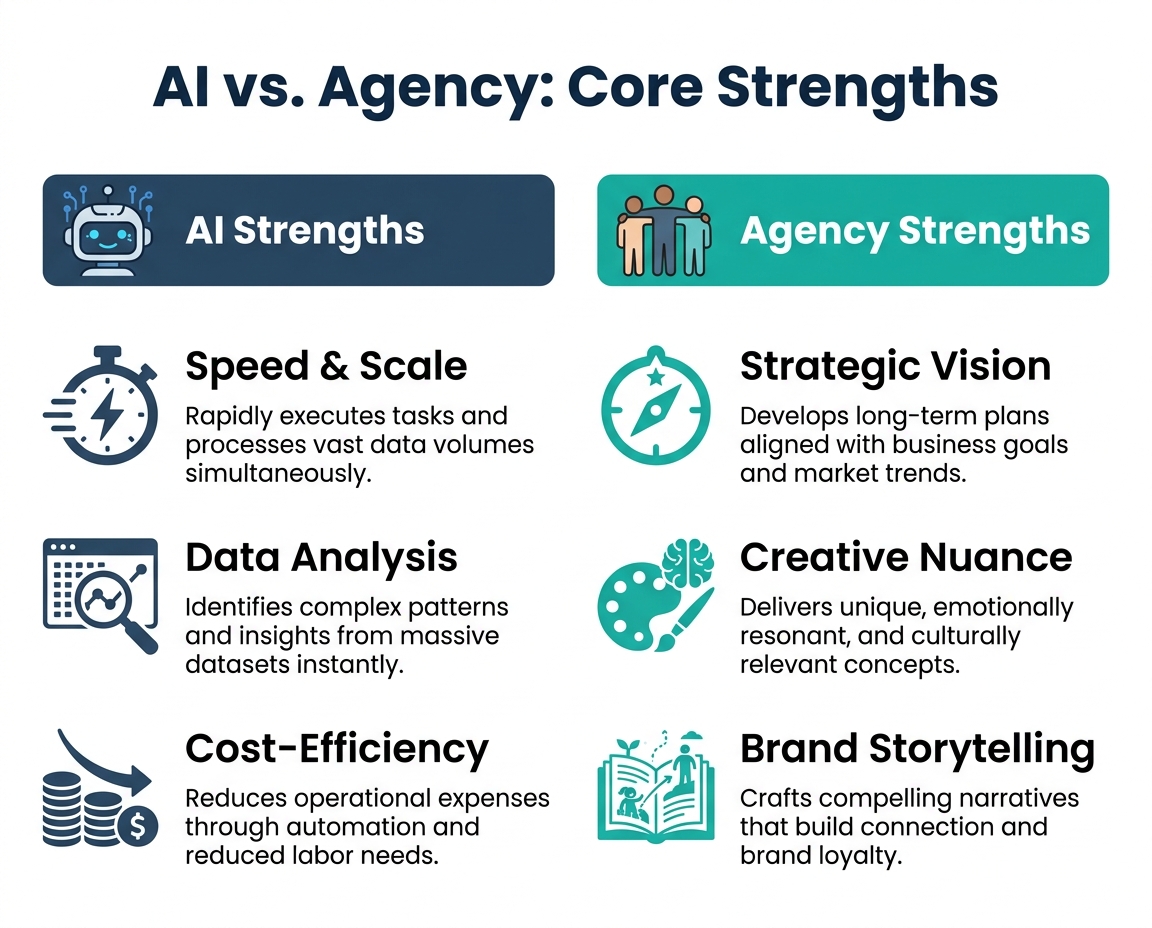
Analytics is the digital marketing channel where AI arguably provides the most transformative value, because the gap between what humans can process and what needs to be processed is largest.
Anomaly detection. AI monitors performance metrics across all channels and flags unusual patterns in real time. A sudden drop in organic traffic, a spike in ad spend, a conversion rate change, or an unexpected traffic source gets surfaced automatically rather than discovered during a weekly review (or worse, a monthly QBR).
Attribution modeling. AI-powered attribution (Google's data-driven attribution, multi-touch models in platforms like HubSpot and Bizible) uses ML to assign conversion credit across touchpoints based on their actual influence rather than arbitrary rules. This replaces last-click attribution with something more reflective of how buyers actually make decisions.
Predictive analytics. AI models forecast campaign performance, lead scoring, churn probability, and pipeline conversion rates based on historical patterns. For B2B companies, predictive lead scoring (which leads are most likely to become qualified opportunities) is one of the highest-value applications of AI in the marketing stack.
Cross-channel reporting. AI aggregates data from multiple platforms (Google Ads, Meta, LinkedIn, HubSpot, Salesforce, Google Analytics) and creates unified dashboards that show the full picture rather than channel-specific silos. More advanced implementations use AI to identify which channel combinations drive the best outcomes, not just which individual channels perform well.
Where analytics AI falls short: Interpretation. AI can surface that organic traffic dropped 15% last week. It cannot reliably explain why, especially when the cause involves competitive shifts, algorithm updates, seasonal patterns, or market changes. The "so what" layer still requires human judgment, industry context, and strategic thinking.
Channel-by-Channel: Where AI Adds the Most Value
Not all channels benefit equally from AI. Here is an honest assessment of where AI for digital marketing delivers the most impact and where the gains are more incremental.
| Channel | AI Impact Level | Highest-Value AI Application | Still Needs Humans For |
|---|---|---|---|
| Paid Search | Very High | Real-time bidding, audience targeting, conversion optimization | Campaign architecture, conversion signal design, budget strategy |
| Paid Social | Very High | Audience expansion, creative testing at scale, bid optimization | Creative concepts, audience exclusions, brand safety |
| SEO / Content | High | Content production volume, technical audit automation, keyword clustering | Original insight, brand voice, factual verification, editorial quality |
| High | Send time optimization, dynamic content, predictive segmentation | Core messaging, relationship building, campaign strategy | |
| Analytics | High | Anomaly detection, attribution modeling, predictive scoring | Interpretation, strategic recommendations, action planning |
| Social (Organic) | Moderate | Content repurposing, scheduling, social listening at scale | Community engagement, authentic voice, relationship management |
| CRO / Website | Moderate | Personalization, copy testing, heatmap analysis | UX strategy, conversion flow design, value proposition |
AI Maturity by Digital Marketing Channel
The AI Digital Marketing Stack: Tools by Function
A practical AI digital marketing stack layers specialized tools on top of your existing platforms. Here is how the pieces fit together.
Foundation layer: your existing platforms. Google Ads, Meta Business Suite, LinkedIn Campaign Manager, HubSpot (or your MAP/CRM), Google Analytics 4, and your CMS. These already have built-in AI features. Before adding external tools, make sure you are using the native AI capabilities: Smart Bidding, Advantage+ campaigns, HubSpot's AI content tools, GA4's data-driven attribution.
Content production layer. AI writing tools for first drafts and variations. AI image generation or adaptation tools for visual content. AI video tools for short-form social video and ad creative. These feed content into your CMS, social scheduler, and ad platforms.
Intelligence layer. AI-powered analytics platforms that aggregate data across channels and surface insights. Predictive scoring tools that identify which leads are most likely to convert. Competitive intelligence tools that track competitor positioning and share-of-voice across channels.
Orchestration layer. This is the least mature but most impactful layer: AI systems that coordinate across channels. Shifting budget from underperforming paid campaigns to high-performing ones in real time. Triggering email sequences based on ad engagement patterns. Adjusting content production priorities based on search trend data. Most marketing teams handle this orchestration manually, which is why cross-channel optimization remains one of the biggest opportunities for AI in digital marketing.
Common Mistakes When Deploying AI Across Digital Channels
These are the patterns we see when companies try to add AI across their digital marketing operations.
Mistake 1: Channel-by-channel AI adoption. Most teams add AI to one channel at a time. They start with content (ChatGPT for blog posts), then add AI to ads (Performance Max), then try AI email tools. The problem is that channel-by-channel adoption does not capture the cross-channel benefits. AI-generated content should feed your ad creative pipeline. Ad performance data should inform your content strategy. Email engagement data should refine your paid media targeting. Isolated AI tools in separate channels miss these connections.
Mistake 2: No quality control layer. AI produces output fast. Without an editorial review process, quality degrades across every channel simultaneously. A content team publishing 5x more blog posts is not an improvement if the posts are generic, inaccurate, or off-brand. Scale without quality is just more noise.
Mistake 3: Using AI for execution without changing strategy. If you deploy AI tools but keep the same strategy, team structure, and processes, you get the same results slightly faster. The real gains come from rethinking what is possible: covering more channels, testing more variations, personalizing at the individual level, responding to data in real time. AI changes what is feasible. Your strategy needs to change to take advantage of it.
Mistake 4: Underinvesting in data infrastructure. Every AI application in digital marketing runs on data. If your CRM is messy, your tracking is incomplete, your attribution is broken, or your conversion events are poorly defined, the AI optimizes against bad signals. Data infrastructure is not exciting work, but it is the foundation everything else depends on.
Mistake 5: Over-relying on platform AI. Google, Meta, and LinkedIn all want you to give their AI more control over your campaigns. That serves their business model (more automated spending within their platform). It does not necessarily serve yours. Use platform AI where it has a clear advantage (bidding, audience expansion) and maintain human control where it matters (strategy, budget allocation across platforms, brand quality).
Ready to deploy AI across your digital marketing channels?
We help B2B companies build AI-native marketing operations that work across channels, not in silos.
The AI-Native Digital Marketing Team
AI does not just change what tools you use. It changes how your marketing team is structured and what skills matter.
| Function | Traditional Team | AI-Native Team |
|---|---|---|
| Content | 3-5 writers, 1-2 editors, 1 designer per channel | 1 senior editor/strategist directing AI production, 1 designer for brand-critical assets |
| Paid Media | 1 specialist per platform (Google, Meta, LinkedIn) | 1 senior strategist managing AI-driven campaigns across all platforms |
| 1-2 email marketers building individual campaigns | 1 lifecycle strategist configuring AI-powered sequences and personalization rules | |
| Social | 1-2 social managers creating daily content per platform | 1 social strategist overseeing AI-generated content with manual community engagement |
| Analytics | 1 analyst pulling weekly reports from each platform | 1 data strategist configuring AI dashboards and interpreting cross-channel patterns |
| Total headcount | 10-15 people across channels | 4-6 senior people directing AI systems |
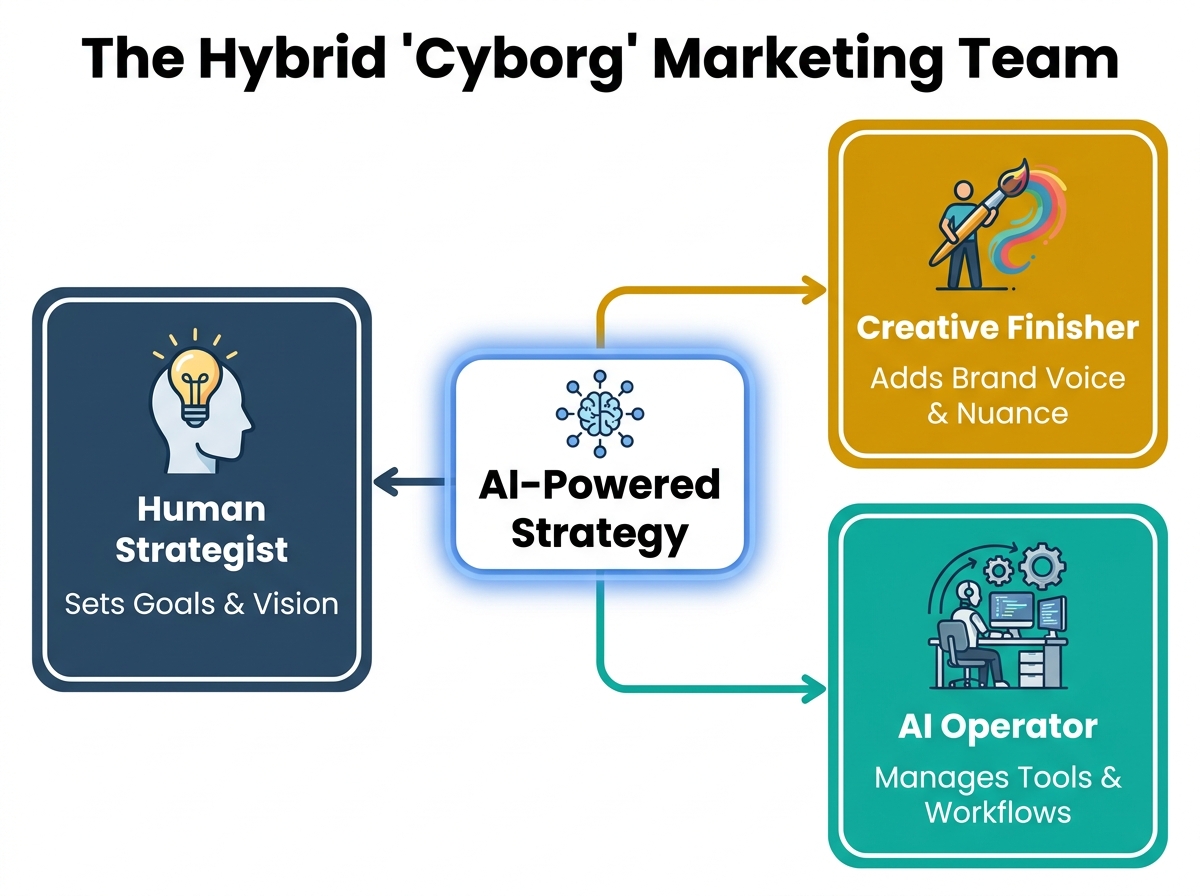
This is not about replacing people with AI. It is about replacing repetitive execution with AI and deploying humans where they add the most value: strategy, creative direction, quality control, and cross-channel thinking. An AI marketing agency operates on this model by default, which is why a small team can cover more channels with higher output than a traditional team three times its size.
Getting Started: A Practical Deployment Roadmap
If you are moving from a traditional digital marketing operation to an AI-powered one, here is a phased approach that avoids the common mistake of trying to transform everything at once.
Phase 1 (Weeks 1-4): Foundation and quick wins. Start with the channels where AI is most mature and the wins are clearest. Enable Smart Bidding across your Google Ads campaigns if you have not already. Activate Advantage+ targeting on Meta campaigns. Set up AI send time optimization in your email platform. These are configuration changes, not structural changes, and they deliver immediate performance improvements.
Phase 2 (Weeks 5-8): Content acceleration. Introduce AI into your content production pipeline. Start with content types that have the clearest quality benchmarks: SEO blog posts, email copy, social post variations. Establish a human review process before anything publishes. Measure output increase and quality consistency. Adjust the AI-to-human workflow ratio based on what you learn.
Phase 3 (Weeks 9-12): Cross-channel integration. Connect the channels. Use content performance data to inform ad creative. Feed ad engagement data into your CRM for lead scoring. Set up automated workflows that trigger actions across channels based on behavior patterns. This is the phase where AI stops being a tool in each channel and starts being the operating system for your digital marketing.
Phase 4 (Ongoing): Optimization and expansion. Expand AI into the channels where it is still developing: organic social, CRO, predictive analytics. Continue refining the human-AI workflow in each channel. Feed what you learn from each channel back into the others. The goal is a connected system where AI handles execution at scale and humans handle strategy and quality across the entire operation.
What Phase 1 Looks Like in Practice
A B2B SaaS company running Google Ads with manual bidding switched to Target CPA bidding and added offline conversion imports from their CRM. They activated Meta Advantage+ audience targeting with existing customer lists as seed audiences. They turned on HubSpot's send time optimization for their email nurture sequences. Total implementation time: about two weeks. Within 45 days, their Google Ads cost per qualified lead dropped by 22%, Meta CPA dropped by 18%, and email open rates increased by 11%. No new tools purchased. No team restructuring. Just configuring the AI features already available in their existing platforms.
Audit Questions for Your Digital Marketing AI Readiness
- Are you using AI bidding strategies on every paid media platform?
- Is your CRM conversion data feeding back to your ad platforms?
- Do you have a human review process for AI-generated content?
- Can you track a customer's journey across channels from first touch to close?
- How many of your channels share data with each other automatically?