Every major ad platform now runs on AI by default. Google Performance Max, Meta Advantage+, LinkedIn Predictive Audiences, and programmatic DSPs all use machine learning to decide who sees your ad, when, and at what price. The competitive advantage is no longer "using AI for ads." It is knowing how to structure inputs, constrain the algorithms, and measure outcomes in ways that the platforms' default settings do not optimize for.
What AI Advertising Actually Means in 2026
Artificial intelligence advertising is not a future concept. It is the current default. If you are running paid campaigns on Google, Meta, LinkedIn, or any programmatic platform, AI is already making the majority of your buying decisions. The bidding is automated. The audience assembly is algorithmic. The creative is increasingly generated or remixed by machine learning models.
The shift happened gradually, then all at once. Google introduced Smart Bidding years ago. Meta launched Advantage+ Shopping Campaigns. LinkedIn rolled out Predictive Audiences. Each platform moved toward a model where the advertiser provides inputs (budget, creative assets, conversion goals) and the AI handles everything else: who to target, how much to bid, which creative combination to show, and when to serve the impression.
This is convenient. It is also dangerous if you do not understand what the AI is actually optimizing for. Platform AI is designed to spend your budget efficiently within the platform's ecosystem. It is not designed to optimize for your business outcomes. It does not know your sales cycle, your deal size, or which leads actually close. Those constraints have to come from you.
The real definition of AI advertising in 2026 is this: using artificial intelligence systems across the entire advertising lifecycle, from audience research and creative production to bid management, budget allocation, and attribution, while maintaining human oversight on the strategic decisions that the AI cannot make well on its own.
The Five Layers of AI in Modern Advertising
AI touches every stage of a paid media campaign. Understanding where it operates helps you know where to trust the automation and where to override it.
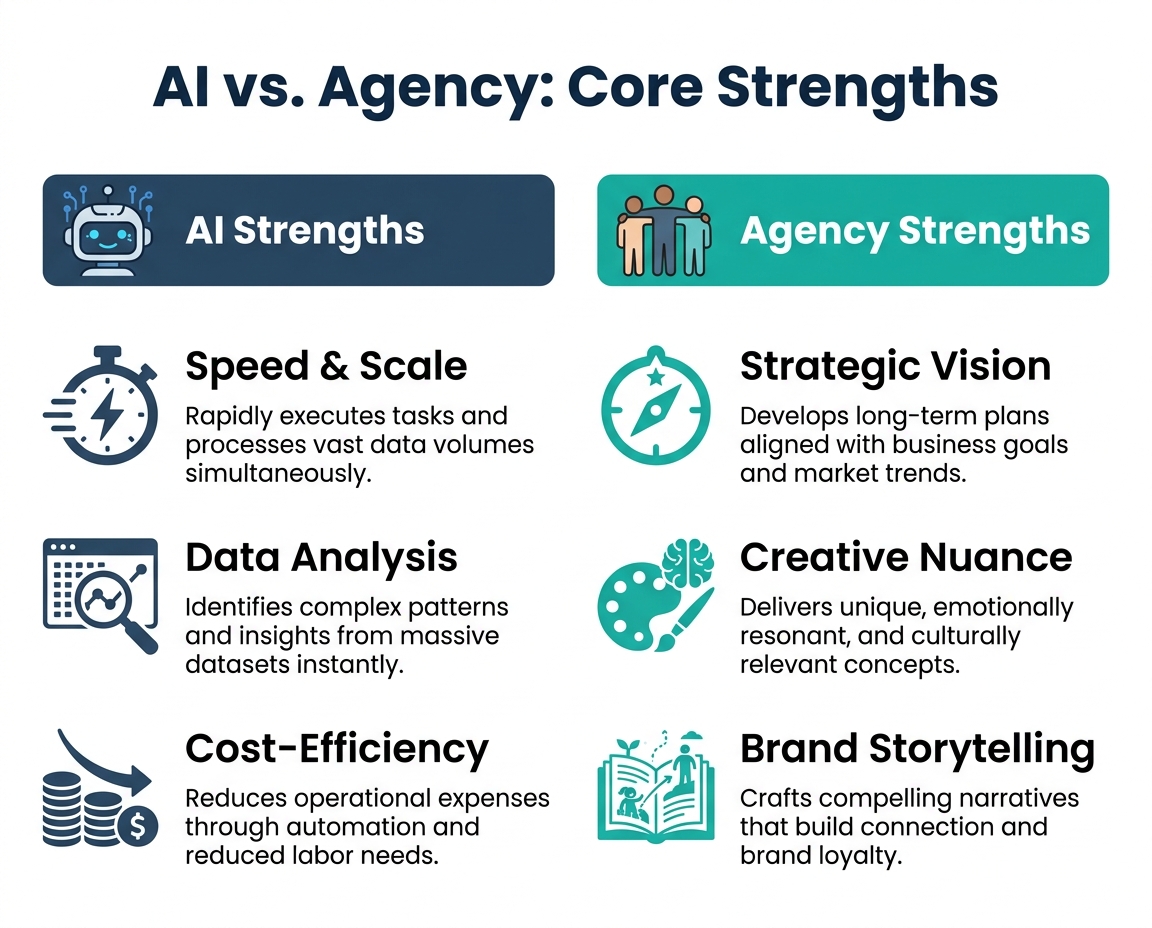
Layer 1: Audience intelligence. AI models analyze behavioral data, intent signals, and lookalike patterns to build audience segments. Google's in-market audiences, Meta's Detailed Targeting Expansion, and LinkedIn's Predictive Audiences all use ML to find people who resemble your existing converters. The AI is good at finding patterns in large datasets. It is less good at understanding whether those patterns reflect genuine purchase intent or superficial correlations.
Layer 2: Creative generation and optimization. AI now generates ad copy variations, headlines, image treatments, and even video snippets. Google's automatically created assets, Meta's Advantage+ creative tools, and standalone platforms handle creative production at speeds no human team can match. The risk: volume without quality control produces generic, forgettable ads.
Layer 3: Bid management. This is where AI has the most undisputed advantage. Real-time bid calculations across millions of auction events, adjusting for time of day, device, user behavior signals, and competitive pressure, require machine speed. Google's Target CPA, Target ROAS, and Maximize Conversions strategies are all ML-driven. Human bid management cannot compete at this scale.
Layer 4: Budget allocation. AI can shift budget across campaigns, ad groups, and channels based on real-time performance data. This is the layer where most teams still operate manually, reviewing performance weekly and adjusting budgets in spreadsheets. AI-native advertising operations automate this redistribution based on predefined rules and live conversion data.
Layer 5: Measurement and attribution. AI-powered attribution models (Google's data-driven attribution, Meta's conversion modeling) attempt to solve the multi-touch attribution problem. They use ML to weight touchpoints based on their actual influence on conversions rather than relying on last-click or arbitrary rules. The models are imperfect, but they are better than the manual alternatives for most advertisers.
AI Advertising by Channel: What Each Platform Offers
Each major ad platform has built its own AI advertising stack. Here is what is currently available and what it actually does.
| Platform | AI Bidding | AI Creative | AI Audiences | Key AI Product |
|---|---|---|---|---|
| Google Ads | Smart Bidding (Target CPA, Target ROAS, Max Conversions, Max Conversion Value) | Automatically created assets, Gemini-powered ad generation | In-market, affinity, custom intent, optimized targeting | Performance Max |
| Meta (Facebook/Instagram) | Campaign Budget Optimization, cost cap, bid cap | Advantage+ Creative (auto-crop, text overlay, brightness adjustments) | Advantage+ Audience, Detailed Targeting Expansion, Lookalikes | Advantage+ Shopping / App Campaigns |
| Maximum Delivery, cost cap bidding | AI-generated copy suggestions, Accelerate campaigns | Predictive Audiences, Audience Expansion | Accelerate Campaigns | |
| Microsoft Ads | Automated bidding (Target CPA, Max Conversions, ROAS) | Auto-generated ads from landing pages via Copilot | In-market, LinkedIn profile targeting, custom audiences | Performance Max (Microsoft) |
| Programmatic (DV360, The Trade Desk) | ML-powered real-time bidding across exchanges | Dynamic Creative Optimization (DCO) | Custom algorithms, contextual targeting, identity graphs | Kokai (The Trade Desk), DV360 custom bidding |
| TikTok | Lowest Cost, Cost Cap, Bid Cap | Smart Creative, AI-generated scripts and video templates | Smart Targeting, custom audiences, lookalikes | Smart+ Campaigns |
The pattern across platforms is clear: each one is pushing advertisers toward handing over more control to the AI. Google's Performance Max is the most aggressive example. You provide assets, a budget, and conversion goals. The AI decides everything else, including which Google properties (Search, Display, YouTube, Gmail, Maps, Discover) to show your ads on. You cannot see keyword-level data. You cannot control placements at a granular level. You are trusting the algorithm.
This works well when the AI has clean conversion data to optimize against. It works poorly when your conversion signal is noisy (long B2B sales cycles, offline conversions not feeding back to the platform) or when the algorithm optimizes for volume over quality.
The Problem With Default AI Advertising Settings
Here is the part most platform sales reps will not tell you: default AI settings on every ad platform are designed to spend your budget, not necessarily to maximize your business results. The platform's AI succeeds when it delivers conversions at or below your target cost. But "conversion" is whatever you defined it as, and most advertisers define it poorly.
Common failure modes in artificial intelligence advertising:
- Optimizing for the wrong conversion event. If you tell Google to maximize "leads" and your form has no qualification step, the AI will find the cheapest leads possible. Those leads will be garbage. The AI did exactly what you asked. You asked the wrong question.
- Audience expansion eating your budget. Both Google and Meta have features that automatically expand your targeting beyond the audience you defined. This can find new prospects, but it can also burn budget on irrelevant traffic. On Meta, Detailed Targeting Expansion is on by default in many campaign types.
- Creative fatigue ignored. AI bid management does not always account for creative fatigue. Your CPA rises not because the algorithm failed, but because the same ad has been shown to the same people too many times. The AI responds by bidding higher to maintain conversion volume rather than surfacing the need for new creative.
- Cross-channel cannibalization. When you run Google Search, Performance Max, and Display simultaneously, the AI systems on each campaign are competing against each other in some auctions. Performance Max in particular can cannibalize branded search traffic and claim credit for conversions that would have happened anyway.
- Attribution inflation. Every platform's AI takes credit for conversions within its attribution window, even when multiple platforms contributed. If you sum the reported conversions across Google, Meta, and LinkedIn, the total will exceed your actual conversions. This is not fraud. It is each platform's model counting overlapping touchpoints.
The solution to all five problems is the same: human oversight on strategy, conversion architecture, and measurement, layered on top of AI execution. Let the AI handle bidding and distribution. Do not let it define your goals, your audiences, or your success metrics without supervision.
Want an honest look at your ad spend?
We will review your current campaign structure, identify where AI defaults may be costing you, and show you what a properly configured AI advertising operation looks like.
AI-Powered Creative: Generative Ads at Scale
Creative production is where artificial intelligence advertising has changed the most in the last two years. The old model: a creative team spends two weeks producing 5-10 ad variations. The new model: AI generates 50-100+ variations in hours, and the ad platform's algorithm tests them in real time to find winners.
What AI can do well in ad creative right now:
- Headline and copy variations. Given a value proposition and target audience, AI generates dozens of headline and body copy combinations. Each variation tests a different angle, tone, or emphasis. This is genuine A/B testing at a scale that was not economically feasible with human copywriters alone.
- Image adaptation. AI tools resize, crop, and adjust images for different placements (feed, stories, display banners, video pre-roll) automatically. Meta's Advantage+ Creative handles aspect ratio changes, text overlay additions, and brightness adjustments without human intervention.
- Video assembly. Platforms like Google and TikTok can assemble short video ads from static images, product feeds, and brand assets. The output is functional for performance advertising, though it lacks the production quality of purpose-built video creative.
- Dynamic Creative Optimization (DCO). Programmatic platforms serve personalized ad combinations by mixing headlines, images, CTAs, and offers based on the viewer's profile. A single campaign can produce thousands of unique ad experiences without manual creative work.
What AI still does poorly in ad creative:
- Brand-distinctive visuals. AI-generated imagery tends toward a recognizable aesthetic. Your ads look like everyone else's AI-generated ads. In a feed full of AI-produced content, the ads that stand out are often the ones with distinctive human creative direction.
- Emotional resonance. AI can produce competent copy. It struggles to produce copy that makes someone feel something specific. For brand campaigns where emotional connection matters, human creative direction remains essential.
- Complex B2B messaging. AI ad copy tools are trained primarily on B2C and ecommerce examples. B2B advertising that requires technical nuance, multi-stakeholder awareness, and long-cycle consideration messaging often comes out generic when AI-generated without heavy guidance.
The optimal approach is layered: humans set the creative strategy and develop the core concepts. AI generates variations and format adaptations. The ad platform's ML tests and optimizes. Humans review performance data and feed insights back into the next creative cycle.
Audience Targeting: How AI Changed Who Sees Your Ads
Traditional audience targeting was manual: select demographics, interests, job titles, and company sizes. Build a list. Upload it. The advertiser made every targeting decision.
AI-powered audience targeting inverts this model. You provide a conversion signal (people who bought, people who booked a demo, people who spent 5 minutes on your pricing page) and the AI finds more people like them. The advertiser defines the outcome. The AI figures out the targeting.
This works well when three conditions are met:
- Sufficient conversion volume. Most platform AI needs a minimum number of conversions per week to optimize effectively. Google recommends at least 30-50 conversions per month for Target CPA. If you are running niche B2B campaigns with 5-10 conversions per month, the AI does not have enough data to learn patterns, and it will make poor targeting decisions.
- Clean conversion signals. If your "conversion" event fires on every form fill, including spam, job seekers, and competitors, the AI learns to find more of those. Garbage in, garbage out. The quality of your conversion data directly determines the quality of AI targeting.
- Appropriate conversion window. If your actual buying cycle is 6 months but your attribution window is 30 days, the AI cannot connect its targeting decisions to actual business outcomes. It optimizes for the signals it can see within the window. For long-cycle B2B, this creates a structural mismatch.
For B2B advertisers specifically, AI audience targeting creates a tension: the platforms want you to go broad and let the algorithm find buyers. But B2B buying committees are small, specific, and hard to identify through behavioral signals alone. A senior VP of Marketing at a $100M SaaS company does not browse the internet differently enough from a marketing coordinator for the AI to reliably distinguish between them based on behavioral data.
The solution: combine AI-powered targeting with explicit audience constraints. Use first-party data (customer lists, CRM data, website visitor pools) as seed audiences. Layer firmographic filters (company size, industry, seniority) on top of AI expansion. Let the AI optimize within boundaries rather than giving it unconstrained freedom.
AI Advertising vs. Traditional Advertising: What Actually Changed
The shift from traditional to AI-powered advertising is not a single change. It is a set of structural changes to how campaigns are built, managed, and measured.
| Dimension | Traditional Advertising | AI Advertising |
|---|---|---|
| Campaign setup | Manual keyword lists, audience definitions, bid settings per ad group | Provide goals, assets, and budget. AI assembles the campaign structure. |
| Bid management | Manual CPC adjustments, rules-based automation, weekly reviews | Real-time ML bidding across millions of auctions per day |
| Creative testing | A/B test 2-4 variations, wait 2 weeks for significance | Test 50-100+ variations simultaneously, AI surfaces winners in days |
| Audience targeting | Advertiser selects demographics, interests, keywords manually | AI finds patterns in conversion data and expands to similar profiles |
| Budget allocation | Monthly budget review, manual redistribution across campaigns | Dynamic reallocation based on real-time performance signals |
| Reporting | Platform dashboards, manual export, spreadsheet analysis | Automated cross-platform dashboards, AI anomaly detection |
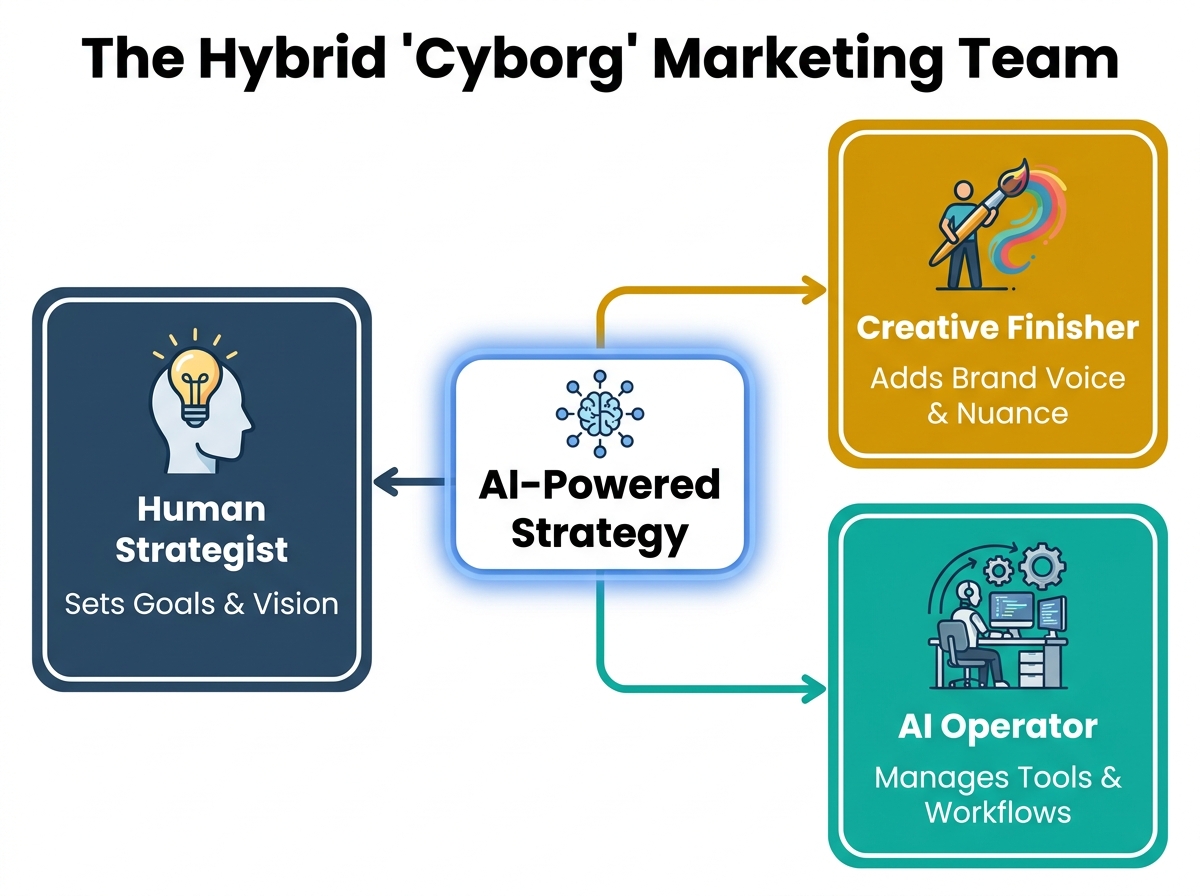
| Human role | Hands-on-keyboard campaign management | Strategy, input architecture, constraint setting, quality review |
The practical difference: a traditional paid media manager might spend 60% of their time on mechanical tasks (bid adjustments, audience builds, reporting pulls) and 40% on strategy. An AI-native advertising operation flips that ratio. The mechanical work is automated. Human time goes toward campaign architecture, creative direction, conversion optimization, and performance analysis.
This does not mean the work is easier. It means the skill set is different. The best AI advertising operators are not people who know how to manually adjust bids. They are people who understand how to structure campaigns so the AI has clean data to learn from, how to set constraints that prevent waste, and how to read performance patterns that indicate the algorithm is going sideways.
Where AI Has the Most Impact in Advertising
B2B AI Advertising: Where the Rules Are Different
Most AI advertising content is written for B2C and ecommerce, where transactions happen on the website, conversion data is clean, and the AI has clear signals to optimize against. B2B is structurally different, and those differences matter for how you deploy artificial intelligence advertising.
Long sales cycles break standard attribution. If your average deal takes 4-6 months from first touch to close, a 30-day attribution window captures only the beginning of the journey. The AI optimizes for early-funnel signals (form fills, content downloads) because those are the conversions it can see. Whether those early-funnel leads actually become revenue is invisible to the platform.
Small buying committees limit audience size. If you sell to VP-level and above at companies with $50M+ revenue in a specific industry, your total addressable audience on any single platform might be 10,000-50,000 people. Platform AI is designed for audiences of millions. At small audience sizes, the algorithm does not have enough data to find patterns, and "broad targeting" recommendations from platform reps will waste budget on irrelevant impressions.
Multi-stakeholder decisions require multi-persona creative. A B2B buying committee typically includes 3-6 decision-makers with different priorities. The CMO cares about growth metrics. The CFO cares about ROI. The IT lead cares about integration complexity. One ad cannot speak to all three. AI creative generation helps here because it can produce persona-specific variations at scale, but only if you provide persona-specific inputs.
Offline conversion data is critical. The most important optimization lever for B2B AI advertising is feeding offline conversion data (qualified opportunities, closed-won deals, revenue) back to the ad platforms. Google's offline conversion imports, LinkedIn's CRM-connected conversions, and Meta's Conversions API all support this. When the AI knows which leads actually became customers, it can optimize for quality, not just quantity. Most B2B advertisers either do not do this or do it inconsistently.
The B2B playbook for AI advertising: feed the platforms your CRM data, constrain audiences with firmographic and seniority filters, generate persona-specific creative variations, and extend attribution windows to match your actual sales cycle. Let the AI optimize within those boundaries.
Building an AI Advertising Strategy That Works
An effective AI advertising strategy has four components. Get any of them wrong and the AI will optimize toward the wrong outcomes.
1. Conversion architecture. This is the foundation. Before you touch an ad platform, define exactly what "success" means for your business. For B2B: a qualified opportunity created in your CRM, not a form fill. Map every conversion event (page view, content download, demo request, opportunity created, deal closed) and assign value to each. Feed the high-value events back to the ad platforms as offline conversions. This gives the AI a true north to optimize toward.
2. Campaign structure. AI advertising does not eliminate the need for thoughtful campaign architecture. Separate branded and non-branded search. Segment campaigns by intent level (problem-aware, solution-aware, vendor-evaluating). Use campaign-level budget controls to prevent the AI from shifting all spend to the easiest conversions. Structure matters because it determines what data the AI has to learn from and what constraints it operates within.
3. Creative system. Build a creative production pipeline that generates variation at scale. Start with 3-5 core concepts (different angles on your value proposition). For each concept, produce multiple format adaptations (text ads, image ads, video, carousel). Use AI tools to generate headline and copy variations of each. Load all assets into the platform and let the ML test combinations. Review weekly: kill underperformers, double down on winning angles, feed insights into the next creative batch.
4. Measurement framework. Track performance at three levels: platform metrics (CTR, CPC, platform-reported CPA), pipeline metrics (qualified leads, opportunity creation rate, pipeline value), and revenue metrics (deals closed, CAC, LTV:CAC ratio). The platform metrics tell you whether the AI is doing its job. The pipeline and revenue metrics tell you whether it matters. If platform CPA is great but pipeline quality is poor, the AI is optimizing for the wrong signal.
Need help setting up your conversion architecture?
Most AI advertising waste comes from poor conversion signals. We can review your current setup and show you exactly where the data gaps are.
Common Mistakes in Artificial Intelligence Advertising
These are the mistakes we see repeatedly in ad accounts. They are not beginner errors. They are structural problems that affect experienced advertisers who have not adapted their process for AI-driven platforms.
Mistake 1: Treating Performance Max as set-and-forget. Google's Performance Max is powerful, but it requires active management. Without asset group segmentation, audience signal refinement, and regular search term analysis (through the insights tab, since search term reports are limited), PMax will default to spending on the cheapest available inventory, which is often Discovery and Display rather than high-intent Search.
Mistake 2: Not excluding audiences. AI audience expansion is aggressive. If you do not explicitly exclude existing customers, competitors, job seekers, and current employees, the algorithm will include them. Exclusion lists are not optional in AI advertising. They are essential constraints.
Mistake 3: Insufficient creative volume. Google recommends 15+ image assets and 5+ videos for Performance Max. Meta's Advantage+ performs best with 50-150 active ad variations. If you are running 3-4 ads per ad set, the AI does not have enough creative to test, and it cannot find the combinations that resonate with different audience segments.
Mistake 4: Optimizing for the wrong funnel stage. If the platform AI is optimizing for top-of-funnel events (clicks, page views, leads) but your actual business goal is qualified pipeline, you will get exactly what you optimized for: lots of low-quality leads. The fix is feeding downstream conversion data back to the platform, but this requires CRM integration, data pipelines, and ongoing maintenance. It is not a one-time setup.
Mistake 5: Ignoring creative fatigue. AI bid management will mask creative fatigue by bidding more aggressively to maintain conversion volume. Your CPA rises gradually, and the algorithm keeps spending because it is still hitting within your constraints. Monitor impression frequency alongside CPA. If frequency is climbing and CPA is rising, the problem is your creative, not the algorithm.
The Role of an AI Advertising Agency
If the platforms handle bidding, creative testing, and audience optimization automatically, what does an AI advertising agency actually do?
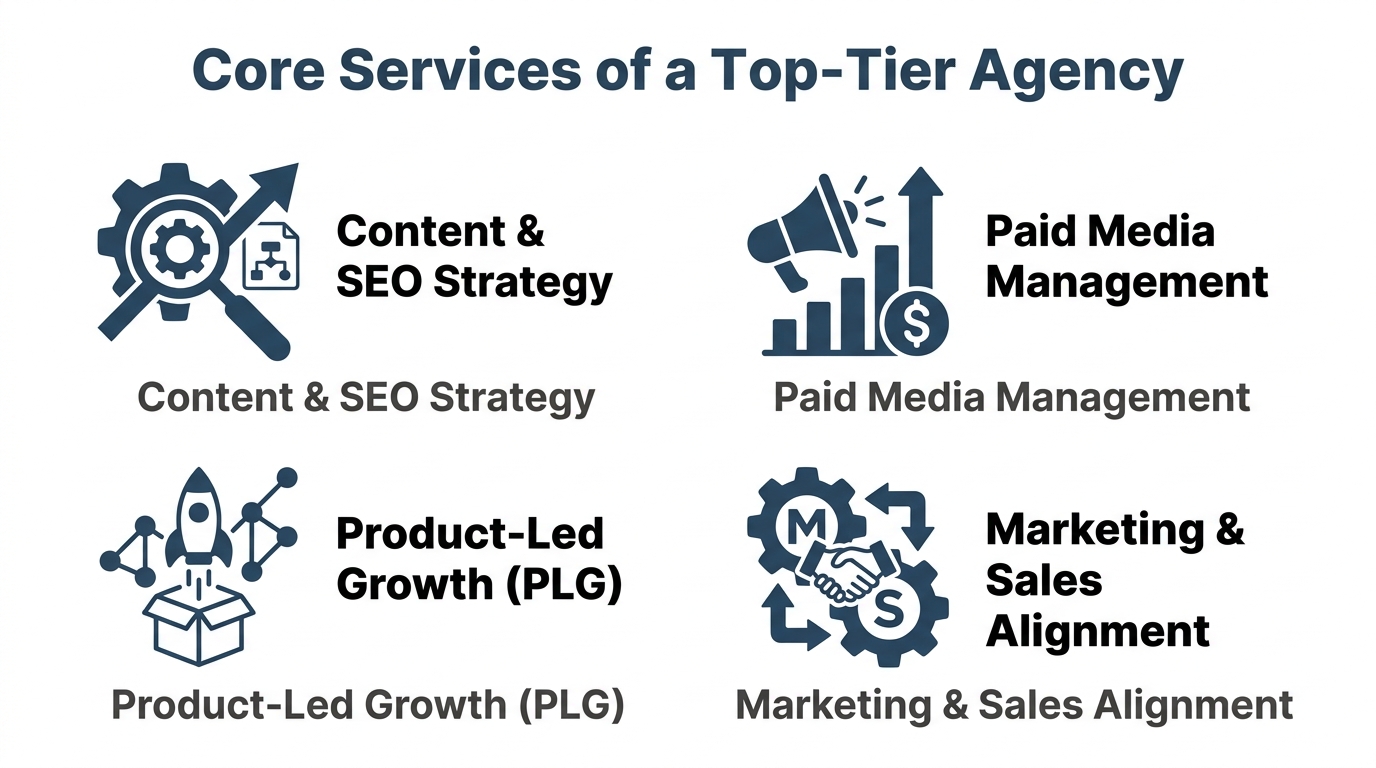
The work has shifted from hands-on-keyboard campaign management to four higher-order functions:
Conversion architecture design. Setting up the data infrastructure that feeds the AI clean, meaningful signals. This includes CRM integration, offline conversion pipelines, event taxonomy, and value assignment. Most in-house teams either do not have the technical capacity or do not prioritize this foundational work, and it determines everything else.
Campaign structure and constraint setting. Designing campaign architecture that gives the AI enough data to learn while preventing it from drifting toward low-quality outcomes. This means segmenting by intent, setting appropriate bid strategies for each stage, building exclusion lists, and defining budget guardrails.
Creative strategy and production. Building a creative pipeline that produces enough variation for the AI to test, while maintaining brand quality and message consistency. This is where the AI-native model shines: small senior teams use AI tools to produce creative volume that would require a large traditional creative department.
Cross-channel intelligence. Reading performance across platforms (Google, Meta, LinkedIn, programmatic) holistically rather than in silos. Each platform's AI optimizes within its own ecosystem. Someone has to look across channels and determine whether the total investment is driving business results, not just platform-reported conversions.
Getting Started With AI Advertising: A 90-Day Framework
If you are moving from traditional campaign management to an AI-first advertising approach, here is a practical timeline.
Days 1-30: Foundation. Audit your current conversion tracking. Identify gaps where downstream events (SQLs, opportunities, closed-won) are not feeding back to ad platforms. Set up offline conversion imports for Google and Meta. Clean your audience exclusion lists. Document your current CPA, pipeline quality, and revenue attribution baseline so you can measure improvement.
Days 31-60: Restructure. Rebuild campaign architecture for AI-first management. Consolidate underperforming campaigns to give the AI more data per campaign to learn from. Set up proper campaign segmentation (branded vs. non-branded, top-of-funnel vs. bottom-of-funnel). Launch expanded creative testing: 15+ image assets, multiple video formats, 20+ copy variations. Enable AI bidding strategies with appropriate targets based on your baseline data.
Days 61-90: Optimize. Analyze initial results against your baseline. The AI needs 2-4 weeks of learning period per major change, so this is when you start seeing whether the new structure is working. Review audience signals: is the AI finding the right people? Review creative performance: which angles and formats are winning? Review conversion quality: are the leads from AI-driven campaigns converting to pipeline at the same rate as manually targeted campaigns? Adjust constraints, creative inputs, and conversion signals based on what you learn.
After 90 days, you should have enough data to know whether AI advertising is producing better results than your previous approach. If it is, the ongoing work is refinement: feeding better data, producing more creative, and expanding to additional channels. If it is not, the problem is almost always in the foundation layer, specifically the conversion data feeding the AI.
What the Foundation Work Looks Like
A B2B software company was spending $40K/month on Google and LinkedIn ads, generating leads at $180 CPA. The problem: only 12% of those leads became qualified opportunities, making the true cost per qualified opportunity over $1,500. After implementing offline conversion imports from their CRM and switching Google's optimization target from "form fill" to "qualified opportunity," the platform AI shifted targeting toward higher-intent prospects. Within 60 days, lead volume dropped by 30% but qualified opportunity volume increased by 45%. The cost per qualified opportunity dropped to under $900. The platform AI was always capable of this. It just needed the right conversion signal to optimize against.
Questions to Ask Before Scaling AI Advertising
- Are your offline conversions (SQLs, opportunities, revenue) feeding back to the ad platforms?
- Does your AI bidding strategy optimize for quantity or quality?
- How many active creative variations are in your campaigns right now?
- Are you excluding existing customers, competitors, and employees?
- Can you track the full journey from ad click to closed revenue?