AI social media is a volume game with a quality ceiling. AI can produce 10-15 social posts from a single blog post, optimize posting schedules, monitor brand mentions across every platform, and generate ad creative at scale. But the social content that builds trust, starts conversations, and generates pipeline still requires a human voice. The winning formula: AI produces the volume. Humans provide the personality, the opinions, and the engagement that make audiences care.
The State of AI in Social Media Marketing
AI touches five distinct functions in social media marketing, each at a different maturity level. Understanding which functions AI handles well and which still require human judgment is the difference between using AI to build your brand and using AI to make your brand sound like everyone else's.
1. Content creation (maturity: high). AI generates post copy, adapts long-form content into platform-specific formats, suggests hashtags, and creates image variations. This is the most visible AI application and the one most teams adopt first.
2. Scheduling and distribution (maturity: high). AI determines optimal posting times per platform per audience segment, adjusts frequency based on engagement patterns, and distributes content across platforms.
3. Social listening and monitoring (maturity: high). AI scans brand mentions, competitor activity, industry conversations, and sentiment trends across platforms at scale. This is arguably where AI provides the most unique value in social media.
4. Paid social advertising (maturity: very high). Platform AI handles bidding, audience targeting, and creative optimization for paid social campaigns. Meta's Advantage+ and LinkedIn's Accelerate are the most developed implementations.
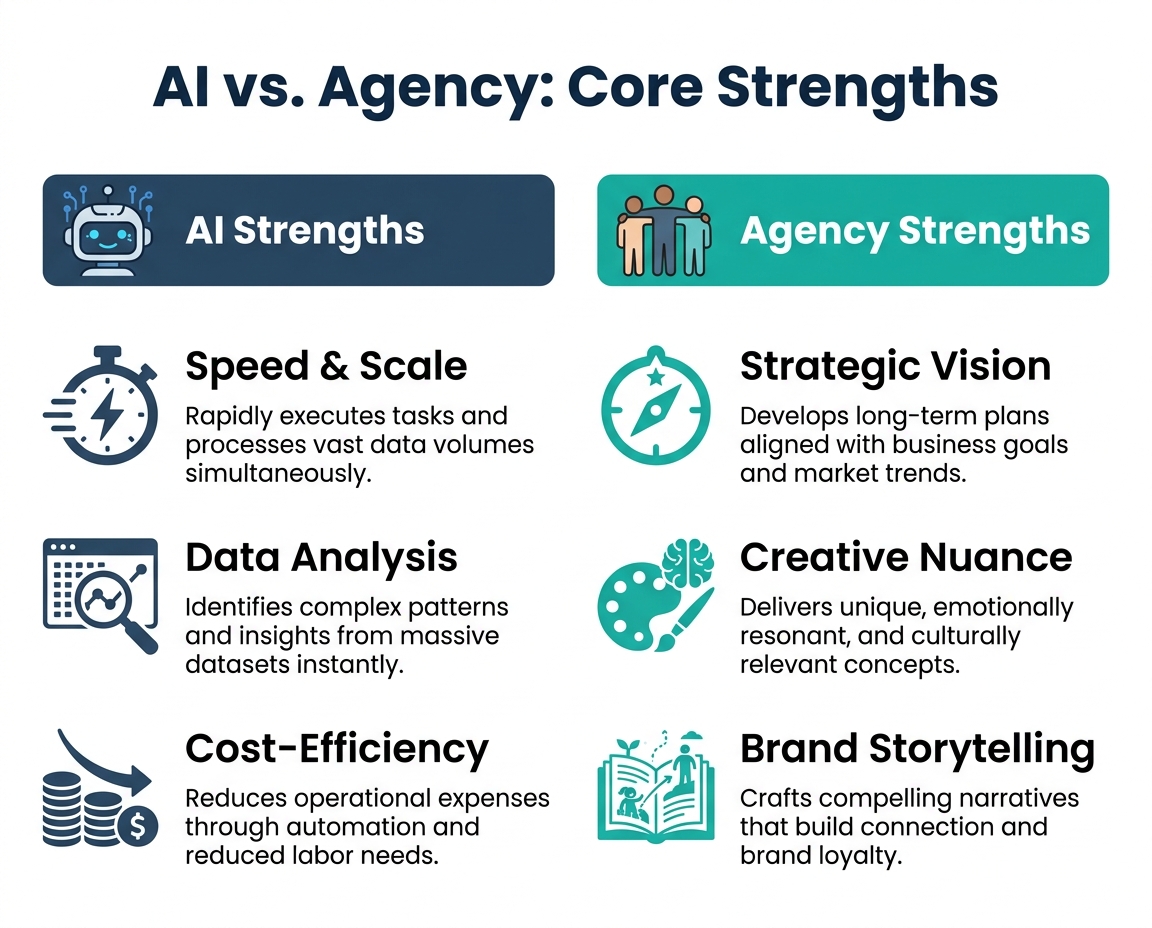
5. Community engagement (maturity: low). AI can draft response suggestions and flag comments needing attention, but authentic engagement, the replies, conversations, and relationship-building that create trust, still requires a human touch. This is the area where AI most consistently falls short.
AI Content Creation for Social Media: The Volume Play
The math is simple. A single long-form blog post, when repurposed by AI, can yield:
- 3-4 LinkedIn text posts (different angles on the same topic)
- 1 LinkedIn carousel (key takeaways in slide format)
- 2-3 X/Twitter threads (breaking down specific sections)
- 2-3 Instagram/Facebook posts (visual quotes, stat callouts)
- 1-2 short video scripts (key insight summarized in 30-60 seconds)
That is 10-15 pieces of social content from one source asset, produced in minutes rather than hours. For B2B companies publishing 2-4 blog posts per month, this repurposing pipeline can fill an entire social calendar without creating net-new social content from scratch.
Where AI content creation works for social:
- Format adaptation. Turning blog sections into LinkedIn carousels, converting data points into shareable stat graphics, and reformatting long paragraphs into punchy social copy. AI handles structural transformation well.
- Variation generation. Creating 5 different versions of the same post to test which angle gets the most engagement. The sheer volume of A/B testing AI enables is its biggest advantage.
- Hashtag and keyword optimization. AI analyzes trending topics, relevant hashtags, and keyword patterns to recommend tags that increase discoverability. This is data processing work that humans cannot do as efficiently.
Where AI content creation fails for social:
- Hot takes and opinions. The social posts that generate the most engagement on B2B platforms (especially LinkedIn) are opinion-driven: "Here's what I think about X, and here's why." AI does not have opinions. It produces consensus-friendly, hedged statements that read as safe but forgettable.
- Personal storytelling. Posts that reference specific experiences, client interactions, or lessons learned from failure require lived context that AI cannot fabricate authentically. Audiences detect manufactured anecdotes.
- Trend responses. When an industry event or viral conversation happens, the fastest, most authentic responses come from humans reacting in real time. AI-generated trend responses are always a step behind and lack the spontaneity that makes social media feel alive.

Platform-by-Platform: How AI Works on Each Social Network
Each social platform has its own algorithm, content format preferences, and audience behavior. AI for social media needs to be configured differently for each.
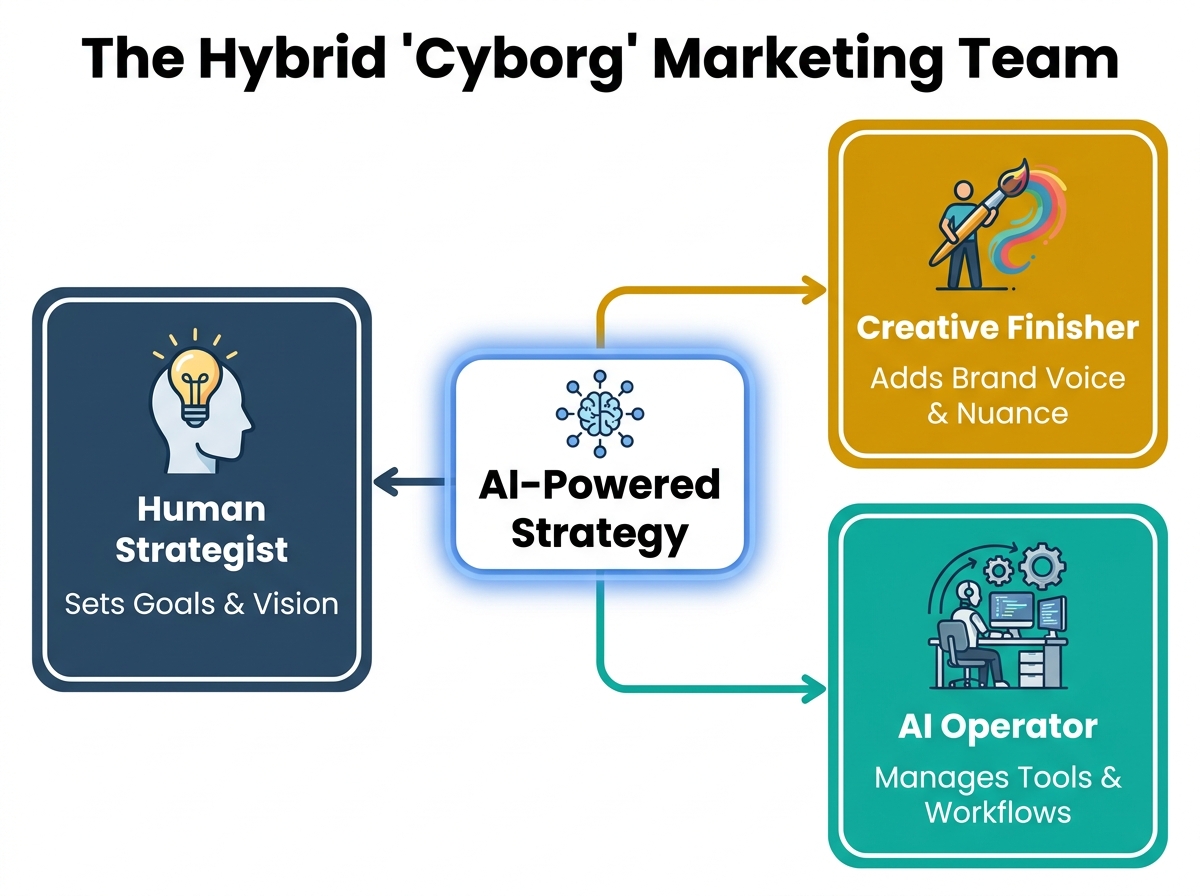
LinkedIn. The most important platform for B2B social media and the one where AI content has the highest risk of sounding inauthentic. LinkedIn's algorithm rewards original thought, engagement (especially comments), and long-form text posts. AI works well for generating first drafts that a human then personalizes with their own perspective, experience, and voice. It does not work well for producing publish-ready posts, because LinkedIn audiences are increasingly sensitive to generic AI copy. The best LinkedIn AI workflow: AI generates the framework and talking points, human adds the opinion, story, or insight that makes it worth reading.
Meta (Facebook/Instagram). Meta's AI ecosystem is the most developed for advertising, with Advantage+ handling targeting, bidding, and creative optimization. For organic social, AI is most useful for visual content adaptation (resizing, reformatting for Stories and Reels), caption generation, and scheduling optimization. Instagram Reels and Stories reward frequent posting, which makes AI-assisted content production valuable for maintaining presence without burning out your team.
X (Twitter). X rewards concise, opinionated, timely content. AI-generated threads can perform well when they break down complex topics into digestible points with a clear point of view. AI-generated single tweets tend to sound generic. The platform's real-time nature means the highest-engagement content is often reactive (responding to industry news, commenting on trends), which is a weak spot for AI because it cannot respond to events it was not prompted about.
TikTok. AI's role on TikTok is primarily in video production assistance: script generation, caption writing, and trend identification. TikTok's algorithm rewards authenticity and entertainment value, which are not AI's strong suits. The most effective B2B TikTok content is behind-the-scenes, personality-driven, and unpolished, qualities that feel more human than AI-generated. AI works best here for script frameworks and posting schedule optimization rather than content creation.
Social Listening and Monitoring: AI's Strongest Social Function
If you use AI for only one social media function, social listening is the highest-value choice. The volume of social conversation across platforms is too large for any human team to monitor manually, and the insights buried in that data directly inform strategy, content, and competitive positioning.
What AI social listening detects:
- Brand mentions and sentiment. AI tracks every mention of your brand, products, and key executives across platforms and classifies them by sentiment (positive, negative, neutral). Sudden sentiment shifts get flagged in real time, giving you an early warning system for potential crises or emerging positive momentum.
- Competitor intelligence. AI monitors competitor social activity: what they are posting, what generates engagement, how their audience is reacting, and where they are gaining or losing share of voice. This intelligence informs both content strategy and competitive positioning.
- Industry trend identification. AI analyzes conversation patterns across your industry to identify emerging topics, growing pain points, and shifting priorities. For B2B content strategy, these trend signals are gold: they tell you what your audience cares about right now, not what they cared about when the last survey was published.
- Influencer and advocate identification. AI identifies individuals who consistently engage with your content, mention your brand positively, or have influence in your target audience. These are potential brand advocates, partnership opportunities, or simply people worth engaging with directly.
The practical output of AI social listening is a weekly or monthly intelligence report that feeds directly into content planning: "Here are the topics gaining traction in your industry, here's what your competitors are posting about, and here's where the conversation gaps are that you could fill." That intelligence loop is more valuable than any individual social post.
| Function | Meta (FB/IG) | X (Twitter) | TikTok | |
|---|---|---|---|---|
| Content generation | Draft posts, carousels, article summaries. Human must add perspective. | Captions, story templates, ad creative variations at scale. | Thread frameworks, reply drafts. Single tweets need human voice. | Script outlines, caption writing. Video itself needs human presence. |
| Scheduling | AI optimal-time posting per audience segment. | AI scheduling across Feed, Stories, Reels with frequency optimization. | AI timing for thread publishing. Real-time posting for trends is manual. | AI posting time optimization based on audience activity patterns. |
| Paid social AI | Accelerate campaigns, Predictive Audiences, Cost Cap bidding. | Advantage+ Suite (audience, creative, placements, budget). Most developed. | Promoted posts with limited AI optimization. | Smart+ Campaigns, AI targeting, Creative Automation. |
| Social listening | Brand mentions, competitor tracking, industry trend monitoring. | Sentiment analysis, brand monitoring, audience insights. | Real-time conversation tracking, trend identification, sentiment. | Trend discovery, hashtag analysis, content performance patterns. |
| Community engagement | AI drafts reply suggestions. Human must personalize and post. | Automated FAQ responses (Messenger). Comments need human touch. | AI flags priority mentions. Engagement must be human-driven. | Comment response suggestions. Stitches and Duets are fully human. |
Want an AI social media strategy that does not sound like AI?
We build AI-powered social content systems with human editorial oversight on every post. Volume goes up. Authenticity stays intact.
The AI Social Content Pipeline: From Source to Schedule
A practical AI social content pipeline has four stages. Each stage has a specific role for AI and a specific role for humans.
Stage 1: Source content identification. AI scans your existing content library (blog posts, case studies, webinars, podcast episodes, whitepapers) and identifies the pieces with the strongest social potential based on topic relevance, evergreen value, and engagement history. Human role: approve the source content list and add any timely topics or company news that AI would not have flagged.
Stage 2: Content adaptation. AI transforms each source piece into platform-specific social content: LinkedIn text posts, carousels, X threads, Instagram visuals, and video scripts. For each piece, AI generates 3-5 variations with different hooks, angles, and formats. Human role: select the strongest variations, add personal perspective or opinion, and edit for brand voice consistency.
Stage 3: Schedule and distribute. AI determines optimal posting times for each platform based on audience engagement data, sets a publishing schedule that spaces content evenly, and queues posts for review. Human role: final approval before publishing, with the ability to pause or replace posts if something timely takes priority.
Stage 4: Analyze and iterate. AI tracks engagement metrics (likes, comments, shares, clicks, impressions) and identifies patterns: which content angles generate the most engagement, which formats perform best on which platforms, and which posting times drive results. Human role: interpret the data and feed insights back into Stage 1 for the next cycle.
B2B Social Media AI: The LinkedIn Problem
For B2B companies, LinkedIn is usually the most important social platform. It is also the platform where AI-generated content is most easily detected and most penalized by audiences.
The LinkedIn AI content problem is specific: the platform rewards thought leadership, personal narrative, and genuine expertise. The posts that generate the most engagement are ones where a person shares a real opinion based on real experience. AI-generated LinkedIn posts tend toward the generic, the safe, and the hedged, exactly the qualities that LinkedIn's algorithm and audience now deprioritize.
What works on LinkedIn with AI:
- Data-driven posts. AI is useful for finding and formatting data points, industry statistics, and research findings into compelling social posts. "Here's what the data says about X" posts perform well when the data is specific and surprising.
- Content repurposing. AI transforms blog posts, webinar transcripts, and case studies into LinkedIn posts that reference the source material. The AI handles the structural transformation; the human adds the "here's why this matters" layer.
- Carousel creation. AI generates slide frameworks for LinkedIn carousels: key takeaways from a blog post, step-by-step guides, comparison frameworks. Carousels get strong engagement on LinkedIn, and AI can produce the framework quickly while a human handles visual design and copyediting.
- Employee advocacy scaling. For companies with multiple thought leaders, AI can produce customized post drafts for each executive, tailored to their voice and expertise area. The executive reviews, personalizes, and posts under their own name. This scales thought leadership without each person spending hours writing from scratch.
AI Social Media Analytics and Reporting
Social media generates enormous amounts of data across multiple platforms. AI's role in analytics is consolidating, pattern-matching, and surfacing insights that would take a human analyst hours or days to identify manually.
Cross-platform performance dashboards. AI aggregates data from LinkedIn, Meta, X, and TikTok into unified views showing total reach, engagement, click-throughs, and conversions. This eliminates the manual process of pulling data from each platform individually and comparing in spreadsheets.
Content performance pattern recognition. AI identifies which content types, topics, formats, and posting times generate the highest engagement on each platform. Over time, the pattern library becomes a content strategy playbook: "Data posts with specific numbers perform 3x better than general insight posts on LinkedIn" or "Carousel posts outperform text posts by 2x on average."
Audience growth and engagement trends. AI tracks follower growth, engagement rate trends, and audience composition changes over time. More importantly, it identifies correlations: "Engagement increased 40% when posting frequency went from 3x to 5x per week on LinkedIn" or "Morning posts (7-9am) generate 2x the comments of afternoon posts."
Competitive benchmarking. AI compares your social metrics against competitors: share of voice, engagement rates, posting frequency, content mix. This context prevents internal metrics from being evaluated in a vacuum. A 3% engagement rate is excellent in some industries and mediocre in others.
Social Media Advertising With AI
Paid social is the most mature AI application in social media. The platform AI handles most of the execution. Your job is configuring it correctly.
For a detailed breakdown of AI-powered paid social setup on Meta and LinkedIn, see our tactical guide. Here is the summary for social-specific context:
Meta paid social AI: Advantage+ Shopping and Advantage+ App campaigns are fully AI-managed. For lead generation, use Advantage+ Audience with customer list seeds, Conversions API for server-side tracking, and Cost Cap bidding to control CPA. Creative volume matters: 50-150 active ad variations across campaigns lets the AI find winning combinations.
LinkedIn paid social AI: Accelerate campaigns automate targeting, bidding, and creative. Predictive Audiences build ML-based lookalikes from your seed audiences. For B2B, LinkedIn's professional targeting data (job title, company size, industry) is its core advantage over Meta. Layer firmographic filters on top of AI audience expansion to prevent the algorithm from expanding into irrelevant professional segments.
TikTok paid social AI: Smart+ campaigns automate targeting and bidding. Creative Automation generates video variations from static assets. TikTok's strength for B2B is awareness and brand building with younger professional demographics. Use it for top-of-funnel awareness, not bottom-of-funnel lead generation.
| Task | AI Handles | Human Handles | Time Savings |
|---|---|---|---|
| Content creation | First drafts, format adaptation, variation generation, hashtags | Opinions, stories, voice editing, final approval | 60-70% faster |
| Scheduling | Optimal timing, frequency calibration, queue management | Priority overrides for timely content, final review | 80-90% faster |
| Social listening | Brand monitoring, sentiment analysis, trend identification, competitor tracking | Strategic interpretation, response decisions, crisis judgment | 90%+ faster (not feasible manually at scale) |
| Paid social | Bidding, audience expansion, creative testing, budget optimization | Strategy, conversion architecture, creative concepts, exclusions | 70-80% faster |
| Community engagement | Reply suggestions, priority flagging, FAQ automation | Actual responses, relationship building, nuanced conversations | 20-30% faster (mostly still human) |
| Analytics | Data aggregation, pattern recognition, anomaly detection, reporting | Insight interpretation, strategy adjustments, action planning | 70-80% faster |
The Anti-Slop Social Strategy: Keeping AI Content Authentic
The biggest risk in AI social media is becoming part of the noise. As more companies use AI for social content, feeds are increasingly filled with posts that sound identical: the same phrasing, the same hedge-everything tone, the same list-of-three structure, the same "let me know your thoughts in the comments" closing. Audiences scroll past this content because they have seen it a hundred times.
An anti-slop social strategy has five components:
- Start with a human opinion. Before AI generates a single word, a human should identify the specific point of view the post will express. Not "AI is changing marketing." That is a fact, not an opinion. Try "Most AI marketing content is garbage because teams skip the editorial step, and here is what that looks like." An opinion creates friction. Friction creates engagement.
- Use AI for structure, not for voice. Let AI create the outline, the data points, and the format adaptation. Then rewrite the opening line, the key insight, and the closing in your own voice. The first and last sentences are what people read. If those sound human, the middle can lean on AI structure.
- Add specifics AI cannot know. Reference a specific client conversation (anonymized), a specific metric from your own experience, a specific thing that happened this week. AI generates generalities. Specifics signal authenticity.
- Kill the hedge phrases. AI defaults to "it's important to note that," "in today's rapidly changing landscape," and "there are several key factors to consider." These phrases scream AI. Delete them. Say the thing directly.
- Engage manually. When someone comments on your post, respond yourself. Not with an AI-drafted reply. With a genuine response that references what they said. The engagement layer is where relationships form, and it cannot be automated without destroying trust.
Building an AI Social Media Calendar
A practical AI-powered social media calendar for B2B combines planned content (repurposed from source assets), reactive content (responses to trends and industry events), and engagement blocks (time dedicated to community interaction).
Weekly structure for a B2B social presence:
- Monday: 1 LinkedIn thought leadership post (opinion-driven, human-edited). Schedule the week's planned content across platforms.
- Tuesday: 1 carousel or data-driven post (AI-generated framework, human-reviewed). Share on LinkedIn and adapt for other platforms.
- Wednesday: Content repurposing day. AI converts latest blog post or content asset into platform-specific social posts. Queue for the rest of the week.
- Thursday: 1 engagement post (question, poll, or hot take designed to generate comments). Dedicate 30 minutes to responding to comments across platforms.
- Friday: 1 lighter post (industry meme, team spotlight, behind-the-scenes). Review weekly analytics and adjust next week's plan.
This yields 5+ posts per week on LinkedIn, with adapted versions on other platforms, using roughly 3-4 hours of human time per week for review, personalization, and engagement. Without AI, producing and managing this volume would take 10-15 hours per week.
Time Allocation: AI Social Media vs. Traditional
Want a social strategy that sounds like you, not like ChatGPT?
We build AI-powered social pipelines with human editorial oversight. More content, same authenticity.
Common AI Social Media Mistakes
These are the patterns that make AI social media content fail:
- Publishing AI drafts without human editing. The single most common mistake. AI-generated posts are first drafts. They need a human to add voice, cut filler, and verify accuracy before publishing.
- Same content on every platform. LinkedIn, X, Instagram, and TikTok have different audience expectations, content formats, and algorithm preferences. Cross-posting the same content everywhere signals laziness and performs poorly on every platform.
- Over-automating engagement. Automated comments, auto-replies, and AI-generated responses erode trust. Audiences can tell. Engagement is the one social function that should remain primarily human.
- Ignoring social listening data. Many teams set up AI social listening tools but never act on the insights. The value is in the feedback loop: listening data should inform content strategy, not just sit in a dashboard.
- Volume without strategy. Posting 3x per day because AI makes it possible, without a strategic reason for each post, dilutes your brand and fatigues your audience. More is only better when each piece earns attention.
Measuring AI Social Media ROI
Social media ROI measurement for B2B remains one of the hardest attribution problems in digital marketing. AI helps with the measurement, but the challenge is structural, not technological.
Engagement metrics (leading indicators): Impressions, engagement rate, follower growth, share of voice vs. competitors. These tell you whether your content resonates. AI dashboards track and trend these automatically.
Traffic metrics (middle indicators): Social referral traffic to website, landing page visits from social, content downloads initiated from social links. These connect social activity to website behavior. Track with UTM parameters on every social link.
Pipeline metrics (lagging indicators): Leads generated from social (organic and paid), social-influenced pipeline (prospects who engaged with social before converting), and social-attributed revenue. For B2B, the most honest measurement is "social-influenced pipeline": the total pipeline value from prospects who had at least one social touchpoint in their journey. This avoids the false precision of single-touch attribution.
AI analytics platforms can automate all three layers and create unified views. The interpretation, deciding whether to invest more in LinkedIn carousels or X threads based on pipeline data, remains a human judgment call.
What the Repurposing Pipeline Produces
A B2B company publishing 3 blog posts per month implemented an AI social repurposing pipeline. Each blog post was converted into 12-15 social posts: 4 LinkedIn text posts with different angles, 1 LinkedIn carousel, 2 X threads, 3 Instagram/Facebook posts, and 2 short video scripts. Total weekly social output went from 2-3 posts (all manually written) to 10-12 posts across platforms. Human time per week dropped from 8 hours to 3.5 hours. LinkedIn engagement increased by 45% over 90 days, primarily because of increased posting frequency and the ability to test multiple content angles per topic rather than publishing once and moving on.
AI Social Media Readiness Checklist
- Do you have enough source content (blogs, webinars, case studies) to repurpose?
- Is there a clear brand voice guide that AI can be prompted to follow?
- Who reviews and approves AI-generated posts before publishing?
- Are you tracking social-influenced pipeline, not just engagement metrics?
- Is someone dedicated to manual community engagement (comments, replies)?